



Scottsdale family law postnuptial agreements are legal contracts signed by married spouses that define how assets, debts, and financial obligations will be handled if the marriage ends. Here is a quick overview:
| Key Question | Quick Answer |
|---|---|
| What is a postnuptial agreement? | A written contract signed after marriage covering property, debt, and spousal support |
| Is it enforceable in Arizona? | Yes — if it is written, voluntary, and based on full financial disclosure |
| Can it cover child custody? | No — Arizona courts decide custody based on the child’s best interests |
| Do both spouses need attorneys? | Not required by law, but strongly recommended |
| How much does it cost? | Typically $2,500–$10,000 for attorney-drafted agreements |
| How long does it take? | Usually several weeks once all financial information is provided |
| Does HB 2861 affect my agreement? | Yes — new rules effective late 2026 shift the burden of proof to the challenging spouse |
Arizona is one of only nine community property states in the U.S. That means without a clear written agreement, everything you and your spouse acquire during marriage is presumed to be owned 50/50 under A.R.S. § 25-211. For Scottsdale couples — where real estate values are high, business ownership is common, and blended families are the norm — that default rule can create serious financial risk.
Whether you are trying to protect a growing business, preserve an inheritance for children from a prior relationship, or simply get clarity on who owns what, a postnuptial agreement can provide a legal foundation that both spouses agree on.
Scottsdale family law postnuptial helpful reading:
- Arizona postnuptial agreement attorney
- Arizona postnuptial agreement cost
- can you do a postnuptial agreement without a lawyer
Understanding the Scottsdale Family Law Postnuptial Agreement
To understand how a postnuptial agreement works in Scottsdale and the broader Maricopa County area, you first have to understand the default rules of Arizona family law.
Under A.R.S. § 25-211, Arizona operates on a strict community property framework. With very few exceptions (such as an inheritance or a gift given specifically to one spouse), any asset, income, or debt acquired by either spouse during the marriage belongs to both spouses equally.
Without a customized agreement, a court during a divorce will seek to divide your community assets and community liabilities 50/50. This means that if you start a business, buy a home near Old Town Scottsdale, or accumulate retirement funds during your marriage, your spouse is legally entitled to half of that value, regardless of whose name is on the account or who did the daily work.
A postnuptial agreement allows couples to opt out of these default community property laws. By drafting a customized contract, you and your spouse can decide exactly how your property and debts should be categorized and split. Understanding these rules is essential when exploring The Ultimate Showdown Between Prenuptial and Postnuptial Agreements and seeing how they apply to your specific marriage.
Prenup vs. Postnup: Key Differences in Arizona
The most obvious difference between a prenuptial agreement and a postnuptial agreement is timing. A prenuptial agreement is signed before the wedding day, while a postnuptial agreement is drafted and executed after the couple has already said “I do.”
However, under Arizona law, the legal difference goes much deeper than the calendar. When you are engaged, you and your partner are considered separate legal individuals. Once you marry, you enter into a legally recognized fiduciary relationship. This means spouses owe one another the highest duty of fair dealing, honesty, and good faith.
Because of this fiduciary duty, Arizona courts historically subject postnuptial agreements to much higher scrutiny than prenuptial agreements. If a spouse challenges a postnup during a divorce, the court will look very closely at whether the agreement is fair, whether there was any coercion, and whether both parties had a clear picture of the finances before signing. You can learn more about these structural differences in our guide on Prenup vs Postnup.
Why Scottsdale Couples Choose a Postmarital Contract
There is a common misconception that asking for a postnuptial agreement means a marriage is on the rocks. In reality, many couples use postnups as a practical tool for financial planning and conflict resolution. In fact, clarifying financial expectations can actually reduce stress and strengthen a marriage.
Some of the most common reasons Scottsdale and Paradise Valley couples seek a postnuptial contract include:
- Business Ownership: If you own a business or launch a startup during your marriage, a postnup can prevent your business partner (your spouse) from gaining operational control or a 50% equity share of the company in a divorce.
- Blended Families: If you have children from a prior relationship, a postnup can ensure that specific assets, such as a family home or an investment account, are preserved for those children rather than being absorbed into the marital estate.
- Inheritances and Trusts: Although inheritances are technically separate property in Arizona, they can easily become “commingled” if you use inheritance funds to pay off a joint mortgage or deposit them into a joint bank account. A postnup keeps these boundaries clear.
- Career Sacrifices: If one spouse steps away from a lucrative career path to raise children, a postnuptial agreement can establish a fair framework for spousal support to protect that spouse’s financial future.
If you are considering these options, review our detailed guide on Postnuptial Agreements for Scottsdale and Paradise Valley Couples to see how local families protect their wealth, or read Post Nup Agreements: Better Late Than Never for insights into timing.
Legal Requirements and the Impact of HB 2861 in Arizona
Historically, Arizona postnuptial agreements were governed entirely by case law, which made their enforceability somewhat unpredictable. Unlike prenuptial agreements, which are governed by the Arizona Uniform Premarital Agreement Act, postnuptial agreements had to rely on general contract principles and judicial interpretations. This lack of a clear statutory framework left many couples wondering, Are Postnuptial Agreements Enforceable?
This legal landscape is changing. In late 2026, Arizona House Bill 2861 (HB 2861) takes effect, establishing the state’s first dedicated statutory framework for postmarital agreements under A.R.S. § 25-202.01.
The New Statutory Framework Under HB 2861
HB 2861 provides much-needed clarity for couples and family law attorneys in Maricopa County. The most significant change introduced by this new law is the shift in the burden of proof.
Under the new statutory framework, a postnuptial agreement is presumed valid if it meets basic statutory requirements. If one spouse wants to challenge the agreement during a divorce, that challenging spouse now bears the burden of proving that the agreement is invalid by clear and convincing evidence. This is a high legal standard, making well-drafted postnuptial agreements much more secure and legally defensible than they were under the old case law rules.
To invalidate an agreement under the new law, a spouse must prove one of the following statutory defenses:
- They did not sign the agreement voluntarily.
- The agreement was unconscionable (extremely unfair) when it was signed, and they were not provided with a fair and reasonable disclosure of the other spouse’s property and financial obligations.
This shift makes it essential to understand the updated rules, which you can explore in our comprehensive breakdown of Postnuptial Agreement Arizona laws.
Drafting a Valid Scottsdale Family Law Postnuptial Contract
To ensure your agreement stands up to court scrutiny and benefits from the protections of HB 2861, it must be drafted with strict adherence to Arizona’s legal formalities.
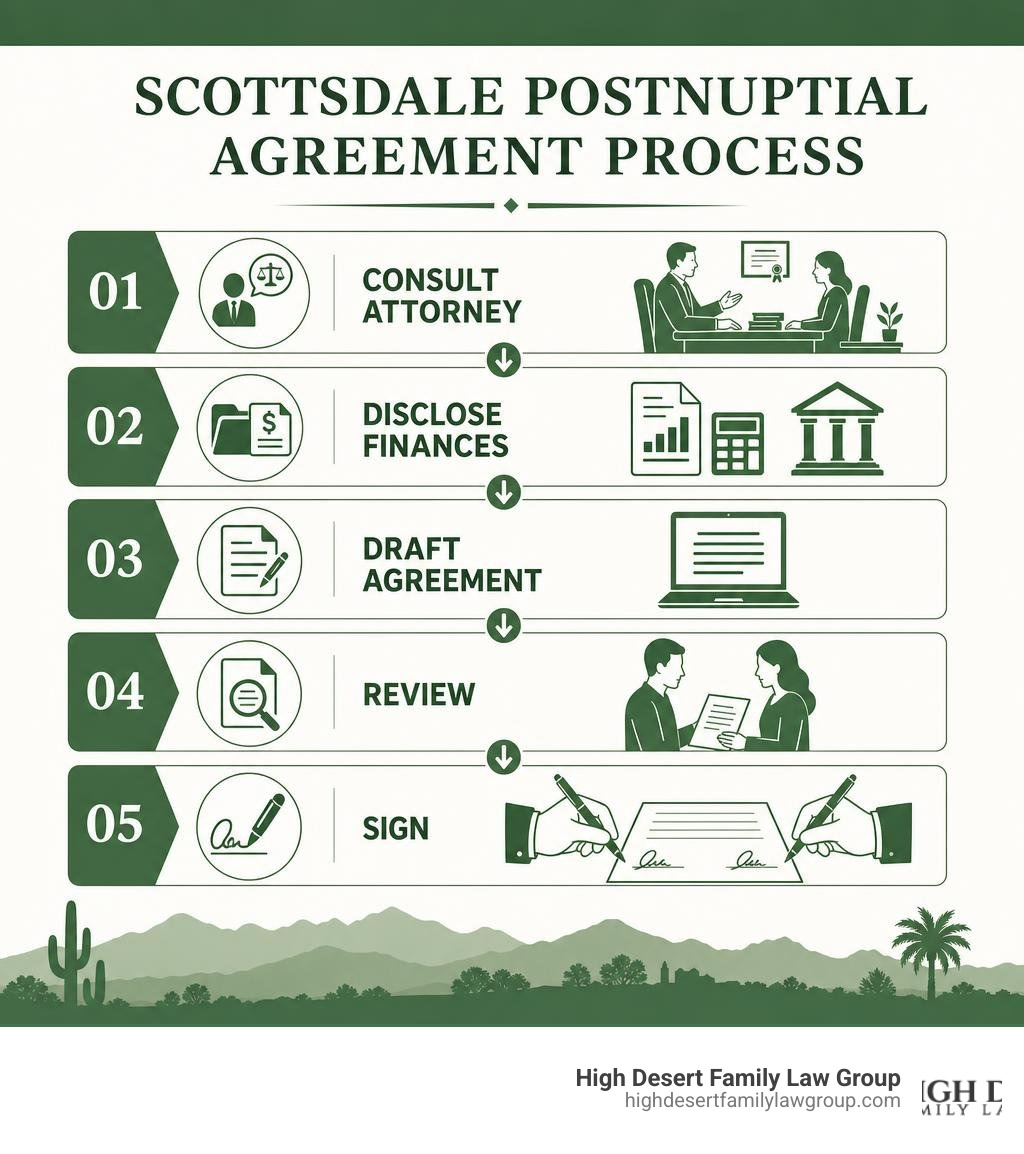
First, the agreement must be in writing and signed voluntarily by both spouses. While notarization is not strictly required to make a contract valid, it is highly recommended. Having the agreement notarized in front of witnesses provides strong evidence that both parties signed the document voluntarily and were who they claimed to be.
Second, there must be full and fair financial disclosure. Both spouses must provide a complete, honest list of all assets, debts, real estate holdings, business interests, and sources of income. Attempting to hide assets or undervalue a business is the fastest way to have a postnuptial agreement thrown out of court later.
Finally, while you can technically draft an agreement yourself, doing so is highly risky. Arizona’s community property laws are complex, and a single poorly written clause can invalidate the entire contract. If you are wondering about the risks of a DIY contract, read our article on Can You Do a Postnuptial Agreement Without a Lawyer? to understand why professional drafting is so critical.
Scope of Postmarital Agreements: What Can Be Covered?
A postnuptial agreement is a highly flexible tool, but it cannot cover everything. Arizona law places strict limits on what spouses can agree to behind closed doors.
To help you understand what you can and cannot include in your contract, we have put together this comparison table:
| What CAN Be Covered | What CANNOT Be Covered |
|---|---|
| Division of community and separate property | Binding child custody (legal decision-making) |
| Allocation of marital debts and liabilities | Binding child support obligations |
| Ownership and control of business interests | Terms that violate public policy or promote divorce |
| Spousal maintenance (alimony) terms or waivers | Provisions regarding illegal acts |
| Treatment of future inheritances and gifts | Personal, non-financial lifestyle rules |
By clearly outlining these items, you can protect your financial interests. For a deeper dive into how these provisions work, visit our dedicated services page on Postnuptial Agreements in Arizona.
Excluded Topics: Child Custody and Support
In Arizona, children are never treated as property. Therefore, you cannot use a postnuptial agreement to establish binding child custody (legal decision-making), parenting time, or child support arrangements.
The legal reasoning is simple: the circumstances of a family can change drastically between the time a postnup is signed and the time a couple divorces. Arizona courts retain ultimate authority over child-related matters. When a couple divorces, a judge will evaluate custody and support based on the best interests of the child at that specific moment, using the Arizona Child Support Guidelines. Any clause in a postnup that attempts to limit child support or pre-determine custody will be ignored by the court.
Challenging a Scottsdale Family Law Postnuptial in Court
If a marriage ends and one spouse is unhappy with the terms of the postnuptial agreement, they may attempt to challenge its enforceability in a Maricopa County court.
The primary grounds for challenging a postnup include:
- Duress or Coercion: If one spouse was forced to sign the agreement under threat, physical pressure, or extreme emotional manipulation.
- Unconscionability: If the agreement is so incredibly one-sided that it leaves one spouse completely destitute while the other retains millions, a judge may find the agreement unconscionable and refuse to enforce it.
- Lack of Disclosure: If one spouse hid a bank account, failed to disclose a business valuation, or lied about their debts, the court can invalidate the agreement due to fraud.
It is also important to note that under A.R.S. § 25-205, the statute of limitations for challenging a postnuptial agreement is “tolled” (paused) during the marriage. This means a spouse does not lose their right to challenge the agreement simply because many years have passed since it was signed. To understand how these challenges play out in a legal split, read our comparison on Postnuptial Agreement vs Divorce.
Costs, Timelines, and Practical Implementation

Creating a postnuptial agreement is an investment in your financial peace of mind. The total cost of drafting a postnup in Scottsdale typically ranges from $2,500 to $10,000. The final price depends on several factors, including the complexity of your assets, whether you own a business, and how easily you and your spouse can agree on the terms.
In addition to attorney fees, if you eventually need to use the agreement during a divorce or legal separation, there are local court filing fees to consider. Currently, the cost to file a Petition for Dissolution of Marriage in Maricopa County is $349, and the responding party must pay $279 to file their response. For comparison, a legal separation filing fee is also $349.
The timeline for creating a postnup is usually relatively quick. Once both spouses provide complete financial disclosures, an experienced family law attorney can typically draft and finalize the agreement within four to eight weeks.
To get a better idea of what to expect financially, read our detailed breakdown of Postnuptial Agreement Cost and look over our historical cost comparisons like Postnuptial Agreement Costs 2025 to see how pricing has evolved.
Amending or Revoking Your Agreement
A postnuptial agreement is not set in stone. As your lives, careers, and assets change, your financial agreements should change with them.
You can amend or completely revoke a postnuptial agreement at any time during your marriage, provided that:
- Both spouses mutually agree to the changes.
- The amendment or revocation is in writing.
- Both parties sign the new document voluntarily after providing updated financial disclosures.
For example, if you sign a postnup early in your marriage, but ten years later you buy a high-value property or start a new joint business venture, it is a smart practice to update your agreement to reflect these new realities. If you are wondering how long you have to make these decisions, check out our guide: How Long After Marriage Can You Get a Postnuptial Agreement?
Frequently Asked Questions about Arizona Postnuptial Agreements
Navigating Arizona’s marital contract laws can be confusing. Here are some of the most common questions we hear from clients in Scottsdale, Paradise Valley, and Chandler.
Do both spouses need separate attorneys for a postnup in Arizona?
While Arizona law does not strictly require both spouses to have their own lawyers, independent legal counsel is highly recommended.
If a single lawyer drafts an agreement for both of you, that lawyer has a conflict of interest. They cannot fully protect the rights of both parties simultaneously. If one spouse does not have an attorney, it becomes much easier for them to claim in a future divorce that they did not understand what they were signing, or that they were pressured into the agreement. Having separate lawyers is one of the strongest ways to prove the agreement was executed voluntarily.
For tips on finding the right advocate, read How to Find the Right Postnup Agreement Lawyer for Your Marriage or check out our guide, Lawyer Up: Your Guide to Postnuptial Experts.
Are postnuptial agreements only for high-net-worth couples?
Absolutely not. While high-net-worth individuals frequently use postnups to protect complex portfolios, these agreements are highly beneficial for couples with modest assets as well.
A postnup can be used to allocate debt, ensuring that if one spouse goes back to school or accumulates significant credit card debt, the other spouse is not held legally responsible for those liabilities. It also provides clear financial boundaries that can prevent costly litigation down the road.
To see how these agreements fit different budgets, review our Postnuptial Agreements in Scottsdale: A Cost and Service Comparison or read about Post Nuptial Contracts for the Modern Couple.
What is the cost to file for divorce or legal separation in Maricopa County?
If you need to file for divorce or legal separation in Maricopa County, the initial filing fee for the petitioner is $349. The responding spouse must pay a filing fee of $279 when they submit their response.
While these court filing fees are relatively small, the actual cost of a contested divorce without a clear postnuptial agreement can easily climb into tens of thousands of dollars in legal fees. Having a valid postnup in place can dramatically reduce these costs by resolving asset and debt disputes in advance. For more information on local divorce procedures, you can visit the Maricopa County Clerk of the Superior Court or consult with a Scottsdale postnuptial agreement attorney.
Conclusion
A postnuptial agreement is one of the most effective tools available to protect your financial future, clarify expectations, and bring peace of mind to your marriage. Whether you are navigating complex business assets, managing inheritance planning, or simply seeking to protect yourself from community debts, having a legally sound agreement is invaluable.
At High Desert Family Law Group, we provide aggressive, individualized representation for clients throughout Greater Scottsdale, Chandler, and the Phoenix metro area. Our dedicated four-person legal team understands that every marriage and financial situation is unique. We work closely with you to draft clear, enforceable agreements that protect your assets and respect your family’s needs.
Don’t leave your financial future to the default community property laws of Arizona. Protect your assets with a Scottsdale postnuptial agreement by contacting us today to schedule your initial consultation.