



Legal separation agreements are written contracts between married spouses that spell out how they will handle property, debts, support, and children while living apart — without ending the marriage.
Quick answer: Here’s what you need to know at a glance.
| Question | Answer |
|---|---|
| Does it end the marriage? | No — you stay legally married |
| Is it legally binding? | Yes — it is enforceable as a contract |
| Does it cover kids and property? | Yes — custody, support, debts, and assets |
| Do you need a lawyer? | Strongly recommended |
| Is it recognized in Arizona? | Yes — Arizona allows legal separation |
| Can it become a divorce later? | Yes — it can be converted to a dissolution |
About 2.5 million Americans are legally separated at any given time. Many use a separation agreement to get clarity and stability during one of the hardest periods of their lives — whether they’re testing the waters, protecting finances, or preparing for an eventual divorce.
Getting this document wrong can have permanent consequences. Courts can reject agreements that are unfair, incomplete, or signed without full financial disclosure. And in some cases, mistakes are irreversible.
That’s why having the right guidance matters.
Understanding Legal Separation Agreements and How They Work
When you and your spouse decide to live apart, your lives do not instantly sort themselves into neat, separate categories. Your bank accounts remain linked, your mortgage payments are still due, and your children still need a stable routine. This is where legal separation agreements step in.
At its core, a separation agreement is a contract governed by contract law. It is a mutually agreed-upon blueprint for how you and your spouse will conduct your personal and financial lives while living apart.
To understand how these agreements work, it is helpful to look at the Different Types of Separation couples typically navigate:
- Trial Separation: This is an informal period where you and your spouse live apart to decide if you want to reconcile or proceed with ending the marriage. While some couples use informal trial separations, having a written agreement during this time can prevent financial misunderstandings and establish clear boundaries.
- Permanent Separation: This occurs when a couple decides to live apart indefinitely with no intention of reconciling, but they have not yet filed for a formal legal separation or divorce.
- Legal Separation: This is a formal legal status granted by a court decree. You remain legally married, but the court issues legally binding orders regarding property division, spousal maintenance, and child custody.
But how does a formal legal separation stack up against a traditional divorce? While they share many of the same procedural steps, the legal outcomes are fundamentally different.
Comparing Legal Separation and Divorce
| Feature | Legal Separation | Divorce (Dissolution) |
|---|---|---|
| Marital Status | You remain legally married. | The marriage is legally terminated. |
| Right to Remarry | Neither spouse can remarry a third party. | Both spouses are free to remarry. |
| Health Insurance | Spouses can often remain on each other’s employer-sponsored health plans (depending on the provider’s policy). | Coverage for the non-employee spouse almost always ends upon finalization. |
| Tax Filing Status | Depending on the agreement and IRS rules, you may still file jointly or as married filing separately. | You must file as single or head of household. |
| Next-of-Kin Status | You may remain each other’s legal next-of-kin for medical or estate decisions unless explicitly modified. | Legal next-of-kin rights are automatically terminated. |
| Property/Debt Division | Assets and debts are divided, and the marital community is frozen or dissolved. | Assets and debts are permanently divided. |
Choosing between these paths is a deeply personal decision. Some couples opt for a legal separation rather than a divorce due to religious beliefs that discourage divorce, a desire to maintain valuable healthcare or military benefits, or simply because they want to keep the door open for eventual reconciliation. In fact, statistics show that about 20% of separated couples eventually reconcile and remain married.
To dive deeper into these distinctions, read our comprehensive guide on The Difference Between Separation and Divorce.
Key Elements to Include in Your Agreement
To ensure your legal separation agreements are robust, enforceable, and capable of preventing future litigation, they must be highly detailed. Think of this document as a comprehensive manual for your separated life.
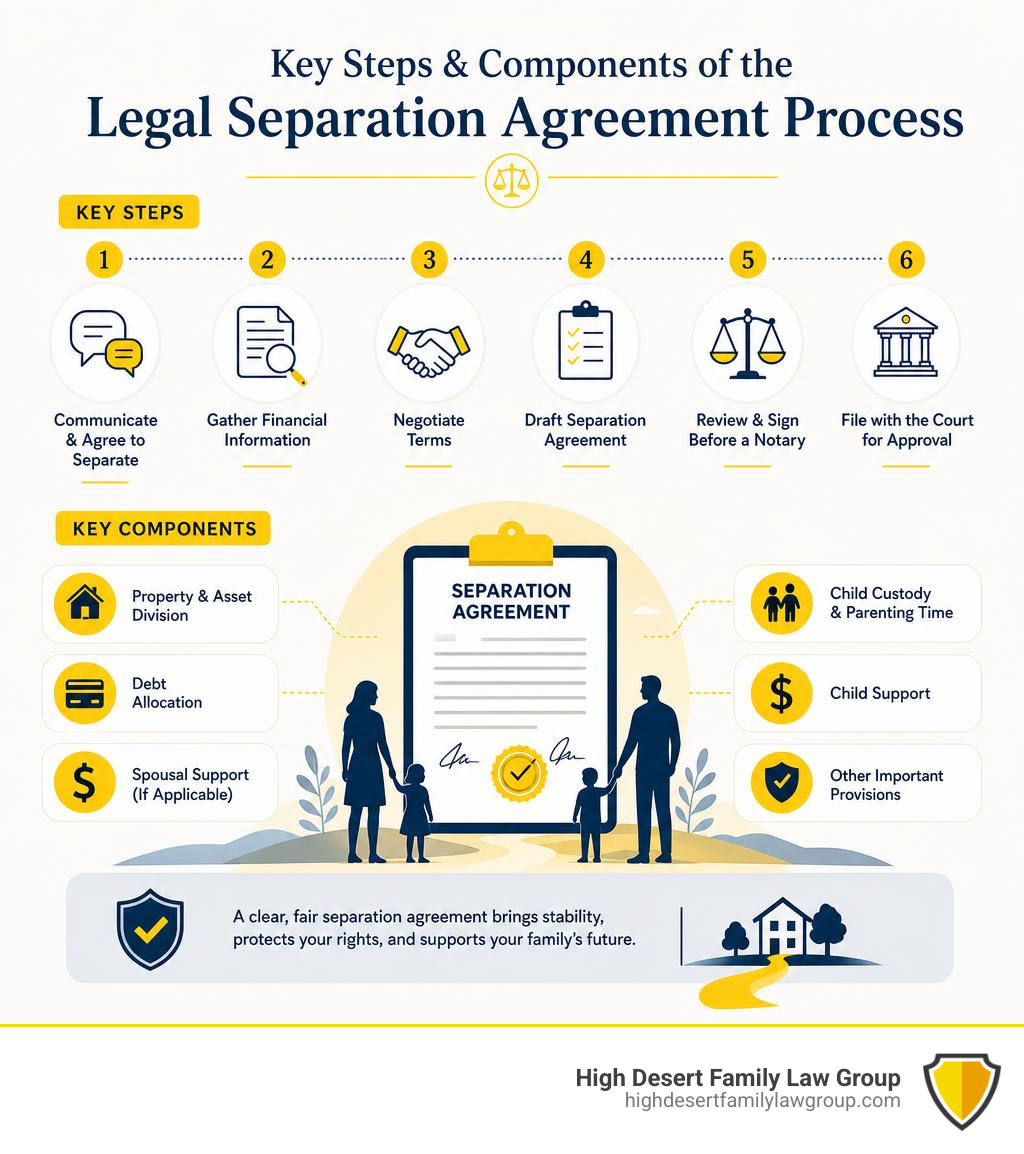
Over 60% of legal separation agreements address child custody, support, and visitation arrangements. However, an effective agreement must cover several key pillars:
- Property Division: Who keeps the marital home? How are bank accounts, retirement assets, and physical belongings split?
- Debt Allocation: Which spouse is responsible for the credit cards, car loans, and mortgage?
- Spousal Support (Alimony): Will one spouse pay monthly support to the other? If so, how much and for how long?
- Child Custody and Parenting Time: Where will the children live, and how will decisions regarding their education, healthcare, and upbringing be made?
- Child Support: How will the financial costs of raising the children be divided?
- Pet Custody: Who gets the family dog or cat, and how will veterinary bills be handled?
Let’s break down these critical components so you know exactly what needs to be negotiated.
Property Division and Debt Allocation
In Arizona, we operate under community property rules. This means that any assets or debts acquired during the marriage are generally considered owned equally by both spouses. When drafting a separation agreement, you must clearly distinguish between community property and separate property (assets owned before the marriage, or acquired via inheritance or individual gift).
To successfully divide your estate, we recommend following these steps:
- Create a Complete Financial Inventory: List every single asset you own, including real estate, vehicles, bank accounts, investment portfolios, business interests, and retirement accounts.
- Perform Asset Valuation: Determine the current, fair-market value of each asset. This may require professional appraisals for real estate or business valuations for privately owned companies.
- Disclose Everything: A willful failure to disclose assets can completely derail your agreement. Under strict legal standards, if a court finds that a party intentionally hid assets or lied on financial affidavits, the court can penalize that party heavily or set the entire agreement aside.
You can review a structured layout of how these assets are typically organized by examining this Sample Separation Agreement – FindLaw.
When it comes to debts, creditors are not parties to your separation agreement. If both of your names are on a credit card, the credit card company can still pursue you for payment even if your separation agreement says your spouse is responsible. To protect yourself, your agreement should include “hold harmless” provisions, mandate the closing of joint accounts, and outline clear timelines for refinancing joint loans (like mortgages or auto loans) into individual names.
Spousal Support and Child-Related Provisions in Legal Separation Agreements
If there is a significant income disparity between you and your spouse, spousal support (also known as spousal maintenance or alimony) may be a central part of your negotiations.
When determining spousal support, courts and attorneys analyze several factors:
- The length of the marriage.
- The standard of living established during the marriage.
- The age, physical condition, and emotional health of both spouses.
- The financial resources and earning capacity of each spouse.
- The contributions of one spouse to the other’s education or career advancement.
For couples with minor children, your agreement must prioritize the children’s best interests. This involves establishing a detailed parenting plan that outlines decision-making authority (legal custody) and a specific schedule for parenting time (visitation), including holidays, vacations, and school breaks.
Child support must also be calculated using state-specific guidelines, which take into account both parents’ gross incomes, parenting time percentages, and healthcare insurance costs.
For parents navigating this process in Arizona, the judicial system provides specialized resources. You can access official forms and guidelines through the Legal Separation with Children – Arizona Judicial Branch portal to ensure your child support and custody arrangements align with state requirements.
Is a Separation Agreement Legally Binding?
Yes, a separation agreement is legally binding, but its level of enforceability depends heavily on how it is executed and filed.

When you first sign a separation agreement, it is treated as a private contract between two parties. For the agreement to be considered valid and enforceable under contract law, it should meet several strict criteria:
- Full Financial Disclosure: Both parties must have a clear, honest picture of the other’s financial situation.
- Voluntary Execution: Neither party can be coerced, threatened, or pressured into signing.
- Notarization: The agreement should be signed by both spouses in the presence of a notary public to verify their identities and intent.
- Independent Legal Advice: It is highly recommended that each spouse has their own independent attorney review the agreement. Having one attorney represent both of you is a direct conflict of interest and makes the agreement highly vulnerable to being overturned in court later.
If you are looking for a baseline template to begin drafting your terms, you can review a Free Marriage Separation Agreement – Rocket Lawyer. However, keep in mind that generic online templates must be carefully customized to comply with Arizona’s specific family law statutes.
The Role of the Court in Enforcing Legal Separation Agreements
While a signed, notarized contract is binding as a private agreement, it achieves its maximum legal power when it is submitted to a judge and incorporated into a formal court order or decree of legal separation.
Once the court approves and signs the agreement, the terms transition from a basic contract to a court order. This distinction is crucial for enforcement:
- If it remains a private contract (Survival): If your spouse stops paying agreed-upon support, your primary remedy is to sue them for breach of contract. This can be a slow, expensive civil court process.
- If it merges into a court order (Merger): If the agreement is merged into the court’s decree, a failure to comply means your spouse is violating a direct court order. You can file a motion for civil contempt of court. The court has aggressive enforcement powers, including wage garnishments, property seizures, and even jail time for willful non-compliance.
To understand the step-by-step procedural mechanics of how these agreements move through the family court system, read our detailed article on How Legal Separation Works in Arizona.
State-Specific Rules and the Reconciliation Process
Family law is governed at the state level, meaning the rules for legal separations vary wildly depending on where you live. For example, legal separation is formally recognized in 43 states. However, 7 states (Delaware, Florida, Georgia, Mississippi, Pennsylvania, Louisiana, and Texas) do not formally recognize legal separation as a court-ordered status. In those non-recognizing states, couples can still use separation agreements as private contracts, but they cannot obtain a decree of legal separation from a judge.
In Arizona, legal separation is fully recognized and governed by strict statutory rules. For instance, unlike a divorce (which requires at least one spouse to have lived in Arizona for 90 days before filing), there is no strict residency duration requirement to file for a legal separation in Arizona, though at least one spouse must be stationed or living in the state at the time of filing.
Furthermore, Arizona is a community property state, meaning the filing of a petition for legal separation is the formal act that “freezes” the marital community. Once the petition is served, any assets or debts acquired by either spouse moving forward are generally classified as their sole and separate property.
Whether you reside in Maricopa County or Pinal County, local court rules can influence your filing. You can learn more about these regional differences by reading How Does Legal Separation Work in Pinal County AZ and exploring our comprehensive guide on Legal Separation in Arizona.
What Happens if Spouses Reconcile?
One of the greatest benefits of a legal separation is that it leaves the door open for a change of heart. If you and your spouse decide to give your marriage another try, you do not have to get remarried—because you never legally stopped being married.
However, you cannot simply tear up your court decree and go back to normal. Under Arizona law (specifically ARS 25-313), terminating a legal separation decree requires a formal legal process:
- Mutual Agreement: Both spouses must voluntarily agree to end the separation.
- Filing a Stipulated Motion: You must file a formal, joint stipulation with the court asking the judge to vacate the legal separation decree.
- Re-forming the Marital Community: Once the court grants the motion, your marital community is legally re-formed. This means that assets and debts acquired after the termination will once again be treated as community property.
- Protecting Creditor Rights: Any debts or financial obligations legally established during the separation remain the responsibility of the designated spouse, and the rights of third-party creditors cannot be retroactively erased by your reconciliation.
To fully grasp how reconciliation impacts your property, support obligations, and parental rights, read our breakdown of Defining Legal Separation in Arizona.
Frequently Asked Questions About Separation
Do I need to get a legal separation before a divorce?
No, you do not need to be legally separated before filing for a divorce in Arizona. You can file for a dissolution of marriage directly at any time.
However, drafting a separation agreement first can be an excellent stepping stone. Couples who use separation agreements are 30% more likely to reach an uncontested divorce if they later decide to end their marriage. This is because the separation agreement can easily be converted into a final divorce decree, saving thousands of dollars in legal fees and avoiding a stressful, drawn-out court battle.
If you are weighing these two options, read our guide: Do I Need to Get a Legal Separation Before a Divorce in Arizona.
Can pets be included in a separation agreement?
Yes, you can absolutely include pets in your separation agreement. Under strict property laws, pets are legally classified as personal property—meaning a court views them similarly to a vehicle or a piece of furniture.
However, we understand that pets are cherished family members. When drafting a customized separation agreement, we can help you create creative “pet custody” arrangements. This can include:
- A shared visitation schedule.
- An agreement on how vet bills, food, and grooming expenses will be split.
- Decisions on who will make medical choices for the pet.
How long can a legal separation last?
In Arizona, a legal separation can last indefinitely. There is no expiration date on a legal separation decree. Some couples remain legally separated for decades.
If either spouse decides later that they want to permanently end the marriage, they can file a petition to convert the legal separation into a dissolution of marriage (divorce). As long as the residency requirements are met at the time of conversion, the court will typically incorporate the terms of your existing separation agreement directly into the final divorce decree.
To learn more about the long-term implications of this status, read What is Legal Separation in Arizona.
Conclusion
Navigating the complexities of legal separation agreements can feel overwhelming, but you do not have to do it alone. A well-crafted agreement protects your financial future, secures your parental rights, and provides the emotional clarity you need to move forward with confidence.
At High Desert Family Law Group, we provide aggressive, individualized representation designed to protect your interests. Our dedicated four-person team works collaboratively to guide Greater Scottsdale and Chandler clients through every stage of family law, from asset division to complex child support negotiations.
We understand that every family is unique, and we tailor our legal strategies to match your specific goals. Let us handle the legal heavy lifting so you can focus on healing and rebuilding your life.
Protect your rights with High Desert Family Law Group today by scheduling a consultation with our experienced legal team.