



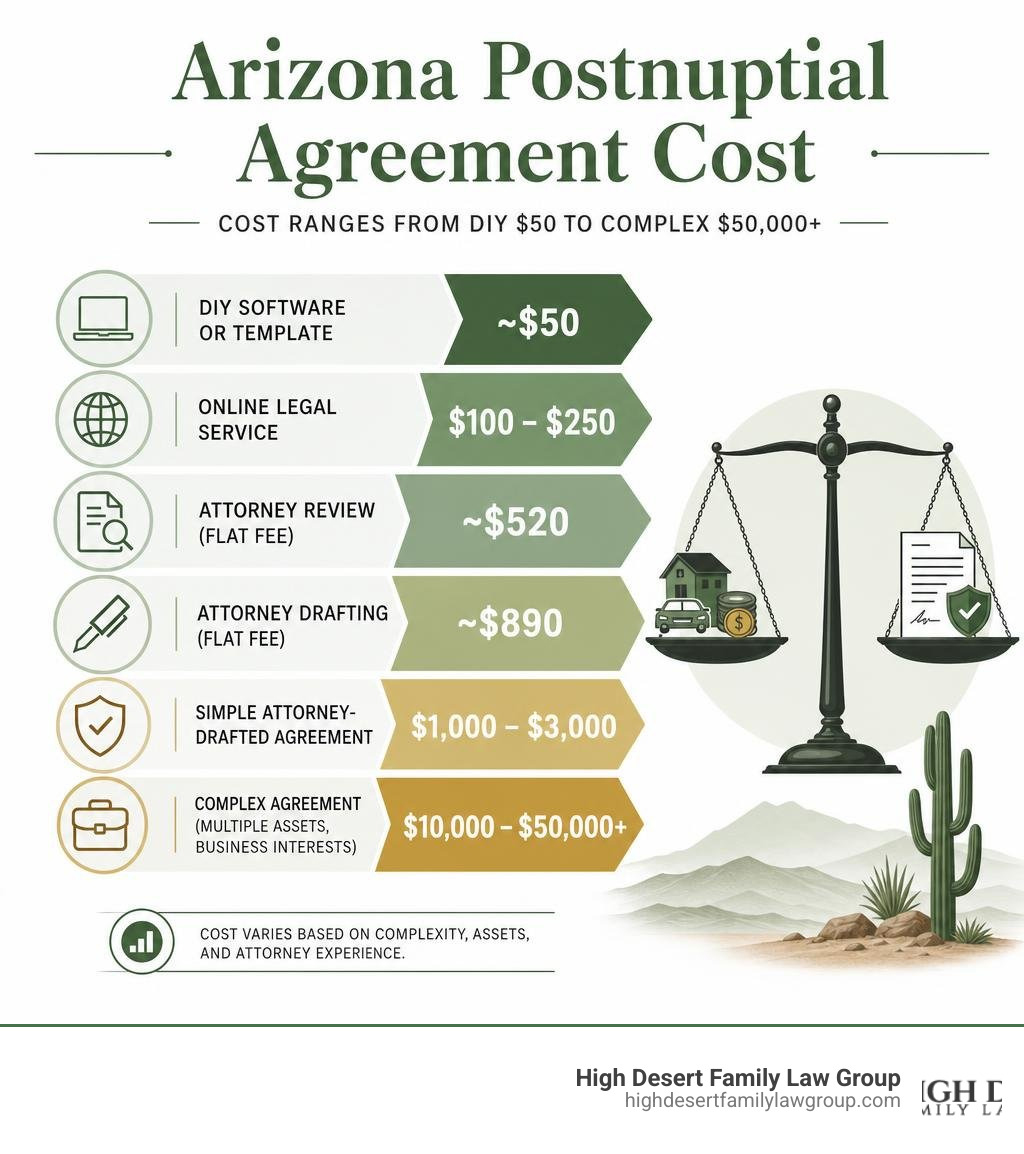
Postnuptial agreement Arizona cost typically falls in this range in 2026:
| Service | Typical Cost |
|---|---|
| DIY software or template | ~$50 |
| Online legal service | $100 – $250 |
| Attorney review (flat fee) | ~$520 |
| Attorney drafting (flat fee) | ~$890 |
| Simple attorney-drafted agreement | $1,000 – $3,000 |
| Complex agreement (multiple assets, business interests) | $10,000 – $50,000+ |
Data based on 180 recent projects via ContractsCounsel and Arizona family law attorney averages.
Getting married is one thing. Figuring out how to protect what you’ve built during your marriage is another challenge entirely.
Maybe your financial situation has changed. Maybe one of you started a business, inherited property, or took on significant debt. Or maybe you simply want clarity — a written agreement that spells out what belongs to whom, and what happens if things go south.
A postnuptial agreement can do all of that. But the first question most couples ask is a practical one: what will it cost?
The honest answer is that it depends — on the complexity of your finances, the attorney you hire, and how well you and your spouse agree on the terms going in. A simple agreement between two people with straightforward finances looks very different from one involving a business, retirement accounts, and separate property disputes.
Similar topics to Postnuptial agreement Arizona cost:
Understanding the Postnuptial Agreement Arizona Cost in 2026
When we look at the financial landscape in 2026, the average postnuptial agreement Arizona cost hovers around $2,000 for standard, uncomplicated marital situations. However, depending on your unique financial portrait, overall costs can run anywhere from a few hundred dollars to tens of thousands.
Understanding these numbers is a crucial first step in your financial planning. Many couples view a postnup as an unnecessary expense, but in reality, it is a proactive investment in your peace of mind. By defining financial boundaries today, you avoid catastrophic legal battles tomorrow.
If you are exploring your Arizona marital agreement options, it helps to look at the breakdown of how these costs are calculated. The total Postnuptial Agreement Cost is driven by whether you are hiring a professional to build the document from scratch or simply to look over something you and your spouse have already structured.
Average Postnuptial Agreement Arizona Cost: Drafting vs. Reviewing
There is a substantial difference in pricing between having an attorney draft a brand-new agreement versus reviewing an existing document. According to recent legal marketplace data tracking family law projects in Arizona:
- Drafting Fees: The average flat-fee cost for an Arizona attorney to draft a customized postnuptial agreement is $890.
- Reviewing Fees: If you already have a draft (perhaps created through a mediation service or an online template) and simply need an attorney to review it to ensure your rights are protected, the average flat-fee cost is $520.
These figures represent baseline marketplace averages. When you work with dedicated family law firms, these numbers can shift based on the level of customized attention your assets require. For a deeper look at historical pricing shifts, you can read about Postnuptial Agreement Costs 2025 to see how inflation and legal updates have influenced modern rates.
Hourly Rates vs. Flat Fees for Arizona Family Attorneys
Family law attorneys in Arizona generally bill using one of two fee structures: hourly rates or flat fees.
- Hourly Rates: The average hourly rate for a family lawyer in Arizona ranges from $200 to $300 per hour, though highly experienced attorneys in metro areas like Scottsdale and Chandler often charge $400 to $500+ per hour. Under an hourly billing structure, the final cost is highly unpredictable. If there are disagreements, endless emails, or multiple rounds of revisions, the hours compile rapidly.
- Flat Fees: Many modern law firms offer a flat-fee model for standard agreements. The average flat-fee rate for a straightforward postnuptial agreement in Arizona is $750 to $1,000. This model provides cost certainty, allowing couples to negotiate openly without watching the clock.
To help you visualize your options, here is a quick comparison of the primary paths you can take:
| Path | Average Cost | Pros | Cons |
|---|---|---|---|
| DIY / Templates | $50 – $250 | Extremely cheap; fast setup | High risk of being thrown out in court; no legal advice |
| Flat-Fee Review | $500 – $700 | Cost-effective; ensures no major red flags | Only covers review; does not include deep customization |
| Standard Attorney Drafting | $1,000 – $3,000 | Legally sound; tailored to your family; includes advice | Higher upfront cost |
| Complex Custom Drafting | $10,000+ | Protects high-value businesses, trusts, and complex assets | Significant financial investment |
How Arizona Community Property Laws Affect Your Postnup
To understand why a postnup is so valuable in Arizona, we have to look at how our state treats marital property. Arizona is one of only nine community property states in the country.
Under Arizona law, any asset acquired or debt incurred by either spouse during the marriage is legally considered community property. This means that, regardless of whose name is on the title, bank account, or credit card, both spouses own an equal 50% share.
If you do not have a valid Postnuptial Agreement Arizona, a judge will divide your community estate right down the middle in a divorce. A postnuptial agreement allows you to override these default state laws. Through a legal process called “transmutation,” you and your spouse can agree to transform community property into separate property (or vice versa), establishing a customized blueprint for your finances.
How Complexity and Assets Impact Your Postnuptial Agreement Arizona Cost
The more complex your financial life, the more work it takes to draft a legally bulletproof agreement. If your situation involves complex assets, your attorney must spend significant time researching, valuing, and structuring the document.
Factors that increase the complexity—and therefore the cost—include:
- Business Ownership: If you or your spouse owns a business in Scottsdale or Chandler, determining its value and deciding how to allocate future appreciation requires specialized clauses. You may even need to pay an independent professional $2,000 to $10,000 for a formal business valuation.
- Retirement Accounts and Pensions: Dividing 401(k)s, IRAs, or military pensions requires careful navigation of tax laws and federal regulations.
- Real Estate Portfolios: Managing multiple properties, rental income, and primary residences adds layers of drafting complexity.
For high-net-worth couples, particularly in affluent areas, specialized agreements are common. If you are navigating these high-value scenarios, we recommend exploring our guide on Postnuptial Agreements for Scottsdale and Paradise Valley Couples to understand how premium assets influence postnuptial agreement cost factors. Complex postnups can start at $10,000 and, in rare cases with extensive global assets, reach up to $50,000.
The Cost of Doing a Postnup vs. Divorce in Arizona
When evaluating the cost of a postnuptial agreement, it helps to weigh it against the alternative: a contested divorce without any pre-existing agreement.
An uncontested divorce where both parties agree on everything can be relatively inexpensive. However, if you have assets and no postnup, a contested divorce in Arizona quickly becomes a financial black hole. The average contested divorce in Maricopa County costs between $15,000 and $50,000 in total legal fees.
By investing $1,500 to $3,000 in a postnuptial agreement today, you are essentially buying an insurance policy. If the marriage succeeds, you gained peace of mind and financial clarity. If the marriage ends, you have bypassed months of stressful, expensive litigation. For a deeper look at this financial trade-off, see our analysis on Postnuptial Agreement vs Divorce.
Legal Requirements for an Enforceable Arizona Postnup

A postnuptial agreement is only worth the paper it is written on if a judge will actually enforce it. If your agreement fails to meet Arizona’s strict legal standards, it can be easily thrown out during a divorce, rendering your investment useless.
To ensure your agreement is legally binding, it must meet several core requirements:
- Written and Signed: The agreement must be in writing and signed voluntarily by both spouses.
- Full Financial Disclosure: Both parties must provide a complete, honest, and accurate accounting of all assets, debts, income, and liabilities. Hiding a bank account or undervaluation of a business is the fastest way to have an agreement invalidated.
- Fair and Equitable Terms: While the agreement does not have to be a perfect 50/50 split, it cannot be so one-sided that it is deemed “unconscionable” (grossly unfair) by a court.
To understand the boundaries of what a judge will accept, review our detailed guide on Are Postnuptial Agreements Enforceable.
Statutory Requirements Under A.R.S. § 25-202.01 and HB 2861
The legal landscape for Arizona postnups changed dramatically with the passage of HB 2861, which established the state’s first formal statutory framework for postmarital agreements under A.R.S. § 25-202.01.
Historically, postnuptial agreements in Arizona faced intense judicial scrutiny. Because married spouses owe each other a fiduciary duty (a legal duty of utmost trust and honesty), courts often assumed postnups were inherently suspect.
Under the statutory framework, the burden of proof shifts to the spouse challenging the agreement. If you execute a postnup that complies with A.R.S. § 25-202.01, the court will presume it is valid. The spouse who wants to throw it out must prove that they signed it under duress, that there was a lack of financial disclosure, or that the terms were unconscionable when signed. This statutory shift makes Arizona postnuptial agreements far more reliable than they used to be, provided they are drafted correctly by an experienced family attorney.
Can You Create a Postnup Without a Lawyer in Arizona?
Technically, yes. Arizona law does not require you to hire an attorney to draft or sign a postnuptial agreement. You can easily find DIY postnuptial software and templates online for about $50, or use basic online document resources that cost between $100 and $250.
However, doing so is highly risky.
Without independent legal counsel, it is incredibly easy to make simple drafting errors that violate Arizona community property statutes or public policy. For example, trying to predetermine child custody or child support in a postnup is completely illegal in Arizona; including these clauses can jeopardize the entire agreement.
Further, if only one spouse has an attorney—or if neither does—it becomes much easier for a disgruntled spouse to claim they didn’t understand what they were signing, or that they were pressured into it. If you want to explore the DIY route, please read Can You Do a Postnuptial Agreement Without a Lawyer and How to Get a Postnuptial Agreement Without a Lawyer to understand the safety measures you must take.
Comparing Postnuptial Agreements to Prenups and Other States
Marital contracts vary widely depending on when they are signed and where you live. Understanding these distinctions can help you make sense of the pricing structures you encounter.
Prenup vs. Postnup Costs in Arizona
While prenuptial and postnuptial agreements cover many of the same financial issues, they differ in timing, legal standards, and average costs.
- Prenuptial Agreements: Signed before the wedding. Because the couple is not yet legally married, they do not yet owe each other fiduciary duties. This makes prenups slightly less complex to defend in court. The average cost of an Arizona prenup ranges from $1,000 to $2,500.
- Postnuptial Agreements: Signed during the marriage. Because the marital relationship already exists, these contracts face higher scrutiny. Spouses must prove there was absolutely no coercion, and the division of existing community property must be handled with extreme care. This added complexity makes postnups slightly more expensive than prenups on average.
To explore this comparison further, read our guide on Prenup vs Postnup or dive into The Ultimate Showdown Between Prenuptial and Postnuptial Agreements.
Arizona vs. Florida Postnuptial Agreement Costs
It can also be helpful to look at how Arizona’s costs compare to other states, such as Florida:
- Florida Costs: In Florida, the average cost for an attorney to draft a postnuptial agreement is $790, and the average cost to review one is $410 (based on ContractsCounsel marketplace data).
- Arizona Costs: Arizona averages are slightly higher, with drafting at $890 and reviews at $520.
This price difference is largely driven by the underlying state laws. Florida is an equitable distribution state, meaning courts divide marital assets based on what is “fair,” which offers judges more flexibility. Arizona is a strict community property state. Untangling community property and transmuting it into separate property requires highly precise drafting to avoid violating state statutes, which naturally drives up the average postnuptial agreement Arizona cost.
Frequently Asked Questions About Arizona Postnups
Navigating marital agreements can feel overwhelming. Here are quick answers to some of the most common questions we receive.
How long after marriage can you get a postnuptial agreement in Arizona?
There is no time limit! You can execute a postnuptial agreement at any point during your marriage—whether you have been married for six weeks, six years, or three decades.
Many couples realize years into their marriage that they need financial boundaries, especially after a major life change like starting a business or receiving an inheritance. To learn more about the timing of these agreements, check out How Long After Marriage Can You Get a Postnuptial Agreement and our guide, Post-Nup Agreements: Better Late Than Never.
Can a postnuptial agreement waive spousal maintenance in Arizona?
Yes, but with strict limitations. Arizona law allows couples to modify or completely waive spousal maintenance (alimony) in a postnuptial agreement.
However, under Arizona’s updated family law guidelines, a court can override this waiver during a divorce if enforcing it would make the spouse eligible for public assistance (welfare) at the time of the divorce. The waiver must be fair and reasonable both when it was signed and when it is being enforced.
Can a postnuptial agreement be challenged or invalidated in court?
Yes. While the new HB 2861 statute makes postnuptial agreements much stronger, they can still be challenged. Common reasons a judge might throw out an agreement include:
- Duress or Coercion: One spouse was pressured or threatened into signing.
- Lack of Financial Disclosure: One spouse hid assets or lied about their income.
- Unconscionability: The terms of the agreement are so incredibly unfair that they shock the conscience of the court.
- Lack of Independent Counsel: If one spouse did not have the opportunity to consult with their own attorney, the court may view the agreement with skepticism.
Conclusion

At the end of the day, a postnuptial agreement is not about planning for a divorce—it is about establishing clear, honest financial communication in your marriage. When both partners know where they stand financially, it removes a massive source of marital stress, allowing you to focus on building a strong life together.
If you are considering a postnuptial agreement in Scottsdale, Chandler, Paradise Valley, or the Greater Phoenix area, you do not have to navigate these complex laws alone. At High Desert Family Law Group, we provide aggressive, individualized representation designed to protect your assets while keeping your family’s unique dynamics in mind. Our dedicated four-person team is here to guide you through every step of the process, ensuring your agreement is legally sound, fair, and built to last.
To learn more about how we can help you protect your future, explore our services regarding Postnuptial Agreements Family Law or contact us today to schedule your consultation.