



When Will This Finally Be Over? What Arizona Parents Need to Know About Custody Battle Timelines
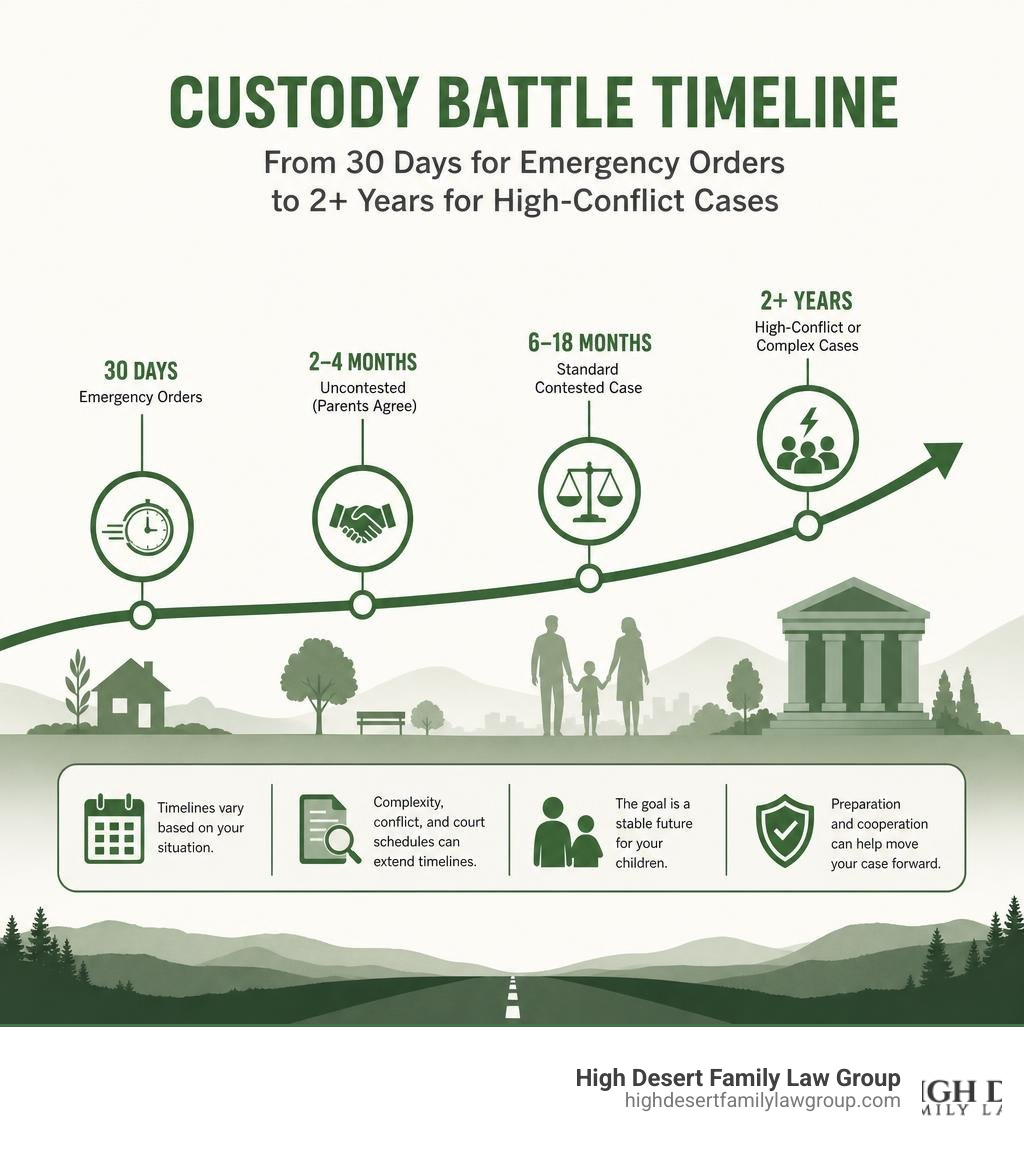
How long can custody battles take? Here is a quick answer:
| Situation | Typical Duration |
|---|---|
| Uncontested (parents agree) | 2 to 4 months |
| Standard contested case | 6 to 18 months |
| High-conflict or complex case | 2 years or more |
| Emergency custody order | As little as 24 to 72 hours |
The honest answer is that there is no single timeline. Some cases wrap up in a matter of weeks. Others drag on for years. The difference usually comes down to how much the parents disagree, how backed up the local courts are, and whether the case requires evaluations, expert testimony, or multiple hearings.
What is clear is that every extra month in court costs more money, adds more stress, and takes a toll on everyone — especially the children caught in the middle.
How Long Can Custody Battles Take on Average?
When parents in Scottsdale or Chandler begin the legal process, their first question is almost always about the timeline. Nobody wants to remain in legal limbo indefinitely. On average, a standard contested custody case in Arizona takes anywhere from 6 to 18 months to reach a final judgment. However, the path your case takes will dictate where you fall on this spectrum.
To understand why some cases wrap up quickly while others drag on, we have to look at the two primary paths a case can take: uncontested and contested.
- Uncontested Cases (The Fast Track): If you and your co-parent can agree on legal decision-making and parenting time, your case is uncontested. In Arizona, even uncontested cases must respect certain administrative timelines, but they can often be finalized in 2 to 4 months. This is because the judge simply needs to review and approve your parenting plan to ensure it meets the Arizona best interests factors.
- Contested Cases (The Scenic Route): When parents cannot agree on major issues, such as where the child will go to school, holiday schedules, or primary residency, the case becomes contested. A contested case requires court intervention, hearings, discovery, and potentially a trial. These cases typically last 9 to 18 months, and high-conflict disputes can easily stretch past the 2-year mark.
Understanding How Long Do Custody Cases Take? requires looking at the regional court landscape. In Maricopa County and Pinal County, court dockets are notoriously crowded. Scheduling and case complexity heavily interact under state guidelines, often dictating how long a case will ultimately last.
Key Stages of the Child Custody Process
Every custody case moves through a series of legal milestones. While it might feel like a chaotic blur, the family court system actually follows a structured sequence. Knowing these steps can help you measure progress and manage your expectations.

Initial Filing and the Question of How Long Can Custody Battles Take to Start
The custody process officially begins when one parent files a Petition to Establish Legal Decision-Making, Parenting Time, and Child Support (or a Petition for Dissolution of Marriage if the parents are divorcing).
Once the petition is filed, it must be formally served to the other parent. The receiving parent then has a specific window to respond:
- 20 days if they are served within the state of Arizona.
- 30 days if they are served outside the state of Arizona.
If the responding parent fails to answer within this timeframe, the filing parent can apply for a default judgment, which can fast-track the case. However, in most cases, the other parent responds, and the court schedules an initial hearing.
For parents in Pinal County, understanding What Happens at a First Child Custody Hearing in Casa Grande AZ is crucial, as this initial appearance sets the procedural tone for the rest of the litigation.
Temporary Orders and Mediation
Because a final custody trial can be many months away, families need ground rules in the meantime. This is where temporary orders come in. Temporary orders establish who the child lives with, the visitation schedule, and who pays child support while the larger case is pending.
In Arizona, courts also heavily emphasize alternative dispute resolution. In fact, Maricopa and Pinal county courts generally require parents to attend mediation before they can proceed to a trial.

During mediation, a neutral third party helps parents attempt to draft a mutually agreeable parenting plan. If mediation is successful, the entire process can be shortened by several months. For local families, crafting solid Child Custody and Parenting Plans for Scottsdale Families is the most effective way to bypass the courtroom entirely. If you are located in the East Valley, working with a dedicated family law attorney can ensure your mediation proposals are legally sound and highly persuasive.
Discovery, Evaluations, and Trial
If mediation fails, the case enters its most time-consuming phase: discovery and evaluations.
- Discovery: This is the formal process of gathering evidence. Parents exchange financial documents, school records, medical histories, and communications. This phase typically takes 60 to 120 days.
- Custody Evaluations: In complex or high-conflict cases, the court may order a custody evaluation or appoint a Best Interests Attorney (BIA) or Court-Appointed Advisor (CAA). These professionals interview the parents, observe the children, and conduct home visits. A thorough custody evaluation can take 3 to 6 months to complete and write up.
- The Trial: Once discovery and evaluations are complete, the case is set for trial. Due to court backlogs, you may have to wait several months just to get a trial date on the judge’s calendar. The trial itself may last anywhere from a few hours to several days.
- Final Judgment: After the trial concludes, the judge will review the evidence and issue a final binding order. This written ruling can take several weeks to be finalized. Knowing What Happens at a Final Custody Hearing? can help you prepare mentally and logistically for this high-stakes conclusion.
Factors That Prolong or Shorten the Custody Timeline
No two families are identical, which means no two custody cases progress at the exact same speed. Several critical variables can either act as an express lane or create a massive bottleneck in your proceedings.
High-Conflict Disputes and How Long Can Custody Battles Take to Resolve
The single greatest driver of a lengthy custody battle is parental conflict. When co-parents let personal animosity dictate their legal strategy, timelines skyrocket.
High-conflict cases often involve:
- Refusal to compromise on minor scheduling details.
- Frequent, angry communication breakdowns.
- A “winner-take-all” mentality where children are used as leverage.
- Repeated motions filed in court over minor disagreements.
In these situations, the court may require multiple hearings before even reaching a trial. Understanding What Happens at a Second Custody Hearing? is often necessary for parents stuck in this cycle. To navigate these turbulent waters, it is helpful to understand how the court evaluates parental cooperation and communication.
Court Backlogs and Jurisdictional Differences
Where you file your case matters. Court capacity, staffing shortages, and the specific judge assigned to your case heavily influence the schedule.
For instance, Maricopa County family courts handle an immense volume of cases, which can lead to longer wait times for hearing dates. Pinal County courts have different scheduling dynamics. If your case is in Pinal County, you should familiarize yourself with Child Custody and Parenting Time in Pinal County: What Parents Should Know to understand local court preferences.
Additionally, the overall timeline of family law litigation is highly dependent on county-specific rules and the complexity of the issues involved.
Emergency Custody Orders vs. Standard Timelines
When a child is in immediate physical danger or facing an urgent safety risk, the standard multi-month timeline is thrown out the window. Parents can file for emergency (ex parte) temporary orders.
- Timeline: A judge will typically review an emergency petition within 24 to 72 hours without a formal hearing.
- The Catch: Emergency orders are strictly temporary. They are designed to keep the child safe until a full hearing can be held, which usually occurs within 20 to 30 days.
- Standard for Approval: Arizona courts set an incredibly high bar for emergency custody. There must be proof of immediate, irreparable harm or ongoing abuse.
To understand when these measures are appropriate, read about Emergency Custody in Pinal County: When Can a Parent Ask the Court to Step In?.
The Financial and Emotional Costs of Prolonged Litigation
It is no secret that the longer a custody battle lasts, the more expensive and emotionally draining it becomes. When a case drags on for a year or more, the financial toll can escalate rapidly.
Prolonged litigation costs accumulate through:
- Ongoing Attorney Fees: While simple cases keep costs manageable, hourly fees over months of litigation add up.
- Expert Witness Fees: If your case requires forensic accountants, child psychologists, or custody evaluators, you will have to pay for their time and testimony.
- Guardian ad Litem (GAL) or CAA Fees: Court-appointed professionals do not work for free; their fees are typically split between the parents.
Beyond the checkbook, the emotional cost is immense. Children thrive on routine and predictability. Living in a state of parental warfare for months on end can lead to anxiety, behavioral issues, and academic decline.
To help budget and prepare for these realities, you can review our historical breakdowns of Child Custody Lawyer Costs 2022 and Child Custody Lawyer Costs 2023 to understand how fee structures operate in Arizona family law.
Frequently Asked Questions About Custody Timelines
Can a custody appeal extend the timeline?
Yes, absolutely. If a parent believes the trial judge made a legal error or abused their discretion, they can file an appeal. However, an appeal does not happen overnight. The appellate process in Arizona can easily add 6 to 12 months (or more) to the overall timeline.
During this time, the original trial court’s order usually remains in effect unless a stay is granted. To learn more about this complex post-trial phase, see What Happens at a Child Custody Appeal Hearing in Arizona?.
How does mediation affect the overall duration?
Mediation is the ultimate shortcut. If you and your co-parent can reach an agreement during mediation, you can bypass discovery, custody evaluations, and a trial. This can shave 6 to 12 months off your timeline. Even if you only agree on some issues (like the holiday schedule) and leave the rest for the judge, you still reduce the time needed for a trial.
What common mistakes delay a custody case?
Several avoidable errors can cause a custody case to stall:
- Poor Record-Keeping: Failing to organize text messages, emails, school records, and financial documents forces your legal team to spend weeks tracking them down.
- Emotional Outbursts: Sending angry text messages or posting on social media can trigger additional hearings and damage your credibility with the judge.
- Ignoring Legal Advice: Taking matters into your own hands or violating temporary court orders will inevitably result in your ex-partner filing motions to enforce, dragging you back to court and resetting your timeline.
Conclusion
So, how long can custody battles take? While an uncontested agreement can be finalized in a few short months, a contested, high-conflict dispute can easily dominate your life for a year or more. The speed of your case depends heavily on preparation, local court dockets, and—above all—the willingness of both parents to prioritize their children’s well-being over personal grievances.
At High Desert Family Law Group, we provide aggressive, individualized representation designed to protect your children and secure a fair outcome without unnecessary delays. Our four-person team serves clients throughout Greater Scottsdale, Chandler, and Pinal County. We focus on building smart, proactive strategies that cut through the noise and keep your case moving forward.
If you are facing a custody dispute and want to know how we can help you navigate this process efficiently, explore More info on custody timelines or reach out to us today to schedule a consultation. Let us help you find the shortest path to a stable, peaceful future for your family.
Disclaimer: The information provided in this article is for general informational purposes only and does not constitute legal advice. For advice tailored to your specific circumstances, please consult with a qualified family law attorney.