



A.R.S. §25-403 Decoded: How Arizona Judges Handle High Conflict Custody

High-conflict custody in Arizona means one parent’s pattern of behavior, repeated filings, obstruction, hostility, or safety allegations has pushed a case beyond standard scheduling disputes into territory where judges add oversight. If that describes your situation, start documenting everything now and talk to a family law attorney before your next exchange or hearing. Arizona courts lean on specific statutes and tools, from parenting coordinators to protective conditions, to manage these cases, and which ones apply to you depends on the facts you can prove.
TL;DR:
- High-conflict custody cases often involve repeated retaliatory filings, hostility in exchanges, and allegations of abuse or parental unfitness that surface continually.
- Once labeled high conflict, cases attract additional professionals like custody evaluators, parenting coordinators, and stricter court orders to manage ongoing disputes.
- Document all communications, missed exchanges, and relevant records early, using timestamped logs and parenting apps, to enhance credibility in court.
- Emergency custody relief can be granted within days for immediate dangers, while modifications require substantial, ongoing changed circumstances that can take months.
- Experienced family lawyers focus on procedural timing, credible evidence, and enforceable proposals to influence judges in complex, high-conflict cases.
Table of Contents
- What “high conflict” looks like in an Arizona custody case
- The Arizona statutes that actually control your custody outcome
- The court tools judges reach for in escalated cases
- Your evidence and communication checklist for a high-conflict case
- Emergency relief, enforcement, and modification timelines
- What experienced counsel actually does in a case like this
- What actually moves the needle in front of a judge
- How High Desert Family Law Group Supports High-Conflict Cases
- Sources
What “high conflict” looks like in an Arizona custody case
Judges do not stamp a case file “high conflict.” It is a working label attorneys, evaluators, and courts apply once certain behavior patterns show up repeatedly, and it changes how the court manages the file.
Some signs are obvious. Others sneak up on parents who think they are just having a rough patch.
- Repeated, retaliatory court filings over minor scheduling disagreements
- Parenting time consistently withheld, delayed, or interrupted without cause
- Exchanges that turn hostile in front of the child, at school pickup, or at a police station lobby
- One parent using the child to relay messages, gather information, or apply pressure
- Refusal to communicate through any channel except confrontation
- Allegations of abuse, substance use, or parental unfitness that surface in nearly every filing
Once a judge or a court-appointed professional starts treating a case this way, the file usually gets more scrutiny, not less. That can mean additional professionals get pulled in: a Best-Interests Attorney, an evaluator, a parenting coordinator. It often means stricter, more specific orders because the court no longer trusts the parents to fill in gaps reasonably on their own. Courts commonly deploy these tools once a case gets labeled this way, according to guidance from Pinnacle Supervisors on how Arizona family courts manage escalated disputes.
The label is descriptive, not procedural. It does not appear on a docket sheet. But it shapes almost everything that happens next, from how much documentation the court expects to how skeptically it reads your next motion.
The Arizona statutes that actually control your custody outcome
Two statutes do most of the heavy lifting in Arizona custody disputes, and if you only read two before your next hearing, read these.
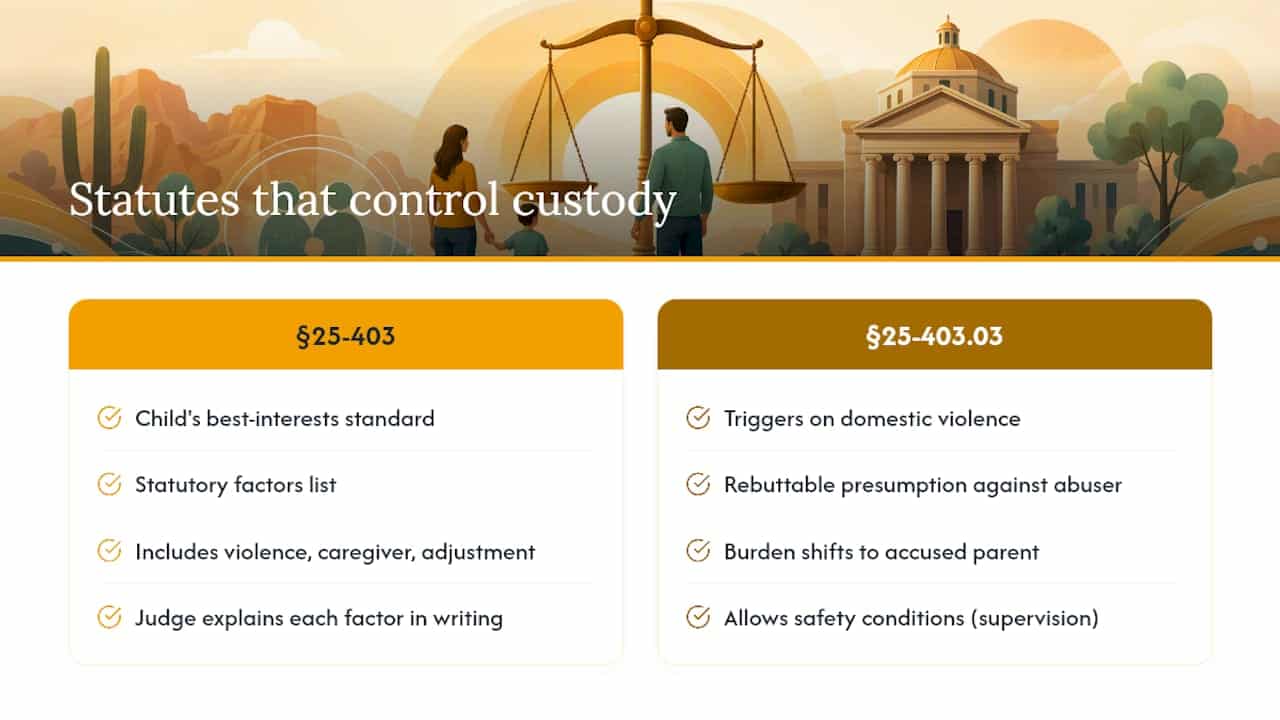
A.R.S. § 25-403 sets the “best interests of the child” standard. It is the backbone of every legal decision-making and parenting-time ruling in the state. The statute lists specific factors judges must weigh, including each parent’s willingness to foster the child’s relationship with the other parent, evidence of domestic violence or coercion, which parent has been the primary caregiver, and the child’s adjustment to home, school, and community. Judges do not get to pick a favorite factor and ignore the rest. They work through the statutory list and explain, in writing, how each one applies.
A.R.S. § 25-403.03 is the one that changes the entire calculus when domestic violence enters the picture. It creates a rebuttable presumption that awarding sole or joint legal decision-making to a parent who has committed significant domestic violence is contrary to the child’s best interests.
When a parent has a documented history of significant domestic violence, Arizona law starts from the assumption that giving that parent decision-making authority harms the child. The burden shifts to that parent to prove otherwise.
That is not a minor technicality. It means the parent alleging abuse does not automatically have to prove the other parent is unfit in some general sense. Once significant domestic violence is established under § 25-403.03, the presumption does the work, and the accused parent has to rebut it.
Courts also have latitude to attach conditions once safety concerns surface, even short of triggering the full presumption. A judge might order supervised parenting time, mandate a batterer’s intervention program, or restrict overnight visits pending further review. These conditions come straight from the court’s authority under Arizona’s domestic violence custody provisions, summarized in this Cornell Law overview of the statute’s practical reach. None of this requires a criminal conviction. Civil custody proceedings run on a different evidentiary standard than criminal court, and judges weigh police reports, medical records, and witness testimony on their own terms.
The court tools judges reach for in escalated cases
Once a case gets treated as high-conflict, expect more people involved in your family’s business, not fewer. Each tool serves a distinct function, and knowing what each one actually does helps you stop dreading the unfamiliar ones.
- Best-Interests Attorney (BIA): Represents the child’s interests directly in court, independent of either parent’s position. A BIA can interview the child, review records, and make recommendations to the judge, and unlike a guardian ad litem, a BIA does not need to prove the child lacks capacity to express preferences.
- Custody evaluations: A licensed evaluator investigates both households, interviews the parents and sometimes the child, and produces a written report with custody recommendations. These carry weight with judges precisely because they come from a neutral third party who spent hours on the case, not minutes.
- Supervised visitation: A trained supervisor observes parenting time and documents what happens, minute by minute in some cases. If you’re facing this, understanding how supervised visitation works in Arizona before your first monitored session matters, since supervisors’ notes often end up as exhibits later.
- Monitored exchanges: A neutral third party or a public location handles the handoff itself, cutting down on direct contact between hostile parents.
- Parenting coordinators: Appointed to resolve day-to-day disputes, like a schedule swap or a school choice disagreement, without both parents filing new motions every time they disagree.
- Family Conciliation Services: Maricopa County Superior Court runs a Parental Conflict Resolution Class and mediation resources through its Family Conciliation Services program, aimed at resolving disputes before they require another hearing.
None of these tools appear automatically. A judge orders them based on what the case file shows, which is exactly why documentation from day one matters so much.
Your evidence and communication checklist for a high-conflict case
Courts reward parents who show up organized. Vague accusations lose to timestamped records every time, and the parent who can hand a judge a clean, chronological file usually looks more credible by default, even before the facts get argued.
Start building your record today, not after your next hearing gets scheduled.
- Save every message. Texts, emails, and parenting-app logs (OurFamilyWizard and similar platforms create timestamped, unalterable records) document patterns far better than your memory will months later.
- Log missed or altered exchanges. Note the date, time, what was supposed to happen, and what actually happened. A pattern of five missed exchanges over three months is far more persuasive than one angry retelling in court.
- Pull school and medical records early. Attendance issues, tardiness tied to custody exchanges, or medical appointments one parent skipped all become relevant exhibits.
- Switch to written communication only. Verbal arguments leave no record. A parenting app or email creates one.
- Set a response window and stick to it. A 48 to 72 hour response expectation, stated plainly in your parenting plan, gives you a documented standard the other parent either meets or doesn’t.
Your proposed parenting plan should build in structure the same way, recognizing that judges require legal paternity before deciding custody to ensure parental rights are properly established. Arizona parenting plans need to designate legal decision-making authority, set a parenting-time schedule, spell out exchange procedures, and establish dispute-resolution methods, and a high-conflict case is exactly where those provisions earn their keep. Consider proposing neutral, public exchange locations, dividing decision-making by category (education to one parent, medical to the other, for example) instead of a blanket joint arrangement that requires constant agreement, and a mediation clause for disputes before either parent can file a new motion. This is the mechanical core of parallel parenting, an arrangement Arizona courts routinely approve once the record shows sustained conflict, and one worth proposing in your own parenting plan draft rather than waiting for the court to impose it.
If your safety or your child’s safety is genuinely at risk, a protective order and supervised exchanges are not optional extras. They are the floor, not the ceiling.
Pro Tip: Keep a single dedicated calendar, digital or paper, just for custody-related events: missed exchanges, appointments, incidents. A scattered record across five apps and a notebook is much harder to hand a judge than one clean timeline.

Emergency relief, enforcement, and modification timelines
Not every dispute waits for a regular hearing date. Arizona courts allow emergency, or ex parte, relief when a child faces immediate danger or when one parent has engaged in custodial interference, meaning the other parent took off with the child, refused a scheduled return, or cut off contact entirely.
Emergency filings move fast, sometimes within days, precisely because the standard is immediate risk, not general unfairness. Judges can issue temporary orders covering:
- Supervised parenting time pending a full hearing
- Restricted or no-contact provisions for one parent
- Supervised or monitored exchanges only
After an emergency order, expect a full hearing scheduled within weeks, not months, though calendars vary by county. A modification petition, by contrast, follows a slower track: courts generally require a substantial and continuing change in circumstances, and evaluations or BIA reports can add months to that timeline. If you’re facing an immediate threat right now, emergency custody procedures exist specifically for that situation, not the slower modification process.
What experienced counsel actually does in a case like this
A family law attorney handling a high-conflict Arizona custody case is doing more than filing paperwork. Expect support across custody litigation, mediation, coordination with supervised-visitation providers, emergency petition drafting, and building out a parenting plan detailed enough to survive contact with an uncooperative co-parent.
An experienced family law practice draws on many years of family law experience and a track record across numerous cases in the Scottsdale area. That kind of repetition matters in high-conflict work specifically, because these cases hinge on procedural timing and evidentiary presentation as much as the underlying facts.
Before your first consultation, gather what you have: existing custody orders, a communication log or export from your parenting app, a calendar of missed or disputed exchanges, and any school or medical records tied to custody issues. Bring it all, even the messy parts. An attorney working from a full picture spots leverage points a partial record hides.
What actually moves the needle in front of a judge
Judges deciding custody spend most of their attention on two things: patterns and credibility. A parent who shows up with a reasonable, enforceable proposal and a calm demeanor tends to read as the more capable co-parent, even when the underlying allegations are serious, according to practitioner observations on what judges look for in high-conflict cases.
Here is what that means in practice. Present your documented evidence in a timeline, not a monologue. Punitive or unrealistic requests, demanding zero contact when the facts do not support it, tend to backfire even when your underlying concerns are legitimate.
Do: stay factual in filings, propose specific enforceable terms, keep every exchange on record.
Don’t: editorialize in court documents, request relief the facts can’t support, argue with the other parent in front of the judge.
How High Desert Family Law Group Supports High-Conflict Cases
If your case involves withheld parenting time, safety concerns, or a co-parent who treats every exchange as a fight, you don’t need general advice. You need someone who has drafted the specific orders Arizona judges actually enforce and who knows which conditions a Maricopa County judge will and won’t approve on sight.

The firm handles custody litigation, mediation, coordination with supervised-visitation providers, emergency petitions, and parenting-plan drafting tailored for complex cases. For many families, mediation resolves disputes faster and with less damage than a courtroom fight, though it only works when both parties negotiate in good faith, which a first consultation can help you evaluate honestly.
Before you schedule, pull together your existing custody orders, a communication log, your exchange calendar, and any relevant school or medical records. If you’re weighing whether your situation calls for litigation, mediation, or something in between, the overview of family lawyer services is a useful starting point, and it points to how to schedule an initial consultation to walk through your specific case.
This article is general information, not a substitute for advice from a qualified lawyer. Consult a qualified legal professional about your own circumstances before acting on anything here.
Sources
- Arizona Revised Statutes § 25-403
- Family Conciliation Services — Maricopa Superior Court
- Arizona parenting plan requirements — Justia (A.R.S. §25-403.02)
- What ‘High-Conflict’ Means in an Arizona Family Court Case — Pinnacle Supervisors