



Keep Your Arizona Move Legal: 45 Day Steps for Shared Custody Parents

Arizona law does allow a shared custody parent to relocate a child, but only if you follow the rules in A.R.S. §25-408. If both parents share court-ordered legal decision-making or parenting time and both live in Arizona, you must give at least 45 days’ written notice before moving a child out of state or more than 100 miles within it. The other parent then has 30 days to object. Move first, and you risk sanctions or an emergency order to return the child.
TL;DR:
- A parent must give at least 45 days’ written notice of an out-of-state move or move over 100 miles within Arizona, using certified mail with detailed information.
- The nonmoving parent has 30 days to object after receiving notice, and relocating during that period can result in sanctions or orders to return the child.
- Courts evaluate the child’s best interests based on stability, community ties, contact with both parents, and genuine reasons for the move, favoring detailed plans and documentation.
- In emergency cases, courts may consider shortened timelines but still require some form of notice and review, emphasizing the importance of a thorough paper trail.
- Proper preparation—including specific notice details, supporting documentation, and a comprehensive parenting plan—significantly improves chances of a successful relocation.
Table of Contents
- What Does Arizona’s Move Away Law Actually Require?
- What Is the Timeline for Notice and Objections?
- How Do Judges Decide Whether a Move Is Allowed?
- What Happens if the Other Parent Objects?
- What Should Your Relocation Checklist Look Like?
- What We See Most Often in Relocation Cases
- How High Desert Family Law Group Can Help With Your Move
- Where to Verify These Rules Yourself
- Sources
- FAQ
What Does Arizona’s Move Away Law Actually Require?
A.R.S. §25-408 kicks in whenever a court order already governs legal decision-making or parenting time and both parents live in Arizona. There’s one common exception: if you and the other parent sign a written agreement about the move, you can skip the formal notice process entirely. Courts still expect that agreement in writing, not a verbal understanding you’re hoping holds up later.
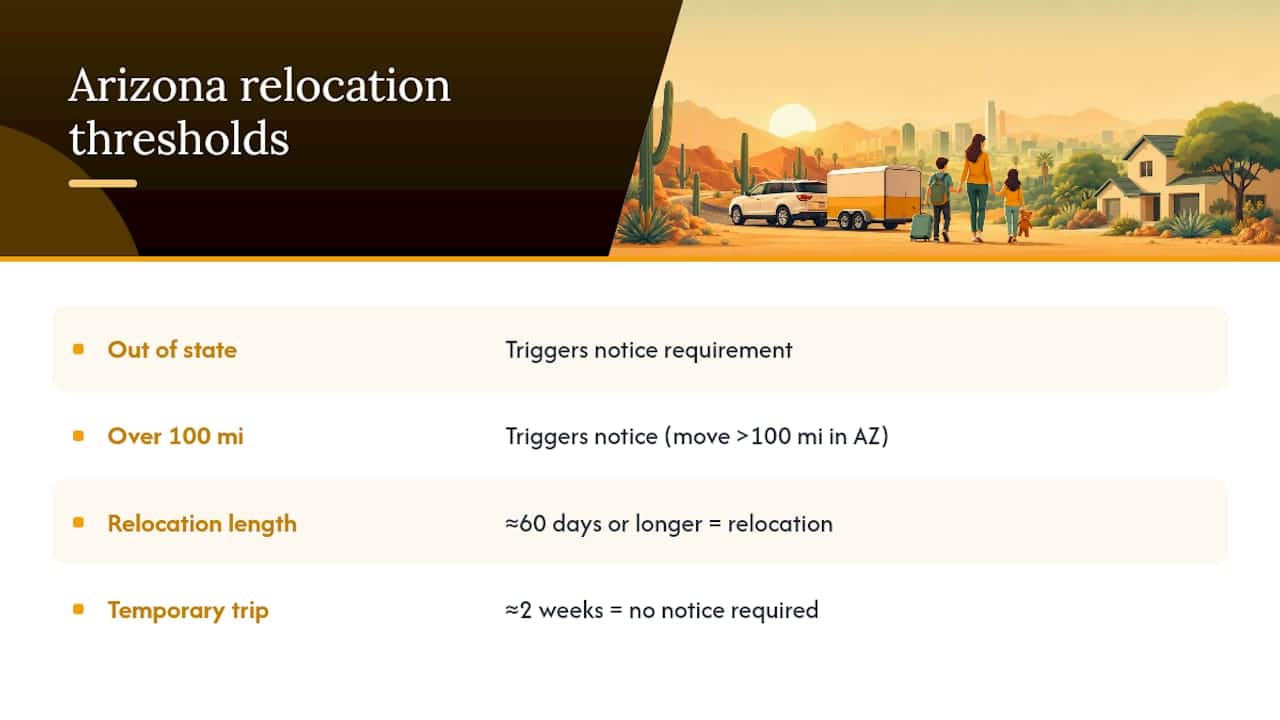
The statute defines relocation broadly. It covers any move out of state, or more than 100 miles within Arizona, from where the child currently lives. Practitioners typically treat a move lasting roughly 60 days or longer as a genuine relocation rather than a temporary trip. A two-week vacation to visit grandparents in another state doesn’t trigger the notice requirement. A permanent move for a new job does.
Notice has to be more than a text message. The statute directs parents to deliver it by certified mail or through the methods outlined in the Arizona Rules of Family Law Procedure, and it should spell out the planned move date, the new address, and the reasons behind it. Courts have little patience for vague or last-minute notice. If you’re unsure how to draft language that holds up, this 45-day notice guide walks through the specifics parents in Arizona commonly get wrong.
What Is the Timeline for Notice and Objections?
The clock matters more than almost anything else in a relocation case. Here’s how it typically runs:
- Deliver written notice at least 45 days before the move. Send it by certified mail and keep the return receipt. That receipt is your proof if the case ever gets contested.
- Wait out the 30-day objection window. The nonmoving parent has 30 days from receiving notice to file a petition objecting to the relocation.
- If a petition gets filed, stay put. You cannot relocate the child while the court’s review is pending. Judges can set a hearing, issue temporary orders, or in some cases decide the matter on written filings alone.
- If nobody objects within 30 days, you can generally proceed. Silence isn’t a formality here. It’s the green light the statute builds in.
Emergency situations get some flexibility. If you’re relocating because of documented safety concerns, a sudden job loss, an eviction, or a health crisis, the Arizona Judicial Branch’s family law resources notes that courts can consider shortened timelines. But that flexibility is not automatic license to skip notice altogether. Courts still review these moves after the fact.
Pro Tip: Save every version of your notice, every mailing receipt, and every email exchange about the move date. Judges weigh credibility heavily in these cases, and a clean paper trail says more than any argument you make in court.
How Do Judges Decide Whether a Move Is Allowed?
Judges apply the best interests standard under A.R.S. §25-403, and the parent asking to move carries the burden of proving the relocation serves the child, not just the parent’s own goals.
Courts weigh several factors when a relocation is contested:
- The child’s physical and emotional well-being, including stability of routine.
- Existing ties to school, extended family, and community.
- Whether the moving parent will facilitate frequent, meaningful contact with the parent who stays behind.
- The reasons for the move and whether they’re genuine versus an attempt to limit the other parent’s access.
- The child’s own wishes, depending on age and maturity.
A parent who shows up with a signed job offer, a lease on a new home, a specific school enrollment plan, and a detailed long-distance parenting schedule stands a dramatically better chance than one who offers a vague “better opportunity” with no documentation. Courts consistently favor arrangements that preserve real contact between the child and both parents, not just contact on paper. A long-distance parenting plan that spells out holiday schedules, transportation logistics, and virtual visit routines does more to persuade a judge than any verbal promise.
What Happens if the Other Parent Objects?
Once a petition objecting to the move lands on the court’s desk, the case shifts into a more formal track. The moving parent typically files a response, both sides may submit affidavits, and the court schedules a hearing, sometimes preceded by temporary orders that keep the current parenting time schedule in place until the judge rules.
Depending on the facts, outcomes can include:
- A temporary order requiring supervised exchanges or a modified schedule while the case proceeds.
- An order compelling the child’s return if the parent relocated without following the statute.
- Sanctions, including fee-shifting, against a parent who ignored the notice and objection process.
- A full denial of the relocation request, keeping the child in Arizona.
- In more severe cases, a change in primary residence to the objecting parent.
None of these outcomes are automatic, and every case turns on its specific facts. But parents who skip the process entirely tend to walk into hearings already on the defensive, regardless of how good their underlying reasons for moving actually were.
What Should Your Relocation Checklist Look Like?
Start with the notice itself. It needs the planned move date, the new address, the reasons for relocating, and a proposed parenting plan that addresses transportation and contact schedules. Skip any of these and you invite an objection just on procedural grounds.
Then gather your supporting paperwork before you send anything:
- Employment offer letters or documentation of a job transfer.
- Lease agreements or purchase contracts for the new home.
- School enrollment records or acceptance letters.
- A childcare plan if you’re moving with young children.
- A written communication and virtual-visit schedule for the nonmoving parent.
If the other parent is likely to object, consider mediation before you ever file anything in court. A written, mutually signed agreement bypasses the entire 45-day and 30-day process under the statute’s exception. Neutral exchange locations and a trial parenting-time template can also defuse tension long before a judge gets involved. The mediation and negotiation options available to Arizona parents often resolve relocation disputes faster and cheaper than litigation.
Pro Tip: Draft your parenting plan proposal before you send notice, not after an objection forces your hand. A plan you offer voluntarily reads as good faith. A plan you scramble to produce after a hearing date gets set reads as an afterthought.
What We See Most Often in Relocation Cases
After more than 20 years handling family law matters across Arizona, the pattern in relocation disputes rarely changes: parents lose ground not because their reason for moving is weak, but because their process is. Moving before the 45 days run, sending notice with no real detail, or showing up to court with no parenting plan turns a reasonable request into a losing one.
The fix isn’t complicated. It’s discipline: certified mail, specific dates, a workable long-distance schedule. Experienced family law attorneys have guided parents through both sides of these cases, drafting notices that hold up and responding to objections that threaten to upend a move already in motion. The law rewards preparation here more than almost any other area of family law.
How High Desert Family Law Group Can Help With Your Move
Relocation cases move fast once a notice goes out or an objection gets filed, and there’s little room to fix a mistake after the 45-day clock starts running.

Attorneys work with Scottsdale-area parents on exactly these situations, from drafting compliant relocation notices to filing emergency petitions when a move needs to happen faster than the standard timeline allows. Whether you’re the parent planning to move or the parent who just received a notice you don’t agree with, the right response depends on facts specific to your custody order, and getting that response wrong can cost you parenting time you won’t easily get back. Our child custody team also handles the modification petitions that often follow a contested relocation, along with mediation when both parents would rather negotiate than litigate. A consultation starts with a review of your current parenting plan and the specific move at issue, then maps out whether notice, objection, or a modification motion is the right next step. If a relocation is on the table for your family, schedule a consultation before you send that notice.
Where to Verify These Rules Yourself
Read the statutes directly: A.R.S. §25-408 on notice and relocation, A.R.S. §25-403 on best-interests factors, and A.R.S. §25-411 on modification timing. Maricopa County residents can find modification petition forms directly through the superior court.
This article is general information, not a substitute for advice from a qualified lawyer. Consult a qualified legal professional about your own circumstances before acting on anything here.
Sources
- 25-408. Rights of each parent; parenting time; relocation of child; exception; enforcement; access to prescription medication and records
- Petition to Modify Legal Decision-Making, Parenting Time and Child Support – Maricopa County
FAQ
Can the Father of My Child Stop Me From Moving Away?
A father with court-ordered legal decision-making or parenting time can file a petition objecting to your move within 30 days of receiving notice under A.R.S. §25-408. He cannot unilaterally block the move himself. Only a judge can prevent relocation, and only after reviewing the case under the best-interests factors in §25-403.
What Is Rule 69 in Arizona?
Rule 69 refers to a provision in the Arizona Rules of Family Law Procedure covering settlement agreements reached between parties, including agreements made on the record in court or in writing. In relocation disputes, such an agreement can formalize a parenting plan or relocation consent without a full trial, similar to the written-agreement exception under §25-408.
Can I Leave My 14 Year Old Home Alone Overnight in Arizona?
Arizona doesn’t set a specific statutory age for leaving a child home alone overnight, so this is a judgment call based on the child’s maturity and the specific circumstances. It’s a separate issue from relocation law, though a parent’s overall judgment about a child’s care can come up in a contested custody or relocation case.
Can I Allow My 17 Year Old to Move Out?
A minor under Arizona law is subject to custody and parenting-time orders until reaching legal adulthood. In practice, courts rarely intervene to force a minor to return home against their wishes, but the underlying legal decision-making order remains in effect until the child reaches majority or the court modifies it.