



When “Custody vs Guardianship” Feels Like Legal Jargon — Here’s What You Actually Need to Know
The difference between custody vs guardianship trips up a lot of families — even those already deep in the legal process. These two terms sound similar, and people often use them interchangeably. But in the eyes of the law, they are very different arrangements with different rules, different courts, and very different consequences for everyone involved.
Here’s the short answer:
| Custody | Guardianship | |
|---|---|---|
| Who gets it? | Usually biological or adoptive parents | Non-parents (grandparents, relatives, family friends) |
| What court? | Family court | Probate court (in most states) |
| Parental rights? | Parents are the custodians | Parents retain rights but lose decision-making authority |
| How long does it last? | Until changed by court order | Usually temporary; ends at age 18 or when parents can resume care |
| Decision-making power? | Full legal and physical authority | Daily care decisions; may be limited on major choices |
If you’re an Arizona parent or caregiver trying to figure out which path applies to your situation, the distinction matters — a lot. The wrong arrangement can leave a caregiver unable to enroll a child in school, authorize medical care, or make decisions in an emergency.
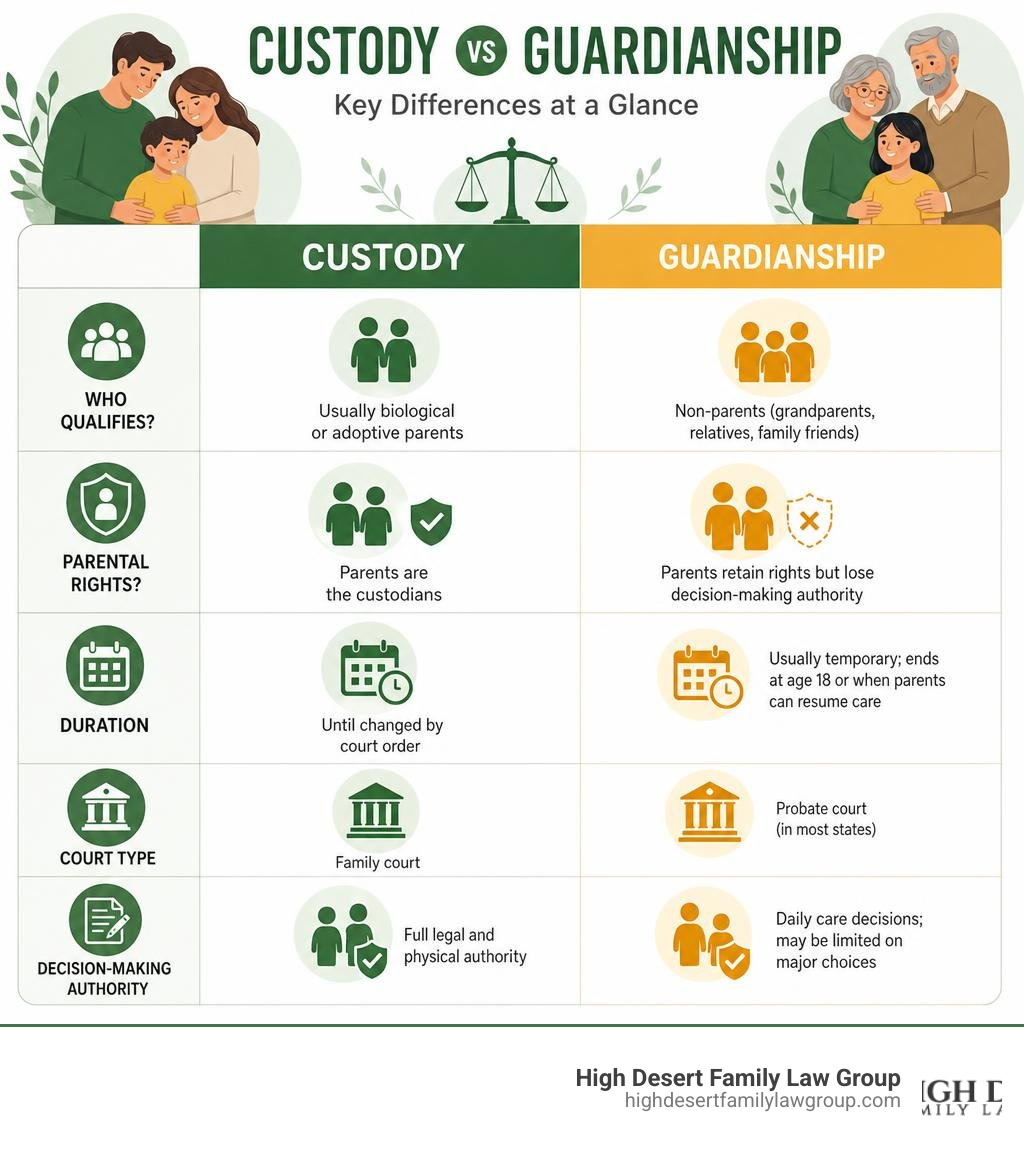
Key Differences: Custody vs Guardianship

To truly understand how these two legal concepts function, we must first look at who they are designed for. In the vast majority of family law matters in Scottsdale and Chandler, Arizona, “custody” (which Arizona legally refers to as “legal decision-making” and “parenting time”) is an arrangement between a child’s biological or adoptive parents. When parents divorce, separate, or establish paternity, the court steps in to divide these rights and responsibilities between them.
Guardianship, on the other hand, is almost always designed for non-parent caregivers. It is a legal relationship established when a child’s biological parents are unable, unfit, or unavailable to care for them. This might occur due to parental substance abuse, incarceration, severe mental health struggles, military deployment, or the tragic passing of both parents.
The differences between these two roles carry significant legal and financial consequences. To help you visualize how these paths diverge, we have compiled a detailed comparison:
| Feature | Child Custody (Legal Decision-Making & Parenting Time) | Legal Guardianship |
|---|---|---|
| Primary Parties | Biological or adoptive parents. | Non-parents (grandparents, aunts/uncles, adult siblings, family friends). |
| Court Jurisdiction | Arizona Family Court (Superior Court). | Arizona Probate Court. |
| Status of Parental Rights | Fully intact, though divided or restricted between the parents. | Suspended or limited, but not permanently terminated. |
| Financial Responsibility | Parents are fully financially responsible and may be ordered to pay child support. | Guardians must provide daily care but are typically not personally liable for the child’s financial support. |
| Duration of Order | Permanent until the child turns 18, unless modified due to a material change in circumstances. | Can be temporary (interim) or permanent, but automatically expires when the child reaches the age of majority (18). |
| Asset Management | Parents manage assets by default, though large inheritances may require a conservatorship. | A guardian of the person manages daily care; a guardian of the estate (or conservator) must manage financial assets under court supervision. |
If you want to dive deeper into the general definitions, you can Learn more about custody vs. guardianship differences to see how these concepts are treated across different legal frameworks.
In our practice at High Desert Family Law Group, we frequently help clients navigate the transition between these two frameworks. Whether you are a parent fighting to protect your parental rights or a relative stepping up to care for a child in crisis, understanding the distinction between Legal Custody vs Legal Guardianship is the first step toward securing a stable future for the child.
Legal Decision-Making: Custody vs Guardianship
One of the most common points of confusion is how much authority a caregiver actually holds under each arrangement. When a parent is awarded legal custody (legal decision-making in Arizona), they have the supreme authority to make major, life-altering decisions for the child. This includes choosing which school the child attends, selecting doctors and approving major medical procedures, and directing the child’s religious upbringing.
A guardian’s decision-making power is also broad, but it comes with unique limitations and ongoing court oversight. When the Probate Court appoints a guardian, that person receives the authority to make daily care decisions — such as enrolling the child in the local school district, taking them to regular pediatric appointments, and signing field trip permission slips.
However, because the biological parents still retain their fundamental parental rights, a guardian’s authority can sometimes be challenged. For example, if a guardian wishes to take the child out of the country, relocate to another state, or make a highly controversial medical decision, they may need to seek explicit permission from the Probate Court or get consent from the biological parents. Understanding the subtle boundaries of Legal Guardianship vs Custody ensures that caregivers do not accidentally overstep their legal bounds, which could lead to complex litigation.
Who Can Seek Custody vs Guardianship?
The pool of individuals who can legally petition for these arrangements is another major differentiator. Custody is almost exclusively the domain of biological or adoptive parents. Under Arizona law, there is a strong presumption that a child’s natural parents should share decision-making and parenting time. Even when a child is born out of wedlock, Arizona law grants automatic legal custody to the mother until paternity is legally established, after which the father can petition for his share of custody.
Guardianship is wide open to third-party caregivers. Grandparents, aunts, uncles, adult siblings, and even close family friends can petition for guardianship if they can demonstrate that the parents are currently unable to provide a safe, stable home.
This third-party option is incredibly vital today. Across the United States, approximately 2.7 million grandparents are raising their grandchildren, often through kinship guardianship or informal custody arrangements. In fact, about 1 in 5 children in the U.S. live in a household headed by a grandparent or other relative. For many of these families, establishing formal legal ties is essential. You can explore how Arizona supports these families by reading about Kinship Guardianship as a Permanency Option – Arizona, which highlights the state’s efforts to keep children out of the traditional foster care system by placing them with loving relatives.
Types of Custody and Guardianship Arrangements

Just as there is no single “one-size-fits-all” family, there is no single type of custody or guardianship. The legal system offers several distinct structures to fit different family dynamics and crises.
Types of Custody (Legal Decision-Making & Parenting Time)
- Sole Legal Decision-Making (Sole Custody): One parent has the exclusive right to make all major decisions regarding the child’s education, healthcare, and religious upbringing.
- Joint Legal Decision-Making (Joint Custody): Both parents must consult with each other and reach a mutual agreement on major decisions. Neither parent can unilaterally make a major change without the other’s consent or a court order.
- Sole Physical Custody: The child resides primarily with one parent, while the other parent typically receives designated parenting time (visitation), unless safety concerns require supervised visits.
- Joint Physical Custody: The child splits their time relatively equally between both parents’ households, requiring a highly coordinated parenting schedule.
Types of Guardianship
- Guardian of the Person: This individual is responsible for the child’s physical care, safety, housing, education, and medical decisions. They handle the hands-on, day-to-day parenting duties.
- Guardian of the Estate: This person is appointed to manage the child’s financial assets, inheritances, or property. This is often necessary if a child inherits a substantial sum of money, as minors cannot legally manage significant assets. The same person can serve as both guardian of the person and estate, or the roles can be split.
- Interim (Temporary) Guardian: Appointed in emergency situations when immediate care is needed — such as a parent’s sudden hospitalization or temporary incarceration — while a permanent solution is being litigated.
Navigating these options requires a clear legal strategy. If you are considering stepping forward to protect a child in your family, learning about the process of establishing Legal Guardianship can help you determine which specific role fits your situation.
Impact on Parental Rights and Duration
The most emotionally charged aspect of custody vs guardianship is how these arrangements impact parental rights. Many parents fear that if a relative is appointed as a guardian, they will lose their children forever.
It is vital to understand that guardianship does not terminate parental rights.
When a court appoints a guardian, the biological parents’ rights are suspended, not severed. The parents remain the legal parents of the child. They still have the right to visit the child (often under court-approved schedules), receive updates on the child’s well-being, and, crucially, they retain the obligation to pay child support. Because the parental bond remains intact, a parent can work to resolve their personal struggles — such as completing a drug rehabilitation program, securing stable housing, or addressing mental health issues — and petition the court to end the guardianship.
This is fundamentally different from adoption, which permanently and irrevocably severs the biological parents’ rights, replacing them entirely with the adoptive parents.
In terms of duration, custody arrangements are designed to be permanent, remaining in place until the child reaches the age of majority (18 in Arizona), though they can be modified if a parent can show a significant and continuing change in circumstances. Guardianships are inherently more flexible. While a permanent guardianship can last until the child turns 18, it is always subject to review. If a parent can prove they have rehabilitated their life, the court will carefully evaluate whether returning the child to the parent’s custody is safe.
If you are a parent facing this situation, you are likely asking: Does Guardianship Override Parental Rights? The answer is that while the guardianship is active, the guardian’s day-to-day decision-making authority overrides the parent’s immediate wishes. However, because the underlying parental rights are preserved, the parent always has a legal path to fight for their child. To explore this delicate balance further, read our comprehensive guide on Guardianship vs Parental Rights.
Legal Processes and Court Determinations
The legal journey to secure custody or guardianship involves entirely different courtrooms and legal standards.
If you are a parent seeking to establish or modify custody, your case will be heard in Family Court (a division of the Arizona Superior Court). These cases are typically initiated through a divorce petition, a petition to establish paternity, or a petition to modify an existing parenting plan.
If you are a relative seeking guardianship, your petition must be filed in Probate Court (or in some instances, Juvenile Court if the state’s child welfare services are involved). The probate process requires a formal petition, background checks, fingerprints, and a court hearing where the petitioner must prove that the biological parents are currently unable or unfit to care for the child.
Regardless of the court or the specific petition, the guiding light for every judge is the best interests of the child standard. The court will not make a decision based on what is most convenient for the adults; instead, they will evaluate:
- The child’s physical safety and emotional well-being.
- The stability of the proposed caregiver’s home environment.
- The child’s integration into their current school and community.
- The history of substance abuse, domestic violence, or neglect by any party.
- The child’s own wishes, if they are of sufficient age and maturity (typically 14 or older in Arizona).
Because these cases are complex and highly scrutinized, understanding the timelines is essential. Caregivers often ask How Long Does Permanent Guardianship Last and how the court defines the terms of the arrangement. While a permanent guardianship is designed to provide long-term stability, it is still legally distinct from adoption. To understand the full scope of this status, you can read about What is Permanent Guardianship and consult FindLaw’s guide on custody, guardianship, and adoption for a national perspective on how these laws intersect.
Frequently Asked Questions About Custody and Guardianship
Can a non-parent obtain custody of a child?
Yes, but the legal hurdle is exceptionally high. In Arizona, a non-parent (such as a grandparent or aunt) can petition for custody (legal decision-making and parenting time) under ARS 25-409, but they must prove they have acted as a de facto custodian.
To win this type of third-party custody case, the non-parent must show by clear and convincing evidence that it would be significantly detrimental to the child’s physical or emotional health to remain in the custody of either biological parent. Because courts strongly favor biological parents, most non-parents find that petitioning for guardianship is a more straightforward and legally viable path to secure the authority they need to care for the child. For a deeper look at how judges weigh these competing interests, see our article on Guardian vs Parent.
How do courts determine the best interests of the child?
When weighing a case involving custody vs guardianship, the court examines several statutory factors. The judge will look at the existing bond between the child and the caregiver, the caregiver’s ability to provide food, shelter, and medical care, the child’s school performance, and any history of domestic violence or drug abuse in the home.
The court’s goal is to maximize stability. If a child has been living happily with a grandparent for several years, the court will be highly hesitant to disrupt that stability unless a biological parent can demonstrate a complete, verified recovery and a safe home environment. You can read more about how these factors are weighed in our guide on Custody vs Guardianship.
Can a guardianship be revoked or changed?
Yes. Guardianship is designed to be a flexible legal tool. If a parent’s circumstances improve — for instance, if they secure stable employment, complete court-ordered rehabilitation, and establish a safe home — they can file a petition to terminate the guardianship.
The court will hold a hearing, review the parent’s progress, and determine whether terminating the guardianship and returning the child to the parent serves the child’s best interests. The guardian can also petition to resign if they are no longer physically or financially able to care for the child, prompting the court to appoint a successor guardian.
Conclusion
Navigating the legal maze of custody vs guardianship is incredibly challenging, especially when the safety and future of a child are on the line. Whether you are a parent fighting to maintain your legal decision-making rights or a dedicated grandparent stepping up to provide a safe harbor for a grandchild, you do not have to carry this heavy burden alone.
At High Desert Family Law Group, we provide aggressive, highly individualized representation for clients throughout Greater Scottsdale and Chandler, Arizona. Our tight-knit, four-person legal team works collaboratively on every case, ensuring that you receive the dedicated attention, strategic advocacy, and compassionate guidance you deserve during this critical time.
If you are ready to secure a stable, legally sound future for your family, contact us today to schedule a consultation. Let us help you find the right path forward, starting with our focused resources on Guardianship vs Custody.