



What Is a Real Estate Attorney Flat Fee — and What Does It Actually Cost?
A real estate attorney flat fee is a single, fixed price you pay for legal representation during a property transaction — no hourly clock, no billing surprises. Here is a quick snapshot of what to expect:
| State | Typical Flat Fee Range | Common Services Covered |
|---|---|---|
| New Jersey | ~$995 | Contract review, closing representation, title coordination |
| Illinois | $400 – $650 | Contract review, deed prep, title clearing, closing attendance |
| Michigan | $350 – $850 | Document review, FSBO transactions, deed drafting |
| Florida | Varies; quote-based | Document review, closing representation, title review |
| California | $1,499 – $5,000+ | FSBO facilitation, business/real estate transactions |
What a flat fee covers: attorney labor — contract review, deed preparation, title commitment review, and closing representation.
What it does not cover: title insurance, transfer taxes, recording fees, surveys, and inspections. Those are third-party costs that appear separately on your closing statement.
Real estate transactions are often the largest financial decisions people make — and the legal fees involved can feel just as confusing as the deals themselves. Understanding your costs upfront can be the difference between a smooth closing and an unexpected bill. That clarity is exactly what a flat fee structure is designed to provide. Yet many buyers and sellers still aren’t sure what a flat fee actually includes, how it compares to hourly billing, or whether it’s the right fit for their situation.
Understanding the Real Estate Attorney Flat Fee vs. Hourly Billing
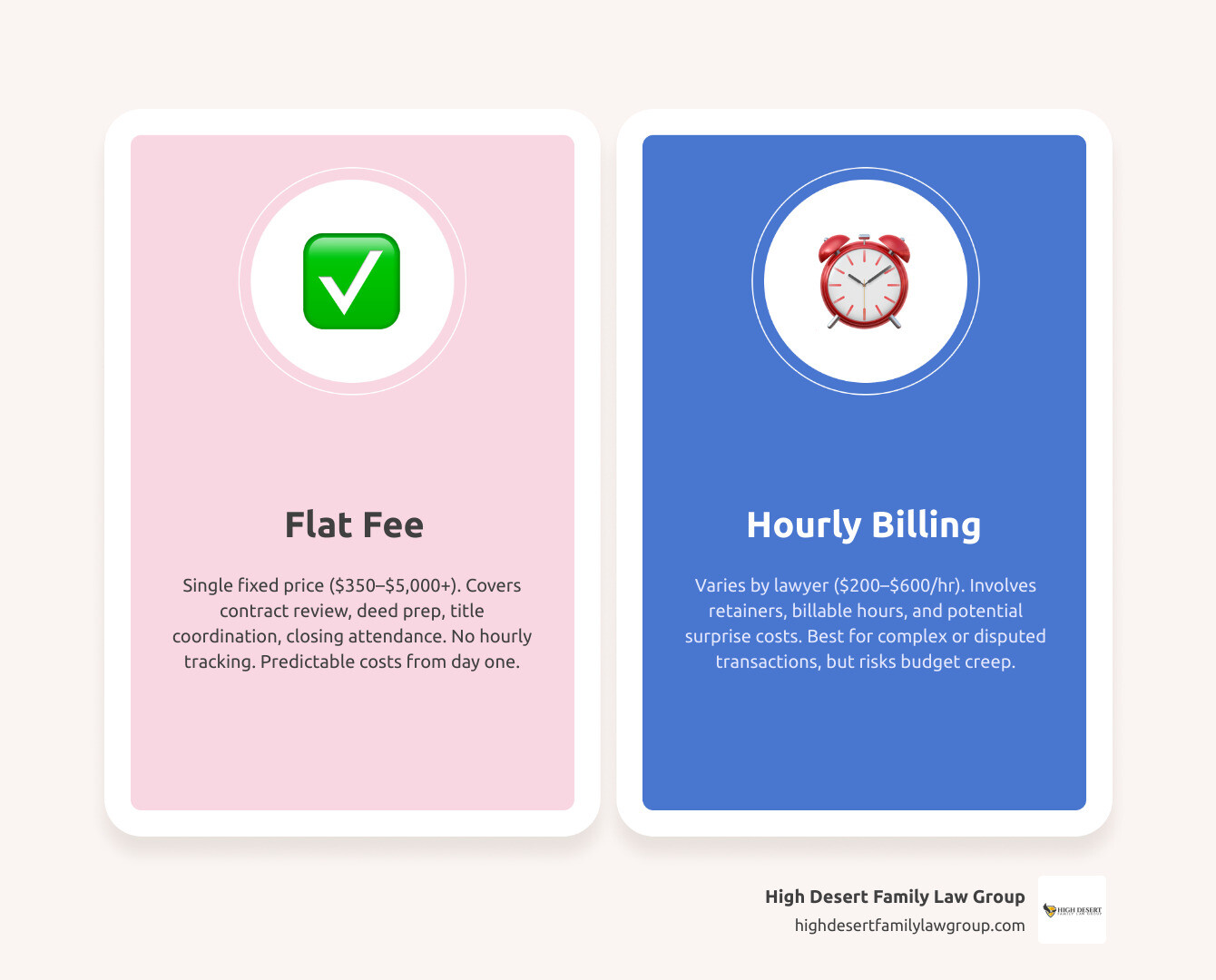
When you set out to hire a legal professional for your property transaction, the first crossroad you encounter is the billing model. Historically, law firms have billed by the hour, but the rise of the real estate attorney flat fee has completely changed the landscape for residential buyers and sellers.
Traditional hourly billing can introduce a layer of anxiety into an already stressful process. Every phone call, quick email, or text message can trigger another charge on your next statement. A flat fee, on the other hand, packages the entire scope of a standard transaction into one predictable number. This structure keeps your budget intact and helps prevent fee disputes before they can even start. If you are curious about how these rates stack up generally, you can read more about the real estate attorney cost per hour to see why so many buyers and sellers prefer a fixed rate.
How Hourly Billing Works in Real Estate
Under an hourly billing model, the attorney charges you based on the exact amount of time they spend working on your file. This time is typically tracked in six-minute increments (one-tenth of an hour).
- The Hourly Rate: Real estate lawyers often charge anywhere from $300 to $450 per hour depending on their experience and geographic market.
- The Retainer: You are usually required to pay an upfront retainer fee, which acts as a security deposit. The attorney draws their hourly fees from this account as they perform the work.
- Unpredictability: If a title issue arises, or if negotiations over home inspection repairs drag on for weeks, your billable hours can skyrocket.
Hourly billing is highly appropriate for complex commercial deals or highly customized transactions, but for standard residential purchases, it can lead to massive budget variances. For a broader look at historic and current pricing trends, check out our guide on real estate attorney cost 2024 to understand how hourly rates have evolved over the years.
The Mechanics of a Flat Fee Structure
A flat fee structure operates on simplicity. The attorney evaluates the standard transaction workflow and quotes you a single, fixed price upfront.
Under this model, the attorney’s incentives are perfectly aligned with yours: they want to complete the transaction as efficiently as possible without sacrificing quality, and you get to ask questions without worrying about a ticking clock. This model is ideal for predictable transactional work such as contract drafting, document review, and closing representation. For a deep dive into the overall structure of these fees across different markets, you can read the ultimate guide to real estate attorney fees.
What is Included (and Excluded) in a Standard Closing Flat Fee?
One of the most common points of confusion for buyers and sellers is assuming that a “flat fee” covers every single expense associated with a real estate closing. It is crucial to understand that the attorney’s flat fee covers legal labor, not the administrative, state, or municipal transactional costs.
To help clarify this distinction, let’s look at a typical workflow diagram of how a flat-fee real estate closing progresses:
As you budget for your transaction, keeping these legal fees separate from your third-party costs will give you the price of peace of mind a guide to real estate lawyer fees so you are not caught off guard at the closing table.
Typical Services Covered Under a Flat Fee
While every law firm has its own specific engagement agreement, a standard residential closing flat fee generally includes:
- Contract Review and Modifications: Examining the initial purchase contract and drafting necessary addenda or riders.
- Inspection Response: Drafting or reviewing requests for repairs or financial credits based on the home inspection report.
- Title Commitment Review: Analyzing the title search to ensure there are no active liens, judgments, or boundary disputes.
- Deed Preparation (for Sellers): Drafting the new deed and associated transfer documents.
- Closing Statement Audit: Reviewing the Closing Disclosure (CD) or settlement statement to ensure all fees, tax prorations, and loan terms are accurate.
- Closing Representation: Attending the final closing meeting to guide you through signing the loan and transfer documents.
These services ensure that your rights are protected from the moment you sign the contract to the moment you hand over the keys. If you want to know more about how these agreements are structured legally, explore our resources on real estate law purchase and sale agreements.
Third-Party Costs Excluded from Attorney Fees
Your attorney’s flat fee does not include third-party fees. These are external expenses paid to government agencies, title companies, or service providers. Examples of excluded costs include:
- Title Insurance Premiums: Paid to the title insurance company to protect against future ownership disputes.
- Transfer Taxes/Stamps: State, county, or municipal taxes levied on the transfer of real property.
- Recording Fees: Charged by the county recorder’s office to officially record the new deed and mortgage.
- Property Surveys: Fees paid to a professional surveyor to map out property boundaries.
- HOA or Condo Association Fees: Charges for obtaining transfer certificates or disclosure packages from the homeowners’ association.
How Much Do Real Estate Attorneys Charge? State-by-State Breakdown
The cost of hiring a real estate attorney varies significantly depending on where you are buying or selling property. Some states are “attorney-closing states,” where legal representation is customary or legally required, while other states primarily rely on title companies to handle escrow and settlement. For a general overview of these national differences, you can review our article on how much do real estate attorneys charge.
Average Real Estate Attorney Flat Fee Rates by State
Let’s take a closer look at how different states handle flat fees for residential closings, based on standard market rates as of July 2026:
- New Jersey: Residential closing representation for properties up to three families typically hovers around a flat fee of $995. This is a highly attorney-driven state where legal counsel is standard.
- Illinois: Flat-fee structures are incredibly popular here. You can find firms charging a straightforward flat fee of $650 for a standard residential closing (buyer or seller), such as those detailed on the $650 Flat Fee — What’s Included | Lysinski page or the broader Pricing — Flat Fees + Transparent Rates | Lysinski menu. Some firms in the Chicago area charge $400 to $500 for sellers, sometimes offsetting these costs through discounted title fees.
- Florida: Flat fees vary depending on the complexity of the deal. While some firms offer quote-based services, others utilize modern structures like the JD Woods Law PLC — Florida Flat-Fee Attorney | AI-Enhanced Legal Services model, which uses technology to offer fast, affordable document reviews and flat-fee estate plans starting around $799. For those selling independently, services like the $99 Flat Fee MLS Listing | Affordable MLS Service FL |Attorneys Realty provide basic DIY MLS access, with transaction management options available.
- Michigan: Firms like Ager Law Office offer incredibly transparent, itemized flat fees starting at $350 for basic document review, $450 for a combined document review package, and $850 for managing a complete “For Sale by Owner” (FSBO) transaction.
- California: Because of the high property values and complexity, flat-fee real estate services often start higher. Standard business formations or basic property transactions can start around $1,499 to $1,500, as shown on the Flat Fee Legal Services | page, while full FSBO facilitation can start around $5,000.
Specialized Flat Fee Services and Deed Transfers
You do not always need an attorney for a full closing; sometimes, you just need help with a specific property-related task. Flat fees are highly common for these specialized administrative services:
- Deed Transfers: If you need to add a spouse to a title, remove an ex-spouse after a divorce, or transfer property into a living trust, flat-fee options are highly efficient. For example, Flat Law Fees offers property deed transfers for a flat fee of $750 plus recording costs.
- Quitclaim Deeds: These are commonly used for simple transfers between family members or into trusts, with drafting fees often ranging from $175 to $350 depending on the firm.
Pros and Cons of Flat Fee Billing for Real Estate Transactions
Like any business arrangement, a real estate attorney flat fee has its own set of advantages and disadvantages. While it is overwhelmingly popular for residential buyers and sellers, it is important to weigh both sides before signing an engagement agreement. If you are trying to decide which fee structure aligns with your financial goals, our article on real estate attorney cost offers helpful guidance.
Benefits of Flat Fees for Buyers and Sellers
- Financial Predictability: You know exactly what your legal costs will be from day one, allowing you to budget your closing costs down to the penny.
- Unlimited Communication: Because you aren’t being billed by the minute, you can call or email your attorney with questions whenever they arise, fostering a healthier attorney-client relationship.
- Aligned Incentives: The attorney is incentivized to work efficiently and resolve issues quickly, rather than dragging out negotiations to bill more hours.
When an Hourly Rate or Different Pricing is Necessary
While flat fees are fantastic for standard transactions, they are not designed to cover every scenario. An hourly rate or a customized fee structure is usually necessary when a transaction becomes unpredictable:
- Active Title Disputes: If a neighbor claims ownership over a portion of your yard, resolving that dispute requires extensive research and negotiation.
- Real Estate Litigation: If a buyer or seller breaches the contract and you have to go to court, litigation is always billed hourly.
- Commercial Real Estate Deals: Commercial transactions involve unique zoning, environmental, and leasing issues that make them too complex for standard flat fees.
For these unpredictable matters, you will want an experienced attorney who can guide you through the process under an hourly model. You can read more about how these complex disputes are handled in our guide to real estate law analyzing and litigating real estate disputes.
Navigating the Closing Process: Attorney Review and Representation
In many real estate markets, the transaction officially begins with a phase known as the “attorney review period.” In states like New Jersey, for instance, there is a mandatory three-day attorney review window. During this time, either the buyer’s or the seller’s attorney can disapprove the contract prepared by the real estate agents, propose modifications, or cancel the deal entirely without penalty.
Having a flat-fee attorney on your side during this crucial window ensures that your contract is tailored to protect your specific interests before it becomes legally binding. This is just one of the many ways legal counsel protects you throughout the transaction. To understand how these laws govern your property rights, check out our comprehensive overview of real estate law.
Do I Need an Attorney or Can I Rely on a Title Company?
A common question among buyers and sellers is: “Why should I pay for an attorney when I’m already paying a title company or a real estate agent?”
While real estate agents and title officers are crucial parts of the transaction team, their roles are fundamentally different from an attorney’s:
- Real Estate Agents: Agents are typically paid on commission. Their primary goal is to successfully close the transaction. They cannot give you legal advice or draft custom legal language if a unique problem arises.
- Title Companies: Title agents represent the title insurance underwriter. Their job is to ensure that the title is clear enough to issue an insurance policy. They do not represent you, and they cannot advocate for your best interests if a dispute occurs between you and the other party.
- Real Estate Attorneys: An attorney is bound by ethical rules to represent only your interests. They are there to identify legal loopholes, protect your earnest money deposit, and ensure you do not inherit hidden liabilities with the property.
How to Choose a Flat Fee Attorney and Avoid Surprise Charges
To ensure a smooth experience, it is vital to choose a reputable attorney and thoroughly review your fee agreement before any work begins. A well-written agreement prevents “scope creep” — which occurs when a standard transaction becomes slightly more complex, and the attorney tries to charge extra fees without your prior consent. If you are entering into a property transaction with partners or co-investors, you may also want to review our insights on real estate partnerships.
Red Flags to Avoid in a Real Estate Attorney Flat Fee Agreement
When reviewing a flat fee agreement, watch out for these common warning signs:
- Vague Scope of Work: The agreement should explicitly list what is included (e.g., “up to two contract modifications, review of title commitment, and attendance at closing”). If the scope is too vague, the attorney may claim a standard task is “out of scope” and bill you extra.
- Hidden Title Fee Markups: Some attorneys offer a very low flat fee but make up for it by charging inflated administrative fees on behalf of the title company they partner with. Ask for a full breakdown of all estimated closing costs upfront.
- Communication Caps: Beware of agreements that limit the number of phone calls or emails you are allowed before hourly rates kick in. A true flat fee should encourage open communication.
- Vague Hourly Triggers: Ensure the agreement clearly defines exactly what triggers an hourly rate (such as active litigation) so you aren’t surprised by an hourly bill for a standard negotiation.
Frequently Asked Questions about Real Estate Attorney Flat Fees
What happens to the flat fee if the real estate transaction falls through before closing?
This depends entirely on your specific agreement. Some attorneys charge a prorated amount for the work they completed up to the point of cancellation (e.g., contract review and inspection negotiations). Other firms may hold your flat fee in a trust account and apply it to your next transaction if you find another property. Always ask your attorney about their cancellation policy before hiring them.
Can a flat fee attorney represent both the buyer and the seller in the same transaction?
Generally, no. Representing both parties in a real estate transaction presents an inherent conflict of interest. The buyer wants the lowest price and maximum repairs, while the seller wants the highest price and no repair obligations. An attorney cannot ethically provide full, aggressive representation to both sides of the same deal.
How do flat fees work when dividing real estate during a divorce?
When a married couple divorces, the family home is often their most valuable joint asset. Dividing or selling this property requires careful legal coordination. While a family law attorney manages the divorce settlement and division of assets, a real estate attorney is often brought in to handle the actual property transfer or sale.
In these cases, a flat fee is highly beneficial. It allows the separating spouses to know the exact cost of drafting quitclaim deeds, transferring titles, or facilitating the sale of the home, keeping additional legal expenses predictable during an already stressful life transition.
Conclusion
Navigating a property transaction can feel overwhelming, but understanding your legal costs shouldn’t be. Choosing a real estate attorney flat fee model gives you the transparency and budget predictability you need to move forward with confidence.
At High Desert Family Law Group, we understand that real estate is often deeply connected to major life transitions. Whether you are navigating a divorce, dividing marital assets, or restructuring your property holdings in the Greater Scottsdale and Chandler, Arizona areas, our dedicated team is here to provide aggressive, individualized representation. We can help you understand the true real estate attorney cost and ensure your assets are fully protected every step of the way. Contact us today to learn how we can bring clarity and peace of mind to your legal journey.