



Divorce Mediation Scottsdale: Attorney-Led Guide 2026

For most Scottsdale couples, divorce mediation is the faster, less expensive, and more private alternative to courtroom litigation. Attorney-led mediation lets both spouses work through child custody, support, property division, and parenting plans with a neutral facilitator who understands Arizona family law — and everything discussed stays off the public record. If you and your spouse can communicate, even imperfectly, mediation is almost certainly worth exploring before you file for contested divorce.
Before your first session, pull together your financial documents and review the divorce mediation checklist from Highdesertfamilylawgroup. Then schedule a consultation to confirm whether your case is a good fit.
What mediation typically covers in Scottsdale:
- Child custody arrangements and legal decision-making
- Parenting-time schedules and holiday plans
- Child support calculations
- Spousal maintenance (alimony)
- Division of community property and separate assets
- Debt allocation and credit account resolution
- Retirement account splits and tax considerations
- Post-judgment modifications when circumstances change
Table of Contents
- What can Scottsdale divorce mediation actually resolve?
- How does the Scottsdale mediation process work, step by step?
- How do you choose the right Scottsdale divorce mediator?
- Who benefits from mediation, and when is it not the right choice?
- Why Highdesertfamilylawgroup for divorce mediation in Scottsdale
- Key Takeaways
- What attorney-led mediation actually looks like in practice
- Ready to start? Here is how to book with Highdesertfamilylawgroup
- Useful sources for deeper preparation
What can Scottsdale divorce mediation actually resolve?
The short answer: nearly every issue a judge would decide, with one key difference: you and your spouse make the decisions, not the court.
Child custody and parenting plans. Arizona courts distinguish between legal decision-making (who decides on education, healthcare, religion) and parenting time (the physical schedule). Mediation produces a detailed parenting plan that both parents sign off on, which a judge then incorporates into the final decree. Parents who negotiate their own plan tend to follow it more consistently than one imposed by a court.

Child support. Arizona uses an income-shares formula, so the numbers are largely driven by each parent’s income and the parenting-time split. A mediator can walk both parties through the calculation and help them agree on deviations — for example, covering private school tuition or extraordinary medical expenses.
Spousal maintenance. Duration and amount are negotiable in mediation. Couples with complex income structures, business ownership, or significant earning-capacity gaps often find mediation more flexible than litigation, where a judge applies statutory factors with less room for creative structuring.
Property and debt division. Community property, separate property, the family home, investment accounts, and business interests can all be addressed. When asset values are disputed, a financial neutral (forensic accountant or appraiser) can be brought into sessions early to prevent late surprises and preserve the negotiated settlement.
Retirement accounts. Dividing a 401(k) or pension requires a Qualified Domestic Relations Order (QDRO). A mediator with family-law experience will flag this requirement and ensure the agreement includes the right language so the QDRO can be drafted correctly after signing.
Mediation can also produce partial agreements — resolving custody and support while leaving a disputed business valuation to a separate process. Anything the parties cannot resolve in mediation can proceed to arbitration or litigation on those specific issues only, which keeps costs lower than full-scale courtroom divorce.
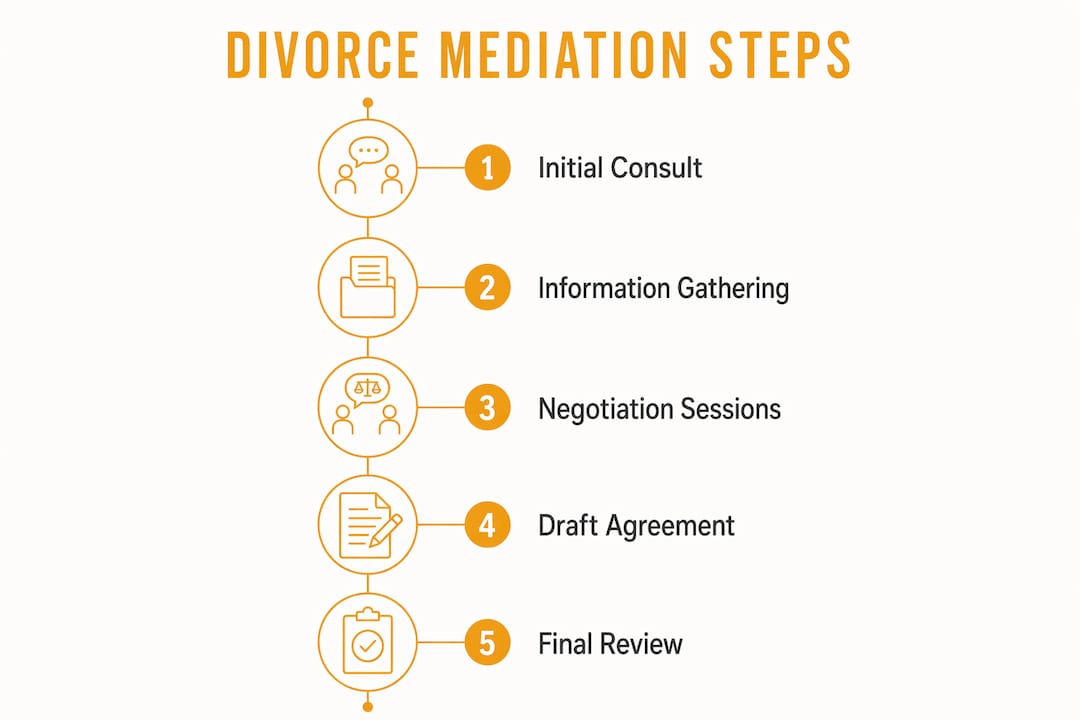
How does the Scottsdale mediation process work, step by step?
The mediated divorce process follows a clear sequence. Knowing what comes next removes most of the anxiety.
- Initial consultation. You meet with the mediator (or the firm’s intake team) to discuss your situation, confirm mediation is appropriate, and review the engagement agreement. This is also when you ask about the mediator’s background, process, and estimated timeline.
- Financial and parenting disclosures. Both spouses exchange mandatory financial disclosures: tax returns, pay stubs, bank statements, retirement account statements, property valuations, and a complete list of debts. Skipping or delaying this step is the single most common reason mediation stalls.
- Joint or shuttle sessions. Most Scottsdale mediations use joint sessions where both spouses sit at the table (in person or virtually). When communication is tense, shuttle mediation keeps the parties in separate rooms while the mediator moves between them. AAA family mediation programs use a similar structured approach for complex family disputes.
- Issue-by-issue negotiation. The mediator guides discussion through each topic — parenting plan first, then financial issues, or in whatever order makes sense for the case. Sessions typically run two to three hours.
- Drafting the mediated agreement. Once both parties reach agreement on all issues, the mediator (or a drafting attorney) prepares a written Mediated Settlement Agreement. This document becomes the basis for the Consent Decree of Dissolution filed with the Maricopa County Superior Court.
- Signing and filing. Both spouses review, sign, and submit the agreement. The court reviews it for compliance with Arizona law and, if approved, enters the final decree.
How long does it take?
Straightforward cases with cooperative parties and clear assets often wrap up in a few sessions over four to eight weeks. Complex cases involving business valuations, high-net-worth assets, or contested parenting issues may take three to six months. Either timeline is typically shorter than contested litigation, which routinely runs a year or more in Maricopa County.

| Case Type | Typical Sessions | Estimated Timeline |
|---|---|---|
| Simple (no minor children, clear assets) | a few sessions | several weeks |
| Moderate (children, standard assets) | multiple sessions | a few months |
| Complex (business, high-net-worth, contested custody) | many sessions | several months |
Confidentiality is one of mediation’s most underrated advantages. Everything said in sessions is protected under Arizona’s mediation confidentiality statutes and cannot be used as evidence if the case later goes to court. Compare that to depositions and court hearings, which are public record. For executives, business owners, and professionals in Scottsdale, that privacy protection alone often justifies the process.
Pro Tip: Bring a consulting attorney to review the draft agreement before you sign, even if you did not have an attorney at the table during sessions. A one-hour review by a family-law attorney costs far less than discovering a drafting error after the decree is entered.
If mediation breaks down entirely, you have options: when mediation breaks down, parties can pursue hybrid mediation (resolving some issues by agreement and litigating the rest), binding arbitration, or full litigation. Partial agreements reached in mediation are still enforceable, so the time spent is rarely wasted.
How do you choose the right Scottsdale divorce mediator?
Not all mediators are equal, and the wrong choice costs you time and money.
Credentials and experience to look for
- JD and active Arizona bar license. An attorney-mediator understands how Maricopa County judges apply Arizona family law, which matters when drafting enforceable agreements.
- Dedicated family-law experience. General civil mediators may lack the depth to handle QDROs, business valuations, or complex parenting disputes.
- Mediation training and certification. Look for formal mediation training beyond a weekend course — organizations like the AAA maintain panels with vetted credentials.
- Financial expertise or access to neutrals. For high-asset cases, the mediator should either have forensic accounting knowledge or a working relationship with financial neutrals.
Fee structures and who pays
Private mediation fees in Arizona depend on the mediator’s hourly rate and the number of sessions required. Many cases cost less per party in total mediation fees than contested litigation. Court-sponsored programs set fees on an income-based scale, but they are available only when a judge refers the case. For most Scottsdale couples, private mediation offers more scheduling flexibility and confidentiality than a court program. Fees are typically split equally between the parties, though the split is negotiable. Review mediation cost expectations before your first call so you can ask the right questions.
Questions to ask in your first consult
- Are you a licensed Arizona attorney?
- How many family-law mediations have you completed in the past two years?
- Do you handle cases with business interests or retirement accounts?
- Who drafts the final agreement — you or the parties’ attorneys?
- What is your hourly rate, and what is a realistic total cost for a case like mine?
- Do you offer virtual sessions?
- What is your cancellation and rescheduling policy?
- How do you handle a situation where one party is not fully disclosing assets?
- What happens if we reach an impasse on one issue?
- Can I have a consulting attorney review the draft before I sign?
Red flags to watch
- The mediator offers legal advice to one party during sessions.
- You are pressured to sign before completing financial disclosures.
- The mediator has no family-law background and no access to financial experts.
- Sessions are rushed, with no time to review documents before agreeing.
- The mediator cannot explain how the agreement will be filed with the court.
Preparing emotionally matters as much as preparing legally. Reviewing conflict-resolution strategies before sessions can reduce escalation and help both parties stay focused on outcomes rather than grievances.
Who benefits from mediation, and when is it not the right choice?
Mediation works best when both spouses are willing to negotiate in good faith. That does not require a friendly relationship — it requires a basic commitment to reaching an agreement.
Good candidates for mediation:
- Couples who want to keep financial details out of the public court record
- Parents who want control over their own parenting plan rather than a judge’s order
- Spouses with significant assets who want to protect family wealth from prolonged litigation costs
- Couples seeking a faster resolution than the Maricopa County court calendar allows
- Self-represented parties who want a structured process with legal oversight
When mediation is not appropriate:
- Active domestic violence or a history of coercion — mediation requires voluntary, equal participation, and a power imbalance undermines that entirely
- One spouse refuses to provide complete financial disclosure
- Severe mental health or substance abuse issues that prevent meaningful negotiation
- One party has already hidden assets or transferred property to avoid division
- A protective order is in place between the parties
Pro Tip: If you have safety concerns but still want to explore mediation, ask the mediator about shuttle mediation (separate rooms, no direct contact) and whether a safety screening protocol is in place before you commit to joint sessions.
For couples unsure whether their situation qualifies, the is mediation worth it page from Highdesertfamilylawgroup walks through the tradeoffs honestly. A brief consultation with a family-law attorney before starting mediation can also clarify whether your case has any issues that need legal protection first.
Why Highdesertfamilylawgroup for divorce mediation in Scottsdale
Highdesertfamilylawgroup brings more than 20 years of Arizona family-law experience to every mediation. The firm’s mediators are licensed attorneys who know how Maricopa County courts apply state law — which means the agreements they help draft are built to hold up, not get kicked back by a judge.
What the firm offers in mediation:
- Attorney-led mediation with full JD credentials and active Arizona bar membership
- Financial analysis support and coordination with forensic experts for high-asset cases
- Parenting-plan drafting tailored to the specific needs of Scottsdale families
- Court-ready agreement preparation and filing assistance
- Private, confidential sessions available in person or virtually
- Free initial consultation to assess fit and scope
The firm has handled thousands of family-law cases across Scottsdale and the greater Phoenix area, including high-net-worth divorces, complex custody disputes, and business-interest divisions. That local court familiarity matters when drafting language that a Maricopa County judge will approve without revision.
Key Takeaways
Attorney-led divorce mediation in Scottsdale resolves custody, support, and property issues faster, more privately, and at lower cost than contested litigation — making it the right first step for most Scottsdale couples.
| Point | Details |
|---|---|
| Mediation covers all core issues | Custody, parenting plans, support, property, debt, and retirement accounts can all be resolved in mediation. |
| Timeline is shorter than litigation | Straightforward cases typically close within a few weeks; complex cases can take several months. |
| Confidentiality is a legal protection | Arizona statutes protect mediation communications from use as court evidence. |
| Cost is typically lower per party | Many private mediations cost under $10,000 per party, compared to contested litigation. |
| Highdesertfamilylawgroup | Attorney-led mediation with 20+ years of Scottsdale family-law experience and a free initial consultation. |
What attorney-led mediation actually looks like in practice
Most people walk into a first mediation consultation expecting a legal argument. What they find instead is a structured conversation focused on facts, priorities, and workable outcomes. That shift surprises a lot of clients — and it is exactly where attorney-led mediation earns its value.
A mediator who is also a family-law attorney does something a pure facilitator cannot: they spot the legal landmines before both parties step on them. A parenting plan that ignores Arizona’s legal decision-making statute, or a property settlement that mishandles a community-property business interest, will cause problems long after the decree is signed. Having that legal lens in the room prevents agreements that feel good on the day but fall apart in enforcement.
What clients most often overlook is preparation. The parties who get the most out of mediation come in with organized financials, a clear sense of their priorities, and some emotional groundwork already done. Reviewing pre-separation steps before your first session is not just emotional preparation — it is strategic. Knowing what you need versus what you want is the difference between a productive session and a stalled one.
Ready to start? Here is how to book with Highdesertfamilylawgroup
Highdesertfamilylawgroup offers a free initial consultation to assess whether mediation fits your situation. The consultation covers your case overview, the issues likely to be addressed, a realistic timeline, and an honest estimate of total cost. You do not need to have everything figured out before you call.

To prepare, gather your most recent tax returns, pay stubs, bank and retirement account statements, and any existing court orders. The firm’s divorce mediation checklist walks you through exactly what to bring. For a detailed breakdown of what mediation typically costs in Arizona, the divorce mediation cost page gives you realistic ranges before you commit to anything.
Book your consultation directly at Highdesertfamilylawgroup by phone or through the online contact form. Most clients leave the first session with a clear picture of next steps and a realistic path to resolution — without setting foot in a courtroom.
Useful sources for deeper preparation
These resources support the points covered above and give you a solid foundation before your first mediation session.
- Highdesertfamilylawgroup — Divorce Mediation Checklist: A practical document list and step-by-step prep guide specific to Scottsdale practice. Start here before your first consult.
- Highdesertfamilylawgroup — How Long Does Divorce Mediation Take: Local timeline guidance with session estimates for straightforward and complex cases.
- Highdesertfamilylawgroup — Is Mediation Worth It?: An honest breakdown of when mediation makes sense and when litigation is the better path.
- AAA Family Mediation Services: Overview of structured family mediation processes, mediator qualifications, and what to expect from a formal panel program.
- MindShift Psychological Center — Conflict Resolution: Practical communication strategies to reduce escalation before and during mediation sessions.
| Resource | Best For |
|---|---|
| HDFG Mediation Checklist | Document prep and pre-session readiness |
| HDFG Timeline Guide | Setting realistic expectations for your case |
| HDFG Is Mediation Worth It? | Deciding between mediation and litigation |
| AAA Family Mediation | Understanding structured mediator selection and process |
| MindShift Conflict Resolution | Communication prep to improve session outcomes |
This article provides general information about divorce mediation in Arizona and is not legal advice. Consult a licensed Arizona family-law attorney to evaluate your specific situation before making any decisions.