



Arizona Parenting Plan: What Every Parent Must Know

Every Arizona parenting plan must include the eight mandatory elements set out in A.R.S. § 25-403.02 and provide a practical parenting-time schedule the court can actually enforce. Two things you can do right now: download the Maricopa Superior Court parenting plan form (DRCVG11f) and draft a schedule with exact days, times, and exchange locations. Courts reject vague plans. Specificity is what gets a plan approved.
Table of Contents
- What your Arizona parenting plan must include by law
- How to draft a practical parenting-time schedule
- Official templates and sample parenting-plan examples
- How to file a parenting plan in Arizona
- What Arizona courts consider when approving or changing a parenting plan
- How to modify or enforce a parenting plan in Arizona
- When to hire an Arizona family law attorney
- Key Takeaways
- What most parents get wrong when drafting a parenting plan
- Highdesertfamilylawgroup helps Arizona parents get parenting plans right
- Authoritative sources and official forms
What your Arizona parenting plan must include by law
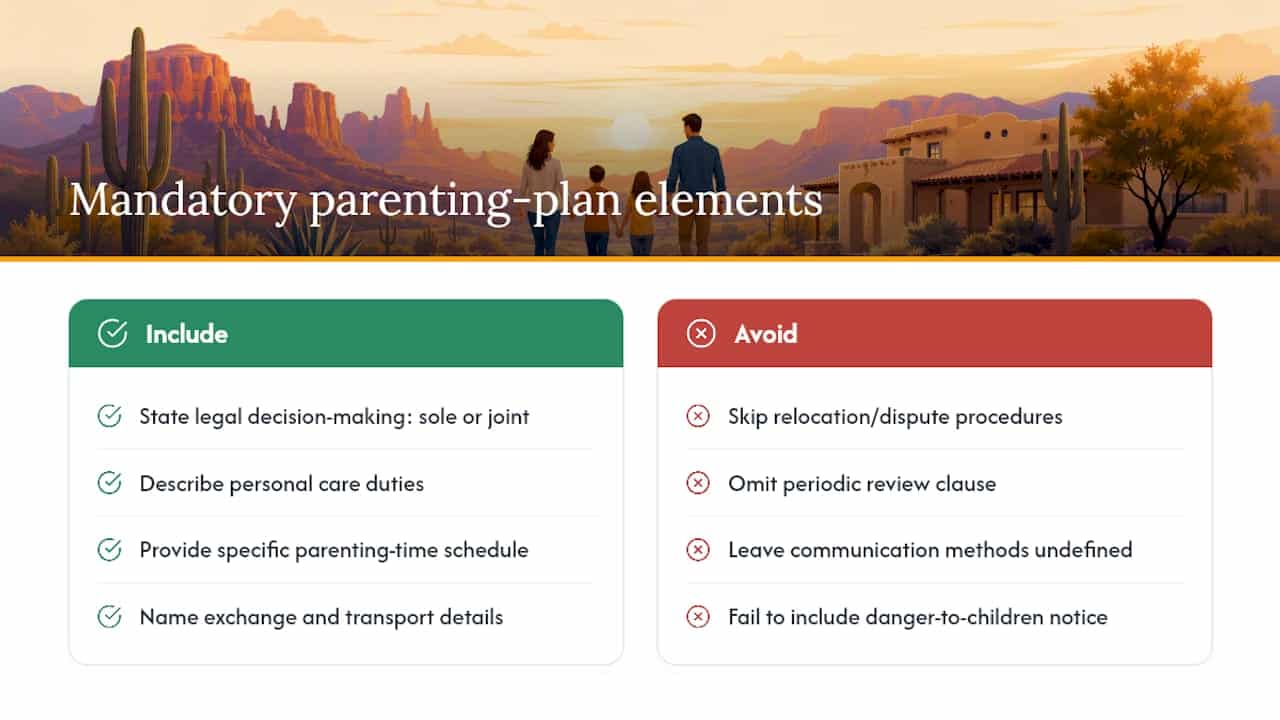
A.R.S. § 25-403.02© lists eight elements that every Arizona parenting plan must contain. Miss any one of them and a judge will send the plan back. Here is each element explained, with example language you can adapt.
1. Designation of legal decision-making
State whether legal decision-making is sole (one parent decides) or joint (both parents decide together). Example: “The parties shall share joint legal decision-making for all major decisions regarding the child’s education, non-emergency medical care, and religious upbringing.”
2. Rights and responsibilities for personal care
Spell out each parent’s day-to-day responsibilities during their parenting time: who handles school pickups, medical appointments, extracurricular activities. Example: “Each parent is responsible for the child’s daily care, supervision, and routine medical decisions during their respective parenting time.”
3. A practical parenting-time schedule
This is the heart of the plan. The schedule must be specific enough to be enforced without a judge’s interpretation. Exact days, times, and locations matter. See Section 3 for full schedule formats and sample language.
4. Exchange and transportation procedures
Name who transports the child, where exchanges happen, and what time. Example: “The receiving parent shall be responsible for transportation at all exchanges. Exchanges shall occur at [specific address or neutral location] at 6:00 PM.”
5. Relocation and dispute-resolution procedures
Address what happens if a parent wants to move and how disagreements about the plan will be resolved. Example: “Any proposed relocation of more than 100 miles shall be governed by A.R.S. § 25-408. Disputes shall first be submitted to mediation before either party may file a motion.”
6. Periodic review
Build in a checkpoint. Plans for younger children especially benefit from a formal review as the child’s needs change. Example: “The parties agree to review this parenting plan every 12 months and to negotiate in good faith any modifications warranted by the child’s changing needs.”
7. Communication methods
Define how parents will communicate with each other and how the child can contact the non-residential parent. Example: “The parents shall communicate by email or a co-parenting app. The child may contact the non-residential parent by phone or video call each evening between 7:00 PM and 8:00 PM.”
8. Danger-to-children notification
Under A.R.S. § 25-403.05(B), the plan must include a statement that both parties understand and will comply with the statutory notification requirement. This applies when a convicted or registered sex offender, or a person convicted of a dangerous crime against children, may have access to the child. The Maricopa County form includes a pre-drafted clause for this element.
Pro Tip: Joint legal decision-making and equal parenting time are two separate things under Arizona law. A.R.S. § 25-403.02(E) explicitly states that shared legal decision-making does not automatically mean equal time. A court can order joint decision-making while awarding one parent significantly more parenting time if that serves the child’s best interests. Confusing the two is one of the most common mistakes parents make when drafting a plan.
How to draft a practical parenting-time schedule
A “practical schedule” under Arizona law means one specific enough to be followed without calling a lawyer every time a question comes up. That means named days, clock times, and physical exchange locations, not just “alternating weekends.”
Common schedule formats
| Schedule | How it works | Best for | Watch out for |
|---|---|---|---|
| Alternate-week (7/7) | Child spends one full week with each parent | School-age children with stable routines | Long gaps from one parent; harder for very young children |
| 2-2-3 rotating | Two days with Parent A, two with Parent B, three with Parent A, then flip | Younger children who need frequent contact with both parents | Complex to track; requires good co-parent communication |
| Week-on/week-off with midweek visit | Primary week with one parent plus one midweek overnight with the other | Children who need consistency but benefit from midweek contact | Transportation burden if parents live far apart |
| Primary/secondary (e.g., 5/2) | Child lives primarily with one parent; other parent has every other weekend plus one weekday | High-conflict situations or when parents live in different school districts | Less time for secondary parent; may need adjustment as child ages |
The AFCC’s “Planning for Parenting Time” guide recommends age-appropriate schedules, noting that predictability and cooperation reduce conflict more than any particular time-split. For infants and toddlers, shorter, more frequent exchanges tend to work better than long stretches. For teenagers, flexibility around their social and academic schedules often matters more than rigid rotation.
Sample clause language
Copy and adapt these for your plan:
Weekday/weekend:
“During the school year, the child shall reside with Parent A Sunday evening through Friday morning. Parent B shall have parenting time from Friday at 3:00 PM through Sunday at 6:00 PM on alternating weekends.”
Summer:
“During summer break, the parties shall have extended parenting time periods to be selected and coordinated annually by mutual agreement to accommodate the child’s needs and parental preferences.”
Holidays:
“Holidays shall be divided as follows: Parent A shall have the child on Thanksgiving in odd-numbered years and Christmas Day in even-numbered years. Parent B shall have the opposite. Holiday schedules take precedence over the regular rotation.”
Exchanges:
“All exchanges shall occur at [neutral location, e.g., child’s school or a named public parking lot] at the times specified above. If a parent is more than 15 minutes late, the other parent may return home and the missed time is forfeited unless the parties agree otherwise in writing.”
Specificity in a parenting schedule is not just a legal formality. It is the single most effective way to reduce post-divorce conflict. When both parents know exactly what the plan says, there is less room for interpretation and less reason to argue. Vague language like “reasonable parenting time” or “alternating weekends” almost always ends up back in court.
Pro Tip: For children under three, consider shorter, more frequent exchanges rather than week-long blocks. The AFCC parenting-time guidance recommends schedules that maintain attachment with both parents while minimizing the stress of long separations. As the child grows, the plan can be reviewed and adjusted.
Official templates and sample parenting-plan examples
Arizona courts provide official forms, and using them matters. A custom-drafted plan that omits a required field or uses non-standard language can delay approval. Here is what is available and where to find it.
Official forms and resources:
- Maricopa Superior Court parenting plan form (DRCVG11f): The primary fillable PDF for Maricopa County. It walks parents through every required element with structured fields and pre-drafted language for the danger-to-children notification. Download it directly from the Maricopa Superior Court parenting plan form.
- Maricopa County parenting plan packet (DRV1Z / DRCVG12h): A more detailed packet that includes prompts for school-year schedules, summer schedules, exchange logistics, and periodic review language. The full packet is the better starting point if your situation is at all complex.
- AZCourtHelp sample plans: The AZCourtHelp parenting plan examples page hosts multiple sample plans, including Plan 12, with explicit time-sharing examples that parents and mediators use as starting points.
- AZ Courts Self-Service Center: The AZ Courts Self-Service Center provides filing instructions and links to family law forms for all Arizona counties, not just Maricopa.
Filled-example snippet (joint decision-making with holiday schedule):
“The parties shall share joint legal decision-making for all major decisions regarding the minor child, including education, non-emergency medical care, and religious upbringing. Neither parent shall make unilateral decisions on these matters without first consulting the other parent and making a good-faith effort to reach agreement. In the event of a disagreement, the parties shall submit the dispute to mediation before seeking court intervention.
Holiday schedule: Mother shall have the child for Thanksgiving in even-numbered years; Father shall have the child for Thanksgiving in odd-numbered years. Christmas Eve shall be with Father from December 24 at 3:00 PM through December 25 at 10:00 AM in even-numbered years, with the schedule reversing in odd-numbered years.”
Custom calendar vs. embedded language: For straightforward schedules, embedding the language directly in the form fields is usually sufficient. For complex arrangements (multiple children with different schedules, long-distance parents, or irregular work shifts), attach a custom calendar as an exhibit and reference it in the form: “See Exhibit A, attached hereto and incorporated by reference.” Courts in Maricopa County accept this approach.
How to file a parenting plan in Arizona
Residency and jurisdiction requirements
Before you file, confirm Arizona has jurisdiction. Under UCCJEA guidance from the AZ Courts Self-Service Center, the child must have lived in Arizona for at least six months before a court can exercise jurisdiction over child-related matters. For the divorce itself, one spouse must have been an Arizona resident for at least 90 days before filing. If your child recently moved to Arizona, you may need to wait before the court can act on custody.
Where to file
File in the Superior Court of the county where you live. Maricopa County residents file at the Maricopa Superior Court. Each county has its own parenting-plan packet, and form versions change. Always download the current PDF from the court’s website the day you plan to file, not a version you saved months ago.
Step-by-step filing checklist
- Download the current forms — Get the parenting plan form and any required cover sheets from your county’s Superior Court website.
- Complete every field — Leave nothing blank. Courts return incomplete forms.
- Serve the other parent — After filing, the other parent must be formally served with the filed documents. Service rules are governed by the Arizona Rules of Family Law Procedure.
Mediation and conciliation
If you and the other parent cannot agree on a parenting plan, most Arizona counties require mediation or conciliation before a contested hearing. Maricopa County’s Conciliation Services offers court-connected mediation. Divorce mediation can resolve schedule disputes faster and at lower cost than a full hearing. If mediation fails, each parent must file a proposed parenting plan and the court will decide.
For parents filing a divorce alongside the parenting plan, the Arizona divorce filing guide covers the full procedural sequence.
What Arizona courts consider when approving or changing a parenting plan
The best-interests standard
Every custody decision in Arizona turns on the child’s best interests. A.R.S. § 25-403 lists the factors courts must consider. The main ones:
- The past, present, and potential future relationship between the child and each parent
- The interaction and interrelationship of the child with parents, siblings, and others who may significantly affect the child’s best interests
- The child’s adjustment to home, school, and community
- The mental and physical health of all individuals involved
- Which parent is more likely to allow the child frequent, meaningful, and continuing contact with the other parent
- Whether one parent has provided primary care of the child
- The nature and extent of coercion or duress used by a parent in obtaining an agreement
- Whether either parent has complied with Chapter 3, Article 5 (domestic relations education)
- The child’s wishes, if the child is of suitable age and maturity
On that last point: Arizona courts do not set a specific age at which a child’s preference controls. A judge considers the child’s maturity and the reasons behind the preference. For more on how courts handle this, see does a child speak at a custody hearing in Arizona.
How judges document their findings
In contested cases, the court must make specific findings on the record for each best-interests factor. A detailed, well-drafted parenting plan makes this easier for the judge and harder for the other side to attack. Vague plans invite judicial rewriting, which rarely satisfies either parent.
Documenting your case
Collect and organize: school records showing each parent’s involvement, medical appointment logs, communication records (texts, emails, co-parenting app messages), and any witness statements from teachers or coaches. If you are raising safety concerns, police reports, protective orders, and documentation of substance abuse treatment are all relevant.
Domestic violence and safety concerns
When domestic violence is alleged, the analysis shifts significantly. Arizona law creates a rebuttable presumption against awarding legal decision-making or parenting time to a parent who has committed domestic violence. The court must make specific findings before overcoming that presumption. Safety concerns related to substance abuse, criminal history, or sex offender status also affect the analysis, particularly given the danger-to-children notification requirement under A.R.S. § 25-403.05(B). For situations involving safety concerns that might support a sole custody request, reasons a father would get full custody covers the relevant factors in detail.
How to modify or enforce a parenting plan in Arizona
Modifying an existing plan
A parenting plan that is a court order cannot be changed just because one parent wants something different. Arizona requires a showing of a substantial and continuing change in circumstances before a court will modify custody or parenting time. Common qualifying changes include a parent’s relocation, a significant change in the child’s needs, a parent’s remarriage affecting the child’s living situation, or documented safety concerns that did not exist when the original order was entered.
Modification checklist:
- File a Petition to Modify — If no agreement is reached, file in the same Superior Court that issued the original order. Include a proposed modified parenting plan.
For relocation-specific modifications, moving out of state with a child and no custody agreement explains the notice requirements and court process under A.R.S. § 25-408.
Enforcing a parenting plan
If the other parent is not following the court order, you have several options:
- Parenting coordinator: In high-conflict cases, the court may appoint a parenting coordinator in Arizona to help implement the plan and resolve disputes without returning to court every time.
Documentation the court wants to see: Keep a log of every missed exchange, late pickup, or denied contact, with dates, times, and any communications. Screenshots of text messages and co-parenting app records are admissible. Courts take parenting-time interference seriously, and a well-documented pattern carries real weight.
When to hire an Arizona family law attorney
Some parenting-plan situations are genuinely manageable without an attorney, particularly when both parents agree, the schedule is straightforward, and there are no safety concerns. Many others are not.
Hire an attorney when:
- One parent wants to relocate more than 100 miles or out of state
- There are allegations of domestic violence, substance abuse, or child abuse
- Legal decision-making is contested and both parents want sole authority
- The child has special needs requiring specific medical, educational, or therapeutic arrangements
- Interstate jurisdiction is at issue under the UCCJEA (child recently moved to or from Arizona)
- The other parent has already hired an attorney
- A prior order is being violated and you need enforcement
What an experienced Arizona family law attorney will do for your case:
An attorney drafts statute-compliant language that covers every element under A.R.S. § 25-403.02, including the clauses that parents most often miss (periodic review, dispute-resolution procedures, the danger-to-children notification). They file pleadings correctly the first time, which matters because procedural errors delay hearings. In contested cases, they present evidence on the best-interests factors, cross-examine witnesses, and argue for the schedule that actually serves your child. They also know county-specific filing differences: what Maricopa County’s Conciliation Services requires, which form versions the clerk is currently accepting, and how local judges tend to rule on contested schedules.
Highdesertfamilylawgroup has handled custody and parenting-plan cases in Scottsdale and Maricopa County for over 20 years. The firm handles everything from uncontested plan filings to fully litigated custody hearings, including relocation disputes and cases involving domestic violence allegations. For parents navigating child custody and parenting plans in Scottsdale, local counsel who knows the court’s current practices is a practical advantage, not just a legal one.
This article provides general legal information about Arizona parenting plans. It is not individualized legal advice. Confirm current statutes, form versions, and local rules with the Arizona courts or a licensed Arizona family law attorney before filing.
Key Takeaways
An Arizona parenting plan must satisfy all eight elements of A.R.S. § 25-403.02, use the current official county form, and provide a specific, enforceable schedule to gain court approval.
| Point | Details |
|---|---|
| Eight statutory elements required | A.R.S. § 25-403.02© mandates legal decision-making, personal care rights, schedule, exchanges, relocation/dispute-resolution, periodic review, communication, and danger notification. |
| Joint decision-making ≠ equal time | Arizona law explicitly separates legal decision-making from parenting time; a court can order joint authority with unequal time. |
| Specificity prevents court conflict | Exact days, times, and exchange locations make a plan enforceable and reduce post-order disputes. |
| Residency before filing | One spouse needs 90 days of Arizona residency; the child must have lived in Arizona for six months before the court has jurisdiction over custody matters. |
| Highdesertfamilylawgroup | The firm drafts statute-compliant parenting plans and handles contested custody hearings in Scottsdale and Maricopa County. |
What most parents get wrong when drafting a parenting plan
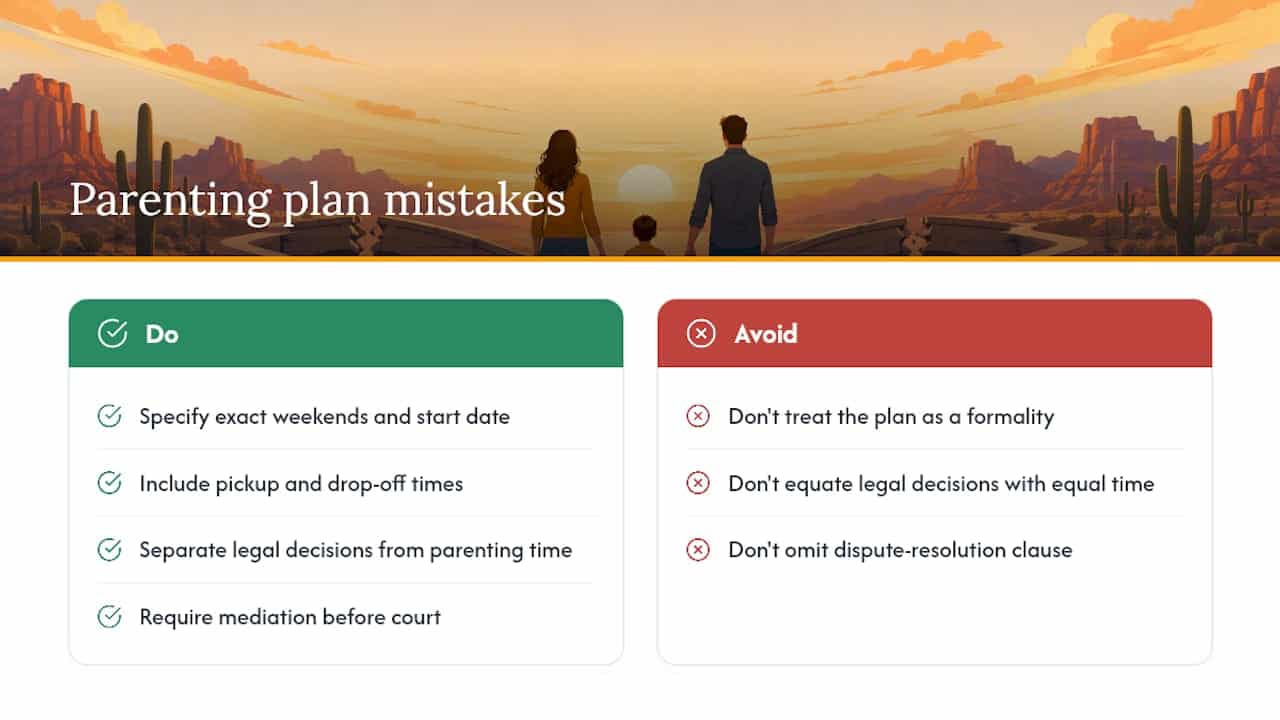
The most common mistake is treating the parenting plan as a formality rather than a binding contract. Parents write “alternating weekends” and think that is enough. It is not. When the first holiday conflict arrives, “alternating weekends” tells neither parent, nor a judge, anything useful. Which weekend? Starting when? What time does the child get picked up? What happens if a parent is late?
The second mistake is conflating legal decision-making with parenting time. A parent who wins joint legal decision-making authority sometimes believes they have also won equal time. They have not. These are separate legal questions, and courts decide them independently based on the child’s best interests. A parent can have full joint decision-making rights and still see the child only every other weekend if that is what the evidence supports.
The third mistake is leaving out the dispute-resolution clause. When parents disagree about the plan later, and most do at some point, a plan without a dispute-resolution procedure sends them straight back to court. A single sentence requiring mediation before any motion practice can save thousands of dollars and months of conflict.
Here is what that looks like in practice:
Vague: “The parties will resolve disputes as they arise.”
Enforceable: “In the event of any dispute regarding this parenting plan, the parties shall first submit the dispute to a mutually agreed mediator within 30 days of the dispute arising. Neither party may file a motion with the court until mediation has been attempted, unless an emergency exists.”
The difference between those two clauses is the difference between a plan that holds and one that generates litigation every time circumstances change. Write the second version.
Highdesertfamilylawgroup helps Arizona parents get parenting plans right
Drafting a parenting plan that actually holds up in court is harder than it looks. The statutory checklist is just the starting point. What separates a plan that gets approved from one that gets sent back, or worse, litigated for months, is the quality of the drafting: specific schedules, clear exchange procedures, enforceable dispute-resolution language, and county-compliant form submissions.

Highdesertfamilylawgroup works with parents in Scottsdale and across Maricopa County on every stage of the parenting-plan process: drafting the initial plan, filing it correctly with the Superior Court, negotiating contested schedules, and representing parents at hearings. The firm brings over 20 years of Arizona family law experience to cases ranging from straightforward uncontested filings to complex relocation and domestic violence matters. If you need help with a child custody arrangement or want to know what your options look like before you file, schedule a consultation with the firm directly at highdesertfamilylawgroup.com.
Authoritative sources and official forms
Before you file, verify that you have the current version of every form. Court PDFs are updated without notice, and filing an outdated version can result in rejection. Check the version date printed on the form itself against the date on the court’s website.
Statutes:
- 25-403.02 – Parenting plans
- 25-403 – Legal decision-making; best interests of child
- Superior Court of Arizona in Maricopa County parenting plan packet (DRV1Z / DRCVG12h)
- Maricopa Superior Court parenting plan form (DRCVG11f)
- Filing a family law case in the court (AZ Courts Self-Service Center)
- 25-403.02 – Parenting plans (Justia secondary copy of statute)
- Planning for Parenting Time: Guidance and sample plans (AFCC)
- Parenting Plan Examples (AZCourtHelp)
Official forms and county resources:
- Maricopa Superior Court parenting plan form (DRCVG11f): The primary fillable form for Maricopa County filings.
- Maricopa County parenting plan packet (DRV1Z / DRCVG12h): The detailed packet with schedule prompts, exchange logistics, and periodic review language.
- AZ Courts Self-Service Center: Forms and filing instructions for all Arizona counties.
- AZCourtHelp parenting plan examples: Sample plans including Plan 12, with time-sharing examples used by parents and mediators.
- AFCC Planning for Parenting Time guide: Age-based sample plans and blank calendars used by courts and mediators.
How to confirm you have the right version: Open the PDF and look for a form number and revision date, usually printed in small text at the bottom of the first page. Cross-reference that date with the version listed on the Superior Court’s forms page. If they do not match, download again. For non-Maricopa counties, go directly to that county’s Superior Court website for their current parenting-plan packet.