



Use ARS §25-315 to Protect Pet Time in Arizona Divorce

In Arizona, pets are treated as personal property and divided like other marital assets under ARS § 25-318. There is no statute authorizing shared custody or a “best interests of the animal” test for a dog or cat. If you want ongoing time with a pet after divorce, your best tool is a written agreement negotiated now and built into your settlement.
TL;DR:
- Pets owned before the marriage or acquired as gifts or inheritance remain separate property if properly documented, while pets purchased during marriage are presumed community property.
- The court considers the primary caregiver, financial contributions, documentation, living situation, and children’s attachment when dividing pets, but no custody or welfare standard exists.
- During divorce proceedings, a preliminary injunction prevents either spouse from hiding or transferring the pet, making prompt documentation crucial for enforcement.
- A detailed written agreement outlining pet possession, expenses, decision-making, and relocation is the most reliable way to secure shared pet arrangements.
- Court modification of pet agreements requires mutual consent or a legal petition, with enforceable orders achievable through compliance or contempt motions.
Table of Contents
- How Arizona law classifies and divides pets
- What judges and courts consider when awarding a pet
- Practical checklist: protect your pet during divorce
- Drafting an enforceable pet agreement
- If you can’t agree: litigation, outcomes, and remedies
- Timing and automatic protections in Arizona divorces
- Consideration of the pet’s best interest and welfare in court decisions
- How temporary custody works while the divorce is pending
- How relocation affects time with a pet
- Modifying pet arrangements after the divorce is final
- Can spouses set up a shared schedule for a pet?
- How Brett and High Desert Family Law Group advise clients
- If you need help protecting time with your pet
- Sources
- FAQ
How Arizona law classifies and divides pets
Arizona courts divide community property equitably under ARS § 25-318, and that statute governs pets the same way it governs furniture, vehicles, or a shared bank account. A pet is not a party to the case and does not get its own hearing. It gets assigned to one spouse as part of the overall property split, sometimes with an offset involving other assets to balance the division.
Whether a pet counts as community or separate property depends on when and how it was acquired. Community property under ARS § 25-211 generally covers anything obtained during the marriage, while a pet owned before the wedding, received as a gift, or inherited can remain separate property if the claiming spouse proves it with clear evidence.
- A pet bought during the marriage is presumed community property.
- A pet owned before the marriage, or received as a gift or inheritance, may qualify as separate property with proof.
- A pet purchased with one spouse’s separate funds, kept clearly apart from shared accounts, may also support a separate property claim.
Some states have passed laws directing judges to weigh a pet’s welfare or living arrangements much like a custody factor. Arizona has not done that. According to a practice guide on Arizona pet custody, Arizona is among the states that still classify pets strictly as property, with no statutory pathway for a best-interest-of-the-pet analysis. That single fact shapes every strategic decision that follows.
What judges and courts consider when awarding a pet
Because Arizona has no pet-specific custody standard, judges fold the question into ordinary equitable division. In practice, that means looking at who can prove the strongest connection to the animal and who has actually paid for its care. The Divorce.law guide to Arizona pet custody lists the evidentiary categories that recur most often in these disputes.
- Primary caregiver conduct: who fed, walked, groomed, and took the pet to appointments on a regular basis.
- Financial contributions: purchase price, vet bills, insurance premiums, food, and boarding costs tied to a specific account or card.
- Documentary proof: microchip registration, adoption papers, and licensing records showing whose name is attached.
- Living situation: which spouse’s home and schedule can reasonably support the pet going forward.
- Children’s attachment: when kids in the household are bonded to the pet, some judges informally weigh that alongside custody arrangements, though this is considered for the children’s benefit, not the pet’s.
Pro Tip: Start a dated folder now, digital or physical, with every vet receipt, adoption record, and photo showing day-to-day care. Judges respond to paper trails, not sentiment.
None of this creates a right to visitation. Courts treat the pet as one line item in the full inventory of marital assets, and the outcome usually comes down to whichever spouse built the clearer record before the case ever reached a judge.
Practical checklist: protect your pet during divorce
Once a divorce petition is filed, a preliminary injunction under ARS § 25-315 automatically prohibits either spouse from hiding, selling, or giving away community property, and that includes pets. Violating it can trigger contempt proceedings. Our explainer on the Arizona preliminary injunction covers what else falls under this protection.
- Never hide, rehome, or transfer a pet once the injunction is in effect, even if you believe you have the stronger claim.
- Gather microchip registration, veterinary records, adoption or purchase receipts, and any boarding or grooming invoices.
- Take dated photos and save texts or emails that show you handling day-to-day care.
- Collect witness statements from a vet tech, dog walker, or neighbor who can confirm who provided regular care.
- If your spouse removes the pet in violation of the injunction, document the date, time, and any witnesses immediately.
- File an emergency motion or a motion for contempt if the pet has been taken or is at risk of being sold or given away.
Bring this documentation to settlement talks first. A judge is a last resort, and the same proof that supports a court filing also gives you leverage in mediation. Our preparing for divorce checklist walks through the broader set of records worth organizing before you file.
Drafting an enforceable pet agreement
The most reliable way to preserve shared time with a pet in a property-law state like Arizona is a written agreement incorporated into your settlement under ARS § 25-318. Once a court incorporates that language into the decree, it becomes an enforceable order, not just a handshake. A practice guide on handling pets in settlement agreements recommends addressing the following elements directly.
- A possession schedule spelling out which days or weeks each person has the pet.
- Expense sharing for food, vet visits, grooming, and emergency care.
- Decision-making authority for major medical choices or end-of-life decisions.
- Relocation and travel provisions if one spouse plans to move.
- A dispute resolution clause, often mediation, for disagreements that arise later.
Pro Tip: Attach a calendar exhibit to the agreement showing exact exchange dates rather than vague language like “alternating weekends.” Specificity prevents future arguments.
Mediation or a collaborative divorce process tends to produce cleaner, more detailed pet clauses than litigation, since both spouses have a direct hand in the wording.
If you can’t agree: litigation, outcomes, and remedies
When spouses can’t settle the question, a judge decides the pet’s fate as part of the overall property division, sometimes offsetting the award with another asset to keep the split fair.
- Possible outcomes include a sole award to one spouse, an award paired with a financial offset, or, occasionally, a court-approved arrangement if both parties stipulate to one.
- Litigating a pet dispute adds cost and delay for an asset judges generally treat as low priority compared to real estate or retirement accounts.
- Because Arizona is a property-law state, judges rarely write detailed visitation schedules for pets on their own; that level of detail typically only survives if the parties agreed to it first.
- If an order is violated after the fact, enforcement options include contempt motions, sanctions, or, in rare cases, liens against other property.
Timing and automatic protections in Arizona divorces
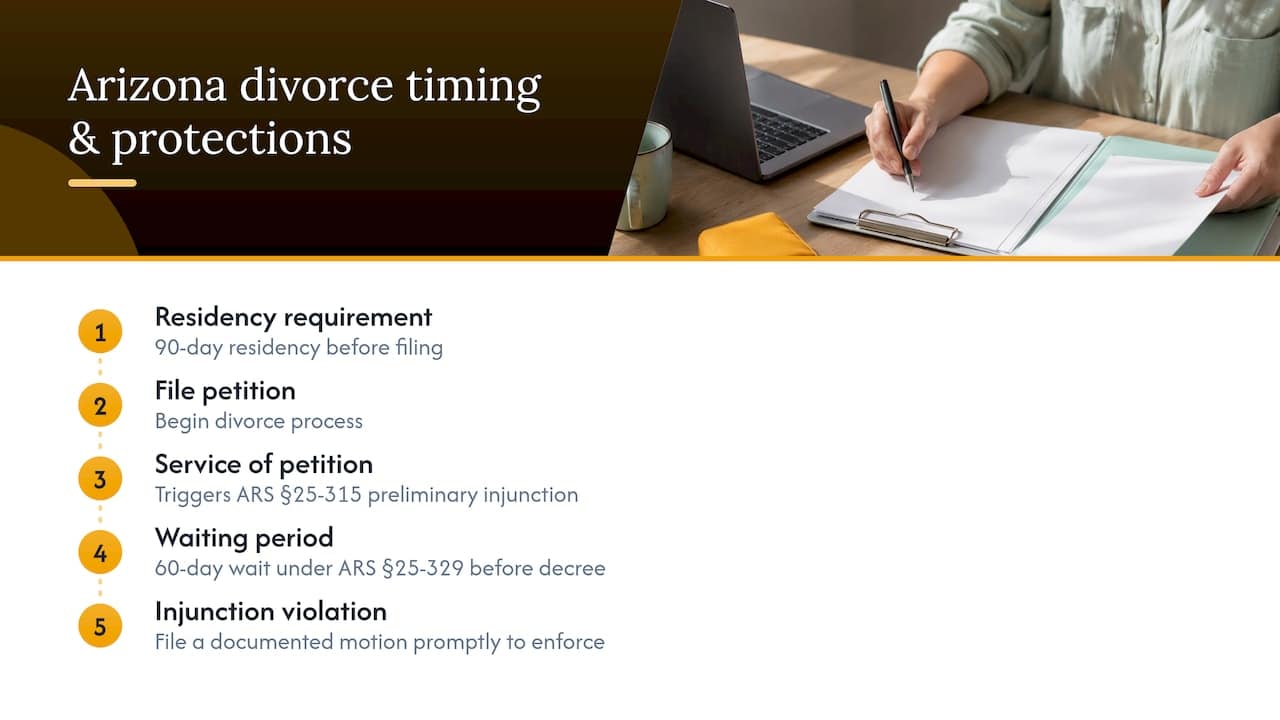
Arizona requires a 90-day residency period before filing and imposes a 60-day waiting period under ARS § 25-329 before a decree can be finalized. The preliminary injunction under ARS § 25-315 takes effect once the petition is served, automatically barring either spouse from disposing of community property, including pets, without agreement. If that injunction is violated, respond quickly with a motion documenting the violation, since delay makes recovery and enforcement harder.
Consideration of the pet’s best interest and welfare in court decisions
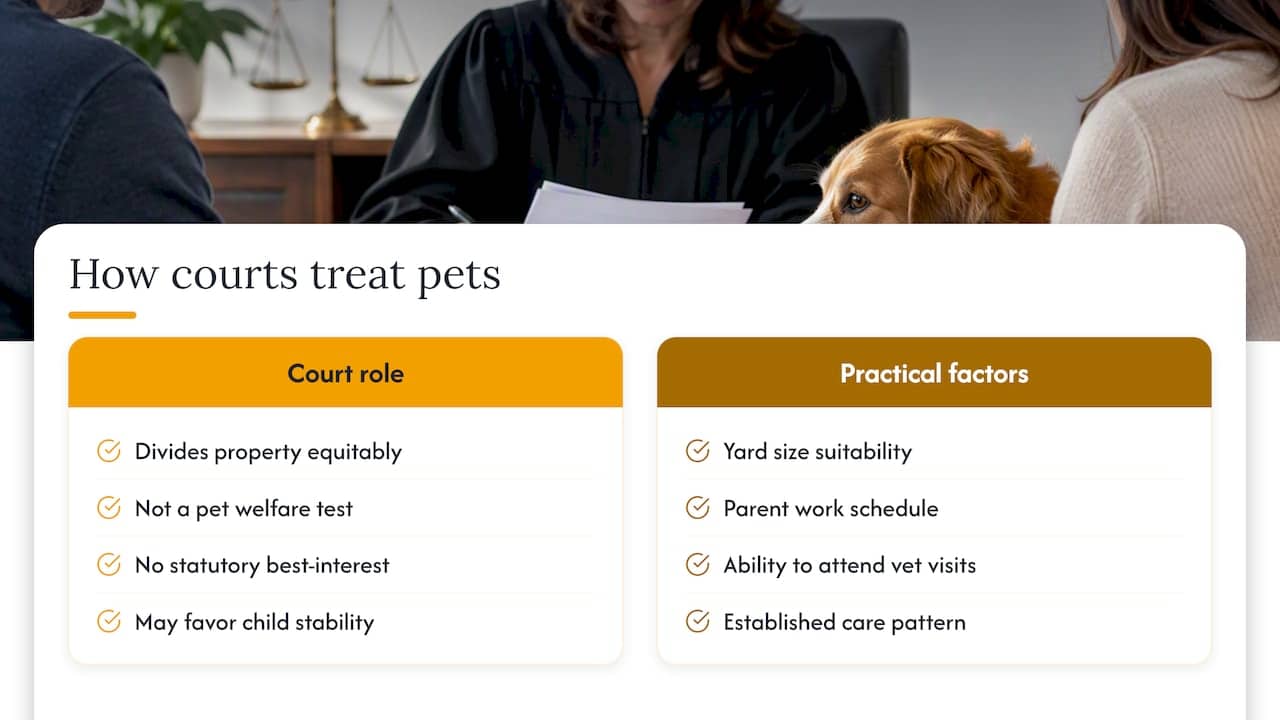
Arizona judges are not asked to determine what’s “best” for a dog or cat the way they would for a child. There is no statutory best-interest test for animals, and a family court’s job is dividing property fairly between two people, not evaluating an animal’s emotional needs. That said, welfare considerations can surface indirectly. A judge might notice which household has a yard suited to a large dog, or which spouse’s work schedule allows for consistent walks and vet visits, but this factors into the equitable division analysis rather than a standalone welfare finding.
Where children are involved, some judges informally lean toward keeping a family pet with the parent who has primary physical custody, reasoning that stability for the children matters more than which adult originally bought the animal. This is not a pet-welfare ruling; it’s a byproduct of prioritizing the children’s routine. Framing your case around practical suitability, space, schedule, and established care patterns tends to land better with a judge than arguments about emotional bonds alone, since the court’s framework is property division, not guardianship.
How temporary custody works while the divorce is pending
While a divorce is pending, there is no formal “temporary custody” order for pets the way there is for children. Instead, the pet typically stays wherever it was living when the petition was filed, protected from being moved, sold, or given away by the preliminary injunction under ARS § 25-315.
If both spouses want a temporary arrangement, such as alternating weeks while the case is active, that has to come from a voluntary agreement or a stipulated order, since Arizona courts won’t impose one on their own initiative absent an agreement. Couples who anticipate a long, contested case sometimes negotiate a short-term pet-sharing agreement early, separate from the final settlement, just to reduce conflict while other issues get resolved. That interim agreement can later be folded into or replaced by the final decree language.
How relocation affects time with a pet
If one spouse plans to move out of state or a significant distance within Arizona, any pet-sharing agreement negotiated earlier in the case may need to be revisited. A possession schedule built around weekly exchanges doesn’t work once one household is hundreds of miles away, and neither spouse is entitled to force the other to facilitate long-distance pet exchanges unless the settlement specifically addresses it.
Relocation clauses in a pet agreement should spell out what happens if either spouse moves: does the pet stay with whoever remains local, does the moving spouse forfeit shared time, or is there a modified schedule involving holiday exchanges instead of weekly ones? Readers dealing with relocation questions involving children should also review the 45-day notice requirements that apply to parenting time, since a family move often affects pet arrangements at the same time it affects custody logistics.
Modifying pet arrangements after the divorce is final
Because a pet clause incorporated into a decree functions as a court order, it can be enforced through the same contempt process used for other property terms. Modifying it later is possible, but only if both spouses agree to new terms or one spouse successfully petitions the court to change the arrangement, which is a higher bar than adjusting child custody, since there is no ongoing “best interest of the pet” standard to justify a modification.
In practice, most changes to pet arrangements happen by mutual agreement rather than court motion. If one spouse’s circumstances change, a new job, a move, a change in living situation, it’s usually faster and cheaper to negotiate an amendment than to file for modification. Our overview of Arizona community property rules explains how property-related decree terms generally hold up over time absent a specific triggering event.
Can spouses set up a shared schedule for a pet?
Arizona law doesn’t prohibit spouses from creating a shared schedule for a pet, it just won’t order one for you. If both parties are willing, a settlement agreement can include a detailed possession calendar, much like a parenting plan, specifying which days, weekends, or holidays each spouse has the animal.
The practical success of these arrangements depends entirely on cooperation, since a court will not police the day-to-day logistics of pet exchanges the way it might oversee child custody transfers. According to practitioner guidance on divorce and pets, voluntary settlement agreements remain the only reliable method for securing shared pet time in states without a custody statute. Couples who can still communicate reasonably well tend to be the best candidates for a true joint schedule; those heading toward a contested case are usually better served negotiating a clean, single-owner outcome with a financial offset instead.
If you need help protecting time with your pet
If you’re facing a pet dispute in your divorce, we can help you negotiate a written agreement, pursue mediation, or file an emergency motion if your spouse has violated the injunction.

Bring your vet records, receipts, and any documentation of daily care to your consultation. Visit our divorce services page to schedule a consultation and get a plan tailored to your situation.
Sources
For verification, review ARS § 25-318, ARS § 25-211, and the Divorce.law Arizona pet custody guide. Always confirm current filing fees and local rules with your county clerk.
This article is general information, not a substitute for advice from a qualified lawyer. Consult a qualified legal professional about your own circumstances before acting on anything here.
- Divorce
- ARS § 25-318 (Arizona Revised Statutes)
- How to handle pets in a divorce settlement agreement (DivorceClear)
- Pets in Divorce: Who Gets the Dog? (Unvow)
FAQ
Is it okay to share a pet with my ex?
Yes, if both of you agree and put the arrangement in writing as part of your settlement. Arizona courts will not order a shared schedule on their own, but they will enforce one that both spouses agreed to and had incorporated into the decree.
What is a spouse entitled to in an Arizona divorce?
A spouse is generally entitled to an equitable share of community property under ARS § 25-318, along with any separate property they can prove was owned before the marriage or received as a gift or inheritance. The exact division depends on the couple’s full financial picture, not a fixed formula.
Who gets custody of a dog after a breakup?
In Arizona, there is no custody in the legal sense for pets, since dogs are treated as personal property and assigned to one spouse through equitable division. Courts look at who paid for the dog, who provided daily care, and what documentation exists, such as microchip and vet records.
What assets are untouchable during a divorce?
Separate property, such as assets owned before the marriage, gifts, or inheritances kept apart from shared accounts, generally stays with the original owner if it can be proven with clear evidence. Once a divorce petition is filed, the preliminary injunction under ARS § 25-315 also protects all community property, including pets, from being sold, hidden, or given away while the case is pending.