



Forced marriage annulment is a legal process that asks a court to declare your marriage was never valid — because your consent was never freely given.
Here is a quick answer if that is what you need right now:
- Who can file: Anyone whose consent was obtained through force, threats, fraud, or coercion
- What it does: Treats the marriage as if it never legally existed
- Key requirement: You generally must not have voluntarily continued living as a married couple after the force ended
- Where to start: File a petition in your state’s family court — in Arizona, at least one spouse must have lived in the state for 90 days before filing
- Time limits apply: Arizona and most states set deadlines, so acting quickly matters
If you are in immediate danger, call 911 or the National Domestic Violence Hotline at 1-800-799-SAFE (7233).
Forced marriage is recognized by the U.S. government as a serious human rights abuse. It can happen through physical violence, emotional blackmail, financial pressure, or threats — and it can happen to anyone, regardless of age, gender, or cultural background.
It is more common than many people realize. In the U.S. alone, roughly 3,000 forced marriage cases were recorded between 2009 and 2011. Globally, the numbers are far higher — the UN estimated that as of 2008, up to 80% of marriages in Afghanistan took place without full and free consent.
If your marriage was forced, you have legal options. Annulment is one of the most powerful — because it does not just end the marriage. It erases it.
Similar topics to Forced marriage annulment:
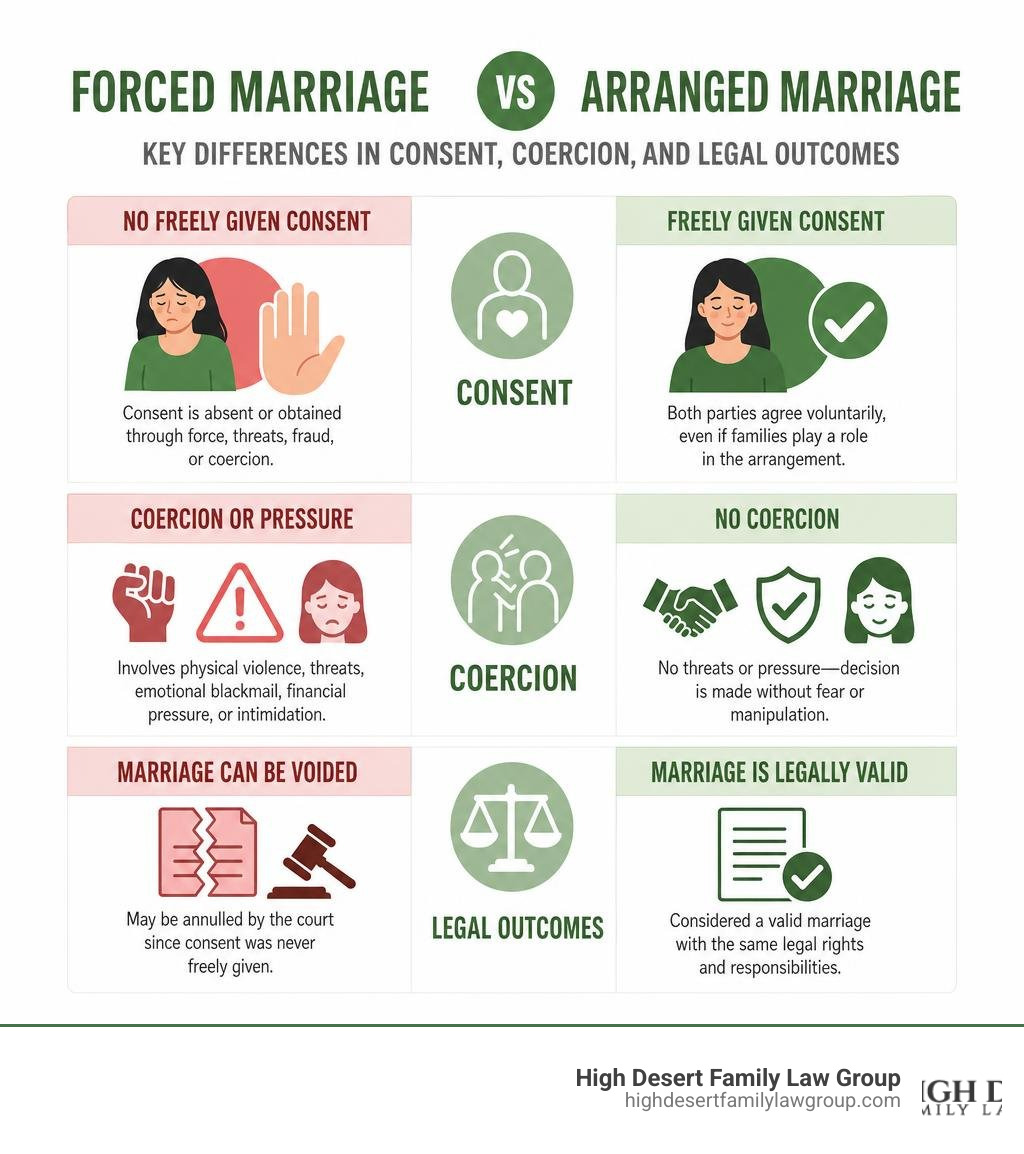
Understanding Forced Marriage vs. Arranged Marriage
To understand how a forced marriage annulment works, we must first look at the legal definition of consent. In any legally binding contract—and marriage is, at its core, a legal contract—both parties must enter into the agreement of their own free will. When consent is missing, the very foundation of the marriage is broken.
There is a vast difference between an arranged marriage and a forced marriage, though they are sometimes confused by those outside of specific cultural traditions.
Defining Forced Marriage and Coercion
A forced marriage occurs when one or both individuals do not—or cannot—give their full and free consent to the union. Instead, the marriage takes place under duress, force, fraud, or intense coercion. This coercion can take many forms:
- Physical Coercion: Threats of violence, physical abuse, captivity, or being forced to travel abroad against your will.
- Emotional and Psychological Blackmail: Family members threatening to disown the individual, self-harm, or claim that the family’s “honor” will be ruined if the marriage does not take place.
- Financial Coercion: Confiscating documents, withholding money, or threatening to leave an individual completely destitute.
Forced marriage is widely recognized as a severe human rights violation. In 2013, the United Nations Human Rights Council adopted its first resolution against child, early, and forced marriages. When children are involved, it is also classified as a form of child abuse. For instance, a 2016 report by the German Ministry of the Interior found that 1,475 children in Germany were in forced marriages, including more than 1,110 girls. To explore the international frameworks and efforts to combat this issue globally, you can read the UNFPA Annulment of Child Marriage Report.
Arranged Marriage: The Element of Choice
In contrast, an arranged marriage relies entirely on the ultimate consent of both individuals. While parents, matchmakers, or respected family members may take the lead in introducing potential partners and facilitating the courtship, both the bride and the groom retain the absolute right of refusal. They can say “no” at any point in the process without facing abuse, threats, or severe social retaliation.
When both parties say “yes” freely and happily, the marriage is legally valid. When that choice is stripped away, the marriage crosses the line into a forced union.
| Feature | Arranged Marriage | Forced Marriage |
|---|---|---|
| Role of Family | Introduces partners, facilitates meetings | Dictates the partner, demands compliance |
| Right of Refusal | Fully respected; either party can say “no” | Denied; saying “no” results in threats or violence |
| Consent | Free, voluntary, and informed | Obtained via duress, emotional blackmail, or force |
| Legal Status | Valid under civil law | Voidable or void under civil law |
Legal Grounds for a Forced Marriage Annulment

When you ask a court for a forced marriage annulment, you are not asking to end a marriage. You are asking the judge to look at the circumstances of your wedding day and declare that because of the force used against you, a legal marriage never actually occurred.
To do this, you must establish specific legal grounds.
Duress and Force as Grounds for Annulment
Under Arizona law, as well as the laws of other states, a marriage is considered “voidable” if consent was obtained through duress, force, or fraud.
- Duress: This means your free will was completely overborne by threats of harm. If you only said “I do” because you feared for your physical safety, your financial survival, or your psychological well-being, you did not legally consent.
- Force: This involves actual physical compulsion or restraint. If you were physically forced to sign a marriage license or participate in a ceremony, the marriage lacks legal validity.
Different states codify these grounds in their statutes. For example, Tex.Fam. Code Section 6.107 allows for an annulment if a party married under duress or force, provided they stopped living with the other party once the force ceased. Similarly, N.Y. Domestic Relations Law Section 140 (2026) permits annulment actions based on force or duress.
In our home state of Arizona, the courts look for a “defect going to the very essence of the marriage relationship.” Duress and physical threats absolutely meet this high standard. You can learn more about what Arizona courts look for by reviewing the Annulment Criteria we use to evaluate our clients’ cases.
How Forced Marriage Annulment Differs from Divorce
It is common to wonder why someone would go through the effort of proving duress for an annulment when they could simply file for a no-fault divorce. While both legal paths end your relationship with the other person, they have very different legal and social consequences.
- The Legal Status: A divorce terminates a valid marriage. An annulment declares that the marriage was void from the very beginning (void ab initio).
- Social and Religious Implications: For many individuals escaping a forced marriage, carrying the social label of “divorced” can bring further cultural stigma or family pressure. An annulment restores your legal status to “single” rather than “divorced,” as if the wedding never happened.
- Financial and Property Division: In a divorce, community property laws require a division of assets and debts acquired during the marriage. In an annulment, because the marriage never legally existed, the court generally attempts to restore both parties to their pre-marriage financial positions, which can prevent a perpetrator from claiming a share of your assets.
To dive deeper into these differences and decide which path fits your situation, see our detailed guide on Annulment vs Divorce.
The Legal Process and Timeline for Annulment
Taking the step to legally dissolve a forced union requires courage, but understanding the roadmap can help demystify the process.
Step-by-Step Process of a Forced Marriage Annulment
Getting an annulment in Arizona involves several clear legal steps:
- Establishing Jurisdiction: To file for an annulment in Arizona, at least one of the parties must have been domiciled (or stationed in the military) in the state for at least 90 days before filing the petition. We regularly assist clients in Scottsdale, Chandler, and the greater Phoenix area with establishing this residency requirement.
- Filing the Petition: We draft and file a formal Petition for Annulment in the Superior Court (such as Maricopa County Superior Court). This petition outlines the specific facts of the force, threats, or coercion that occurred.
- Serving the Respondent: The other party must be formally served with the court papers. If they are cooperative, they can sign an acceptance of service. If they are uncooperative or if your safety is at risk, we utilize professional process servers to handle this safely and legally.
- The Court Hearing: Unlike a standard no-fault divorce, which can sometimes be completed entirely on paper, an annulment almost always requires a brief hearing. You must present evidence to a judge to prove that the marriage was forced. If the other party fails to respond to the petition, we can seek an ex-parte default decree of annulment.
For a comprehensive breakdown of these steps under local laws, read our guide on Obtaining an Annulment in Arizona and explore how we approach Marriage Annulment in Arizona.
Timelines and Statutes of Limitations
When it comes to a forced marriage annulment, time is of the essence.
- The Cohabitation Bar: The absolute most critical rule in forced marriage cases is that you must not voluntarily cohabit (live together as spouses) once the force, threat, or duress has stopped. If you continue to live with the person voluntarily after the danger has passed, the law may view this as “ratifying” the marriage, which can strip away your right to an annulment.
- Statutes of Limitations: While some states allow a forced marriage to be annulled at any time, others set strict deadlines (such as four or five years from the date of the marriage). In Arizona, the law requires that you file within a “reasonable time” after discovering the grounds or being freed from the duress.
To understand how these timelines might apply to your specific situation, read our articles on How Long After a Marriage Can It Be Annulled? and Can You Get an Annulment After 10 Years of Marriage?.
Safety Planning and Support Resources

If you are currently in a forced marriage or are facing pressure from your family to enter into one, your physical safety is the single most important priority. Escaping a forced marriage can be dangerous, particularly if your family or community reacts with anger or threats of violence.
Safety Planning and Confidential Resources
Before you take any legal steps, it is vital to have a safety plan in place.
- Secure Your Documents: If possible, safely secure your passport, birth certificate, driver’s license, and immigration documents. Keep them in a safe place outside of your home (such as with a trusted friend or in a bank safety deposit box).
- Confidential Communications: Use safe devices to research your options. Perpetrators and family members may monitor your phone logs, search history, or emails. Use a public library computer or a trusted friend’s phone if you suspect you are being monitored.
- Emergency Contacts: Keep emergency numbers saved. The National Domestic Violence Hotline (1-800-799-SAFE) and the National Human Trafficking Hotline (1-888-373-7888) can provide confidential housing, safety planning, and emotional support.
Navigating Family Law Safely
Our legal team understands the delicate nature of these cases. We work hand-in-hand with you to manage the family law aspects of your situation with the utmost discretion.
We can assist you by:
- Keeping your physical address confidential on court documents where legally permissible.
- Handling all communications with your spouse or their family through our office, so you do not have to interact with them directly.
- Structuring child custody and parenting time agreements to include supervised exchanges or third-party drop-offs to ensure you are never placed in a vulnerable position.
Frequently Asked Questions about Forced Marriage Annulment
What evidence is required to prove a marriage was forced?
Because the legal burden of proof rests on the person asking for the annulment, you must provide clear evidence that your consent was missing. Helpful evidence includes:
- Written Communications: Text messages, emails, social media messages, or letters showing threats, emotional blackmail, or pressure from your spouse or family members.
- Witness Testimony: Affidavits or live testimony from friends, counselors, teachers, or coworkers who witnessed the pressure or to whom you confided your fears before or during the marriage.
- Police or Medical Reports: Any documentation of domestic violence, physical restraint, or calls for emergency help.
- Financial Records: Evidence that your family controlled your finances, withheld your documents, or used money to force your compliance.
Does annulling a marriage affect child custody or legitimacy?
A common misconception is that annulling a marriage makes any children born during the union “illegitimate” or deprives them of legal rights.
In Arizona, this is absolutely not the case. Under state law, children born during an annulled marriage remain fully legitimate. The court handles child custody (legal decision-making), parenting time, and child support in the exact same manner as it would in a divorce. The judge will make these decisions based entirely on the “best interests of the child.” To see how these requirements work in practice, read our guide on Annulment Requirements.
What is the average cost of annulling a forced marriage?
The cost of an annulment varies widely depending on whether the other party contests the case. An uncontested annulment—where the other party does not respond or agrees to sign the paperwork—is significantly less expensive and can be resolved quickly. A contested annulment, where we must go to trial to prove the duress, requires more time and resources.
If you are facing severe financial hardship or your family has cut off your access to funds, we can help you apply for a deferral or waiver of court filing fees. For a transparent breakdown of potential legal fees, check out our guide on Annulment Cost.
Conclusion
No one should ever be forced into a marriage against their will. If you have been pressured, threatened, or coerced into a union, please know that you are not trapped. The law provides a clear path to reclaim your agency, your identity, and your future.
At High Desert Family Law Group, we provide aggressive, individualized representation to clients throughout Greater Scottsdale, Chandler, and the surrounding Arizona communities. Our four-person legal team is dedicated to standing by your side, protecting your assets, and helping you close this painful chapter safely and decisively.
You deserve to choose your own path. If you are ready to explore your options for a forced marriage annulment, contact us today to schedule a confidential legal consultation. We are here to help you break the chains and start fresh.
Learn more about our services here: High Desert Family Law Group Family Law Services.