



The rules for marriage annulment are not the same as divorce rules — and getting them wrong can cost you time, money, and legal standing.
Here is a quick answer if you need it now:
Key Rules for Marriage Annulment at a Glance:
- An annulment declares a marriage legally invalid from the start — as if it never happened
- You must prove a specific legal ground (fraud, bigamy, incapacity, force, etc.) — a short marriage alone is not enough
- Grounds fall into two categories: void marriages (automatically invalid) and voidable marriages (valid until a court rules otherwise)
- Time limits apply to most voidable marriage grounds — act quickly after discovering the issue
- Residency rules vary by state (Arizona requires 90 days; California has no waiting period for annulment)
- Property division and spousal support are not automatic after annulment — rights depend on whether you qualify as a putative spouse
- Children born during an annulled marriage remain legitimate in most states
- Religious annulments (such as Catholic canon law proceedings) have no legal effect on your civil marital status
Annulment is rare. Courts are selective. And the rules differ significantly from state to state.
That is why knowing exactly what qualifies — and what does not — matters before you file anything.
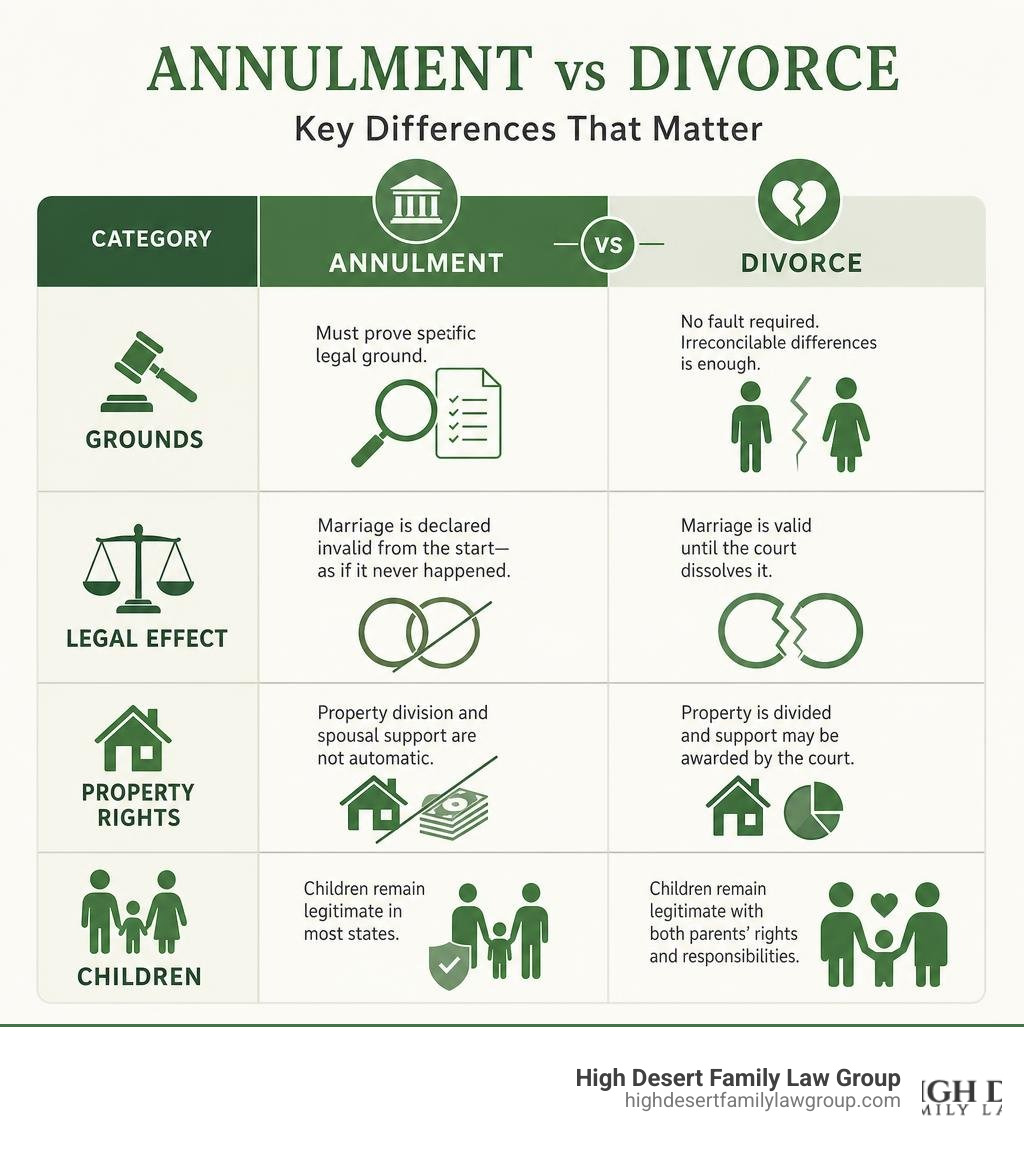
What is a Civil Annulment and How Does It Differ From Divorce?
When a marriage breaks down, most people immediately think of divorce. However, a civil annulment is a completely different legal mechanism. While a divorce legally dissolves a valid marriage, a civil annulment is a judicial declaration that a valid marriage never actually existed in the first place.
If you receive a divorce, the law recognizes that you were married, but that the union has now ended. If you receive an annulment, the court erases the marriage from your legal history. In the eyes of the law, you return to the status of single individuals who were never married to each other.
Legal separation is yet another path. A legal separation does not end the marriage or declare it invalid. Instead, it allows a couple to live apart and establish court-ordered arrangements for property division, spousal maintenance, and child custody while technically remaining legally married.
Understanding the differences between these options is critical. We often help clients weigh these paths by using a direct comparison of their legal features:
| Legal Feature | Civil Annulment | Divorce (Dissolution) | Legal Separation |
|---|---|---|---|
| Legal Status of Marriage | Declared null, void, and non-existent from the beginning. | Valid marriage is legally dissolved. | Marriage remains legally intact. |
| Primary Requirement | Must prove specific legal grounds (e.g., fraud, bigamy). | No-fault (irretrievably broken) in most jurisdictions. | Irretrievably broken (or mutual consent). |
| Property Division | No automatic community property rights (unless “putative spouse” rules apply). | Equitable or community property division rules apply automatically. | Court divides assets and debts without dissolving the marriage. |
| Spousal Support | Generally unavailable (unless a party qualifies as a putative spouse). | Court may award temporary or permanent spousal maintenance. | Court may award spousal maintenance during the separation. |
| Ability to Remarry | Yes, immediately (the prior marriage is legally erased). | Yes, once the final decree is entered. | No, the parties remain legally married to each other. |
Choosing between these options depends heavily on your unique situation, religious beliefs, and financial interests. For a deeper dive into how these paths compare, you can read our comprehensive guide on Annulment vs Divorce.
The Legal Rules for Marriage Annulment: Void vs. Voidable Marriages

To navigate the rules for marriage annulment, you must understand the fundamental distinction between a void marriage and a voidable marriage. This distinction dictates whether your marriage was dead on arrival or if it requires active legal intervention to be set aside.
Void Marriages
A void marriage is one that is legally non-existent from its very inception. It is prohibited by law, meaning it violates public policy so deeply that no court or agreement of the parties could ever make it valid. Because a void marriage is inherently invalid, either party (or even an interested third party in some cases) can challenge it at any time.
Common examples of void marriages include:
- Bigamy: When one spouse is already legally married to someone else at the time of the second ceremony.
- Incest: Marriages between close blood relatives (consanguinity) that violate state laws.
In the case of a void marriage, a court petition is technically a request for a “suit to declare a marriage void” rather than a standard annulment. However, obtaining a formal court decree is still highly recommended to clear up public records, resolve property issues, and establish custody arrangements.
Voidable Marriages
A voidable marriage, on the other hand, is considered legally valid and binding unless and until one of the spouses takes legal action to challenge its validity. If the injured spouse does not file for an annulment within a reasonable time—or if they continue to live with their spouse after discovering the defect—they may “ratify” the marriage, making it permanently valid.
Common grounds that make a marriage voidable include:
- Fraud or Misrepresentation: One party lied about an essential aspect of the marriage (e.g., hiding a pregnancy by another man, marrying solely for immigration benefits, or falsely claiming an intention to have children).
- Duress or Force: Consent to marry was obtained through physical threats or severe coercion.
- Lack of Mental Capacity: A spouse was temporarily or permanently unable to understand the nature of the marriage contract due to severe psychiatric conditions, cognitive impairment, or acute intoxication from alcohol or narcotics at the time of the ceremony.
- Physical Incapacity: An incurable physical inability to consummate the marriage (impotence) that was unknown to the other spouse at the time of the wedding.
State laws govern how these categories are handled. For example, some jurisdictions have highly detailed rules regarding who can bring these suits and when. If you are curious about how other states structure these definitions, you can review the statutory frameworks found in the Vermont Laws on Void and Voidable Marriages.
Specific Grounds and Rules for Marriage Annulment Across Jurisdictions
Because family law is governed at the state level, the rules for marriage annulment vary widely across different jurisdictions. What qualifies as an easy annulment in one state may be completely unavailable in another.
Statutory Grounds and Rules for Marriage Annulment in Arizona
In Arizona, courts are generally reluctant to grant annulments unless the petitioner can provide clear and convincing evidence of a legal defect at the time of the marriage. To file for an annulment in our state, at least one of the spouses must have been domiciled (residing) in Arizona for at least 90 days before filing the petition.
Arizona law allows annulments when there is an impediment that renders the marriage void or voidable. These impediments include:
- Undisclosed prior marriages (bigamy)
- Incestuous relationships
- Lack of consent due to mental illness, temporary incapacity, or severe intoxication
- Fraud that goes to the “essential essence” of the marital relationship
- Being under the age of consent without proper parental or judicial approval
Additionally, Arizona is one of only three states that recognizes covenant marriages. If you entered into a covenant marriage, the requirements to end or annul the union are even stricter, requiring pre-marital counseling and very specific statutory grounds.
If you are considering filing in our local courts, it is essential to review the official procedural guidelines. You can find detailed resources on the Arizona Annulment Information page, or read our step-by-step breakdown of Marriage Annulment in Arizona to understand how our local judges handle these cases.
Rules for Marriage Annulment in Other States: California, Texas, and New York
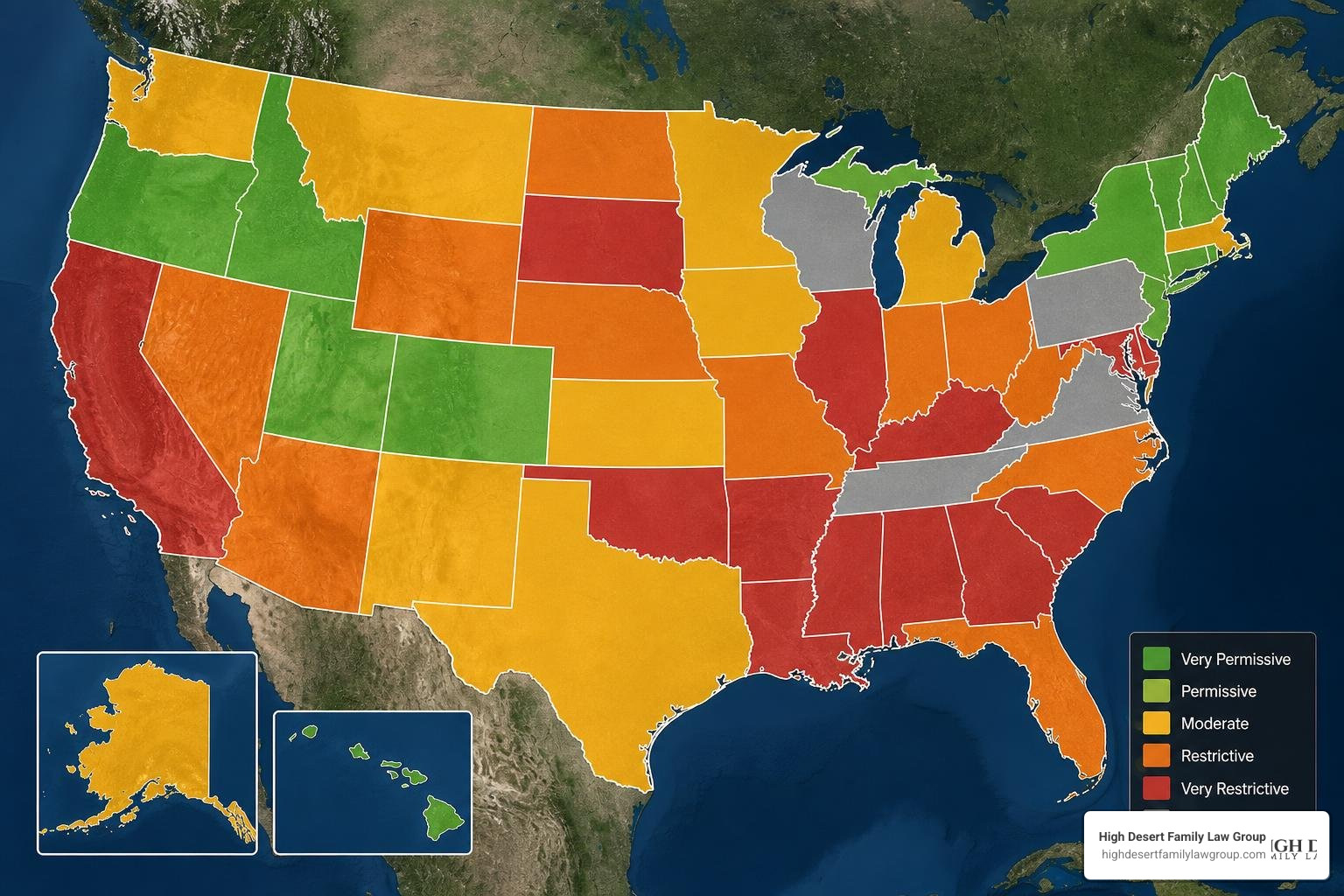
To highlight how much these rules can shift when you cross state lines, let’s look at how California, Texas, and New York handle annulments:
California
Unlike its strict divorce rules, California does not require a six-month residency period or a waiting period to file for an annulment; you simply must be living in the state at the time of filing. California courts recognize eight specific grounds for annulment, including being under the age of consent, prior existing marriages, unsound mind, fraud, force, and physical incapacity.
Texas
Texas law outlines exactly seven specific situations where an annulment may be granted. These include:
- Underage marriage (without parental consent)
- Marriage under the influence of alcohol or narcotics
- Impotency
- Fraud, duress, or force
- Mental incapacity
- Concealed divorce (where a spouse hid a divorce that occurred within 30 days prior to the marriage)
- Violating the statutory 72-hour waiting period after obtaining a marriage license
Texas imposes incredibly strict statutes of limitations on these grounds. For example, a suit based on a concealed divorce must be filed within one year of the marriage, and an action based on the 72-hour waiting period must be filed within 30 days.
New York
In New York, annulments are only granted for narrow, fault-based reasons. These include a spouse being under the age of 18, a spouse lacking the mental capacity to consent, physical incapacity, consent obtained by force or fraud, or a spouse suffering from an incurable mental illness that has lasted for five years or more. New York courts require robust proof, and simply wanting a quick exit from a brief marriage will not suffice.
Financial and Custody Impacts: Property, Support, and the Putative Spouse
Many people assume that an annulment is a “cleaner” break than a divorce because it erases the marriage. However, the financial and custodial realities of an annulment can actually be far more complex.
Property Division and Spousal Support
Because an annulment establishes that a legal marriage never existed, standard community property laws and automatic rights to spousal maintenance (alimony) generally do not apply. In a standard annulment, the court cannot simply divide assets 50/50 or order one party to pay spousal support. Instead, the parties are treated as unmarried individuals who co-owned property, which often requires separate civil property division processes.
However, there is a major legal exception designed to protect innocent partners: the putative spouse doctrine.
The Role of a Putative Spouse
A “putative spouse” is someone who believed, in good faith, that their marriage was completely legal, only to discover later that it was void or voidable due to a legal defect (such as their partner hiding a prior undissolved marriage).
If a judge finds that a party qualifies as a putative spouse:
- The court can apply equitable distribution or community property principles to divide the assets acquired during the union.
- The putative spouse may be deemed eligible to receive spousal support.
- The bad-faith spouse (the one who knew about the impediment) is typically barred from claiming these equitable protections.
Child Custody, Child Support, and Legitimacy
A common misconception is that annulling a marriage makes the children of that union “illegitimate.” Under modern family law rules, children born during an annulled marriage remain fully legitimate.
When an annulment is granted, the court still retains full jurisdiction to establish:
- Legal decision-making authority (custody)
- Parenting time schedules
- Child support obligations in accordance with state guidelines
The legal standards used to determine child custody in an annulment are identical to those used in a divorce: the court will always make decisions based on the best interests of the child.
Before deciding which path to take, it is wise to evaluate the financial landscape of your case. You can explore whether this option makes financial sense for your situation by reading our analysis on Is Annulment Cheaper Than Divorce.
Civil vs. Religious Annulments
One of the most frequent points of confusion for couples is the difference between a civil annulment and a religious annulment.
- Civil Annulment: A legal proceeding conducted in a state court. Only a civil annulment (or a civil divorce) can change your legal marital status under state law, allowing you to legally remarry.
- Religious Annulment: A purely ecclesiastical proceeding conducted by a religious body (such as a Catholic tribunal). A religious annulment has zero legal effect on your civil status. If you obtain a religious annulment but do not secure a civil divorce or civil annulment, you remain legally married in the eyes of the government.
For members of the Catholic Church, a marriage is governed by both divine law and canon law. Ecclesiastical tribunals examine the validity of the marriage at the time of consent. These proceedings are highly structured, relying on canonical guidelines such as the Vatican’s Instruction Dignitas Connubii, which provides the procedural rules for church tribunals handling causes of nullity.
While we respect and understand the immense personal and spiritual importance of religious annulments, our legal team focuses exclusively on securing your rights, property, and freedom through the civil court systems of Arizona.
Frequently Asked Questions about Annulment Rules
How long after marriage can you get an annulment?
There is a widespread myth that any short marriage (such as one lasting less than a week or a month) can be easily annulled. This is incorrect. The length of the marriage is not a legal ground for annulment.
The timeline for filing depends entirely on whether the marriage is void or voidable:
- Void Marriages: Because these are invalid from the start, they can typically be challenged at any time, even years later.
- Voidable Marriages: You must act promptly upon discovering the defect. If you continue to live with your spouse after learning of the fraud, incapacity, or force, you may legally “ratify” the marriage, losing your right to an annulment.
What happens if one spouse contests the annulment?
If your spouse disagrees with the annulment, the case becomes “contested.” Your spouse may argue that the alleged grounds do not exist, or that you ratified the marriage by continuing to cohabit.
In a contested annulment, the court will schedule an evidentiary hearing. Because the burden of proof is on the person requesting the annulment, you must present clear and convincing evidence (such as medical records, financial documents, or witness testimony) to prove your grounds. If you cannot meet this burden, the judge will deny the annulment, and you will have to file for a standard divorce instead.
Are children born during an annulled marriage considered legitimate?
Yes. In Arizona and virtually all other U.S. jurisdictions, children born to an annulled marriage are legally recognized as legitimate. The parent-child relationship is not erased by the annulment of the parents’ marriage contract. Both parents retain their natural parental rights and responsibilities, including the obligation to provide financial support.
Conclusion
Navigating the rules for marriage annulment requires a deep understanding of statutory grounds, strict timelines, and the unique financial protections of family law. Because courts grant annulments so selectively, attempting to file without experienced legal counsel can lead to dismissed petitions, wasted filing fees, and unprotected assets.
At High Desert Family Law Group, we provide aggressive, individualized representation tailored to your specific goals. Our dedicated four-person team serves clients throughout the Greater Scottsdale and Chandler, Arizona areas, helping you protect your future whether you are pursuing an annulment, a divorce, or a complex property division.
If you are ready to explore your options and find the fastest, most secure path forward, contact us today to schedule a consultation. For more information on how we can help you navigate these challenging transitions, check out More info about family law services.