



Arizona Custody: Present a Child’s Wishes Without Coaching

Arizona courts will consider a child’s wishes when the child is of suitable age and maturity, but that preference is only one factor among many in the best interests analysis and rarely decides a case on its own. Judges weigh a child’s stated preference against safety concerns, domestic violence, substance abuse, and the stability each parent offers. Courts typically gather this information through in-chambers interviews, a guardian ad litem, or a custody evaluator rather than putting a child on the witness stand.
TL;DR:
- Courts consider a child’s preference only if the child is of suitable age and can express a reasoned, independent decision supported by consistent reasoning.
- In-camera interviews, guardian ad litem reports, and custody evaluations are used to gather a child’s views while minimizing pressure and protecting confidentiality.
- A child’s preference can carry significant weight only when it is credible, age-appropriate, and supported by the child’s overall record and independence from coaching.
- Establishing a strong, factual record of routines, stability, and independent observations is more influential than a single quote or expressed desire.
- Safety concerns such as domestic violence or substance abuse can override a child’s expressed wishes in custody determinations.
Table of Contents
- What Arizona law and court rules require
- How courts collect a child’s view
- When a child’s wishes make a real difference
- How parents can responsibly present a child’s wishes
- What to expect in court and the likely timeline
- Practitioner perspective: what an experienced Arizona family law firm does for clients
- Our take on what actually moves these cases
- If you need help with your custody case
- FAQ
- Sources
What Arizona law and court rules require
A.R.S. § 25-403 directs courts to make legal decision-making and parenting time determinations based on the child’s best interests, considering all relevant factors. One of those factors is the wishes of the child, but only “if the child is of suitable age and maturity.” The statute does not set a specific age. Instead, judges look at whether a child can express a reasoned, independent preference rather than repeating something a parent told them to say.
When a custody case is contested, the court cannot simply announce a decision. A.R.S. § 25-403(B) requires the judge to make specific findings on the record about each relevant factor, including what weight, if any, was given to the child’s wishes. This requirement matters because it creates an actual record that an appellate court can review later.
The Arizona Rules of Family Law Procedure also govern how a child’s views reach the judge. Key provisions include:
- A judge may conduct an in-camera interview on written motion or on the court’s own initiative.
- Interviews must be recorded, and the child must be told about the limits of confidentiality before it starts.
- Judges are directed to take special precautions in cases involving allegations of domestic violence or abuse.
- Very young children are generally not interviewed unless the court finds they are capable of forming an intelligent preference.
Separately, A.R.S. § 25-405 gives courts explicit authority to interview a child in chambers specifically to learn the child’s wishes about legal decision-making and parenting time.
How courts collect a child’s view
Arizona judges rarely question a child directly in open court. The process is designed to protect the child from feeling like a witness against either parent, while still giving the judge usable information.
- In-camera interviews happen in the judge’s chambers, outside the courtroom, usually requested through a motion under the family law procedure rules. The session is recorded, and the record is typically made available to both parties unless they agree otherwise.
- Guardians ad litem (GALs) are appointed to represent the child’s best interests throughout the case, investigating home environments, talking with the child, and reporting findings to the court.
- Custody evaluators conduct a more clinical assessment, often including interviews, observation, and sometimes psychological testing, then submit a written report with recommendations.
- CASA volunteers (Court Appointed Special Advocates) may be involved in certain cases, particularly where the child’s welfare is a central concern.
When conflict runs high or there are signs of coaching, judges frequently lean on a GAL or evaluator’s report instead of interviewing the child directly. A neutral professional trained in age-appropriate interviewing techniques can draw out a child’s actual views without the pressure of a courtroom setting, which often produces a more reliable picture than a direct question ever could.
When a child’s wishes make a real difference
There is no fixed age at which a child’s opinion starts to count in Arizona. Judges instead look at a cluster of factors that tell them how much weight a particular child’s preference deserves.
- Maturity and reasoning: A judge listens for whether the child can explain specific, coherent reasons for a preference, not just a one-word answer.
- Consistency over time: A child who has expressed consistent views across different settings carries more credibility than one whose story shifts.
- Signs of coaching: Rehearsed language, scripted phrases, or statements that mirror one parent’s talking points reduce how much a court trusts the stated preference.
- Age-appropriate content: A preference tied to practical, age-appropriate reasons (school, friends, routine) tends to land differently than one rooted in resentment toward a parent.
- Safety overrides: Findings of domestic violence, substance abuse, or DUI history can outweigh a child’s preference entirely, since the statutory factors covering safety carry independent weight regardless of what the child says.
An appellate decision from 2025 confirmed that a court may give substantial weight to a child’s wishes when the record supports it, but the judge still has to evaluate every best-interest factor and put specific findings on the record rather than leaning on the child’s statement alone. A separate Arizona Supreme Court opinion reinforces that a child’s preference can outweigh other considerations only when it is credible and backed by the broader record, not simply because the child expressed it.
How parents can responsibly present a child’s wishes

What a parent does before and during a custody case often matters more than what the child actually says. Courts are trained to spot pressure, and a parent who appears to have shaped a child’s answer can damage their own credibility far more than it helps their case.
Helpful steps include:
- Keep a factual record of routines, school involvement, and daily caretaking rather than relying on the child’s opinion as evidence.
- Encourage the child to speak naturally with a GAL or evaluator rather than rehearsing talking points beforehand.
- Request an evaluation or GAL appointment early, since these reports take time to complete and often shape the rest of the case.
- Build a parenting plan around the child’s actual needs, including school stability and existing relationships, rather than simply what the child says they want.
Avoid these common mistakes:
- Asking a child leading questions like “don’t you want to live with me?”
- Discussing the case, the other parent, or court dates in front of the child.
- Posting about the custody dispute on social media, which can surface in court as evidence of pressure or poor judgment.
- Any attempt to coach responses, even subtly, since evaluators and judges are specifically trained to notice it.
Pro Tip: Frame every request around the child’s documented needs, school records, medical history, daily schedule, rather than a single quote attributed to the child.
What to expect in court and the likely timeline
A contested case touching on a child’s wishes usually moves through a predictable sequence, though the pace depends on how crowded the court’s calendar is and whether evaluations are ordered.
- Motions are filed requesting an in-camera interview, a GAL, or a custody evaluation.
- Evaluations and GAL investigations typically take weeks to months to complete.
- An evidentiary hearing follows, where evidence, reports, and sometimes the recorded interview are presented.
- The judge issues findings addressing each best-interest factor, including the weight given to the child’s wishes.
- Either parent may appeal if the findings are incomplete or unsupported by the record.
Because A.R.S. § 25-403(B) requires specific findings, a judge who skips over how they weighed the child’s preference creates grounds for appeal. Outcomes where a child’s wishes played a real role tend to include modified parenting time schedules, a supervised transition period, discretion for the child to arrange additional contact, or an outright denial of the preference when safety findings point the other way, as can happen in cases involving domestic violence.
Practitioner perspective: what an experienced Arizona family law firm does for clients
Translating a statute into a winning case takes more than reading the law. In practice, attorneys handling these matters typically:
- Gather school, medical, and caretaking records that corroborate (or contradict) a stated preference.
- File motions requesting an in-camera interview or GAL appointment at the right point in the case.
- Retain qualified custody evaluators when the case calls for a more detailed assessment.
- Coordinate with a GAL to make sure the child’s voice reaches the court without the child feeling caught in the middle.
- Prepare evidence and testimony for the hearing in a way that supports every best-interest factor, not just the child’s preference.
Our team has guided many cases through exactly this process, and we know that realistic timelines and transparent cost expectations matter as much as courtroom strategy.
Our take on what actually moves these cases
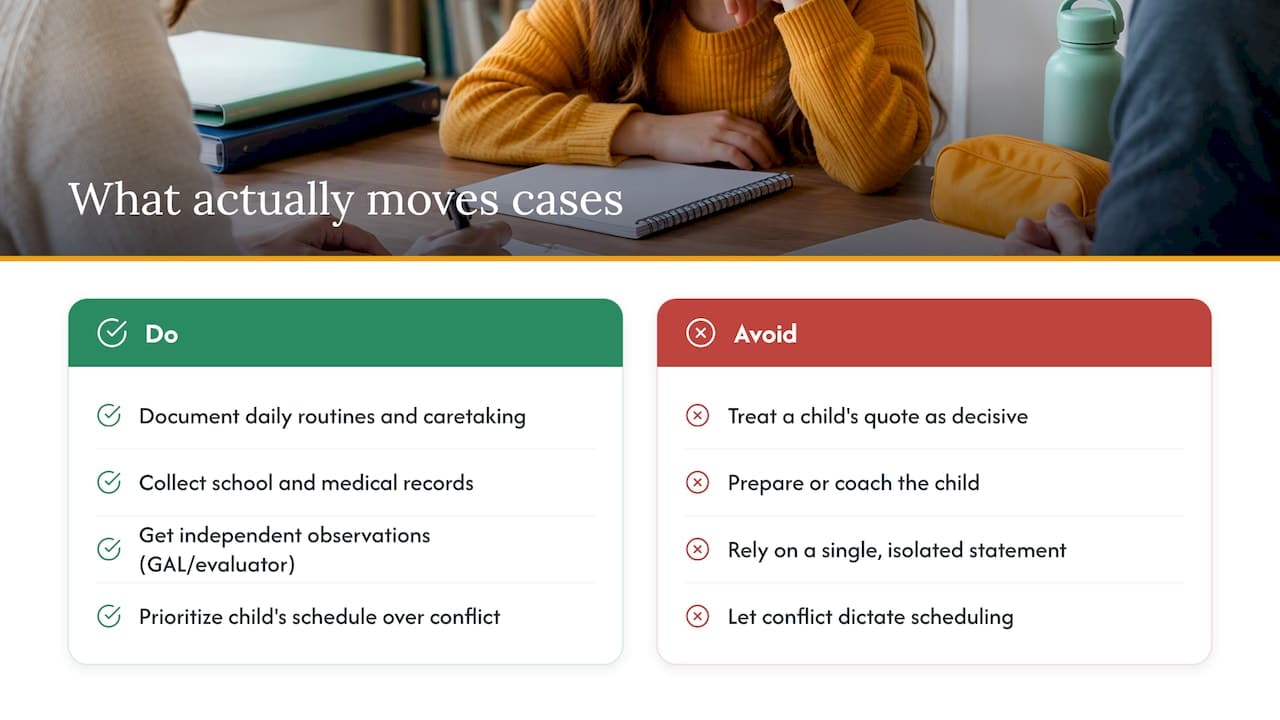
The conventional advice on this topic puts too much weight on the child’s words themselves and not enough on the record surrounding them. Parents often assume that if their child says they want to live with them, the case is decided. It is not, and treating a child’s statement as the centerpiece of a case tends to backfire once a judge starts asking who prepared the child to say it.
What actually moves these cases is consistency: a child whose preference lines up with documented routines, stable caretaking, and independent observations from a GAL or evaluator. A single quote from a child, however heartfelt, rarely survives scrutiny on its own. Parents who prioritize building that broader record, school involvement, medical appointments, a track record of putting the child’s schedule ahead of conflict, give a judge something sturdier to rely on than a child’s momentary answer to a hard question.
If you need help with your custody case
Custody disputes involving a child’s wishes rarely stay simple, and the stakes of getting the record wrong are high. We handle child custody matters, including cases that call for a best interest attorney to represent the child’s position directly, relocation and interstate custody questions, and mediation for parents who want to resolve parenting time without a drawn-out court fight.

Getting started usually begins with a consultation where we review your current parenting time arrangement, any prior court orders, and relevant records like school and medical documentation. From there, we help you decide whether an evaluation, GAL request, or mediation track fits your situation best. If you are facing a custody dispute where your child’s wishes are likely to come up, reach out to discuss your options before your next hearing date.
FAQ
At what age can kids decide what parent to live with in Arizona?
Arizona law does not set a fixed age; courts instead look at whether a child shows suitable age and maturity to form an independent, reasoned preference. A child’s wishes are considered as one factor among several, not as a binding decision the child makes alone.
What is the biggest mistake in a custody battle?
The most damaging mistake is putting a child in the middle of the conflict, whether through leading questions, coaching, or exposing them to disputes about the other parent. Judges and evaluators are trained to recognize rehearsed or pressured statements, and this can undercut a parent’s credibility more than it helps their position.
What is rule 69 in Arizona?
Certain rules under the Arizona Rules of Family Law Procedure govern agreements reached between parties, including settlements read into the record or signed during a case. These are separate from the rules covering in-camera child interviews, which fall under different provisions of the same family law procedure rules.
What makes a dad lose custody?
A father, like any parent, can lose custody or decision-making authority when findings show domestic violence, substance abuse, or instability that conflicts with the child’s best interests. Specific circumstances such as these carry independent weight under the law and can outweigh a child’s stated preference entirely.
Sources
- Arizona Revised Statutes § 25-403 – Legal decision-making; best interests of child
- Arizona Rules of Family Law Procedure (rules on interviewing children)