



Prove and Protect an Inheritance in Arizona Divorce: 4 Steps

Under Arizona law, inheritance is generally separate property and not subject to division in divorce. The main exceptions arise when inherited funds get commingled with marital money, when a spouse retitles inherited property into joint names, or when community funds pay down a mortgage or fund improvements on an inherited asset. The sections below walk through the statutes, the case law, and the practical steps that protect an inheritance when a marriage is ending.
TL;DR:
- Inheritances received during marriage are presumed to remain separate property unless they are commingled with marital funds or retitled jointly.
- Depositing inheritance into a joint account or paying joint expenses from separate inherited funds can result in loss of its separate status, requiring careful tracing.
- An equitable lien can compensate the community when community funds are used for mortgage paydowns or improvements on inherited property, without converting it to community property.
- Proper documentation, including deeds, bank statements, and clear records, is essential to prove an inheritance’s separate status in disputes.
- A prenuptial or postnuptial agreement can specify inheritance treatment in divorce, reducing the need for invasive tracing and legal uncertainty.
Table of Contents
- Statutory foundation: what Arizona law actually says about inheritances
- When a separate inheritance can become disputed: commingling, retitling, and gifts
- When the community has a claim: equitable liens and the Drahos/Barnett approach
- Common scenarios: inherited house, cash, and business interests
- How to prove separate-property tracing: evidence the court accepts
- Practical steps to protect an inheritance before or during divorce
- Impact of inheritance received before the marriage on division during divorce
- Effect of inheritance received during the marriage but kept separate
- How inherited retirement accounts or pensions are treated in divorce
- Tax implications of dividing inherited property during divorce
- Impact of prenuptial or postnuptial agreements on inherited property in Arizona divorces
- How an Arizona family law practitioner approaches inheritance disputes
- How High Desert Family Law Group can help with inheritance issues
- FAQ
- Sources
Statutory foundation: what Arizona law actually says about inheritances
Arizona’s community property system starts with a clear carve-out for inherited assets. A.R.S. § 25-213 states that property a spouse acquires by gift, devise, or descent, along with any increase, rents, issues, and profits from that property, belongs to that spouse alone. An inheritance received by one spouse stays that spouse’s separate property even if the marriage continues for decades afterward.
That classification does not end the analysis, though. A.R.S. § 25-318 directs the court handling a dissolution to assign each spouse’s separate property back to that spouse while dividing community property equitably. The same statute allows a judge to place a lien on separate property to secure a payment the court orders, which becomes important when community funds have been spent improving an inherited asset.
Timing also matters. A.R.S. § 25-211 treats property acquired during the marriage as community property, with exceptions for gifts, devises, and inheritances, and it addresses how service of a divorce petition affects later acquisitions.
- Inheritance received at any point in the marriage is presumptively separate property.
- Increases, rents, and profits generated by that inheritance remain separate unless the character changes.
- Courts must assign separate property to its owner and divide community property fairly.
When a separate inheritance can become disputed: commingling, retitling, and gifts
An inheritance loses its separate character fastest through commingling: mixing inherited funds with marital money until the two can no longer be distinguished. Depositing an inheritance into a joint checking account used for household bills is the classic example. So is paying the joint mortgage from an inherited account without keeping a record of which dollars came from where. Once inherited and community funds blend in the same account, FindLaw’s summary of A.R.S. § 25-213 notes that courts will require tracing to sort out what remains separate.
Retitling creates a separate problem. Adding a spouse’s name to a deed or account that once held only inherited funds can look like an intentional gift to the community, and Arizona courts scrutinize that intent closely.
- Written disclaimers or emails stating the funds were meant to stay separate carry weight.
- Account histories showing consistent, isolated deposits support a separate-property claim.
- Contemporaneous notes made near the time of the transfer are more persuasive than explanations offered years later.
Pro Tip: Never deposit an inheritance into a joint account “just temporarily.” Open a separate account in your name only and leave it untouched by marital spending.
When the community has a claim: equitable liens and the Drahos/Barnett approach
Even when an inherited house or account stays titled in one spouse’s name, the community can still have a financial claim against it. An equitable lien attaches when community funds reduce the principal on a mortgage secured by separate property or pay for capital improvements that raise its value. Arizona appellate decisions addressing equitable liens and tracing, including the approach courts apply following Drahos and Barnett, use a formula as a starting point for calculating what the community is owed.
The Drahos/Barnett baseline is: community reimbursement equals the community’s contribution, plus the community’s contribution divided by the asset’s base value, multiplied by any appreciation. Courts can adjust that figure based on the specific facts of the case, including how much of the appreciation came from the market versus the contribution itself.
- An equitable lien compensates the community; it does not convert the inherited asset itself.
- The remedy applies to mortgage paydown and improvements, not to routine maintenance like repairs or taxes.
- Courts weigh documentation quality heavily when deciding how much reimbursement to award.
The goal in these cases is reimbursement, not transformation. The house, account, or business stays the separate property of the inheriting spouse; the community simply gets paid back for what it put in.
Common scenarios: inherited house, cash, and business interests
Most inheritance disputes in Arizona divorces fall into a handful of recurring patterns.
- Inherited house: When a spouse inherits a home and later adds the other spouse to the title, courts often treat that as a gift to the community, splitting the equity. When the house stays titled solely in the inheriting spouse’s name but community funds paid the mortgage or financed a remodel, the more common outcome is an equitable lien rather than a forced sale or equal split. For more detail on how Arizona treats inherited real estate specifically, see our discussion of separate property and Paradise Valley homes.
- Inherited cash in accounts: Funds that stay in a dedicated account, never mixed with paychecks or joint spending, are the easiest to trace and protect. A balance that never drops below the original inherited amount is strong circumstantial evidence the money remained separate.
- Business or investment inheritances: When a spouse inherits a business or investment that grows during the marriage through both market performance and the owner’s labor, Arizona courts apportion the profits between separate and community sources rather than assigning the whole gain to one side.
How to prove separate-property tracing: evidence the court accepts
Tracing is the process of showing a court, dollar for dollar or through a reasonable pattern, that specific funds remained separate property. Judges want documentary proof first.
- Deeds, probate records, or beneficiary designations showing the asset came from an inheritance.
- Bank statements and closing statements showing the funds moved directly from the estate to a separate account or purchase.
- A transaction history free of deposits from paychecks, joint accounts, or marital income.
When records are incomplete, Arizona courts accept circumstantial tracing: showing that an account balance never dropped below the original separate contribution, or applying percentage allocations when funds mixed only partially. Arizona appellate decisions on apportionment reinforce that courts expect this kind of careful accounting when separate and community money mix.
For larger estates or businesses, a forensic accountant can reconstruct years of transactions that informal tracing cannot. Firms like Foley Family Law describe how forensic accounting experts isolate separate contributions from community ones; the cost makes sense when the disputed value clearly exceeds the expert’s fee.
Pro Tip: Before hiring a forensic accountant, ask for a rough estimate of recoverable value. If the inheritance in dispute is modest, documentary tracing alone may be enough.
Practical steps to protect an inheritance before or during divorce
Protecting an inheritance is mostly about discipline with paperwork and accounts, not complicated legal maneuvering.
- Keep inherited funds in an account titled only in your name, separate from any joint account.
- Preserve the probate paperwork, beneficiary designation, or estate closing statement that proves the source of the funds.
- Consider a prenuptial or postnuptial agreement that spells out how inherited assets will be treated, or add a written disclaimer any time you handle inherited money jointly with your spouse.
- If divorce is already pending, stop any commingling immediately, gather your records, and talk with a family law attorney before moving or spending inherited funds. Our overview of the Arizona divorce preliminary injunction explains what restrictions apply to both spouses once a case is filed.
Pro Tip: Keep a simple spreadsheet noting the date, source, and amount of every inherited deposit. A habit that takes five minutes now can save thousands in tracing costs later.
Impact of inheritance received before the marriage on division during divorce
An inheritance received before a couple marries starts out as separate property and generally stays that way, but premarital timing does not make it immune from the same commingling risks that apply to inheritances received later. If a spouse inherited money years before the wedding and kept it in a dedicated account that was never touched by marital funds, it remains separate under A.R.S. § 25-213 regardless of how long the marriage lasted.
Problems arise when premarital inherited funds get folded into joint planning after the wedding, such as using inherited savings as a down payment on a home titled in both spouses’ names. That single act can convert what started as separate property into a community asset, or at least create a mixed-character asset that requires tracing to sort out.
The length of the marriage matters less than most people assume. A twenty-year marriage does not automatically dilute a premarital inheritance’s separate character, as long as the funds were never mixed with community money or retitled jointly. What matters is the paper trail from the moment of inheritance forward. Our guide to Arizona community property laws covers how courts draw this line between premarital and marital acquisitions more broadly.
Effect of inheritance received during the marriage but kept separate
An inheritance received while already married is treated exactly the same as one received before marriage under Arizona law: it is separate property from the moment it is received, provided it stays that way. The timing of the inheritance relative to the wedding date has no bearing on its classification; what matters is whether the receiving spouse kept it apart from community funds.
Spouses who inherit during a marriage and want to preserve that separate status should treat the inheritance the same way they would any asset they are trying to protect. That means a dedicated account, no joint titling, and no use of the funds for shared expenses without a clear repayment plan or documentation.
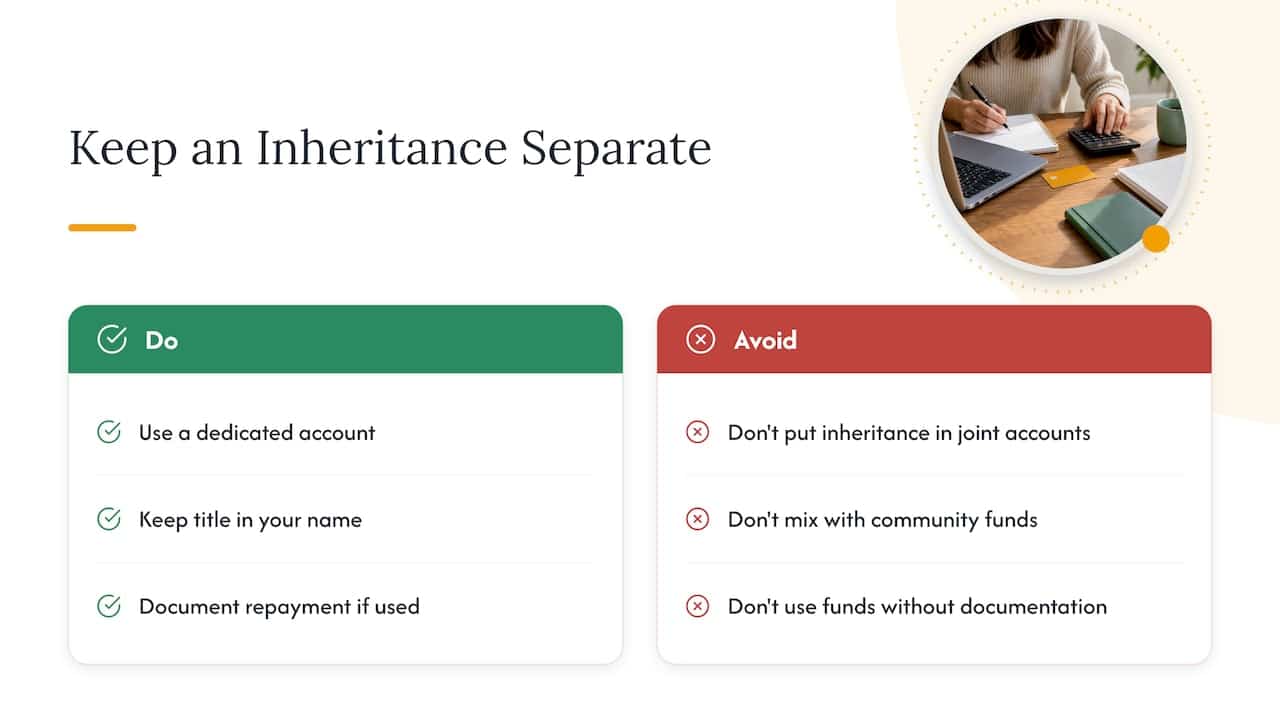
The risk during marriage is that daily financial life makes commingling easy to do without thinking. A spouse who inherits $50,000 mid-marriage and parks it in the household’s shared checking account to “earn interest for a while” has created a tracing problem even if the money is later moved back out. Courts look at the full transaction history, not just where the money ended up. Keeping inherited funds untouched in their own account from day one remains the simplest way to avoid a dispute, regardless of when in the marriage the inheritance arrived.
How inherited retirement accounts or pensions are treated in divorce
Inherited retirement accounts, such as an inherited IRA from a parent, follow the same separate-property rule as cash or real estate under A.R.S. § 25-213. The account belongs to the spouse who inherited it, and growth within that account also remains separate as long as no community contributions are added to it.
The complication comes from contributions made during the marriage. If a spouse rolls an inherited retirement account into an existing 401(k) that also receives ongoing payroll contributions, the inherited portion can become difficult to separate from the community portion built through employment during the marriage. Once mixed, apportionment becomes necessary, similar to the business and investment scenarios discussed earlier.
Beneficiary designations also deserve attention. An inherited retirement account typically passes to the named beneficiary regardless of marital status, but a divorce decree can still affect how the account interacts with spousal maintenance or the overall property division. Spouses holding inherited retirement accounts should keep rollover statements and contribution records that clearly separate the inherited principal from any later, marital-source additions, since those records are what a court or a forensic accountant will rely on if the account’s character is disputed.
Tax implications of dividing inherited property during divorce
Dividing marital assets as part of a divorce decree does not typically trigger a taxable event between spouses, and this applies to property that has already been determined to be community property versus an inherited asset ruled to remain separate. Because inherited property is usually awarded entirely to the inheriting spouse rather than split, the tax question that matters most is what happens if that property is sold later.
Inherited assets generally receive a stepped-up basis to their value at the time of the original owner’s death, which affects capital gains calculations if the inheriting spouse later sells the house, investment account, or other asset. A divorce does not change that basis, but it does mean the inheriting spouse alone will be responsible for any capital gains tax when the asset is eventually sold.
When a court awards an equitable lien in favor of the community for mortgage paydown or improvements, that reimbursement is generally treated as part of the property settlement rather than as separate taxable income. Specific tax outcomes depend on the asset type, how long it is held, and each spouse’s broader financial situation, so a tax professional’s review alongside your attorney’s advice is worth the modest cost before finalizing a settlement that involves a significant inherited asset.
Impact of prenuptial or postnuptial agreements on inherited property in Arizona divorces
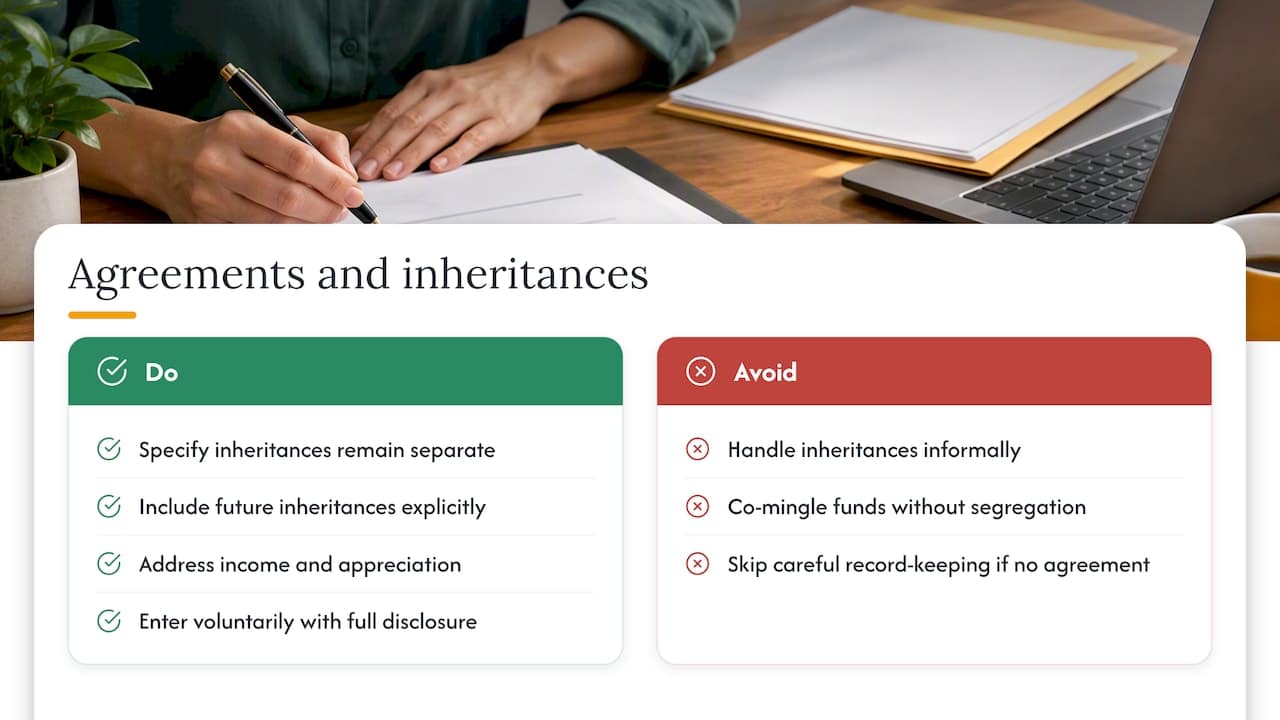
A prenuptial or postnuptial agreement can remove most of the guesswork around how an inheritance will be treated if a marriage ends. Spouses can specify in advance that any inheritance, including future inheritances not yet received, will remain separate property no matter how it is later managed, titled, or spent during the marriage.
This matters most for couples who know a sizable inheritance is likely, such as when a spouse is a named beneficiary in a parent’s estate plan. A well-drafted agreement can address not just the inheritance itself but also how income or appreciation from it will be classified, removing the need for tracing arguments years later.
Postnuptial agreements serve the same function for inheritances received after the wedding, letting spouses formalize separate treatment of funds that might otherwise invite a commingling dispute if handled informally. Courts generally enforce these agreements when they are entered voluntarily, with full financial disclosure, and without evidence of coercion.
For spouses without a prenuptial or postnuptial agreement, the statutory presumption under A.R.S. § 25-213 still provides real protection, but it requires the kind of careful record-keeping and account segregation described throughout this article. An agreement simply makes the outcome more predictable and reduces the evidence burden if a dispute ever reaches court.
How an Arizona family law practitioner approaches inheritance disputes
Tracing disputes come down to documentation quality. Our team reviews account histories and probate paperwork early to gauge whether a claim is provable before recommending a forensic accountant, since that expense only makes sense when the disputed value justifies it. Early legal review almost always costs less than untangling a commingled account two years into a case.
How High Desert Family Law Group can help with inheritance issues
Sorting out whether an inheritance stayed separate, or figuring out what the community is owed for a mortgage paydown, takes someone who reads account statements the way a court will. We handle divorce litigation, mediation, and property division matters, and we start every inheritance-related case with a records review so you know where you stand before negotiations begin.

If an inheritance is part of your marital estate, reach out through our divorce services page to schedule a review of your records and discuss next steps.
FAQ
Does receiving an inheritance during marriage automatically make it community property in Arizona?
No. Under A.R.S. § 25-213, an inheritance is separate property regardless of when during the marriage it was received. It only risks becoming community property if the funds are commingled with marital money or the asset is retitled into both spouses’ names.
How to avoid selling a house in divorce?
Spouses can avoid selling a house by having one spouse buy out the other’s equity share, trading other marital assets of equivalent value, or agreeing to a deferred sale after children reach a certain age. When the house traces back to an inheritance kept separate, the inheriting spouse may be able to keep it outright while reimbursing the community for any equitable lien.
What are some creative ways to keep the house after a divorce?
Options include refinancing to buy out the other spouse’s interest, offsetting the house’s value against retirement accounts or investment assets in the settlement, or negotiating a delayed buyout paid over time. For an inherited home, documenting that the down payment and mortgage came from separate funds strengthens the case for keeping it without a lien dispute.
Should I keep my house in divorce?
That depends on whether you can afford the mortgage and upkeep alone and whether keeping the house serves your longer-term financial goals better than taking other assets instead. Our overview of who gets the house in a divorce without children walks through the factors Arizona courts and spouses typically weigh.
How to deal with a house in divorce when it was inherited?
Start by gathering the deed, probate documents, and any mortgage or improvement records tied to the home. Those records determine whether the house stays fully separate or whether the community is owed reimbursement under the equitable lien approach described in Arizona appellate decisions.
Sources
- Arizona Revised Statutes § 25-213 – Separate property
- FindLaw — Arizona Revised Statutes § 25-213 (annotation and explanation)
- Arizona Court of Appeals opinion addressing equitable lien and Drahos/Barnett