



Temporary Orders in Arizona: How to File and What Happens

A temporary order is a short-term court directive Arizona judges issue while a divorce, custody, or paternity case is still pending. You get one by filing a verified Motion for Temporary Orders under Rule 47 of the Arizona Rules of Family Law Procedure, or a Rule 48 emergency motion if the situation can’t wait for a hearing date. File it with, or shortly after, your initial petition.
Attach a proposed order, a parenting plan or child support worksheet if kids are involved, and an Affidavit of Financial Information if money is on the table. A.R.S. § 25-316 and Rule 47 govern what the court can grant and how the motion has to be built.
Temporary orders don’t decide your case. They decide who pays the mortgage, where the kids sleep, and who covers the car payment while your case works its way to a final decree.
- File a verified Motion for Temporary Orders (or emergency motion without notice if there’s real urgency).
- Attach a proposed order, parenting plan/child support worksheet, and financial affidavit.
- Serve the other party and prepare for a resolution management conference.
Key Takeaways
Filing a compliant, well-documented Motion for Temporary Orders under Rule 47 is the fastest path to interim relief in an Arizona family law case.
| Point | Details |
|---|---|
| File under Rule 47 | Submit a verified motion with a proposed order, parenting plan, and financial affidavit attached. |
| Emergency option exists | Rule 48 allows orders without notice, but requires a 10-day evidentiary hearing afterward. |
| Timeline is fast | Expect a resolution management conference near 30 days and a ruling within 21 days of the hearing. |
| Forms matter | DRT11f, DRT12f, DRCVG11f, and DROSC13f cover the core filing requirements. |
| Get help drafting the motion | Highdesertfamilylawgroup prepares temporary order motions and hearing strategy for Scottsdale clients. |
Table of Contents
- What Kinds of Relief Can Arizona Temporary Orders Cover?
- How Do You File a Motion for Temporary Orders in Arizona?
- Can You Get an Emergency Temporary Order Without Notice?
- How Long Does It Take to Get a Temporary Orders Hearing in Arizona?
- What Forms Do You Need for Temporary Orders in Arizona?
- How Should You Prepare for a Temporary Orders Hearing?
- What Happens After a Temporary Order Is Entered?
- Why a Tight Proposed Order Changes the Outcome
- How High Desert Family Law Group Handles Temporary Orders
- Arizona Temporary Order FAQs
- Sources
What Kinds of Relief Can Arizona Temporary Orders Cover?
Arizona law gives judges a specific menu of interim relief under A.R.S. § 25-316. You don’t have to guess what’s available or invent a request the court has no authority to grant.
- Legal decision-making (custody) and parenting time
- Temporary child support
- Temporary spousal maintenance
- Exclusive use of the family home
- Equal possession of liquid assets
- Interim attorney fees
- Assignment of debts and who pays which bills during the case
Courts can also decide who keeps using a car, who stays in the house, and who covers a specific recurring expense. None of it locks in the final outcome. Temporary orders are modifiable by definition, and they automatically terminate once the final decree is entered or the case is dismissed, unless the decree says otherwise.
How Do You File a Motion for Temporary Orders in Arizona?
You can file with your initial petition or afterward, including in some post-decree matters where circumstances change fast. Rule 47 spells out exactly what the motion has to contain: a verified statement of the legal and jurisdictional basis, the specific relief you’re requesting, and the required attachments. A generic request for “help with money and the kids” will not survive scrutiny. Judges want line-item asks.
- Complete the Motion for Temporary Orders and attach a proposed order that mirrors exactly what you’re asking for.
- Prepare supporting documents: parenting plan, child support worksheet, and Affidavit of Financial Information.
- File the Order to Appear along with the motion.
- Submit everything with the clerk of the Superior Court.
- Serve the opposing party according to Rules 40 and 41.
- Complete any required meet-and-confer step before the hearing.
A few practical notes worth knowing before you walk into the clerk’s office:
- The Maricopa County DRT packet bundles the forms you’ll actually need, including local instructions most self-represented filers miss on a first pass.
- Bring extra copies. Courts routinely want one for the judge, one for the file, and one for service.
- If your case only involves child support and there’s no real dispute, ask about the simplified temporary child support process. It moves faster than a contested motion.
Can You Get an Emergency Temporary Order Without Notice?
Yes, but the bar is high. Rule 48 allows a court to grant relief without notifying the other party only when your verified motion lays out specific facts showing irreparable injury, loss, or danger to you or a minor child. Vague fear isn’t enough. You need dates, incidents, and details a judge can act on.
- The motion must certify what efforts, if any, you made to give notice.
- No bond is typically required unless the judge orders one.
- The court must set an evidentiary hearing generally within 10 days of granting an order without notice.
- The judge must state specific findings in the order explaining why immediate relief was justified.
10 days. That’s the window Rule 48 builds in for the other side to be heard once an ex parte order is entered. It exists because emergency relief only works one direction until someone checks it, and Arizona courts move fast to correct that imbalance. If you’re dealing with a safety-driven filing rather than a scheduling emergency, a partner resource on emergency orders of protection walks through how those overlapping but distinct filings work.
How Long Does It Take to Get a Temporary Orders Hearing in Arizona?
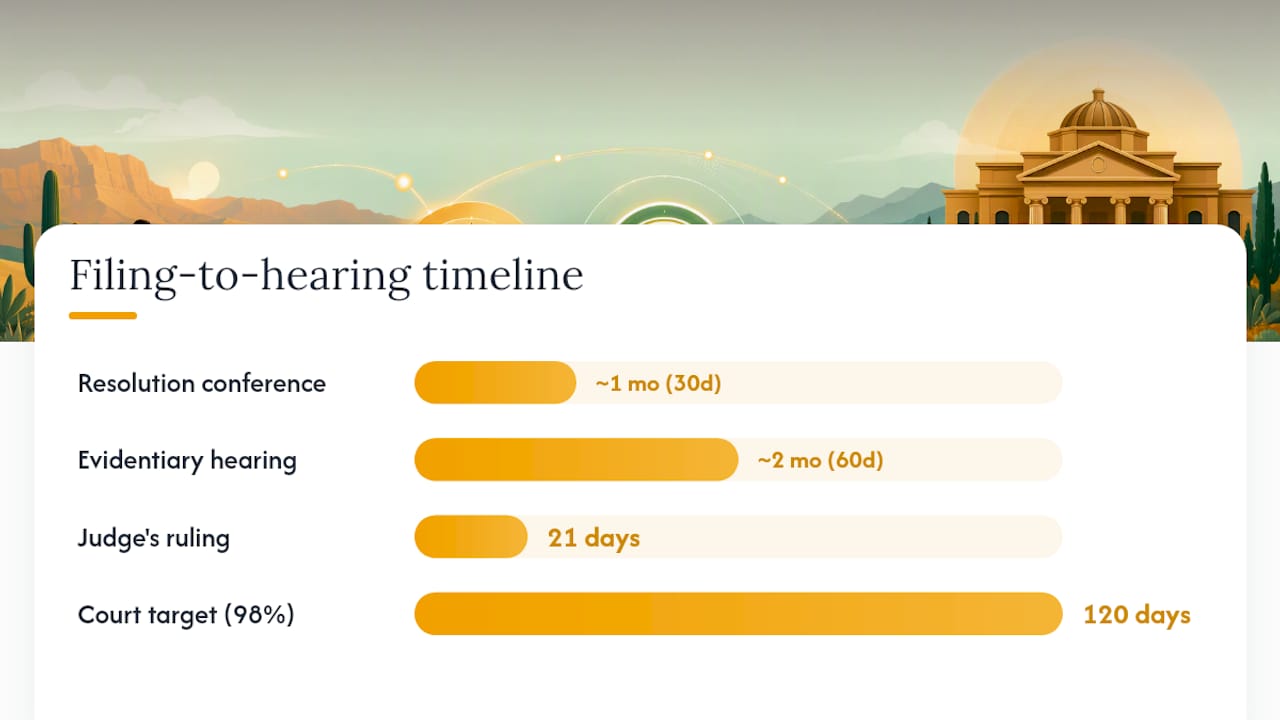
Once you file, the court schedules a resolution management conference, generally within about a month, and Rule 47 pushes toward an evidentiary hearing on custody and parenting-time issues within about two months of filing, absent a waiver or good cause to extend it. After the hearing wraps, the judge has to rule within about three weeks. That 21-day rule matters. It’s one of the few hard deadlines in family court, and it means a compressed hearing doesn’t turn into months of silence.
Expect the hearing itself to move fast. Judges lead the questioning, witnesses are limited, and you don’t get to relitigate the whole marriage. Stick to the specific relief in your motion.
- Exchange exhibits and witness lists several days before the hearing, per Rule 47 timelines.
- Bring a proposed order that’s ready for the judge to sign, not a draft.
- Keep direct testimony short and focused on the facts that support your specific request.
Case-processing standards from the Arizona courts target resolving 90% of pre-decree temporary matters within 60 days and 98% within 120 days, which tells you how seriously the system treats delay on interim issues.
What Forms Do You Need for Temporary Orders in Arizona?
Maricopa County’s DRT packet bundles the forms most filers need in one place, and knowing the codes ahead of time saves a trip back to the clerk’s window.
- DRT11f (Motion for Temporary Orders): the core filing that states your requested relief.
- DRT12f (Order to Appear): sets the hearing and notifies the other party.
- DRCVG11f (Parenting Plan): required for any custody or parenting-time request.
- Child Support Worksheet: calculates the support figure using state guidelines.
- DROSC13f (Affidavit of Financial Information): required for support or spousal maintenance requests.
- Proposed order, recent income documents, and bank statements to back up the numbers.
If your motion involves only simplified temporary child support and the other party doesn’t respond, the court can enter your proposed order as filed. File your copies with the assigned judicial officer, and get exhibits to the other side at least three days before the hearing date, not the morning of.
How Should You Prepare for a Temporary Orders Hearing?
Practitioners treat these hearings as triage, not trial. A temporary orders hearing gives the judge maybe 15 to 30 minutes to decide who pays what and where the kids sleep next week, so anything that doesn’t serve that decision gets cut.
Pro Tip: Keep your opening statement to 60 to 90 seconds. Hand the judge a one-page proposed order that mirrors your spoken request word for word, and paginate your exhibits so you’re never flipping through a stack while the clock runs.
- Prioritize immediate, concrete facts: current income, who’s paying the rent now, where the child slept last night.
- Skip the marital history and the long list of grievances. It doesn’t move the temporary decision.
- Build a one-page chronology for the judge showing the relief requested, the supporting facts, and the dollar amount if money is involved.
A protection order hearing guide covers similar hearing-presentation tactics if your case involves safety concerns alongside custody or support.
What Happens After a Temporary Order Is Entered?
Temporary orders generally expire when the final decree is entered or the case is dismissed, unless the decree says the order continues. Until then, they’re enforceable and modifiable.
- To change a temporary order, file a new motion showing a material change in circumstances, usually for support or parenting-time adjustments.
- To enforce one, file a motion to enforce rather than waiting out the noncompliance.
- Remedies include contempt findings, make-up parenting time, or wage withholding for unpaid support.
If your situation shifts again after the final decree, the process for modifying a post-decree order follows a similar material-change standard.
Why a Tight Proposed Order Changes the Outcome
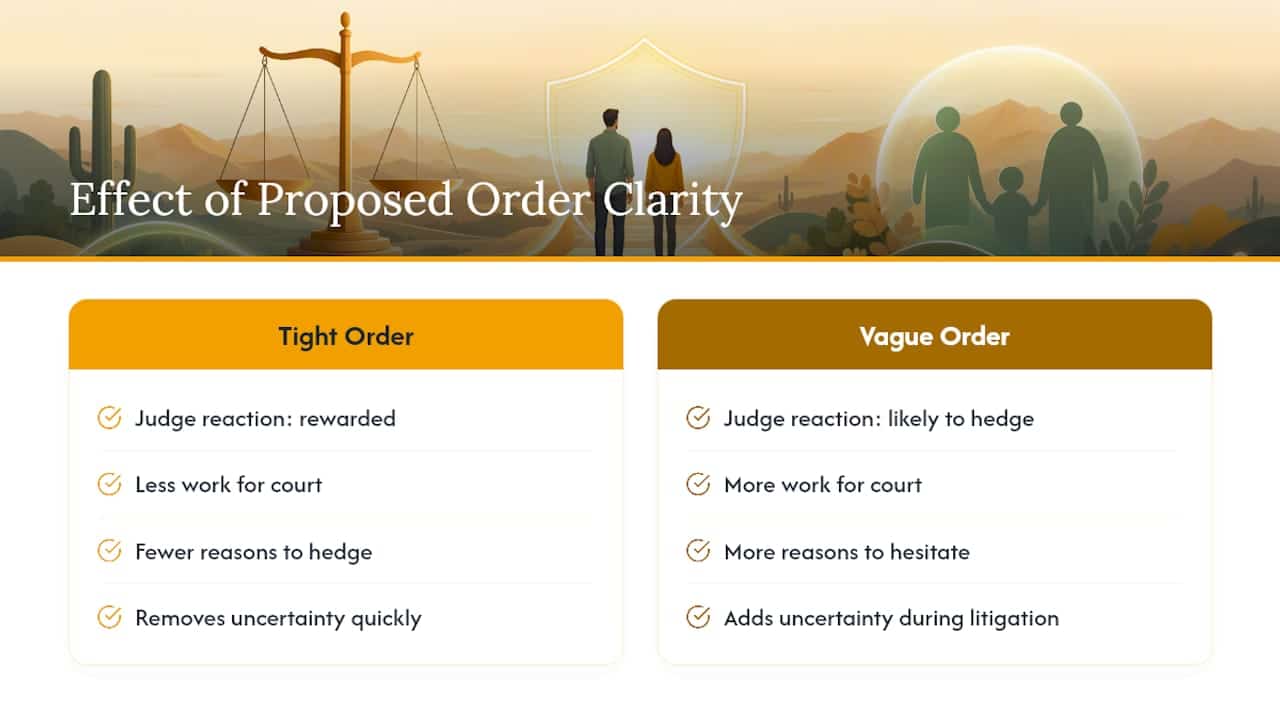
Judges reward clarity in a room where time is the scarcest resource. A short, well-supported proposed order that matches your testimony word for word gives the court less work to do and fewer reasons to hedge. That’s not a courtroom trick. It’s just how a compressed hearing actually functions.
Temporary orders exist to remove uncertainty during litigation, not add to it. They tell you who’s paying the light bill and who’s picking up the kids on Tuesday while the bigger case plays out. Getting that resolved quickly and correctly protects your finances and your parenting time long before the final decree ever gets signed. If drafting the motion or building a hearing strategy feels out of reach on your own, that’s exactly the gap a family-law attorney is built to close.
How High Desert Family Law Group Handles Temporary Orders
Highdesertfamilylawgroup drafts and files temporary motions for Scottsdale clients who don’t have weeks to spare, including emergency ex parte requests when the situation genuinely can’t wait for a standard hearing date. That’s the real advantage over trying to navigate Rule 47’s attachments and deadlines alone: a filing built correctly the first time doesn’t get bounced back by the clerk or picked apart at the hearing.

Our attorneys handle the parenting plans, child support worksheets, and financial affidavits that make up a complete motion, then prepare you for exactly what the judge will ask. Bring your income documents, a rough parenting schedule, and any bills in dispute to a first consultation. If cost is your main hesitation, our page on Arizona divorce attorney fees breaks down what representation typically runs. Schedule a consultation today to get your temporary orders motion moving.
Arizona Temporary Order FAQs
How long do temporary orders last in Arizona?
They generally last until the final decree is entered or the case is dismissed, unless the decree extends them.
Do I need a lawyer to file for temporary orders in Arizona?
No, but Rule 47’s attachment and verification requirements trip up a lot of self-represented filers, and a rejected motion costs you time you don’t get back.
Can temporary orders be changed later?
Yes. Either party can file a new motion showing a material change in circumstances to modify support or parenting-time terms.
What’s the difference between a temporary order and a final decree?
A temporary order covers immediate needs while the case is pending and carries no weight on the final outcome; the decree resolves the case permanently.
How fast can I get an emergency order without notice?
If your verified motion shows irreparable injury under Rule 48, the court can issue relief immediately, but must set a hearing within 10 days so the other party can respond.
This article is general information, not a substitute for advice from a qualified lawyer. Consult a qualified legal professional about your own circumstances before acting on anything here.
Sources
- Rule 47. Motions for Temporary Orders
- 25-316 – Temporary orders; definition
- How to File a Motion and Papers for Temporary Orders (Maricopa Superior Court)
- Family Law – Pre-decree Temporary Orders (Arizona case processing standards)