



Post Decree Modification Arizona: What You Need to Know

A post-decree modification in Arizona is a formal court petition asking a family court judge to change an existing final order — covering custody, parenting time, child support, or spousal maintenance — after your divorce or separation decree has been entered. The controlling legal test under Arizona Revised Statutes §25-327 is whether a substantial and continuing change in circumstances has occurred since the last order. If you cannot show that, the court will not reopen the matter.
Here is what Arizona courts can typically change, and what stays locked in:
Generally modifiable:
- Legal decision-making (what Arizona calls “custody”)
- Parenting time and visitation schedules
- Child support amounts, health insurance coverage, and medical cost allocation
- Spousal maintenance (alimony)
Generally final:
- Property division — under §25-327, the court cannot revoke or modify property disposition unless conditions exist to reopen a judgment under Arizona law. That bar is high and rarely cleared.
High Desert Family Law Group handles post-decree matters regularly and can assess whether your specific facts meet the threshold before you spend time and money filing.
Table of Contents
- Which parts of your decree can Arizona courts actually change?
- What is Arizona’s legal standard, and when can you file?
- What kinds of changes do Arizona judges actually find persuasive?
- How do you actually start a post-decree modification in Arizona?
- Should you try mediation before going to a contested hearing?
- Which court has jurisdiction when parents or children have moved?
- What evidence do Arizona courts expect when you file?
- What can the court order, and what happens if the other party ignores it?
- What does a modification case actually cost, and how long does it take?
- When should you call a lawyer, and how can Highdesertfamilylawgroup help?
- Key Takeaways
- What most people get wrong about modifying a decree
- Highdesertfamilylawgroup handles post-decree modifications in Scottsdale and across Arizona
- Useful sources for Arizona post-decree modification filings
Which parts of your decree can Arizona courts actually change?
Arizona courts have broad authority to revisit support and parenting arrangements, but that authority has real limits. Understanding where those limits fall saves you from filing a petition the court will dismiss on day one.

Child support is one of the most commonly modified orders. A completed Child Support Worksheet reflecting updated income and parenting time figures is required with every modification filing. Changes in health insurance availability — gaining or losing employer coverage — explicitly qualify as a substantial and continuing change under §25-327.
Legal decision-making (joint vs. sole custody) can be modified when circumstances affecting the child’s welfare have materially shifted. This is a higher bar than parenting time alone. For a deeper look at what parental rights in Arizona actually cover, that context matters before you file.

Parenting time modifications are more common and somewhat easier to obtain than full custody changes. A parent’s relocation, a child’s changing school or activity schedule, or a documented pattern of interference can all support a petition.
Spousal maintenance can be modified or terminated on a showing of changed circumstances. It ends automatically on the death of either party or the remarriage of the receiving spouse, unless the decree says otherwise. The alimony modification standards in Arizona turn on whether the change is both substantial and ongoing, not just temporary.
Property division stays final. A job loss does not reopen the house split. A business that grew in value post-decree does not get redistributed. The only path to revisiting property is a motion to reopen the judgment itself, which requires fraud, mistake, or similar extraordinary grounds.
Common scenario: A parent who loses their job and can no longer pay the ordered support amount has strong grounds for a child support modification. A parent who simply dislikes the parenting schedule does not.
Pro Tip: If you want to modify legal decision-making, you almost certainly need to address child support and parenting time at the same time. Courts look at these together, and filing a piecemeal petition often leads to a second filing, anyway.
What is Arizona’s legal standard, and when can you file?
The phrase “substantial and continuing” does real work in Arizona family law. Both words matter. A change that is significant but temporary — a parent’s illness that resolves in six weeks, a short-term income dip — will not meet the standard. The change must be ongoing and material enough that the original order no longer serves its purpose.
The one-year waiting rule applies specifically to legal decision-making and parenting time. Under Arizona Revised Statutes §25-411, a motion to modify generally cannot be filed within one year of the most recent order. The exceptions are narrow:
- The child’s current environment may seriously endanger their physical, mental, moral, or emotional health
- Domestic violence has occurred
- The other parent has failed to comply with the existing parenting time order in a meaningful way
Emergency and temporary relief is available outside the one-year window when a child faces immediate danger. Courts can issue temporary orders quickly in those situations, with a full hearing to follow. Emergency grounds are not a workaround for ordinary dissatisfaction — judges see those attempts and they damage credibility.
Military families get a specific carve-out. If a decree references a military deployment, either parent may file to modify after deployment ends, and the court must hold a hearing or conference within thirty days of that filing.
When do modifications take effect? Under §25-327, a granted modification becomes effective on the first day of the month following notice of the petition, unless the court orders a different date for good cause. That means filing promptly matters — a support reduction approved in October takes effect November 1, not retroactively.
Timeline checkpoints:
- Confirm the date of the most recent order
- Determine whether the one-year bar applies to your type of modification
- Assess whether an emergency exception exists
- Calculate the likely effective date if the court grants relief
What kinds of changes do Arizona judges actually find persuasive?
Courts do not modify orders because one parent is unhappy. They modify them because facts on the ground have shifted enough that the original order no longer works. Here are the categories of change that consistently appear in successful petitions.
Custody and parenting time:
- A child develops a serious medical or mental health condition requiring a different caregiving arrangement
- Documented substance abuse by one parent, especially with evidence of use around the child
- Repeated domestic violence incidents, with police reports or protection orders as supporting evidence
- One parent’s relocation that makes the current schedule physically impossible
- A child’s persistent school failure tied to the current living arrangement
- An older child’s expressed, consistent preference — Arizona courts give this weight, particularly for teenagers. The question of whether teenagers can choose their parent is more nuanced than most parents expect.
Child support:
- A significant, documented income increase or decrease for either parent
- Long-term unemployment or disability that is not self-imposed
- Incarceration (Arizona courts can suspend future interest on support judgments during incarceration under certain conditions per §25-327)
- A major change in the child’s health insurance situation
- A substantial shift in parenting time that changes the support calculation
What does not qualify: A parent’s general unhappiness with the schedule, minor personality conflicts, or a one-time incident that did not recur. Courts also look skeptically at modifications filed shortly after a contested hearing — the inference is that the losing party is simply relitigating.
How do you actually start a post-decree modification in Arizona?
Filing a modification petition in Arizona is procedurally specific. Missing one required element means the clerk’s office rejects the packet outright — clerks cannot accept incomplete filings, and you leave with your papers and a delay.
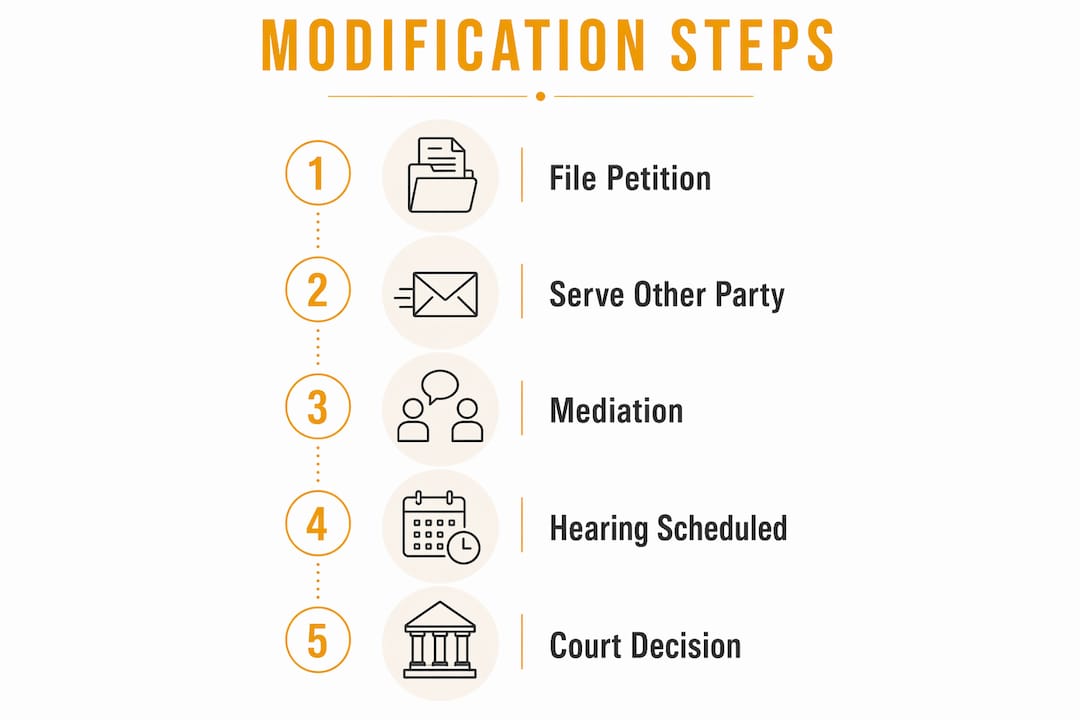
Step-by-step filing checklist:
- Gather your documents first. You need the original decree, the most recent court order you want to change, and any certified copies if the order came from another Arizona county.
- Complete the verified petition. Under Rule 91, the petition must be verified (signed under oath), state the grounds for modification with specific facts, and include an Order to Appear for the other party.
- Prepare supporting forms. For child support changes: a completed Child Support Worksheet, Current Employer Information Sheet, and Child Support Order. For parenting time changes: a proposed Parenting Plan with a detailed schedule, holiday provisions, and exchange logistics.
- Assemble the packet in order. Practitioners assemble packets as: petition, verification, Order to Appear, proposed order, then exhibits tabbed and numbered. Courts process complete, organized packets faster.
- File with the clerk and pay the filing fee. The clerk reviews the petition for Rule 91 compliance. A deficient petition is rejected, but you typically receive 30 days to correct it.
- Serve the other party. Proper service is required before the court will schedule a hearing. Service rules follow Arizona Rules of Civil Procedure.
- Await the court’s response. The court either issues the Order to Appear (scheduling the initial conference or hearing) or rejects the petition with a written explanation.
Required documents at a glance:
- Verified petition or motion to modify
- Copy of the current order being modified
- Affidavit of facts supporting the change
- Child Support Worksheet (if support is at issue)
- Proposed Parenting Plan (if parenting time is at issue)
- Current Employer Information Sheet
- Proof of income (paystubs, tax returns)
Pro Tip: Assemble your entire packet before going to the clerk’s office. A single missing form sends you home. The Maricopa County Superior Court’s ezCourtForms tool generates the Child Support Worksheet, Child Support Order, and Employer Information Sheet in one session — use it before you print anything.
Should you try mediation before going to a contested hearing?
Many Arizona courts require mediation before scheduling an evidentiary hearing on custody or parenting time disputes. Even when it is not mandatory, it is almost always worth attempting. A mediated agreement gives both parents control over the outcome; a judge’s ruling gives neither.
Why mediation works well for post-decree disputes:
- Faster resolution than waiting for a hearing date on a crowded docket
- Lower cost than full litigation, especially for straightforward schedule adjustments
- Both parties retain input on the final terms
- Agreements reached in mediation tend to hold longer because both sides chose them
For a realistic look at whether mediation is worth it in your situation, the cost-benefit calculation depends heavily on how far apart the parties are and whether communication has broken down entirely.
Other alternatives to a contested hearing:
- Stipulated agreement: Both parties sign an agreed modification, which the court reviews and enters as an order. No hearing required if the judge approves it.
- Motion for temporary orders: Useful when you need immediate relief while the full modification is pending. A temporary order can stabilize the situation while the case proceeds.
- Parenting coordinator: Some Arizona courts allow appointment of a parenting coordinator to resolve ongoing disputes without returning to court for every disagreement.
When mediation is not appropriate: Credible domestic violence allegations change the calculus entirely. Courts treat those cases differently, and placing a victim in a room with an abuser to negotiate is not a solution. If domestic violence is a factor, tell your attorney before any ADR is scheduled.
| Approach | Best for | Approximate speed |
|---|---|---|
| Stipulated agreement | Both parties already agree on terms | Weeks |
| Mediation | Parties disagree but can communicate | 1–3 months |
| Contested hearing | Significant factual disputes | 3 months |
Which court has jurisdiction when parents or children have moved?
Jurisdiction is the most expensive mistake in post-decree practice. Filing in the wrong court wastes your filing fee, delays relief, and can result in dismissal without prejudice — meaning you start over.
Arizona’s basic jurisdictional rules:
- Arizona retains jurisdiction over a custody order as long as at least one parent or the child still lives in Arizona
- If both parents and the child have all left Arizona, jurisdiction may shift to the child’s new home state under the Uniform Child Custody Jurisdiction and Enforcement Act (UCCJEA)
- For child support, the Uniform Interstate Family Support Act (UIFSA) governs; the original issuing state generally keeps jurisdiction as long as one party still lives there
Common relocation pitfalls:
- Assuming Arizona still has jurisdiction because the original order was issued here — that is not always true
- Filing a modification in Arizona when the child has lived in another state for six or more months
- Failing to register an Arizona order in the new state before seeking enforcement there
- Relocating a child without court approval when the decree requires it
Before you file, check:
- Where the child has lived for the past six months
- Where each parent currently lives
- Whether the original decree retained exclusive jurisdiction language
- Whether any other state has issued a competing order
Pro Tip: Maricopa County’s own instructions state clearly: if the order you want to change is from another state, talk to a lawyer before filing anything in Arizona. That advice applies in reverse too — if you moved away from Arizona, confirm the right forum first.
What evidence do Arizona courts expect when you file?
A modification petition lives or dies on its factual record. Vague allegations (“the other parent is irresponsible”) accomplish nothing. Specific, dated, corroborated facts are what move judges.
Evidence checklist:
- Affidavit or verified petition: Must state specific facts, not conclusions. “On March 3, 2025, my child came home with bruises and reported that [parent] had been drinking” is useful. “The other parent drinks too much” is not.
- Medical and therapist records: Especially relevant for custody changes tied to a child’s health or mental health needs
- School records: Attendance logs, grade reports, teacher communications — useful for showing how the current arrangement affects the child’s education
- Paystubs and tax returns: Required for any support modification; two to three years of returns plus recent paystubs gives the court a complete income picture
- Child Support Worksheet: Mandatory for support modifications; must reflect current income and actual parenting time
- Communication logs: Texts, emails, and app-based messages documenting interference, threats, or noncompliance with existing orders
- Police reports and protection orders: Critical for domestic violence or substance abuse allegations
- Drug test results: If substance abuse is alleged, documented test results carry far more weight than testimony alone
How to structure your proposed orders: Make the judge’s job easy. A proposed parenting plan should include a weekly schedule, a holiday schedule with specific dates, exchange location and time, and a dispute resolution clause. Vague proposals (“we will share holidays equally”) create future conflicts and signal to the court that the petitioner has not thought it through.
Numbered steps for organizing your evidence packet:
- Tab and number every exhibit before filing
- Reference each exhibit by tab number in your affidavit (“See Exhibit 3, school attendance records”)
- Lead with neutral third-party records (medical, school, police) rather than your own declarations
- Include a timeline of key events as a separate exhibit if the facts span more than a few months
Pro Tip: Neutral third-party records — a pediatrician’s notes, a school counselor’s report, a police incident report — carry more weight than anything you write yourself. Gather those first, then build your affidavit around them.
What can the court order, and what happens if the other party ignores it?
Courts have several options when a modification petition comes before them, and the outcome is rarely all-or-nothing.
Possible outcomes:
- Denial: The court finds no substantial and continuing change and dismisses the petition
- Temporary emergency orders: Immediate relief pending a full hearing, available when a child faces danger
- Permanent modification: A new order replaces the relevant portion of the original decree
- Partial modification: The court changes support but not parenting time, or adjusts the schedule without changing legal decision-making
Effective dates matter. Under §25-327, a modification takes effect on the first day of the month following notice of the petition, unless the court orders otherwise. Filing in October means a November 1 effective date for support changes, assuming the court grants the petition.
When the other party does not comply:
- Contempt proceedings: File a motion for order to show cause. The non-complying party must appear and explain. Sanctions can include fines, attorney fee awards, and in serious cases, jail.
- Wage garnishment: For support arrears, an income withholding order can be issued directly to the employer. This is often the fastest enforcement tool.
- Motion for sanctions: Courts can award attorney fees against a party who willfully violates an order.
- Interstate registration: If the other party has moved to another state, register the Arizona order in that state before seeking enforcement there. UIFSA governs this process.
Enforcement and modification are separate tracks. If the other parent is not following the current order, you may need both a contempt motion and a modification petition running simultaneously.
What does a modification case actually cost, and how long does it take?
Realistic expectations prevent bad decisions. Here is what the process typically looks like in Arizona.
Typical timeline:
- Filing to initial conference or Order to Appear: Two to six weeks, depending on the county’s docket
- Mediation (if required or elected): One to three months after filing
- Evidentiary hearing (contested cases): Three to twelve months or more after filing, depending on complexity and local court scheduling
Court costs and attorney involvement:
| Item | Typical amount | Notes |
|---|---|---|
| Filing fee | $97 (Maricopa County) | Per Arizona court fee schedules |
| Statutory waiting period | 1 year | For legal decision-making/parenting time; exceptions apply |
| Mediation | Varies | Often required before hearing; can resolve the case entirely |
| Attorney fees (uncontested) | Lower range | Document prep, review, mediation attendance |
| Attorney fees (contested hearing) | Higher range | Discovery, expert witnesses, multiple court appearances |
Levels of attorney involvement:
- Unbundled help: An attorney reviews your petition and advises on strategy without full representation. Cost-effective for straightforward, uncontested modifications.
- Full representation: Necessary for contested hearings, interstate issues, domestic violence allegations, or complex support calculations. The scope of what a family lawyer does in a modification case can range from a single filing to months of litigation.
- Mediation attendance: Having counsel present at mediation, even if not fully retained, often produces better agreements.
Contested modifications involving custody, relocation, or significant support disputes are among the more expensive family law proceedings. Mediation that resolves the case early is almost always cheaper than a full hearing.
When should you call a lawyer, and how can Highdesertfamilylawgroup help?
Some modifications are straightforward enough that a self-represented party can navigate them with the court’s self-help resources. Many are not. Here are the situations where legal help is not optional.
Red flags that require an attorney:
- Alleged abuse, domestic violence, or child endangerment
- One parent wants to relocate out of state with the child
- The other parent lives in a different state and jurisdiction is unclear
- Complex income situations (self-employment, business ownership, variable compensation)
- The other parent has repeatedly violated existing orders
- Incarceration or long-term disability affecting support obligations
- You are the responding party and the petition contains serious allegations against you
What Highdesertfamilylawgroup handles for post-decree clients:
- Drafting and filing verified petitions and supporting documents
- Representation at mediation sessions
- Contested modification hearings before Maricopa County Superior Court and other Arizona family courts
- Enforcement actions, including contempt motions and wage garnishment
- Interstate relocation matters and jurisdictional analysis
- Emergency temporary order filings when a child’s safety is at issue
Highdesertfamilylawgroup brings over 20 years of Arizona family law experience to post-decree matters, with a team that has handled thousands of cases in Scottsdale and the surrounding area. The firm’s approach combines direct legal strategy with clear communication — clients know what is happening and why.
What to bring to your initial consultation:
- Your case number and a copy of the current order you want to change
- Any prior modification orders
- Recent paystubs and tax returns (if support is at issue)
- A written timeline of key events since the last order
- Communication logs, police reports, or other documentation of the change in circumstances
Pro Tip: Write out a one-page timeline before your consultation. Attorneys work faster when they can see the sequence of events clearly. It also helps you organize your own thinking about whether the facts actually meet the “substantial and continuing” standard.
Key Takeaways
A post-decree modification in Arizona requires showing a substantial and continuing change in circumstances under §25-327, and the one-year waiting rule applies to custody and parenting time unless an emergency exception exists.
| Point | Details |
|---|---|
| Modifiable vs. final | Custody, parenting time, support, and maintenance can be changed; property division is generally permanent. |
| Legal standard | Courts require a “substantial and continuing” change — temporary or minor shifts do not qualify. |
| One-year waiting rule | Legal decision-making and parenting time modifications cannot be filed within one year of the last order, with narrow exceptions. |
| Effective date rule | Granted modifications take effect on the first day of the month after notice of the petition under §25-327. |
| Highdesertfamilylawgroup | The firm handles the full range of post-decree matters in Scottsdale and Arizona, from petition drafting to contested hearings and enforcement. |
What most people get wrong about modifying a decree
The conventional wisdom around post-decree modifications tends to be either too optimistic (“just show things changed”) or too discouraging (“courts never change custody”). Neither is accurate, and both lead to bad decisions.
The real problem is that most people approach a modification the way they approached the original divorce: emotionally, with a focus on being right rather than being persuasive. A judge reviewing a modification petition is not interested in who was wronged. They are looking at a narrow question: has something changed materially enough that the current order no longer serves its purpose?
The cases that succeed are the ones where the petitioner walks in with a documented factual record, a realistic proposed order, and a clear theory of why the change benefits the child or reflects the actual financial reality. The cases that fail are the ones built on frustration, vague allegations, and the assumption that the judge will connect the dots.
Jurisdiction is the other trap nobody talks about until it is too late. A parent who moved from Scottsdale to Denver two years ago, whose child now lives in Colorado, and who files a modification in Maricopa County Superior Court has just paid a filing fee to get dismissed. Confirming jurisdiction before filing is not a formality. It is the first substantive question in every interstate case.
The other underrated factor: timing your filing correctly. Because modifications under §25-327 generally take effect the first of the month after notice, a support reduction filed in late October takes effect November 1. A filing delayed until November means December 1. For someone paying hundreds of dollars a month more than they should, that month matters.
Highdesertfamilylawgroup handles post-decree modifications in Scottsdale and across Arizona
When the facts in your life have changed but your court order has not, the gap between those two realities has real consequences. Highdesertfamilylawgroup works with Arizona residents who need to close that gap — whether that means drafting a petition for a straightforward support adjustment or representing a client through a contested custody hearing with interstate complications.

The firm handles the full post-decree process: petition drafting, affidavit preparation, mediation representation, contested hearings, and enforcement actions when the other party does not comply. Clients in Scottsdale and the surrounding area get direct access to attorneys with over 20 years of Arizona family law experience and a track record across thousands of cases. Understanding what a family lawyer does in a modification matter helps you decide how much help you actually need — and Highdesertfamilylawgroup can walk you through that assessment in an initial consultation. Bring your case number, current orders, income records, and a timeline of what has changed. Contact High Desert Family Law Group to schedule your consultation.
Useful sources for Arizona post-decree modification filings
Primary statutes and rules:
- Arizona Revised Statutes §25-327 — Modification and termination of maintenance, support, and property disposition; the “substantial and continuing” standard and effective date rules
- Arizona Revised Statutes §25-411 — Modification of legal decision-making and parenting time; one-year rule, emergency exceptions, military family provisions
- Rule 91, Arizona Family Law Rules — Post-judgment procedure requirements: verification, Order to Appear, clerk review, and rejection/correction process
Court forms and self-help:
- Maricopa County Superior Court — Agreement to Modify Legal Decision-Making, Parenting Time, and Child Support — Step-by-step instructions for agreed modifications, including the full forms packet list
- Arizona Court Help — Petition to Modify forms (Yuma County self-help center) — Contested modification packet and required forms checklist
Highdesertfamilylawgroup resources:
- Alimony in Arizona — Spousal maintenance modification standards and eligibility
- Parental rights in Arizona — Legal decision-making and custody concepts
- Is mediation worth it — Cost-benefit analysis for post-decree ADR
A note on forms: Use official county court self-help centers or the Arizona Judicial Branch’s own resources for forms. Third-party checklists and generic legal websites frequently lag behind current rule amendments and county-specific requirements. When in doubt, confirm with the clerk’s office or an attorney before filing.
This article provides general legal information about Arizona family law and is not legal advice for your specific situation. Consult a qualified Arizona family law attorney to evaluate your circumstances and confirm current rules before filing any court documents.