



Collecting spousal support shouldn’t be this hard — but for many Arizona residents, it is.
Here’s a quick answer if you need it fast:
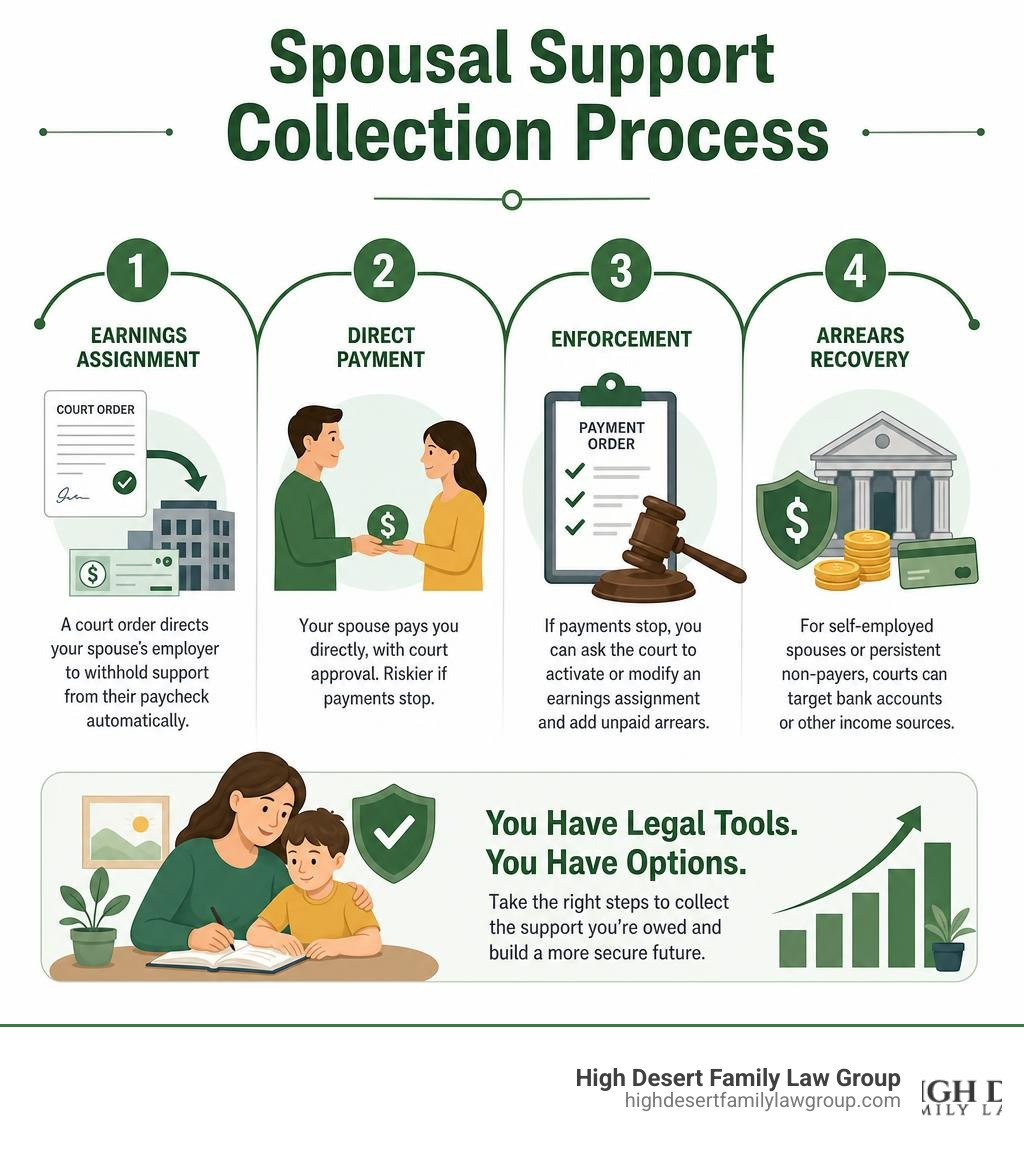
How to collect spousal support:
- Earnings assignment (most common) — A court order directs your spouse’s employer to withhold support from their paycheck automatically.
- Direct payments — Your spouse pays you directly, with court approval. Riskier if payments stop.
- LCSA assistance — If you also receive child support, the Local Child Support Agency can help enforce both.
- Court enforcement — If payments stop, you can ask the court to activate or modify an earnings assignment and add unpaid arrears.
- Wage garnishment / asset seizure — For self-employed spouses or persistent non-payers, courts can target bank accounts or other income sources.
Divorce is stressful enough. But when the support payments your court order guarantees just… don’t arrive, the financial pressure can feel crushing. Whether your ex has gone quiet, changed jobs, or is simply ignoring the order, you have real legal tools available — and knowing how to use them makes all the difference.
According to the U.S. Census Bureau, only about 43% of people owed support receive the full amount. That means the majority are leaving money on the table — often because they don’t know their enforcement options.
Common collecting spousal support vocab:
Primary Methods for Collecting Spousal Support
When a court orders spousal support (often referred to as spousal maintenance or alimony in Arizona), the order itself is just a piece of paper. To actually get the cash into your bank account, you must rely on specific collection pathways. In our practice serving Scottsdale and Chandler, we find that establishing a reliable payment method from day one is the best way to prevent future disputes.
There are two primary ways to collect these payments: through automated wage withholding or via direct payments. Understanding how each method operates helps you make informed decisions during your divorce negotiations. For a deeper dive into how these structures are set up initially, read our Beginner’s Guide to Spousal Maintenance.

Income Withholding and Earnings Assignment Orders
The most reliable and common method for collecting spousal support is an earnings assignment order, also widely known as an income withholding order (IWO). This is a direct court order sent straight to the paying spouse’s employer.
Once the employer receives the IWO, they are legally obligated to deduct the support amount directly from the employee’s paycheck and route it to the state’s payment clearinghouse. In Arizona, this is typically processed through the Support Payment Clearinghouse, which acts as the State Disbursement Unit (SDU).
This automated process offers several key benefits:
- Removes Personal Friction: You do not have to interact with your ex-spouse or send monthly reminders.
- Guarantees Documentation: Every payment is officially tracked by the state, creating an indisputable record of compliance or non-compliance.
- High Compliance Rates: As noted in resources like the California Courts Self-Help Guide, wage withholding is the single most effective way to ensure consistent payments.
However, employers must follow strict federal and state priority rules. If your ex-spouse owes both child support and spousal support, child support deductions always take priority. If their earnings are capped by federal withholding limits, your spousal support payment may only be partially fulfilled, with the remainder accumulating as past-due debt (arrears).
Direct Payments and the Risks of Informal Agreements
Some couples prefer to manage payments directly, bypassing employers and state disbursement agencies. Under a direct payment setup, your former spouse might write you a monthly check, send a bank wire, or use a peer-to-peer payment app.
While this can work well for highly amicable divorces, we always advise clients to proceed with caution. If you choose this route, you must still secure formal court approval. Agreeing to direct payments “off the record” without a judge’s signature leaves you with virtually no legal recourse if your ex suddenly stops paying.
Even with court approval, direct payments carry significant risks:
- Lack of Official Tracking: Disputing whether a payment was made, late, or short can quickly turn into a “he-said, she-said” argument without an SDU ledger.
- Default Risk: If your ex experiences financial trouble or anger post-divorce, direct payments are often the first thing they stop sending.
- Delayed Enforcement: If payments stop, you cannot immediately garnish wages. You must first go back to court to ask a judge to lift the “stay” on your earnings assignment order.
To protect yourself, make sure your settlement agreement explicitly states that an income withholding order will be drafted and signed by the court, but “stayed” (put on hold) as long as direct payments remain timely. If a payment is missed by even a few days, you can immediately petition the court to activate the withholding order. For more details on managing these orders, check out Everything You Need to Know About Your Spousal Maintenance Order.
What to Do When Payments Stop: Enforcement Steps
It is a frustratingly common scenario: your ex-spouse misses a payment, then another, and suddenly you are facing a mounting pile of unpaid bills. When collecting spousal support grinds to a halt, sitting back and hoping they will catch up is rarely a winning strategy. You must take proactive legal steps to enforce the court’s mandate.
Adding Past-Due Arrears to an Earnings Assignment
If your ex-spouse has fallen behind on their obligations, those unpaid amounts do not simply vanish. They accumulate as “arrears.” In Arizona, past-due spousal support accrues interest at the legal rate, which can quickly increase the total amount owed.
To collect this past-due money, you can petition the court to modify your existing earnings assignment. This process allows you to add an extra payment amount on top of the regular monthly support obligation until the debt is fully satisfied.
For example, if your standard support is $1,000 per month, and your ex owes $5,000 in arrears, a judge might order an additional $200 per month to be withheld from their paycheck specifically to pay down the debt. This mechanism is similar to enforcement procedures used in other jurisdictions, such as those detailed in the California Courts Guide on Long-Term Support.
Collecting Spousal Support from Social Security and Other Income Sources
What happens if your ex-spouse retires, or their primary source of income shifts to federal benefits? Many people mistakenly believe that federal funds are completely off-limits for civil judgments. Fortunately, federal law allows for the garnishment of certain federal benefits—including Social Security retirement and disability payments—to satisfy domestic support obligations.
However, the legal distinction between spousal support (maintenance) and property division is critical here. Federal law strictly limits the garnishment of Social Security benefits to “domestic support obligations” like child and spousal support. They cannot be garnished to satisfy a property settlement judgment.
This legal boundary was highlighted in the appellate case In re Marriage of Kalebic, where a party attempted to collect a massive judgment from their ex-spouse’s Social Security benefits. Because the original divorce decree did not clearly allocate the judgment amounts between actual maintenance and property division, the collections court lacked the authority to garnish the federal benefits. This case serves as a vital reminder: your divorce decree must be drafted with absolute precision, clearly labeling support obligations so they remain enforceable against all legal income sources.
Handling Self-Employed Spouses and Irregular Income
Collecting spousal support from a self-employed spouse is one of the most challenging tasks in family law. When a spouse owns their own business, they control their own payroll. They can easily lower their official salary, delay paychecks, or hide personal expenses inside business accounts to make it look like they cannot afford support.
In these situations, standard income withholding orders are often ineffective because there is no traditional HR department to process the paperwork. Instead, we must deploy more aggressive enforcement strategies:
- Bank Account Levies: If we can identify your ex’s personal or business bank accounts, we can request a court order directing the bank to freeze and turn over funds to satisfy the support debt.
- Lien on Business Assets: We can place a legal lien on real estate, equipment, or other valuable assets owned by your ex or their business. This prevents them from selling or refinancing the property without paying you first.
- Lump-Sum Buyouts: In cases involving highly volatile income, it is often wise to negotiate a lump-sum buyout during the divorce rather than risking years of collection battles.
When structuring a lump-sum settlement, tax implications must be carefully managed. For agreements finalized after 2019, spousal support is generally non-deductible for the payor and non-taxable to the recipient. To ensure a lump-sum buyout is treated properly by the IRS and does not trigger unexpected tax liabilities, parties often refer to guidelines like those found in IRS Private Letter Ruling 200127039, which outlines how courts can structure non-alimony designations for lump-sum settlements.
State-by-State Variations in Spousal Support Enforcement
Although our practice is strictly focused on helping clients in Scottsdale, Chandler, and the surrounding Greater Phoenix areas, many of our clients move out of state after their divorces, or their ex-spouses relocate for work. Because family law is governed at the state level, the rules for enforcing and collecting spousal support can vary significantly depending on where the parties reside.
California and Oregon Collection Rules
In California, the enforcement of spousal support is deeply integrated with their local child support agencies. If a recipient is receiving both child and spousal support, the Local Child Support Agency (LCSA) can step in to enforce both obligations simultaneously. California also heavily relies on standardized forms to streamline wage garnishment, making it relatively straightforward to activate an earnings assignment if a payor defaults.
Oregon takes a highly formalized, self-service approach for cases that do not qualify for full state-run child support services. The Oregon Department of Justice provides specific self-service packets for income withholding. Under Oregon law, a recipient can independently file a motion for withholding if the payor is at least one month behind on support and their employer’s location is known, bypassing the need for a lengthy court hearing.
Delaware, Iowa, Massachusetts, and Illinois Frameworks
Other states place different statutory limits and procedural requirements on support:
- Delaware: Alimony duration is strictly capped by the length of the marriage. If a marriage lasted less than 20 years, a party cannot collect support for longer than 50% of the marriage’s duration. For marriages over 20 years, there is no statutory cap.
- Iowa: Unlike child support, Iowa does not use a rigid mathematical formula to calculate spousal support. Courts retain broad discretion, looking closely at how property was divided before determining the final support amount.
- Massachusetts: If a spouse fails to provide financial support during a marriage or separation, the other spouse can file for “separate support” under guides like the Mass.gov Separate Support Guide. This allows a spouse to secure financial support and health insurance coverage without actually filing for a full divorce.
- Illinois: Illinois courts maintain a strict separation between the family law division and the general civil collections division. If you need to clarify or modify a support order to aid in collection, you must return to the family court that issued the original decree; a general collections judge cannot modify or reallocate a divorce judgment.
Key Factors in Determining and Modifying Support Orders
To successfully collect spousal support, you must first have a valid, enforceable court order. Whether you are negotiating a new agreement or trying to modify an existing one, understanding how courts view these support obligations is essential.
In Arizona, courts do not award spousal maintenance to punish a spouse. Instead, the goal is to assist a transitionally dependent spouse in achieving financial independence, or to maintain a fair standard of living after a long-term marriage. You can read more about who qualifies for this assistance in our guide on Alimony Qualifications.
How Courts Calculate and Structure Spousal Maintenance
Arizona does not use a simple online calculator to determine spousal support. Instead, judges exercise broad discretion, weighing a variety of statutory factors to decide if support is appropriate, how much should be paid, and how long it should last.
Some of the key factors considered under Arizona law include:
- The Marital Standard of Living: The lifestyle established during the marriage.
- Duration of the Marriage: Longer marriages are much more likely to result in longer support terms.
- Earning Capacities: The relative income and future earning potential of each spouse.
- Age and Health: Whether physical or mental limitations prevent a spouse from working.
- Contributions to the Other’s Career: Sacrifices made by one spouse to help the other obtain an education or build a business.
To understand how these factors apply in our local courts, explore our comprehensive breakdown of Alimony in Arizona. Additionally, the state has been working to standardize these decisions; you can review the latest updates directly via the Arizona Judicial Branch Spousal Maintenance Guidelines.
Modifying Your Agreement for Collecting Spousal Support
Life is unpredictable. Jobs are lost, illnesses occur, and financial situations change. If either you or your ex-spouse experiences a “substantial and continuing” change in circumstances, you can petition the court to modify the support order.
If both parties agree to the modification, you can draft a written stipulation and submit it to a judge for signature without ever setting foot in a courtroom. If you are modifying an order that involves wage withholding, you must also file updated withholding orders to ensure the employer adjusts the paycheck deductions correctly. This streamlined process is similar to modification procedures used in other states, such as the steps outlined in the California Courts Guide on Modifying Support.
Frequently Asked Questions About Collecting Spousal Support
Can spousal support be collected from Social Security benefits?
Yes. Under federal law, Social Security retirement and disability benefits can be garnished to satisfy court-ordered spousal support and child support obligations. However, they cannot be garnished for general property division judgments. It is vital that your divorce decree clearly distinguishes between support payments and property division to ensure these benefits remain accessible if your ex defaults.
What options exist if the paying spouse is self-employed?
If a self-employed spouse refuses to pay, traditional wage withholding may not work. However, you can ask a judge to order direct bank account levies, place liens on their business or personal real estate, or hold them in contempt of court, which can carry penalties including fines and jail time.
How do child support and spousal support withholding prioritize?
If your ex-spouse’s paycheck is garnished for both child support and spousal support, child support is always paid first. Under federal and state laws, employers must prioritize child support obligations. Any remaining available funds under withholding limits are then applied to your spousal support order.
Conclusion
At the end of the day, collecting spousal support should not feel like a battle you have to fight alone. If your former spouse is ignoring their court-ordered obligations, or if you are preparing to navigate a divorce in Scottsdale or Chandler, having an experienced team in your corner is invaluable.
At High Desert Family Law Group, we provide aggressive, individualized representation. Our four-person legal team works collaboratively to protect your financial future and ensure your support orders are fully enforced. We understand the local court systems, the nuances of Arizona family law, and the exact steps required to get your payments back on track.
If you are ready to stop the drama and secure the financial stability you deserve, contact us today to discuss your Spousal Maintenance case. We are here to help you move forward with confidence.