



What Arizona Community Property Laws Mean for Your Marriage and Divorce
Arizona community property laws establish that most assets and debts acquired during a marriage are owned equally by both spouses — regardless of whose name is on the title or who earned the money.
Here’s what that means in plain terms:
| Key Rule | What It Means |
|---|---|
| Who it applies to | All married couples in Arizona |
| What counts as community property | Assets and debts acquired during marriage |
| How it’s divided in divorce | Equitably (fairly), not always exactly 50/50 |
| What stays separate | Gifts, inheritances, and premarital assets |
| Governing statute | A.R.S. § 25-211 and A.R.S. § 25-318 |
| Residency requirement to file | 90 days of domicile in Arizona |
| Waiting period after filing | 60 days from service of divorce papers |
Arizona is one of only nine community property states in the U.S. That puts it in a small group with California, Texas, Nevada, and a handful of others. For anyone going through a divorce here, that distinction matters enormously.
With 40–50% of U.S. marriages ending in divorce — and the average lasting just under eight years — the question of who gets what is one of the most urgent and stressful issues couples face. Arizona’s community property rules shape every part of that answer.
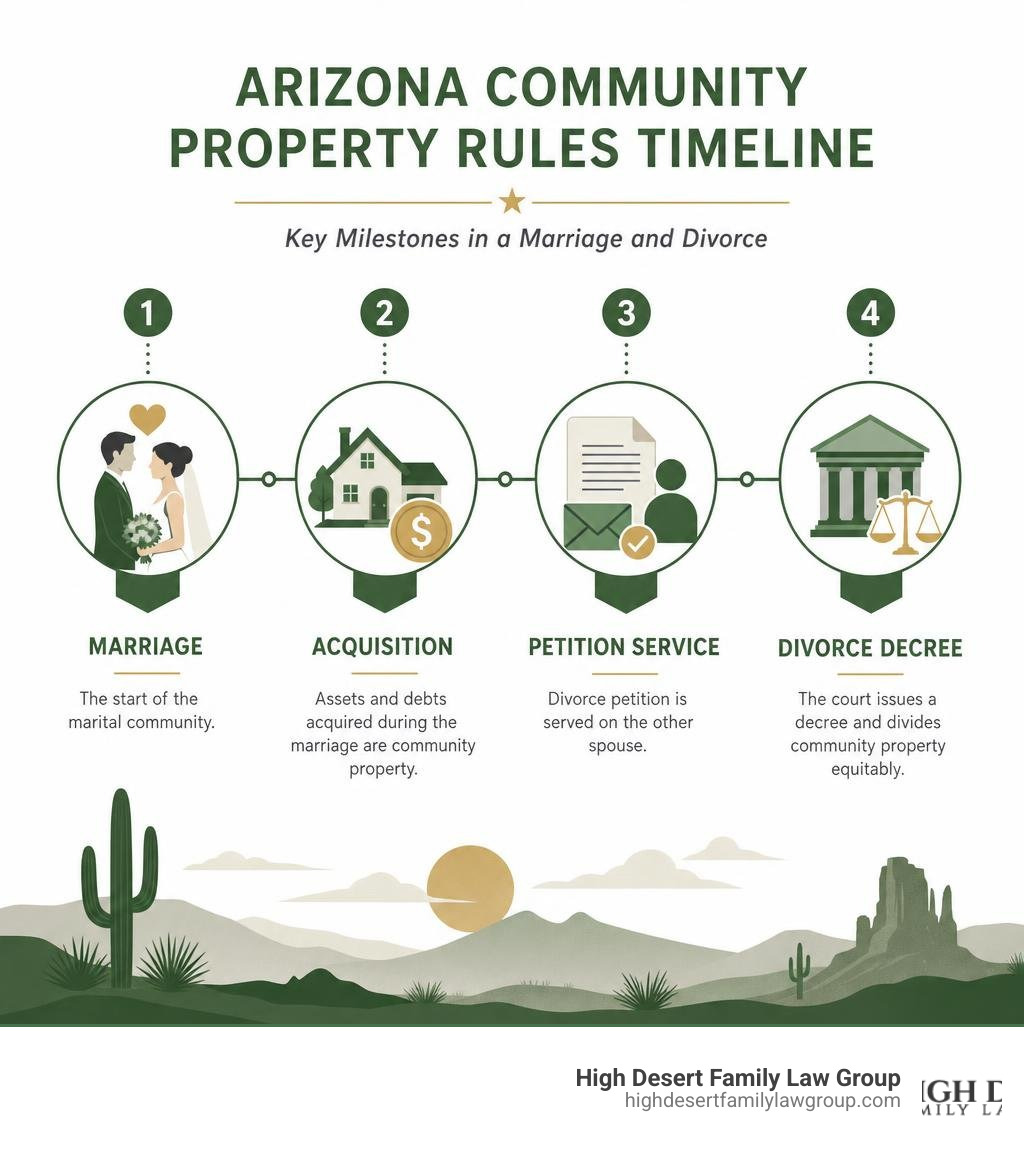
Understanding Arizona Community Property Laws and the Presumption of Joint Ownership

At its core, Arizona law presumes that any asset acquired by either spouse during the marriage belongs to both spouses equally. This is known as the presumption of joint ownership. Whether you bought a shiny new car, opened a savings account, or finally purchased that dream home in Scottsdale, the law views these acquisitions as a joint effort.
This legal framework has fascinating roots. Unlike most eastern states that inherited English common law, Arizona’s property system was heavily influenced by Spanish and Mexican legal traditions. These traditions viewed marriage as a shared economic partnership where both partners contribute equally to the community’s success.
This historical view was solidified in early Arizona case law. In the landmark 1914 case LaTourette v. LaTourette, the Arizona Supreme Court formally established that husbands and wives have completely equal, vested rights in their community property.
Under modern statutes, specifically A.R.S. § 25-211, all property acquired by either spouse during the marriage is community property. When a couple decides to dissolve their marriage, understanding this default rule is the first step in preparing for property division and divorce.
How Arizona Community Property Laws Define Separate Property Exceptions
Of course, not every single item you own during a marriage is thrown into the shared pot. Arizona law carves out clear exceptions. Under A.R.S. § 25-211 Exceptions, certain assets are classified as sole and separate property. These exceptions include:
- Premarital Assets: Anything you owned before you said “I do.”
- Gifts: Property given specifically to one spouse (and not to the couple jointly) during the marriage.
- Inheritances: Assets acquired through a will (devise) or state inheritance laws (descent) by one spouse individually.
- Post-Petition Acquisitions: Property acquired after a petition for divorce, legal separation, or annulment is officially served, provided the petition ultimately results in a final decree.
If you receive a generous inheritance from a relative or a personal gift from a friend, that asset remains yours alone—unless you choose to share it in a way that changes its legal status.
The Impact of Commingling and Transmutation on Separate Assets
While separate property starts out protected, it can easily lose its protected status through two legal concepts: commingling and transmutation.
Commingling occurs when separate funds and community funds are mixed together so thoroughly that they can no longer be distinguished. For example, if you receive a $50,000 inheritance (separate property) and deposit it into a joint checking account that you and your spouse use for daily household expenses, those funds become commingled. If a court cannot clearly trace which dollar belongs to your inheritance and which belongs to the community, the entire account may be deemed community property.
Transmutation is the explicit or implied conversion of separate property into community property. This frequently happens with real estate. If you owned a home in Chandler before the marriage, it is your separate property. However, if you later add your spouse’s name to the deed or title, you have likely transmuted that asset into community property.
To protect your separate assets, we always recommend keeping inherited or premarital funds in sole and separate bank accounts, maintaining meticulous documentation, and avoiding using community funds to pay down separate debts.
How Assets and Debts Are Divided in a Divorce
When a marriage ends, the court must divide the marital estate. Many people assume that a community property state requires a strict, mathematically precise 50/50 split of everything. In Arizona, that is not entirely true.
Arizona law requires an equitable division, not necessarily an equal one. We owe this distinction in part to Justice Sandra Day O’Connor, who, before her historic appointment to the U.S. Supreme Court, advocated for the 1973 reform of A.R.S. § 25-318. This reform replaced the word “equal” with “equitable,” granting judges the flexibility to divide assets in a way that is fair given the unique circumstances of each couple.
While courts still use a 50/50 split as their starting point, they can deviate from this baseline under certain conditions. Importantly, Arizona is a “no-fault” divorce state. This means that marital misconduct—such as infidelity or irreconcilable differences—does not play a role in how property is divided.
However, courts will consider economic misconduct, often referred to as “marital waste” or “dissipation.” If one spouse spent community funds on non-marital interests (such as gambling, expensive gifts for a paramour, or hiding assets), the court can sanction that behavior by awarding a larger portion of the remaining community property to the innocent spouse.
Additionally, if a couple owns property outside of Arizona, the court treats it as “quasi-community property.” If the asset would have been classified as community property had it been acquired while living in Arizona, the court will divide it accordingly.
To help visualize this, we can look at how different assets are categorized during a divorce using a divorce settlement checklist:
| Asset/Debt Type | Typically Community Property? | Typically Separate Property? | Key Division Factors |
|---|---|---|---|
| Primary Residence | Yes (if bought during marriage) | Yes (if owned before & kept separate) | Equity, refinancing ability, children’s needs |
| Retirement Accounts | Yes (marital contributions only) | Yes (premarital contributions only) | QDRO requirements, valuation dates |
| Inherited Wealth | No | Yes | Must be kept uncommingled |
| Credit Card Debt | Yes (if incurred for family benefit) | Yes (if premarital or post-service) | Creditor rights, assignment of debt |
| Personal Injury Awards | Partially (lost wages portion) | Partially (pain & suffering portion) | Purpose of the compensation |
Dividing Marital Debts and Creditor Rights
Just as spouses share in the financial wins of a marriage, they also share in the losses. Under arizona community property laws, any debt incurred by either spouse during the marriage is presumed to be a community debt. This includes credit cards, car loans, mortgages, and even medical bills.
There are limited exceptions. If a debt was incurred solely for a spouse’s separate benefit and did not serve the marital community (or if a spouse had absolutely no knowledge of or access to a specific account), a court may assign that debt solely to the responsible party. Premarital student loans also remain the separate responsibility of the spouse who went to school.
However, there is a major catch that catches many divorcing couples off guard: divorce decrees do not bind third-party creditors.
If the court assigns a joint credit card debt to your ex-spouse under a debt distribution plan, and your ex-spouse stops making payments, the credit card company can still legally pursue you for the full balance. Creditors are not parties to your divorce case. Under A.R.S. § 25-318, the court must include a mandatory notice warning you of this exact risk. To protect yourself, it is often best to pay off joint debts during the divorce process or refinance loans into individual names.
Overriding Arizona Community Property Laws with Marital Agreements
If you do not want Arizona’s default legal rules to dictate your financial future, you have the power to write your own rules. Spouses can override community property laws by executing valid prenuptial or postnuptial agreements.
These agreements allow you to clearly define what will remain separate property and how assets or debts will be divided if the marriage ends. To be legally enforceable in Arizona, these divorce settlement agreements must meet strict criteria:
- They must be in writing.
- They must be signed voluntarily by both parties.
- Both spouses must provide a fair, full, and reasonable disclosure of their financial assets and debts before signing.
A well-drafted marital agreement provides immense peace of mind, ensuring that both parties enter and exit the marriage with clear, predictable expectations.
Special Rules for Complex Assets: Real Estate, Retirement, and Businesses

When a divorce involves high-value or complex assets, standard division rules require careful, expert application. This is especially true for real estate, retirement portfolios, and closely-held business interests.
The marital home is often a couple’s most valuable asset. Deciding who gets the house in a divorce typically comes down to three choices:
- Sell and Split: The home is sold, the mortgage is paid off, and the remaining net equity is divided equitably between the spouses.
- Refinance and Buyout: One spouse keeps the home and refinances the mortgage into their individual name, paying the departing spouse their share of the equity in cash or through other assets.
- Deferred Sale: If minor children are involved, the court may allow the custodial parent to remain in the home for a set period before eventually selling it and splitting the proceeds.
Businesses and professional practices present their own set of hurdles. Valuing a business during a divorce requires specialized forensic accounting. A key distinction in Arizona law is separating enterprise goodwill (the value of the business’s reputation and client base, which is a divisible community asset) from personal goodwill (the value tied directly to an individual’s unique skills and reputation, which remains separate property).
Splitting Retirement Accounts, 401(k)s, and Pensions
Retirement assets accumulated during a marriage are community property, even if only one spouse’s name is on the account. However, you cannot simply log in and transfer half of a 401(k) or pension to your ex-spouse without triggering massive tax penalties and early withdrawal fees.
To divide these accounts safely, the court must issue a Qualified Domestic Relations Order (QDRO). A QDRO is a specialized legal document that instructs the retirement plan administrator to split the account according to the terms of the divorce decree.
For IRAs, a QDRO is not required, but the transfer must still be executed properly as a “transfer incident to divorce” to avoid tax consequences.
Beyond retirement, couples should also consider the tax benefits of community property during estate planning. Arizona couples enjoy a “double step-up in basis.” When one spouse passes away, the tax basis of all community property resets to its current market value, potentially saving the surviving spouse thousands of dollars in capital gains taxes.
Because a divorce fundamentally changes your asset structure, it is critical to update your estate plans, trusts, and beneficiary designations immediately after your divorce is finalized.
Frequently Asked Questions about Arizona Property Division
Navigating the complexities of property division can raise many questions. Here are some of the most common concerns we hear from clients in Greater Scottsdale and Chandler.
Is Arizona a strict 50/50 divorce state?
No. While Arizona courts use a 50/50 split as a starting baseline, the statutory standard is equitable (fair) division.
In some cases, a court may order an unequal split if the circumstances demand it. A classic example is the case Toth v. Toth, where the marriage lasted only two weeks. The husband had used his separate, premarital funds to purchase a home in joint names. The court ruled that awarding the wife a full 50% of the home’s value after such a brief union would be highly inequitable, ultimately awarding her a much smaller portion.
Does filing for divorce immediately freeze community property?
No, simply filing does not freeze your assets, but the official service of the petition on your spouse does change the rules.
Once the petition is served, a statutory preliminary injunction goes into effect. This injunction prevents either spouse from hiding, selling, or transferring community property without the other’s consent or a court order, except for typical daily living expenses or business necessities.
Furthermore, under A.R.S. § 25-214, both spouses retain equal management and control over community property during the marriage, but major transactions—like selling real estate—require both signatures.
Can a spouse be held responsible for the other’s separate debts?
Generally, no. If your spouse entered the marriage with student loans, credit card debt, or other liabilities, those remain their sole and separate responsibility.
Creditors of separate debts generally cannot target your separate property or your half of the community property to satisfy those debts. However, any debts accumulated during the marriage are presumptively community obligations, meaning both of you could be held liable.
Conclusion
Understanding arizona community property laws is the key to protecting your financial well-being during a major life transition. Whether you are dealing with a straightforward division of household assets or navigating complex business valuations and real estate holdings, having the right legal strategy makes all the difference.
At High Desert Family Law Group, our dedicated four-person legal team provides aggressive, individualized representation tailored to the unique needs of clients in Greater Scottsdale and Chandler, Arizona. We understand that property division is about more than just numbers—it is about securing your future.
Once your divorce is complete, we can also guide you through the process of retitling assets, updating your estate plans, and ensuring your new financial life starts on solid ground. If you are ready to discuss your options, learn more about how Arizona handles fault vs no-fault divorce and schedule a consultation with our experienced team today.