



Military Divorce in Arizona: Rights, Rules & Next Steps

Yes, you can file for military divorce in Arizona. The state courts have jurisdiction if either spouse has been domiciled in Arizona or stationed here as an active-duty service member for at least 90 days before filing. Get that threshold right, invoke your federal protections under the Servicemembers Civil Relief Act (SCRA) if deployment affects your ability to participate, and understand how the Uniformed Services Former Spouses’ Protection Act (USFSPA) governs how military retirement pay gets divided. Those three things determine the outcome more than anything else.
Immediate priorities:
- Establish jurisdiction. Document 90 days of Arizona domicile or military stationing before you file under A.R.S. § 25-312.
- Invoke SCRA protections. If active-duty obligations prevent you from participating in proceedings, request a stay immediately.
- Protect retirement and benefits. Understand the USFSPA and DFAS rules before any decree is signed. A poorly drafted order can permanently cost a spouse their share.
For free military-family resources, contact Military OneSource at any stage. For Arizona-specific legal representation, Highdesertfamilylawgroup is available for a case assessment.
Table of Contents
- How do Arizona filing rules work for military divorce?
- What federal rules change a military divorce in Arizona?
- How does Arizona divide military retirement pay?
- How do Arizona courts handle custody when a parent is deployed?
- How are child support and spousal maintenance calculated for military members?
- What are realistic timelines for an Arizona military divorce?
- How do you protect SBP, TRICARE, TSP, and other benefits after divorce?
- JAG vs. civilian counsel: who can actually represent you in Arizona?
- Ten practical next steps if you’re considering a military divorce in Arizona
- Key Takeaways
- What most clients get wrong about military divorce in Arizona
- How Highdesertfamilylawgroup helps military families through divorce in Arizona
- Official resources and further reading
How do Arizona filing rules work for military divorce?
Arizona courts can hear a military dissolution case under A.R.S. § 25-312 when at least one spouse is domiciled in the state or stationed here as a service member, and that presence has been maintained for at least 90 days before filing. Military stationing satisfies the 90-day rule even when a service member’s legal domicile is technically another state. That distinction matters for service members who are stationed at Luke Air Force Base or Davis-Monthan but claim a home state elsewhere.

Once you file, Arizona imposes a mandatory 60-day waiting period after service of process before a court can enter a final decree under A.R.S. § 25-329. That clock does not start on the filing date; it starts when the respondent is properly served. A deployment or an unlocatable service member can delay service significantly, which pushes the entire timeline.
Filing steps:
- Gather proof of 90-day presence (military orders, lease, utility bills, base housing records).
- Complete the Petition for Dissolution of Marriage and a military affidavit identifying the respondent’s military status.
- Pay filing fees or request a fee waiver. Maricopa County filing fees typically range from $349 to $360, while Pima County fees range from $266 to $311, depending on the case and court. Check the county court website for the latest schedules.
- Serve the respondent. For deployed members, courts may authorize alternative service methods, but you need to petition for that specifically.
- Wait out the 60-day period, then schedule hearings or submit a consent decree.
For a step-by-step walkthrough of the filing process, Highdesertfamilylawgroup’s guide on how to file for divorce in Arizona covers the paperwork and local court requirements in detail.
| Filing Fact | Details |
|---|---|
| Residency requirement | 90 days of domicile or military stationing in Arizona before filing |
| Statutory basis | A.R.S. § 25-312 |
| Waiting period | 60 days after service of process (A.R.S. § 25-329) |
| Maricopa County filing fee | $349–$360 |
| Pima County filing fee | $266–$311 |
| DFAS processing time | 30–90 days after final decree (when orders are properly drafted) |
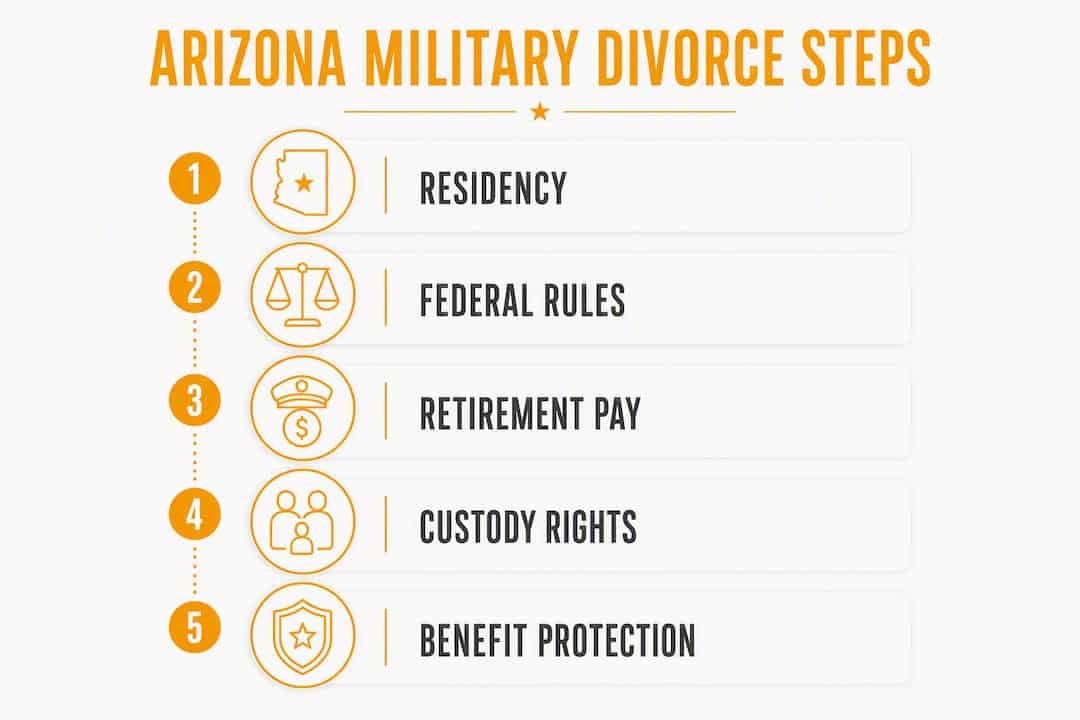
One strategic note: Arizona is a community property state, which affects how military retirement and other marital assets are divided. If you have a choice of forum, comparing Arizona’s community property approach against a non-community-property state before you file can change the math on pension division and support. Once you file in Arizona, that framework applies.
What federal rules change a military divorce in Arizona?
Two federal statutes overlay Arizona family law in every military dissolution case. Understanding them before you walk into court is not optional.
The Servicemembers Civil Relief Act (SCRA)
The SCRA allows an active-duty service member to request a stay of civil proceedings for at least 90 days when military duties materially affect their ability to participate. The stay is not automatic; the service member must request it and provide a letter from their commanding officer confirming that current duties prevent participation and a date when participation will be possible. Courts can grant extensions beyond the initial 90 days. The SCRA also protects service members from default judgments entered without proper notice, and it caps interest rates on pre-service debts at 6%.
- A stay pauses the entire proceeding, including discovery and hearings.
- Courts must appoint counsel for a service member before entering a default judgment if the member has not appeared.
- SCRA protections apply to active-duty members of all branches, including activated National Guard and Reserve members.
- The SCRA does not prevent a divorce from proceeding indefinitely; it delays it while the service member is genuinely unable to participate.
The Uniformed Services Former Spouses’ Protection Act (USFSPA)
USFSPA gives state courts the authority to treat military retired pay as marital property subject to division. Without it, federal law would preempt state courts from touching retirement pay at all. Under USFSPA, Arizona courts can award a former spouse a share of military retirement as part of the community property division. The Defense Finance and Accounting Service (DFAS) then processes those orders and, when the 10/10/10 rule is satisfied, pays the former spouse directly.
DFAS does not simply accept any court order. The order must meet specific DFAS formatting and content requirements, which is one of the main reasons a civilian attorney with DFAS drafting experience matters more than most clients expect.
How these federal rules change courtroom procedure:
- A pending SCRA stay means the court cannot move forward on any contested issue until the stay expires or is lifted.
- A default judgment entered without proper SCRA compliance is voidable, which can unwind months of work.
- USFSPA limits what a court can award: the former spouse’s share cannot exceed 50% of the member’s disposable retired pay (or up to 65% when combined with support obligations).
- Federal jurisdiction over military benefits means some issues, like TRICARE eligibility, are governed entirely by federal rules regardless of what the Arizona decree says.
How does Arizona divide military retirement pay?
Military retired pay is divisible as community property under USFSPA and Arizona’s community property rules. The marital portion is typically calculated using the “time rule”: the number of years the marriage overlapped with creditable military service, divided by the total years of service at retirement. If a service member served 20 years and the marriage overlapped with 15 of those years, the marital fraction is 15/20, or 75%. A former spouse awarded 50% of the marital portion would receive 37.5% of the total retired pay.
The 10/10/10 rule: payment method, not entitlement
The 10/10/10 rule requires that the marriage lasted at least 10 years, the service member served at least 10 years of creditable military service, and those two periods overlapped by at least 10 years. When all three conditions are met, DFAS will pay the former spouse directly. When they are not met, the court can still award a share of retirement pay, but the service member must make those payments personally. That distinction is critical for enforcement: a former spouse relying on the service member’s voluntary compliance has far less security than one receiving DFAS direct payments.
The 20/20/20 rule: benefit continuation
The 20/20/20 rule applies when the marriage lasted at least 20 years, the service member served at least 20 years, and those periods overlapped by at least 20 years. A former spouse who meets all three thresholds retains full TRICARE coverage and access to military exchanges and commissaries after the divorce. Partial overlap (the 20/20/15 rule) provides a more limited transitional TRICARE benefit.
| Rule | Threshold | What It Governs |
|---|---|---|
| 10/10/10 | 10 yrs marriage / 10 yrs service / 10 yrs overlap | DFAS direct payment to former spouse |
| 20/20/20 | 20 yrs marriage / 20 yrs service / 20 yrs overlap | Full TRICARE and exchange/commissary access |
| 20/20/15 | 20 yrs marriage / 20 yrs service / 15 yrs overlap | Transitional TRICARE only |
What DFAS requires in a Military Pension Division Order (MPDO)
DFAS will reject orders that do not include specific language. A properly drafted MPDO or court order must include:
- The service member’s full name, Social Security number, and branch of service.
- A clear statement that the court has jurisdiction under USFSPA.
- The formula for calculating the former spouse’s share (time rule fraction or fixed percentage).
- Whether the award is based on the retirement pay at the time of divorce or at the time of retirement (the latter is generally more favorable to the former spouse).
- Language specifying that the award survives the member’s death or disability retirement.
- The former spouse’s name, address, and Social Security number.
DFAS processing typically takes from a few weeks to several months after the final decree when orders are drafted correctly. Errors or missing language restart that clock.
Pro Tip: Avoid using a fixed dollar amount in the MPDO. DFAS prefers a percentage or fraction formula because it automatically adjusts for cost-of-living increases. A fixed dollar amount can create enforcement problems years later and may require a return to court to modify.
For more on how Arizona courts apply federal law to divide retirement accounts, Highdesertfamilylawgroup’s guide on QDRO requirements in Arizona covers the drafting mechanics in detail.
How do Arizona courts handle custody when a parent is deployed?
Deployment does not disqualify a parent from custody or parenting time. Arizona courts look at the best interests of the child, and a parent’s military service is one factor among many, not an automatic strike against them. The practical challenge is that deployment creates gaps in physical availability that courts must address with temporary orders rather than permanent modifications.

Courts generally distinguish between a temporary custody arrangement during deployment and a permanent modification of the parenting plan. A deployment that takes a parent away for six months does not, by itself, justify a permanent change in legal decision-making authority. Judges are aware of this distinction, and a well-drafted temporary order protects the deployed parent’s rights while the child’s daily needs are covered.
Deployment planning steps to include in agreements or orders:
- Designate a caregiver (often a family member) who will have physical custody during deployment.
- Specify communication methods and minimum frequency (video calls, phone calls, messaging apps).
- Establish a decision-making backup for routine and emergency decisions when the deployed parent is unreachable.
- Include a “right of first refusal” clause so the non-deployed parent must offer the deployed parent’s designated caregiver time before using third-party childcare.
- Set a clear transition plan for when the deployed parent returns, including a reintegration period.
- Address relocation restrictions so the non-deployed parent cannot move the child out of state during deployment without court approval.
Document parenting involvement consistently before, during, and after deployment. Communication logs, shared calendars, school records, and medical appointment records all build a picture of active parenting that courts find persuasive. A Family Care Plan, which service members are required to maintain, can also serve as evidence of the parent’s planning and commitment.
Pro Tip: File a temporary custody order before deployment, not after. Courts are far more receptive to a proactive plan submitted jointly than to a contested modification request filed mid-deployment when emotions are high and communication is difficult.
For county-specific custody guidance, Highdesertfamilylawgroup’s resource on child custody and parenting time in Pinal County covers local practice in detail.
How are child support and spousal maintenance calculated for military members?
Arizona courts calculating child support and spousal maintenance for military members look at total compensation, not just base pay. Basic Allowance for Housing (BAH), Basic Allowance for Subsistence (BAS), and special pays are typically included in the income calculation. BAH in particular can be substantial, especially in high-cost-of-living areas near major installations, and courts commonly treat it as available income for support purposes.
- Identify all compensation sources. Pull the service member’s Leave and Earnings Statement (LES), which itemizes base pay, BAH, BAS, special pays, and any tax-exempt combat zone pay. Combat zone pay is generally excluded from income for support calculations, but the treatment can vary by judge.
- Apply the Arizona Child Support Guidelines. Arizona uses an income shares model. Both parents’ incomes are combined, and each parent’s share of the total support obligation is proportional to their income contribution.
- Calculate spousal maintenance separately. Arizona courts consider the length of the marriage, the standard of living during the marriage, each spouse’s earning capacity, and the financial resources available. Military allowances factor into the “standard of living” analysis.
- Understand DFAS allotments for enforcement. When a court orders child support or spousal maintenance and the service member fails to pay, DFAS can be directed to withhold payments through an involuntary allotment. This requires a properly served court order and compliance with DFAS processing requirements.
- Know the garnishment limits. Federal law caps the amount that can be garnished from military pay for support obligations, but those caps are higher than standard wage garnishment limits when child support is involved.
- Use Arizona enforcement tools. If a service member is not paying court-ordered support, Arizona courts can hold them in contempt, intercept tax refunds, and report the delinquency to credit bureaus. DFAS allotments are often the most reliable enforcement mechanism because they do not depend on the service member’s cooperation.
One practical note on tax treatment: spousal maintenance paid under pre-2019 divorce agreements has different federal tax treatment than agreements finalized after the Tax Cuts and Jobs Act changes. For divorces finalized after December 31, 2018, spousal maintenance is neither deductible by the payer nor includable in the recipient’s income. This affects how both parties should approach negotiating the amount.
What are realistic timelines for an Arizona military divorce?
Service of process on a deployed service member is one of the most common procedural bottlenecks in Arizona military divorce cases. Personal service is the default, but when a service member is deployed overseas, courts can authorize alternative service methods, including service through the commanding officer, certified mail to the last known address, or, in limited circumstances, publication. Each alternative requires a court petition and adds time.
Checklist for serving a deployed service member:
- Attempt personal service first and document the attempts.
- If personal service fails, file a motion for alternative service with supporting evidence of the service member’s deployment status.
- Attach military orders or a command letter confirming the deployment location if available.
- Once alternative service is authorized, execute it precisely as the court orders and file proof of service immediately.
- The 60-day waiting period under A.R.S. § 25-329 begins from the date of proper service, not from the date the court authorizes alternative service.
SCRA stay mechanics:
To request a stay, the service member submits a written application to the court explaining how current military duties prevent participation and attaches a letter from their commanding officer confirming the conflict and providing a date when participation will be possible. The initial stay is at least 90 days. Courts can grant extensions, and a service member can request additional stays if circumstances continue. The stay covers all civil proceedings, including discovery, depositions, and hearings.
Typical timeline windows:
Key milestone windows for an Arizona military divorce:
Establish 90-day presence → File petition → Serve respondent → 60-day waiting period begins → Discovery (contested cases: 3–6 months) → Pretrial conference → Final hearing → Decree entered → DFAS processing (30–90 days post-decree). Uncontested cases typically resolve in 90–120 days from filing. Contested cases run 6–18 months. A SCRA stay adds at least 90 days to any contested phase it touches.
To see how deployment can compound delays: a contested case that would normally resolve in nine months can stretch to 15 months or longer when a service member requests an initial SCRA stay (90 days), the stay is extended once (another 60–90 days), and service of process required alternative service authorization (an additional 30–45 days). None of those delays are improper; they are the system working as designed. Planning for them from the start, rather than treating them as surprises, is what separates a well-managed case from a chaotic one.
How do you protect SBP, TRICARE, TSP, and other benefits after divorce?
Military divorce touches a cluster of benefits that civilian divorce never encounters, and the consequences of missing a step are often permanent. Benefits do not automatically transfer or terminate at the moment of divorce; each one has its own administrative process and deadline.
Benefits to address in every military divorce:
- Survivor Benefit Plan (SBP). SBP provides a monthly annuity to a designated beneficiary after the service member’s death. A divorce does not automatically remove a former spouse as the SBP beneficiary, but it does create a window for elections. If the decree awards SBP coverage to the former spouse, the service member must make a “former spouse” SBP election within one year of the divorce. Miss that deadline and the coverage is gone permanently.
- TRICARE. Former spouses who meet the 20/20/20 rule retain full TRICARE coverage. Those who meet the 20/20/15 rule get a transitional benefit. Everyone else loses TRICARE at divorce and should explore COBRA coverage through the Department of Labor or marketplace options immediately.
- Thrift Savings Plan (TSP). TSP is divided through a Retirement Benefits Court Order (RBCO), not a standard QDRO. The decree must specifically address TSP and include the required RBCO language. TSP funds awarded to a former spouse can be rolled into an IRA or kept in a TSP account in the former spouse’s name.
- Servicemembers’ Group Life Insurance (SGLI). SGLI beneficiary designations do not change automatically at divorce. The service member must update the designation through their personnel office. A former spouse who remains listed as beneficiary will receive the proceeds regardless of what the divorce decree says.
- Military exchange and commissary privileges. These continue only for former spouses who meet the 20/20/20 rule. There is no partial benefit here.
Concrete steps and decree language:
- The decree should include a specific SBP election requirement with a deadline and a mechanism for the former spouse to “deemed election” if the service member fails to act.
- Include a clause requiring the service member to update all beneficiary designations within 30 days of the decree and provide written confirmation.
- Address TSP with an RBCO that specifies the percentage or dollar amount and the account to which funds should be transferred.
- For TRICARE, the decree should state whether the former spouse qualifies under the 20/20/20 rule and, if not, include a provision for transitional health coverage costs.
Legal separation, rather than full dissolution, is worth considering for some military families. Under A.R.S. § 25-313, a legal separation preserves certain benefits and status that a final divorce would terminate. For a spouse who does not meet the 20/20/20 threshold but is close, staying legally separated rather than divorcing can preserve TRICARE eligibility. Highdesertfamilylawgroup’s guide on how to file for legal separation in Arizona explains when that option makes strategic sense.
JAG vs. civilian counsel: who can actually represent you in Arizona?
JAG legal assistance is genuinely useful. A base legal office can explain your rights, review documents, advise on SCRA protections, and help you understand the general framework of military divorce. What JAG cannot do is appear as your attorney in Arizona state court. That is a hard limit, not a policy preference.
Military OneSource is explicit on this point: military legal assistance is advisory, and service members need private civilian counsel for state divorce litigation. The moment your case involves a court appearance, a contested hearing, a DFAS-ready pension division order, or an enforcement action, you need a licensed Arizona family law attorney.
Why the distinction matters in practice: Arizona’s community property rules, local court procedures, DFAS drafting requirements, and custody practice all require someone who appears regularly in Arizona courts. A DFAS order drafted without knowledge of current DFAS formatting requirements will be rejected. A custody order that does not account for Arizona’s parenting-time statutes may not be enforceable. Local bench familiarity, knowing which arguments resonate with which judges, is the kind of knowledge that only comes from regular courtroom practice in Arizona.
Questions to ask a prospective Arizona military divorce attorney:
- How many military divorce cases have you handled in Arizona, and in which counties?
- Have you drafted DFAS-ready Military Pension Division Orders that were accepted without rejection?
- Are you familiar with SCRA stay procedures and the documentation courts require?
- What is your fee structure for military divorce cases, and do you offer payment plans?
- What is your typical timeline for an uncontested versus contested military case?
- Do you have experience with deployment-related custody modifications?
Pro Tip: Ask specifically whether the attorney has experience with cases involving nearby installations, such as Luke AFB or Davis-Monthan. Local installation familiarity affects everything from understanding military pay structures to knowing how command-level support policies interact with court orders.
Highdesertfamilylawgroup brings over 20 years of Arizona family law experience, including military divorce cases, DFAS order drafting, and custody work for deployed parents. The firm practices in Scottsdale and serves clients across the Phoenix metro area.
Ten practical next steps if you’re considering a military divorce in Arizona
- Document 90 days of Arizona presence. Gather military orders, base housing records, utility bills, or lease agreements showing continuous presence in Arizona for at least 90 days before you plan to file.
- Pull all pay and benefit records. Request your Leave and Earnings Statements for the past 12–24 months, your retirement points statement, TSP account balance, and current SGLI beneficiary designation.
- Request a SCRA stay if applicable. If active-duty obligations are preventing you from participating in proceedings already filed against you, contact your JAG office immediately to prepare the commanding officer letter and stay application.
- Consult a civilian Arizona family law attorney. JAG can advise, but only a licensed Arizona attorney can represent you in court, draft DFAS-ready orders, and navigate local procedure. Schedule a consultation before you file or respond.
- Calculate an estimated pension share. Use the time rule formula (overlap years divided by total service years, multiplied by the percentage awarded) to estimate what a court might award. The DFAS USFSPA guidance and a retirement pay estimator can help you run preliminary numbers.
- Preserve SBP rights. If you are the former spouse, make sure the decree includes SBP language and a deemed-election clause. If you are the service member, understand that the one-year election deadline after divorce is firm.
- Update your Family Care Plan and emergency contacts. A current Family Care Plan protects your parental rights during deployment and demonstrates active parenting to a court. Update emergency contacts through your personnel office at the same time.
- Plan temporary custody before deployment. If deployment is imminent, work with your attorney to file a temporary parenting order now. Courts prefer proactive plans over contested modifications filed mid-deployment.
- Do not change beneficiary designations unilaterally until advised. Changing SGLI or TSP beneficiaries without legal guidance during a pending divorce can create legal complications and may violate temporary orders. Get advice first.
- Start collecting financial records. Bank statements, tax returns, retirement account statements, and documentation of any military-specific assets (housing allowances, special pays) are all relevant to property division and support calculations. Gather them early; discovery disputes over financial records are one of the most common sources of delay.
Tools and resources: Military OneSource offers free financial counseling and legal referrals for military families. DFAS provides a retired pay estimator and USFSPA forms at dfas.mil. Arizona court self-help centers in Maricopa and Pima counties have dissolution packets, though those packets are not designed for military-specific issues.
Pro Tip: Contact DFAS early in the process, even before the decree is final, to request their current MPDO checklist and sample language. DFAS updates its requirements periodically, and an attorney working from an outdated template will produce an order that gets rejected. Starting with the current checklist saves weeks.
Key Takeaways
A military divorce in Arizona is governed by both Arizona’s 90-day jurisdiction rule and federal statutes, SCRA and USFSPA, that override state procedure and control how retirement pay and benefits are divided and enforced.
| Point | Details |
|---|---|
| 90-day jurisdiction rule | Arizona requires 90 days of domicile or military stationing before filing under A.R.S. § 25-312. |
| SCRA stay protection | Active-duty members can request at least a 90-day stay of proceedings when military duties prevent participation. |
| 10/10/10 vs. court award | The 10/10/10 rule governs DFAS direct payments only; courts can still divide retirement pay without it. |
| Benefits require specific decree language | SBP, TSP, and TRICARE each need tailored order language and administrative steps with firm deadlines. |
| Highdesertfamilylawgroup | The firm handles DFAS-ready order drafting, custody for deployed parents, and enforcement in Arizona courts. |
What most clients get wrong about military divorce in Arizona
The single most common mistake is treating the 10/10/10 rule as a threshold for whether retirement pay can be divided at all. It is not. It only determines whether DFAS will pay the former spouse directly. Courts award shares of military retirement to spouses who do not meet 10/10/10 every day; the enforcement mechanism is just different, and that difference is significant. A former spouse relying on the service member’s voluntary payments has a much harder road than one with DFAS direct payments. Clients who do not understand this distinction often accept settlements that look fair on paper but are nearly unenforceable in practice.
The second mistake is incomplete DFAS orders. Attorneys who do not regularly draft Military Pension Division Orders often miss required language, use fixed dollar amounts instead of percentage formulas, or fail to address what happens if the service member retires at a different pay grade than anticipated. DFAS rejects those orders, the case has to return to court, and the former spouse goes months without payment. Drafting a DFAS-ready order the first time is not a luxury; it is the difference between an enforceable decree and an expensive do-over.
The third is service-of-process failures on deployed members. Petitioners sometimes attempt personal service once, fail, and then sit on the case rather than petitioning for alternative service. That inaction does not pause the case; it just delays it while the respondent’s SCRA protections remain in play. Courts in Maricopa and Pima counties have clear procedures for alternative service on deployed members. Using them promptly is what moves a case forward.
Arizona’s community property framework, combined with the federal overlay of USFSPA and SCRA, creates a system where the details of drafting and procedure determine outcomes far more than the underlying facts of the marriage. Local bench familiarity and DFAS drafting experience are not marketing language; they are the specific skills that prevent the mistakes above.
How Highdesertfamilylawgroup helps military families through divorce in Arizona
Military divorce in Arizona requires an attorney who can work in two legal systems at once: Arizona’s community property courts and the federal framework governing military benefits. Highdesertfamilylawgroup handles both.

The firm’s services for military clients include DFAS-ready Military Pension Division Order drafting, custody and parenting-time planning for deployed parents, spousal maintenance and child support calculations that account for military allowances, SBP and TSP decree language, enforcement actions through DFAS allotments, and mediation for families seeking a less adversarial path. With over 20 years of Arizona family law experience and thousands of cases handled, the team understands the local courts and the federal rules that apply to every military dissolution.
To schedule a consultation, contact Highdesertfamilylawgroup directly. Bring your Leave and Earnings Statement, military orders showing Arizona stationing, retirement points statement, and any existing court filings. The initial meeting focuses on your specific situation, not a generic overview. For fee and consultation information, visit the firm’s family law attorney page. If you are weighing your options before committing to full litigation, the firm also offers divorce mediation as a structured alternative.
Official resources and further reading
These sources let you verify rules, download DFAS forms, and find Arizona court filing packets directly from the issuing authority.
- DFAS USFSPA Legal Guidance — The primary source for MPDO requirements, direct-payment rules, the 10/10/10 threshold, and current DFAS forms. Download the current MPDO checklist here before drafting any pension division order.
- U.S. Department of Justice — SCRA Resources — Explains SCRA protections, how to request a stay, and enforcement rights for active-duty members. Includes guidance on default judgment protections and the interest-rate cap.
- Military OneSource — Military Divorce milLife Guide — Free resource covering JAG limits, civilian counsel needs, deployment custody issues, and financial counseling referrals for military families.
- A.R.S. § 25-312 — Arizona Residency Requirement — The statutory text establishing the 90-day domicile or stationing requirement for Arizona dissolution jurisdiction.
- Arizona Legislative Text — Dissolution Statutes — Full statutory language for Arizona dissolution and legal separation procedures, including the 60-day waiting period under A.R.S. § 25-329.
- A.R.S. § 25-313 — Decree of Legal Separation — Statutory basis for legal separation in Arizona; relevant for military families weighing separation against full dissolution to preserve benefits.
- Luke AFB — Divorce in Arizona (Base Legal Pamphlet) — Base-level guidance on Arizona divorce procedures, legal separation distinctions, and Family Support Center resources available to service members and dependents.
- DFAS — Defense Finance and Accounting Service (USA.gov) — Official government portal for DFAS, including contact information, garnishment processing, and links to military pay and benefits resources.
This article provides general legal information about military divorce in Arizona and is not a substitute for advice from a licensed Arizona family law attorney. Laws and DFAS requirements change; confirm current rules with the applicable statute, DFAS directly, or a qualified attorney before taking action.