



How to Serve Divorce Papers in Arizona: 2026 Guide

To legally serve divorce papers in Arizona, you must use one of five court-approved methods: Acceptance of Service, a registered process server, the county sheriff or constable, restricted delivery mail or a national courier with signature confirmation, or court-authorized alternative service or publication. You cannot hand-deliver the papers yourself. Once service is complete, you must file proof with the clerk before your case can move forward.
A few deadlines govern everything that follows. The respondent has 20 calendar days to file a response if served inside Arizona, or 30 days if served outside the state. The clock starts the day after service, not the day of. Miss the 120-day window to complete service after filing, and the court may dismiss your case entirely. Even after service is done, Arizona law requires a minimum 60-day waiting period before a judge can sign a final divorce decree.
Your immediate next steps:
- Choose your service method now (use sheriff or a process server if there is any safety concern)
- Prepare two complete copies of the Petition for Dissolution of Marriage and the Summons
- Obtain the correct proof-of-service form for your chosen method
- File that proof with the clerk as soon as service is confirmed
Key Takeaways
Serving divorce papers in Arizona correctly means choosing a court-approved method, filing original proof with the clerk on time, and meeting every deadline that service triggers.
| Point | Details |
|---|---|
| Five valid service methods | Acceptance of Service, process server, sheriff/constable, restricted delivery mail, or court-authorized publication. |
| 120-day filing deadline | Complete service within 120 days of filing or risk case dismissal. |
| Response windows | Respondent has 20 days (in-state) or 30 days (out-of-state) to file a written response. |
| 60-day waiting period | A final divorce decree cannot be entered until at least 60 days after the date of service. |
| Highdesertfamilylawgroup | The firm coordinates service, files proof documents, and drafts alternative-service motions for Arizona clients. |
Table of Contents
- Which documents must be served and when
- How to serve divorce papers in Arizona: all valid methods
- How to prove service to the court
- If you were served: what to do right now
- What to do when you cannot locate the other party
- Fees, timing, and common mistakes to avoid
- When to get an Arizona family-law attorney
- What practitioners see go wrong most often
- Highdesertfamilylawgroup can handle the service process for you
- Sources
Which documents must be served and when
The core documents that must be served are the Petition for Dissolution of Marriage and the Summons. If the court has issued any Temporary Orders, those must be served at the same time. Serving only part of the packet is a common mistake that can invalidate service entirely.
The filing date and the service date are two different things, and the difference matters. Filing starts the 120-day clock you have to complete service. Service starts the respondent’s response window and the 60-day waiting period before a decree can be entered. A case filed in January but not served until May is already running out of time.
Official guidance from the Maricopa Superior Court: “Service of process must be completed in a manner permitted by law and proof of service must be filed; valid methods include Acceptance of Service, process server, sheriff/constable, restricted mail, or, with court permission, alternative service or publication.” (How to Serve Notice in Family Court Cases in Maricopa County)
The Maricopa Superior Court’s DR2 packet and Pima County’s Packet #10 both identify the required forms by name: the Acceptance of Service (DR22 in Maricopa), the Return of Service or Affidavit of Service for sheriff and process-server methods, and the Motion to Serve by Alternative Service or Publication when standard methods have failed. Download the packet for your county before you do anything else.
How to serve divorce papers in Arizona: all valid methods
Arizona courts recognize five primary service methods, each with its own steps, costs, and proof requirements. Here is how each one works.
1. Acceptance of Service
The other party signs a notarized form acknowledging receipt of the papers. That is all it does. Signing does not mean they agree with the petition, and courts are clear on this point. The signed Acceptance must be notarized by a notary public or a deputy clerk at the courthouse, then filed with the clerk. The official service date is the day the signed Acceptance is filed, not the day it was signed.
This method is fast and free, but it requires cooperation. Do not use it if there is any history of domestic violence, coercion, or safety risk. In those situations, a neutral third party creates a cleaner, safer record.
2. Registered process server
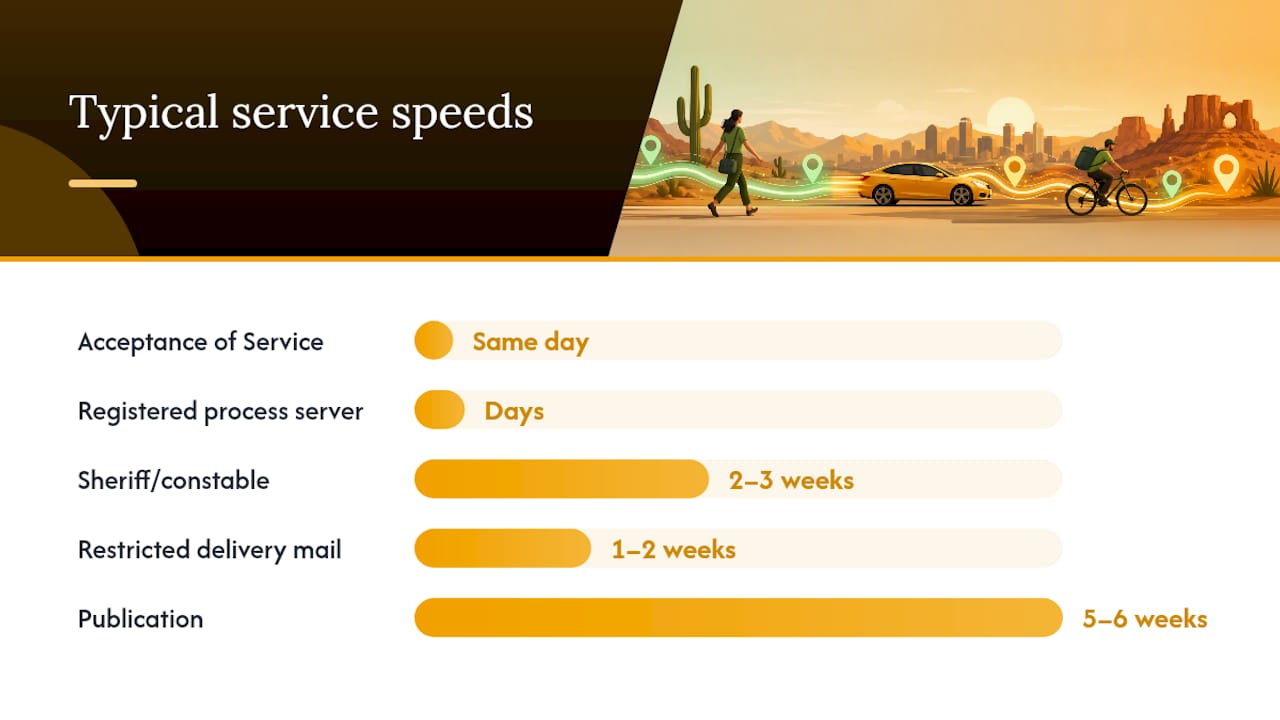
Hire a private process server registered with the Arizona Supreme Court. Provide them with two complete copies of the Petition and Summons, the respondent’s last-known address, a physical description, and any other identifying details that help locate them. Most process servers complete service within a few days to a week when an address is current.
After service, the process server completes an Affidavit of Service, which you then file with the clerk. Private process-server fees are typically not waivable or deferrable, so budget for this cost upfront.
3. Sheriff or constable service
Contact the civil division of the sheriff’s office in the county where the respondent lives. Provide the same packet of documents and identifying information. The sheriff’s office charges a fee for service, and in some counties that fee may be waivable or deferrable by court order if you qualify for a fee waiver.
Timing is the tradeoff. Sheriff service can take two to three weeks depending on the office’s backlog. If your 120-day deadline is approaching, a private process server is faster. After service, the sheriff files a Return of Service with the court.
4. Restricted delivery mail or national courier
Mail the documents via USPS restricted delivery with return receipt, or use a national courier (such as FedEx or UPS) with signature confirmation. Restricted delivery means only the named recipient can sign for the package. A standard certified mail receipt is not enough; it must be restricted delivery.
After delivery, complete an Affidavit of Service by Mail and file it along with the signed return receipt. Keep the original receipt. If the respondent refuses to sign or the package is returned unclaimed, this method fails and you need to switch to another option.
5. Alternative service or service by publication
This method requires court permission first. You cannot simply decide to publish a notice. File a Motion to Serve by Alternative Service or Publication, show the court what diligent search steps you took, and wait for the judge to grant the motion.
Once approved, the notice must run in a county-appropriate newspaper at least once a week for four consecutive weeks, and service is treated as complete 30 days after the first publication. Expect five to six weeks from the first publication date before service is legally complete. After the run ends, file an Affidavit of Publication with the clerk.
One practical limit: courts often restrict the relief available after publication. A judge may grant the divorce itself but decline to rule on property division or other issues where the respondent had no real notice.
Method comparison at a glance:
| Method | Best for | Typical cost | Proof document | Speed |
|---|---|---|---|---|
| Acceptance of Service | Cooperative spouse, no safety risk | Free | Acceptance of Service (DR22) | Same day |
| Registered process server | Fast, reliable, impartial record | Varies by provider | Affidavit of Service | Days |
| Sheriff/constable | Budget-conscious, fee waiver possible | County fee | Return of Service | 2–3 weeks |
| Restricted delivery mail | Cooperative spouse, known address | Postage + fee | Affidavit of Service by Mail | 1–2 weeks |
| Publication | Cannot locate respondent | Newspaper fees | Affidavit of Publication | 5–6 weeks |
How to prove service to the court
Filing proof of service is not optional. The court will not schedule hearings or enter orders until it sees proof that the other party was properly notified.
Key rule: The service date on your proof document is the date that starts the respondent’s response clock and the 60-day waiting period. Get it right, and file it promptly.
Each method has a matching proof document:
File the original proof document, not a photocopy. Maricopa County uses the DR-series forms (DR22 through DR31 depending on method); Pima County uses its own Packet #10 forms. The Maricopa County Clerk of the Superior Court can confirm local filing requirements. Retain a date-stamped copy for your own records. The date on that filed proof is the date your case clock officially starts running.
If you were served: what to do right now
Being served starts a hard deadline. You have 20 calendar days to respond if you were served inside Arizona, or 30 days if served outside the state. The clock begins the day after service, not the day you received the papers.
Your immediate checklist:
- Read the Petition and Summons carefully and note every claim the petitioner is making
- Write down the exact date you were served and calculate your response deadline
- Gather financial records, property documents, and any custody-related evidence
- Decide whether to hire an attorney before filing a response (strongly recommended if children, significant assets, or safety issues are involved)
- File a written Response with the clerk before your deadline if you disagree with anything in the Petition
If you do nothing, the petitioner can file for a default judgment after your deadline passes. A default does not mean the divorce is final immediately. The 60-day waiting period from the date of service still applies before a final decree can be entered, but a default judgment removes your ability to contest the terms.
If you were served in a situation involving domestic violence or a restraining order, contact a family-law attorney or a local domestic violence resource before taking any other step. Document everything and keep copies of all papers in a safe location.
What to do when you cannot locate the other party
Courts expect a real, documented search before they will authorize alternative service. “I don’t know where they live” is not enough on its own.
Pro Tip: Keep a written log of every search step with dates: addresses checked, phone numbers tried, emails sent, social media profiles reviewed, and any contacts you reached out to. Courts look for effort, and a detailed log is your evidence.
Document these search steps before filing your motion:
- Check last-known addresses (prior residence, family members’ homes, employer address)
- Search public records, voter registration, and property records
- Try phone numbers, email addresses, and social media profiles
- Contact known mutual acquaintances or family members
- Check vehicle registration records if available
Once you have documented those efforts, file a Motion to Serve by Alternative Service and/or Publication with the court. The motion must describe your search steps in detail and explain why standard service is not possible. The judge reviews the motion and either grants or denies it.
| Step | Action required | Timing |
|---|---|---|
| Document diligent search | Log all search attempts with dates | Before filing motion |
| File motion | Submit Motion to Serve by Alternative Service/Publication | After search is complete |
| Court approval | Wait for judge’s order | Varies by court |
| Publish notice | Run notice in county newspaper, once per week | 4 consecutive weeks |
| Service complete | 30 days after first publication | After publication run |
| File affidavit | Submit Affidavit of Publication to clerk | After publication ends |
For the full publication rules, Pima County’s Packet #10 and the Yavapai County self-service instructions both walk through the mechanics in plain language.
Fees, timing, and common mistakes to avoid
Typical costs and timelines:
- Sheriff/constable service: county-set fee, potentially waivable; allow 2–3 weeks
- Registered process server: fees vary by provider and location; typically days, not weeks
- Restricted delivery mail: postage plus the restricted-delivery fee; delivery within 1–2 weeks if the address is current
- Publication: newspaper fees plus court filing costs; add 5–6 weeks to your timeline
Private process-server fees are generally not waivable, while sheriff fees may be waivable or deferrable by court order depending on county rules. If cost is a concern, ask the clerk about a fee-waiver application when you file.
Safety first: In any case involving domestic violence, threats, or a history of coercion, skip the Acceptance of Service entirely. Use the sheriff or a registered process server. The goal is an impartial, documented record that does not require any direct contact between the parties.
Common mistakes that delay cases:
- Filing a photocopy of the proof instead of the original
- Recording the wrong service date (using the signing date instead of the filing date for Acceptance of Service)
- Mailing without restricted delivery and then discovering the return receipt is invalid
- Skipping the diligent-search documentation before filing a motion for alternative service
- Forgetting to serve Temporary Orders along with the Petition and Summons
Pro Tip: Set a calendar reminder for day 100 after filing. If service is not complete by then, you have 20 days left before the 120-day dismissal risk kicks in. You have enough time to switch methods or file a motion to extend.
When to get an Arizona family-law attorney
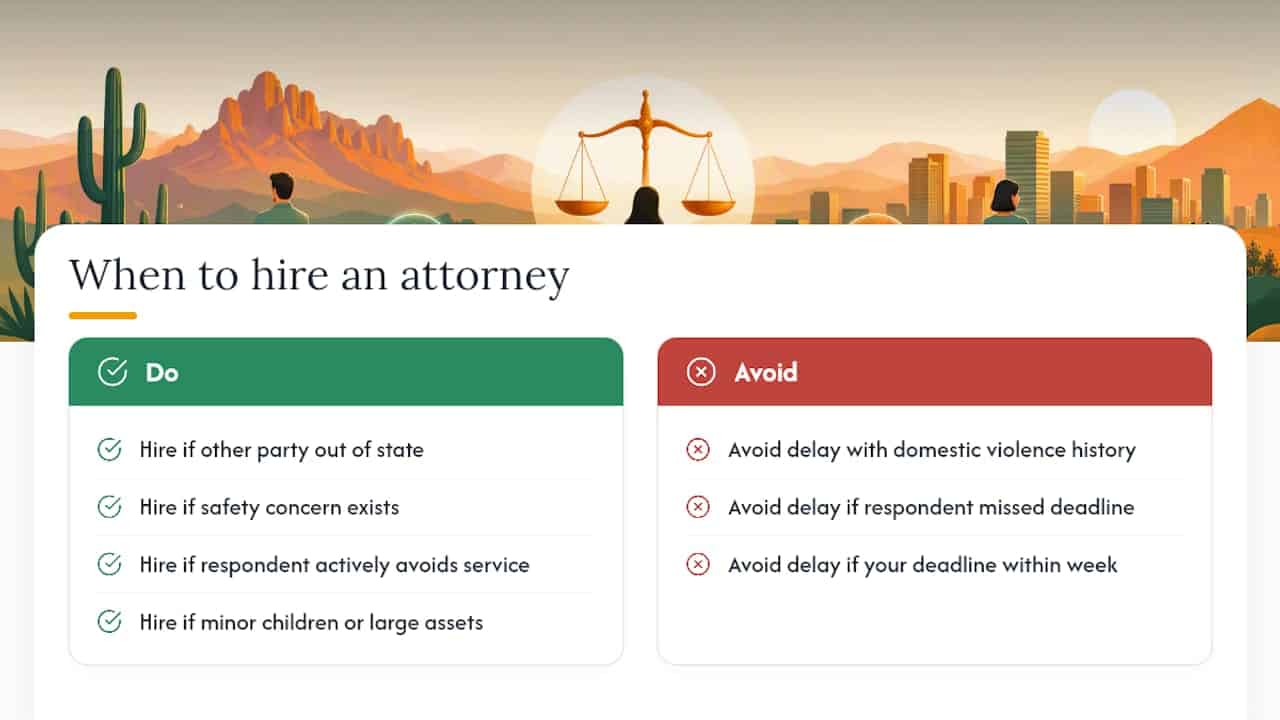
Some service situations are straightforward. Others are not. An attorney becomes worth the cost the moment any of these apply: the other party is out of state or overseas, there is a safety concern, the respondent is actively avoiding service, or the case involves minor children or significant shared assets.
A local Arizona family-law attorney handles the procedural details that trip up self-represented filers: drafting a Motion to Serve by Alternative Service that meets the court’s factual standard, preparing affidavits that match the clerk’s formatting requirements, and filing proof documents on time in the right county.
What to bring to an initial consultation: your file-stamped Petition and Summons, any Acceptance-of-Service or Return-of-Service documents you already have, the respondent’s last-known address and contact information, a log of any attempts to locate or serve them, and documentation of any safety concerns. The more complete your file, the faster an attorney can assess your options.
When to hire immediately: if there is a domestic violence history, if the respondent has already missed the response deadline and you need to file for default, or if you are the respondent and your deadline is within a week.
For readers still working through the Arizona divorce filing process before service, understanding the full sequence from filing to final decree helps you plan each step. And if you want to know what happens after you serve your spouse, the procedural path from service to hearing is worth reading before your deadline arrives.
What practitioners see go wrong most often
The most common service failure is not a dramatic mistake. It is a small one: the petitioner files a photocopy of the Acceptance of Service instead of the original, or records the date the form was signed rather than the date it was filed. The clerk rejects it, the proof is missing from the record, and the case stalls while the petitioner scrambles to fix it.
The second most common issue is using Acceptance of Service in a situation where it should never have been used. A client comes in after their spouse signed the form under pressure, or after the petitioner hand-delivered it without a notary present. Neither scenario creates valid service, and both require starting over.
One case that illustrates the difference: a petitioner in a high-conflict custody matter initially planned to use Acceptance of Service to save time. After reviewing the circumstances, the decision was made to use a registered process server instead. The process server completed service in two days, filed a clean Affidavit of Service, and the case proceeded without any challenge to the validity of service. That choice also removed any claim that the respondent was pressured or misled about what they were signing.
Highdesertfamilylawgroup can handle the service process for you
Navigating service rules county by county, managing the 120-day deadline, and making sure the right proof lands with the right clerk on time is exactly where procedural errors pile up for self-represented filers. Highdesertfamilylawgroup handles all of it: coordinating with registered process servers, drafting Motions to Serve by Alternative Service, preparing and filing proof-of-service documents, and advising on safety-conscious service strategies when the situation calls for it.

With over 20 years of Arizona family-law experience and thousands of cases handled in Scottsdale and the surrounding area, the firm knows which county clerks have specific formatting preferences, which service methods hold up under challenge, and how to move a case forward when the other party is uncooperative or unreachable. Attorney fees and cost expectations are covered during intake, so there are no surprises. To schedule a consultation, visit Highdesertfamilylawgroup’s family law attorney page or call the firm directly. Bring your file-stamped Petition and Summons, any service documents you already have, and a list of the respondent’s known contact information.
Sources
These are the primary official resources for Arizona divorce service. Download the packet for your county before you prepare any documents.
- How to Serve Notice in Family Court Cases in Maricopa County, Arizona
- Arizona Revised Statutes §25-329 (60-day waiting period)
- Packet #10 — Instructions: Service on the Other Party (Pima County)
For the Acceptance of Service form specifically, use Maricopa’s DR22. For sheriff service, the Return of Service is filed by the sheriff’s office directly. For mail service, complete the Affidavit of Service by Mail and attach the signed return receipt. For publication, file the Affidavit of Publication after the four-week run ends.
This article provides general legal information about Arizona divorce service procedures and is not a substitute for advice from a licensed Arizona attorney. Service rules vary by county and case type. Confirm current requirements with the clerk of your filing court or a qualified family-law attorney before taking action.