



Spousal maintenance in Arizona is financial support one spouse pays to the other after a divorce or legal separation. Courts award it only when specific legal conditions are met — it is never automatic.
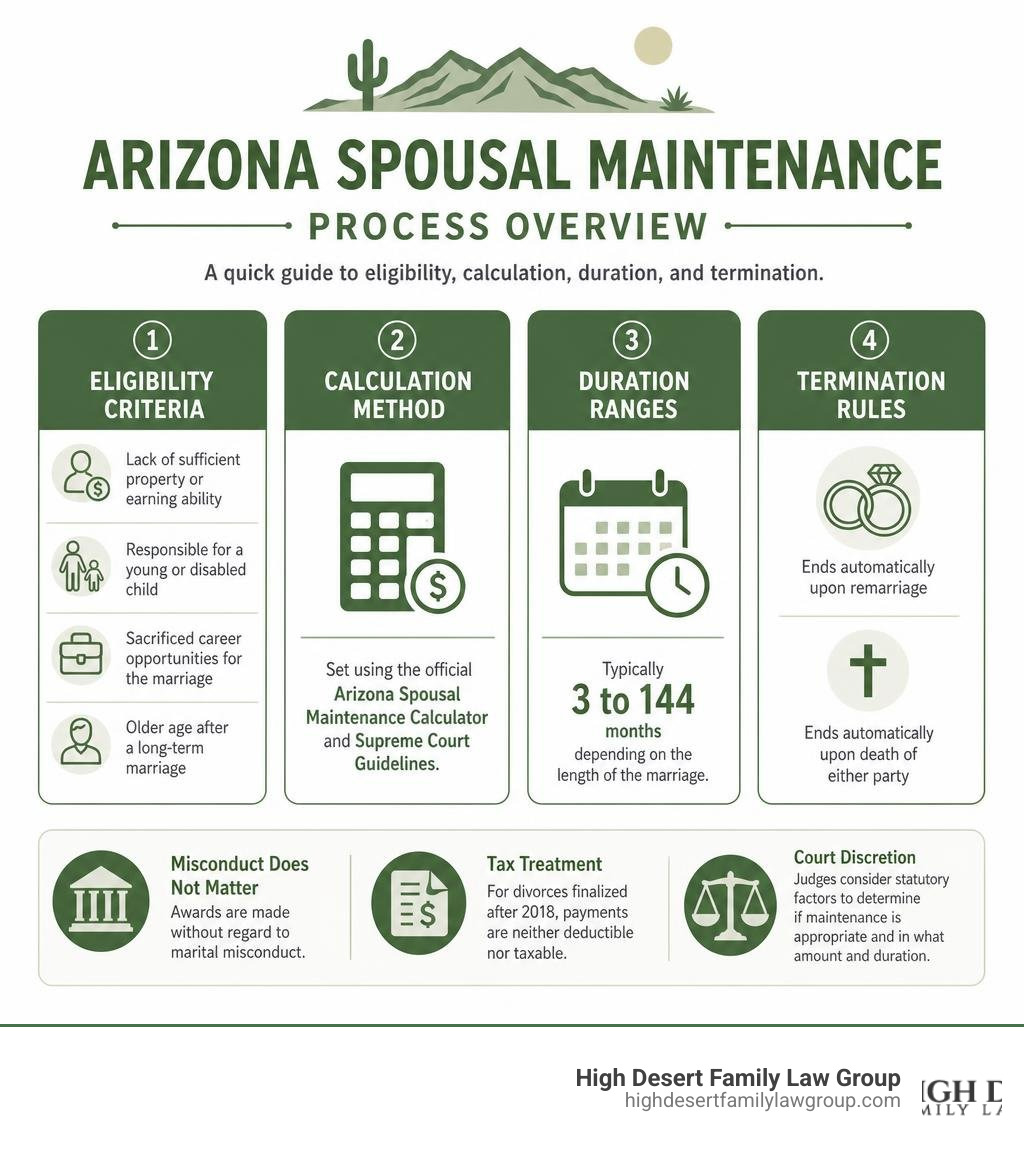
Here is a quick snapshot of how it works:
| Question | Quick Answer |
|---|---|
| Who qualifies? | Spouses who lack sufficient property or earning ability, care for a young or disabled child, sacrificed career for the marriage, or are older after a long marriage |
| How is the amount set? | Using the official Arizona Spousal Maintenance Calculator and Supreme Court Guidelines |
| Typical monthly range | Roughly $500 to $2,500 per month |
| Typical duration | 3 to 144 months, depending on marriage length |
| Does misconduct matter? | No — awards are made without regard to marital misconduct |
| Does it end automatically? | Yes — upon remarriage or death of either party |
| Is it tax-deductible? | No — for divorces finalized after 2018, payments are neither deductible nor taxable |
Arizona updated its spousal maintenance rules significantly in 2022, 2023, and again in 2025. If you are going through a divorce right now, the rules that apply to your case are likely different from what you may have heard before — or what a friend experienced years ago.
This guide breaks down exactly how the system works in plain language, so you can walk into your case informed and confident.
Easy spousal maintenance arizona word list:
Understanding Spousal Maintenance Arizona Rules vs. Traditional Alimony
When people hear the word “alimony,” they often think of old-school Hollywood divorces where one ex-spouse gets a massive, lifetime check to maintain a lavish lifestyle. In Arizona, we do not even use the word “alimony” in our official statutes. Instead, the law refers to it as spousal maintenance.
This is more than just a semantic difference. The shift in terminology highlights a fundamental philosophy: Arizona’s system is designed to help a lower-earning spouse transition to self-sufficiency. It is not meant to act as a permanent financial bridge or a tool for wealth redistribution, nor is it a punishment for marital wrongdoing.
Under Alimony in Arizona, our family courts operate under a strict “no-fault” divorce framework. This means that when evaluating a request for spousal maintenance in Arizona, judges are prohibited from considering marital misconduct. Whether a spouse was unfaithful, abandoned the home, or simply stopped trying, those actions do not impact the calculation of support.
Historically, Arizona family courts possessed vast, unstructured discretion when determining support awards. This often led to highly unpredictable outcomes, where two families with identical financial profiles could receive wildly different rulings depending on the judge assigned to their case. To establish consistency and encourage out-of-court settlements, the Arizona Supreme Court introduced standardized Spousal Maintenance Guidelines. These guidelines, which were updated with major revisions, provide a clear formulaic structure that balances the actual financial needs of the recipient with the realistic paying capacity of the higher earner.
Eligibility vs. Entitlement Under Arizona Law
One of the most common points of confusion for individuals navigating an Arizona divorce is the difference between being eligible for spousal maintenance and being entitled to actually receive it. Arizona law uses a strict two-step analysis to make this determination under Beginner’s Guide to Spousal Maintenance.
- Step 1: Eligibility (A.R.S. § 25-319(A)): The court must first determine if the requesting spouse meets at least one of the threshold criteria established by state law. If the requesting spouse does not meet any of these specific legal gateways, the inquiry ends immediately. The court cannot award spousal maintenance, regardless of how much more money the other spouse makes.
- Step 2: Entitlement and Calculation (A.R.S. § 25-319(B)): Once eligibility is established, the court moves to the second step. Here, the judge weighs 13 statutory factors to decide whether an award is actually appropriate, how much it should be, and how long it should last.
This two-step process means that even if you technically qualify under Step 1, a judge may still decide that an award of $0 is appropriate after analyzing the practical financial realities of both parties under Step 2.
Filing Fees and Residency Requirements for Arizona Divorce
Before a court can even consider a request for a spousal maintenance order, you must meet the state’s strict procedural and jurisdictional requirements for filing a dissolution of marriage. Under A.R.S. § 25-312, at least one of the spouses must have been domiciled (resided) in Arizona for a minimum of 90 days before the petition for divorce is filed.
Once the petition is filed and successfully served upon the other spouse, Arizona enforces a mandatory 60-day waiting period under A.R.S. § 25-329. This “cooling-off” period is designed to prevent impulsive divorces and allows the parties time to negotiate temporary arrangements. No final divorce decree can be signed by a judge until this 60-day window has fully closed.
The financial cost of initiating a divorce also varies slightly depending on your location:
- Maricopa County Filing Fees: The filing fee to petition for divorce is approximately $349, with a corresponding response fee of around $274.
- Statewide Range: Depending on the specific county in Arizona, filing fees generally range from $266 to $364.
If a party is unable to afford these court costs, they can apply for a deferral or waiver of the fees, which is typically granted if their household income falls at or below 125% of the federal poverty guidelines.
The Gateway to Support: A.R.S. § 25-319(A) Eligibility and the 13 Statutory Factors

The primary gateway to obtaining spousal support is found in 25-319 – Maintenance; guidelines; computation factors . This statute outlines the exact legal standards that a spouse must meet before a court can even begin calculating a potential monthly payment.
The Four Statutory Eligibility Criteria under A.R.S. § 25-319(A)
To clear the first hurdle of the two-step analysis, the spouse requesting support must prove they meet at least one of the following eligibility pathways under Alimony Qualifications:
- Lacks Sufficient Property: The spouse lacks sufficient property, including community property apportioned to them in the divorce, to provide for their reasonable daily needs.
- Inadequate Earning Capacity: The spouse is unable to be self-sufficient through appropriate employment, or is the custodian of a child whose age or condition is such that the custodian should not be required to seek employment outside the home.
- Significant Career Contributions: The spouse made a significant financial or personal contribution to the other spouse’s education, training, vocational skills, career, or earning ability, often at the expense of their own professional advancement.
- Long-Duration Marriage and Age: The marriage was of long duration (typically 10 to 16+ years), and the requesting spouse is of an age that may preclude them from gaining the necessary training or employment to become fully self-sufficient.
The 13 Statutory Factors for Determining Spousal Maintenance Arizona Awards
If the court finds that the requesting spouse is eligible under at least one of the criteria above, it must then evaluate the 13 statutory factors outlined in Arizona Revised Statutes Title 25. Marital and Domestic Relations § 25-319 | FindLaw to determine the actual amount and duration of the support. These factors include:
- The standard of living established during the marriage.
- The duration of the marriage.
- The age, employment history, earning capacity, and physical and emotional condition of the spouse seeking maintenance.
- The ability of the paying spouse to meet their own reasonable needs while paying maintenance.
- The comparative financial resources of both spouses, including their respective earning capacities.
- The contribution of the spouse seeking maintenance to the earning ability of the other spouse.
- The extent to which the spouse seeking maintenance has reduced their income or career opportunities for the benefit of the other spouse.
- The ability of both parties to contribute to the future educational costs of their mutual children.
- The financial resources of the party seeking maintenance, including marital property awarded in the divorce.
- The time necessary for the recipient to acquire the education or training needed to find suitable employment.
- Excessive or abnormal expenditures, destruction, concealment, or fraudulent disposition of community property.
- The cost of health insurance for both parties.
- Any actual damages resulting from criminal conduct committed by one spouse against the other.
As noted in Spousal Maintenance Eligibility (§ 25-319) | Arizona Law , these factors give the court a comprehensive financial picture. Marital misconduct is explicitly excluded from this list, ensuring the process remains focused strictly on economic reality and self-sufficiency.
How the Arizona Spousal Maintenance Calculator and Guidelines Determine Your Award
For divorces filed or modified, Arizona courts use a standardized mathematical framework to calculate spousal support. This process relies on the Spousal Maintenance Calculator – Maricopa County Superior Court in conjunction with the official Supreme Court guidelines.
The calculator operates by taking the gross incomes of both spouses, factoring in the size of the family, and applying a formula based on Bureau of Labor Statistics (BLS) Consumer Expenditure Survey data. The goal of this formula is to determine a “Preliminary Target Range” for the monthly payment. This range is designed to cover the basic living expenses of the lower-earning spouse while ensuring the paying spouse is not left financially destitute.
Key Changes in the 2025 Arizona Spousal Maintenance Guidelines
Effective September 1, 2025, the Arizona Supreme Court adopted major updates to the Spousal Maintenance Guidelines – Arizona Judicial Branch . These changes were implemented following a comprehensive review of empirical data from the first year of the guidelines’ use. The most significant updates include:
- Higher-Income Threshold Adjustments: The threshold where the higher-income adjustment begins was raised from $100,000 to $175,000. Additionally, the maximum cap for this adjustment was reduced to 70%. This change prevents disproportionately high awards in high-earning households.
- Removal of Mortgage Principal: Mortgage principal payments have been completely removed from the guideline calculation. This prevents “double-counting” when the marital home is being divided or sold.
- Retirement Asset Income Attribution: Courts can no longer attribute income to retirement accounts if withdrawing those funds would incur an early-withdrawal penalty. Furthermore, Social Security retirement income cannot be attributed to a spouse until they reach full retirement age.
- Overtime Income Rules: When calculating a spouse’s actual income, courts must now look at the average overtime earned over the three years immediately preceding the filing, rather than just the most recent year.
Calculating Duration, Marriage Length, and the Rule of 65
Determining how long a spousal maintenance order will last is strictly tied to the length of the marriage. The guidelines establish specific duration brackets based on the number of months the couple was married.
According to empirical data collected from a review of 490 cases (63% of which were in Maricopa County), the average duration of awarded support was 44 months, with a median duration of 24 months. Indefinite or lifetime support was awarded in only 2% of the analyzed cases, confirming that Arizona family courts heavily favor temporary, rehabilitative support.
| Marriage Length (Months) | Marriage Length (Years) | Standard Support Duration Range | Historical Average Duration Awarded |
|---|---|---|---|
| Under 24 months | Under 2 years | Up to 12 months | 11 months (for 3-12 mo. range) |
| 24 to 60 months | 2 to 5 years | 6 to 36 months | 16 months |
| 60 to 120 months | 5 to 10 years | 6 to 48 months | 23 months |
| 120 to 192 months | 10 to 16 years | 12 to 60 months | 41 months |
| 192+ months | 16+ years | 12 to 144 months (or 50% of marriage length) | 56 months (for 12-96 mo. range) |
An important exception to these rigid duration brackets is the Rule of 65. This rule applies when the age of the spouse seeking maintenance, added to the length of the marriage in years, equals or exceeds 65.
For example, if a 45-year-old spouse is divorcing after a 21-year marriage (45 + 21 = 66), the Rule of 65 is triggered. When this occurs, the court has the legal discretion to award support that exceeds the standard calculator brackets, as older spouses after long marriages face unique challenges when attempting to re-enter the modern workforce. In the 490 cases analyzed, the Rule of 65 was applied in 32% of cases, resulting in an average duration of 55 months.
Managing, Modifying, and Enforcing Your Spousal Support Order
Once a judge signs a final divorce decree, the terms of the spousal support order become legally binding. However, because life is unpredictable, the legal system provides mechanisms to manage, modify, or enforce these orders over time under Everything You Need to Know About Your Spousal Maintenance Order.
Temporary Orders and Tax Treatment After 2018
Divorces do not happen overnight. Because the legal process can take months, spouses often need financial assistance while the litigation is ongoing. Under Arizona Rule of Family Law Procedure 47, a spouse can petition the court for temporary spousal maintenance. These temporary orders remain in place only until the final divorce decree is entered, and the duration of temporary support does not count toward the final post-divorce support duration.
It is also critical to understand the tax implications of these payments. For all Arizona divorces finalized after December 31, 2018, spousal maintenance in Arizona is tax-neutral:
- The paying spouse cannot deduct the payments on their federal or state income tax returns.
- The receiving spouse does not report the payments as taxable income.
This tax treatment means that every dollar awarded is “after-tax” money, which must be carefully factored into your financial planning during negotiations.
Modifying or Enforcing a Spousal Maintenance Arizona Order
Unless the spouses have explicitly agreed in writing that their support order is completely non-modifiable, Arizona courts retain continuing jurisdiction over the order. To successfully modify a support amount or duration, the party requesting the change must file a “Petition to Modify” and prove that a “substantial and continuing change in circumstances” has occurred.
According to Spousal Support 101: A Guide to Collecting Your Payments Without the Drama, qualifying changes typically include:
- An involuntary loss of employment or a severe, permanent reduction in income.
- A serious physical disability or medical diagnosis that prevents a spouse from working.
- The receiving spouse successfully completing their education and becoming fully self-sufficient ahead of schedule.
If a paying spouse simply stops making their court-ordered payments, the receiving spouse has several strong enforcement tools available. They can file a petition for civil contempt of court, seek a judgment for arrears (unpaid support) plus interest, or obtain an Income Withholding Order (wage garnishment) that automatically deducts the support directly from the paying spouse’s paycheck.
Frequently Asked Questions About Arizona Alimony
When does spousal maintenance automatically terminate in Arizona?
Under Arizona law, spousal maintenance automatically terminates upon the death of either party or the legal remarriage of the receiving spouse, unless the written agreement or final decree explicitly states otherwise. Cohabitation with a new romantic partner does not automatically terminate support, but it can be used as a ground to petition the court for a modification if the cohabitation significantly reduces the recipient’s actual living expenses.
Can spousal maintenance be made non-modifiable?
Yes. Under A.R.S. § 25-317, spouses can enter into a written agreement stating that the amount, duration, or both aspects of their spousal maintenance order are completely non-modifiable. Once a judge approves this agreement and incorporates it into the final decree, neither party can request a change in the future, regardless of how drastically their financial circumstances change.
How does the removal of mortgage principal affect my monthly payments?
The removal of mortgage principal from the 2025 guideline calculations generally results in lower monthly spousal maintenance awards, particularly in middle-to-high-income households. By excluding the principal portion of the mortgage payment, the calculator focuses strictly on direct, non-equity living expenses, preventing the receiving spouse from building personal real estate equity at the direct expense of the paying spouse’s monthly support obligation.
Conclusion
Navigating the complexities of spousal maintenance in Arizona requires a clear understanding of the law, a realistic look at your finances, and a strategic approach. Because the rules are highly structured and frequently updated, having the right legal team in your corner can make all the difference.
At High Desert Family Law Group, we provide aggressive, individualized representation for clients throughout Greater Scottsdale, Chandler, and the surrounding areas. Our dedicated four-person legal team works collaboratively to protect your financial future, whether you are seeking support to rebuild your life or defending against an unreasonable demand.
If you need clear guidance and strong advocacy for your Spousal Maintenance case, contact us today to schedule a consultation.