



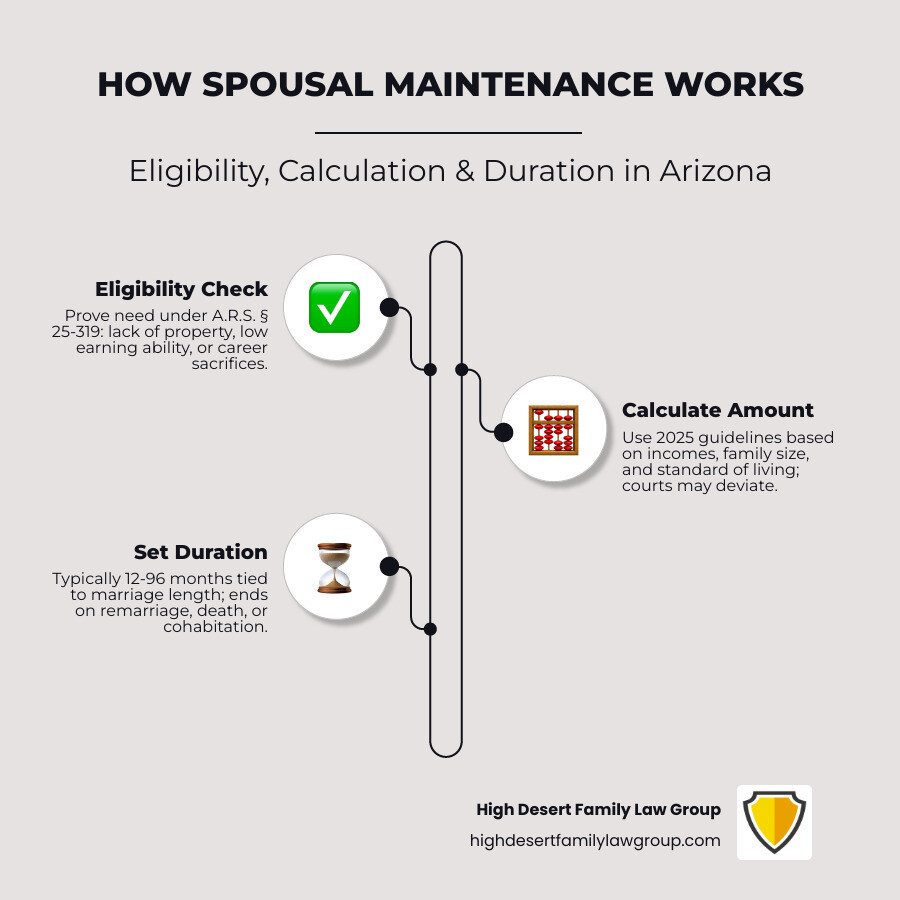
Spousal maintenance is money one spouse pays to the other after a divorce or legal separation. Here is a quick overview:
| Question | Quick Answer |
|---|---|
| What is it? | Court-ordered financial support from one ex-spouse to the other |
| Who gets it? | A spouse who can’t meet their own needs after divorce |
| How much? | Based on income, marriage length, family size, and a state calculator |
| How long? | Typically 12–96 months, depending on how long you were married |
| Is it automatic? | No — you must qualify under Arizona law (A.R.S. § 25-319) |
| Can it change? | Yes — it can be modified or terminated if circumstances change |
Divorce is already stressful. Add a spousal support dispute on top of it, and the financial stakes can feel overwhelming. Will you receive support? Will you be ordered to pay it? For how long? These are questions that can shape your financial life for years.
Arizona has changed significantly how these decisions are made. In 2022, the state legislature amended the spousal maintenance law to focus on self-sufficiency — meaning support is now designed to help a spouse get back on their feet, not necessarily to support them forever. Since then, the Arizona Supreme Court has adopted structured guidelines (updated most recently in 2025) that make outcomes far more predictable than before.
What Spousal Maintenance Means in Arizona
In the Grand Canyon State, spousal maintenance is the official term for what many people colloquially call “alimony.” It is a court-ordered payment from one spouse to another, intended to bridge the financial gap that often occurs when a household splits into two. Whether you are going through a full dissolution of marriage or a legal separation, the court has the authority to step in and ensure one party isn’t left in a state of financial ruin.
We often see cases where support is needed immediately. This is known as “temporary orders” or pendente lite support. These orders provide a financial lifeline while the divorce is still pending in the Maricopa County courts. Once the divorce is finalized, the “post-decree” support begins, which is governed by the final judgment signed by the judge.
Spousal Maintenance vs Alimony vs Spousal Support
You might hear these terms used interchangeably on TV or in movies, but in Arizona, “spousal maintenance” is the only term you’ll see in the Arizona Revised Statutes.
- Alimony: An older term still used in many Eastern states.
- Spousal Support: Often used in states like New York to describe support paid while a couple is still legally married but living apart.
- Spousal Maintenance: The specific legal term used in Arizona divorce and legal separation cases.
Regardless of the name, the goal remains the same: ensuring both parties can move forward with a semblance of financial stability.
When Spousal Maintenance Is Decided
Timing is everything in a divorce. The clock for spousal maintenance usually starts with the “service date”—the day the divorce petition is officially delivered to the other spouse.
We work with our clients to address support at three main stages:
- Temporary Support: Established shortly after the petition is filed to cover bills during the litigation.
- The Final Decree: The permanent (though often time-limited) arrangement set during a trial or through a negotiated settlement.
- Modification: If life throws you a curveball—like a job loss or a medical emergency—we can return to court to ask for a “post-decree” modification.
Who Qualifies for Spousal Maintenance
Not everyone who gets a divorce in Scottsdale or Chandler will receive spousal maintenance. Arizona law is very specific about who is eligible. Under A.R.S. § 25-319, a spouse must first meet a “threshold” requirement. You don’t just get support because your ex makes more money; you must show a genuine need or a significant contribution to the marriage that warrants an award.
To see if you might meet these criteria, check out our detailed guide on Alimony Qualifications.
Arizona Eligibility Factors for Spousal Maintenance
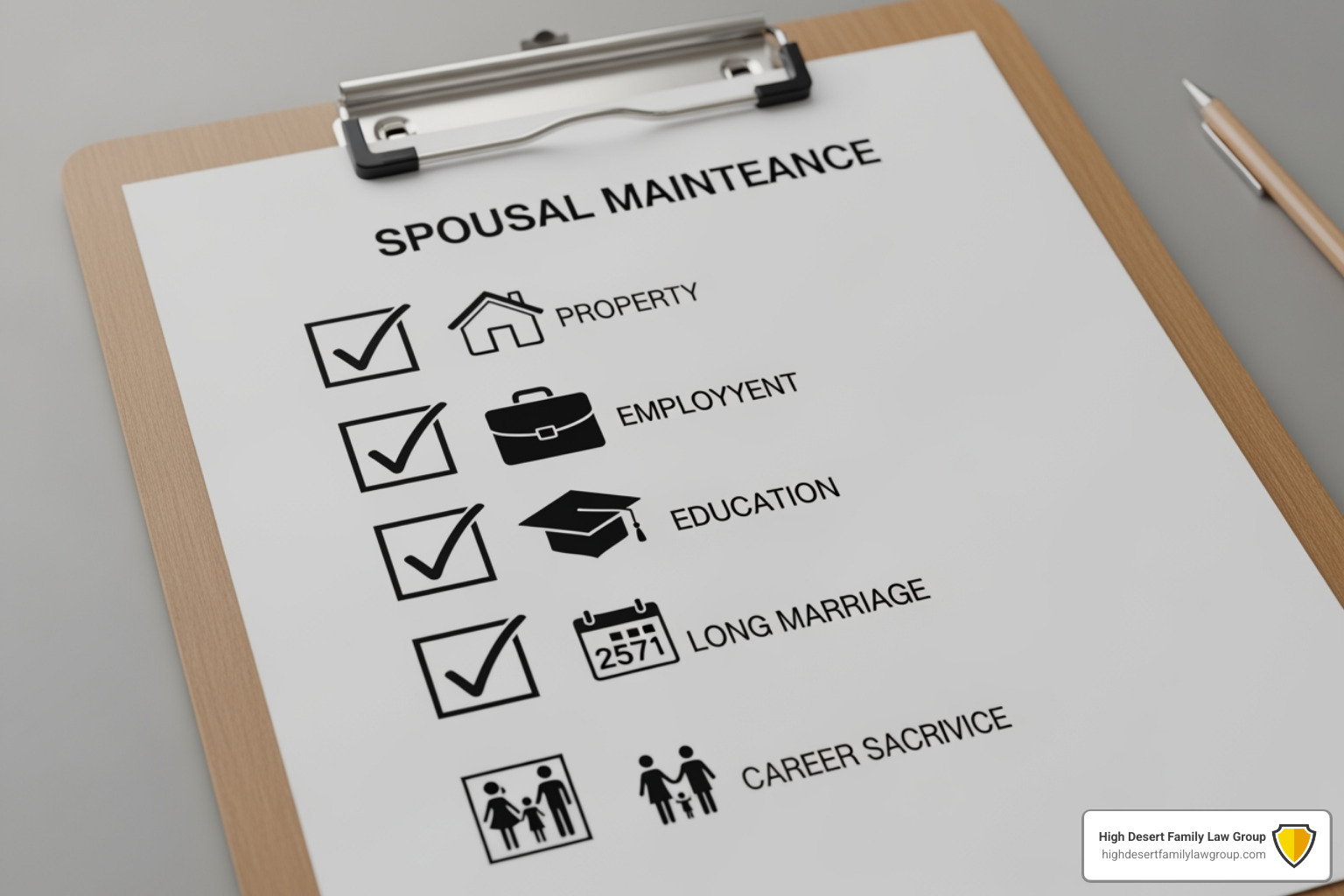
To qualify, a judge must find that the spouse seeking support meets at least one of these five factors:
- Lacks sufficient property: You don’t have enough assets (even after the community property is divided) to provide for your reasonable needs.
- Unable to be self-sufficient: You cannot support yourself through appropriate employment, or you are the custodian of a child whose age or condition makes it inappropriate for you to work outside the home.
- Contribution to education: You contributed to the educational opportunities of the other spouse (e.g., putting your partner through medical school while you worked).
- Long marriage/Age: The marriage was of long duration, and you are of an age that may preclude the possibility of gaining employment to become self-sufficient.
- Career Sacrifice: You significantly reduced your income or career opportunities for the benefit of the other spouse.
Eligibility vs Entitlement
It is vital to understand the difference between being eligible and being entitled to a specific dollar amount.
- Eligibility is the “gatekeeper.” If you don’t meet the factors listed above, the conversation ends there.
- Entitlement is the next step. Once you pass the gate, the court uses the state’s official guidelines and calculator to determine exactly how much you should receive and for how long.
Even if you are eligible, if the calculator shows that your resources and your ex’s resources are relatively equal, the “entitlement” might be zero.
How Courts Calculate Spousal Maintenance
Gone are the days when a judge would simply pick a number that “felt right.” As of 2025, Arizona uses a highly structured, data-driven system to ensure consistency across all counties. The Arizona Spousal Maintenance Guidelines provide a specific formula that attorneys and judges must follow.
How the Arizona Spousal Maintenance Guidelines Work
The 2023 guidelines, which received a major overhaul effective September 1, 2025, were designed to remove the guesswork. These rules prioritize self-sufficiency and predictability. By using a standardized calculator, the state aims to encourage settlements—if both parties know what the “math” says, they are more likely to agree rather than spend thousands on a trial.
Income, Expenses, and Family Size in Spousal Maintenance Cases
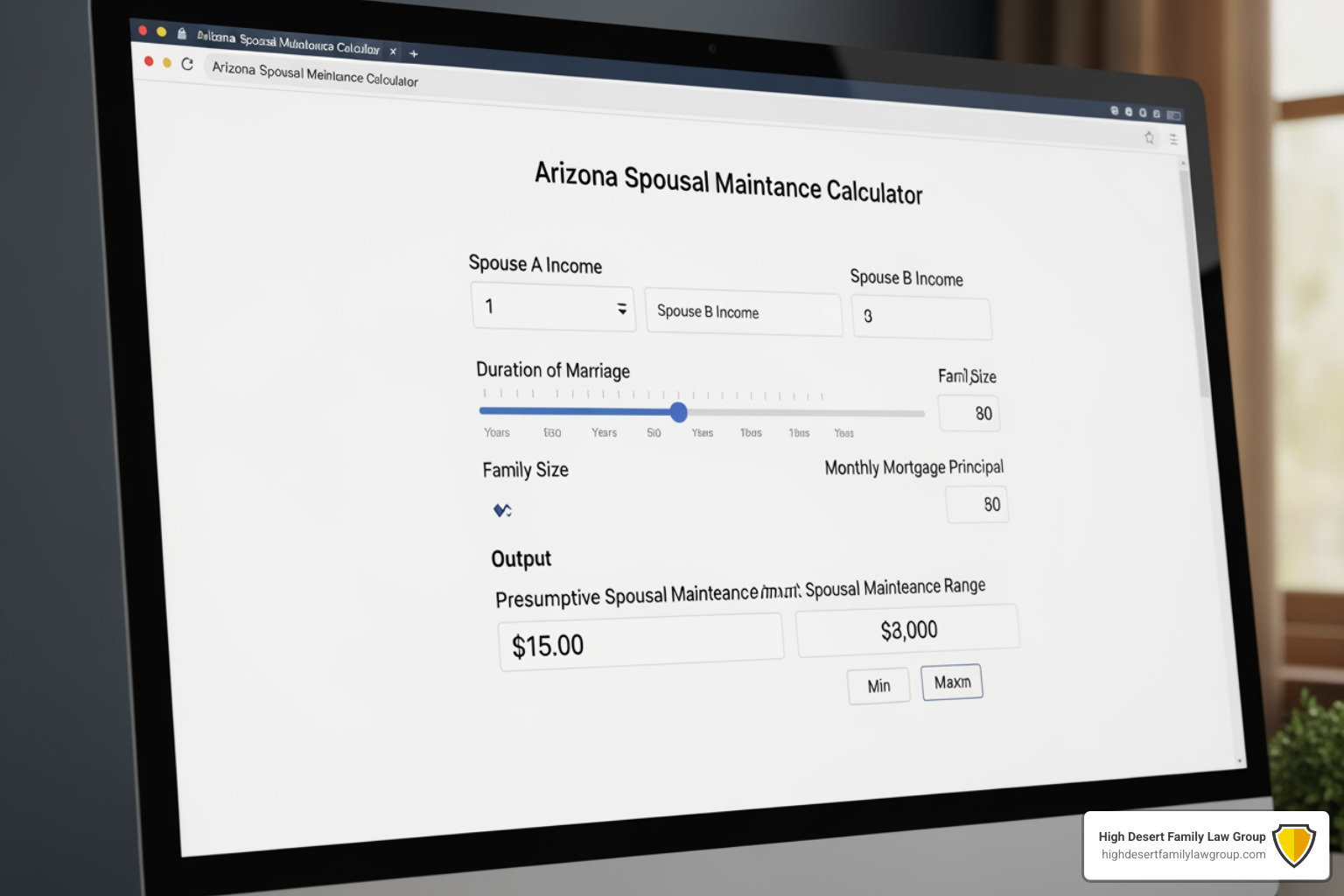
The calculator isn’t just about your base salary. It looks at “Actual Income,” which includes:
- Wages, commissions, and bonuses.
- Recurring gifts and prizes.
- Military allowances (like BAH and BAS).
- Self-employment income (minus “ordinary and necessary” expenses).
The tool also considers “Family Size.” This includes the two spouses and any children for whom a legal support obligation exists. Interestingly, the Arizona calculator also looks at “Mortgage Principal.” Because paying down a mortgage builds equity (an asset), the guidelines require us to handle these figures carefully to avoid “double counting” assets as income.
When a Judge Can Deviate From the Guideline Amount
While the calculator provides a “presumptive range,” it isn’t set in stone. We can argue for a deviation if the calculated amount is unjust. Common reasons for deviation include:
- Marital Waste: If one spouse spent community funds on an affair, gambling, or drugs.
- Unusual Expenses: High medical bills or special needs for a child.
- High Income Cases: If the combined income is extremely high, the standard formula might produce a “windfall” that exceeds reasonable needs.
How Long Spousal Maintenance Lasts and When It Ends
One of the biggest questions we get at High Desert Family Law Group is: “How long will this last?” In May 2026, the answer is almost always tied to the length of your marriage. Arizona has moved away from “permanent” awards in favor of “transitional” support that has a clear end date.
Duration Ranges for Spousal Maintenance in Arizona
The court calculates the “length of marriage” from the wedding date to the date the divorce petition was served. The guidelines generally follow these standard ranges:
- Marriages 10–16 years (120–192 months): Support typically lasts between 12 and 60 months.
- Marriages 16+ years (192+ months): Support typically lasts between 12 and 96 months.
The goal is to provide enough time for the receiving spouse to gain the education or job experience necessary to stand on their own two feet. You can see how other states, like California, handle long-term support for comparison.
The Rule of 65 and Long-Term Awards
There is a special exception to the 96-month cap known as the Rule of 65. This rule applies if:
- The spouse seeking maintenance is at least 42 years old.
- The marriage lasted at least 16 years.
- The sum of the spouse’s age and the marriage length equals 65 or more.
If you meet the Rule of 65, the judge has much broader discretion. In these cases, support could potentially last longer than the standard 8-year maximum, sometimes even indefinitely if the spouse is unlikely to ever enter the workforce due to age or health.
When Spousal Maintenance Can Be Modified or Terminated
Life doesn’t stop after the divorce decree is signed. Spousal maintenance orders are usually “modifiable” unless the parties specifically agree in writing that they are “non-modifiable.”
Support typically ends early if:
- The receiving spouse remarries.
- Either spouse passes away.
- The receiving spouse begins “cohabitating” with a romantic partner in a way that significantly reduces their financial need.
If you’ve experienced a “substantial and continuing change in circumstances”—like a 30% drop in income or a forced retirement—we can help you file for a modification. For more on this, visit our page on Spousal Maintenance.
Common Issues, Myths, and Practical Tips
There is a lot of misinformation out there about spousal maintenance. Let’s clear up a few things:
- Taxes: For any divorce finalized after December 31, 2018, spousal maintenance is not tax-deductible for the person paying it, and it is not considered taxable income for the person receiving it. This was a massive shift in federal law that we must account for in every negotiation.
- Bankruptcy: You cannot “wipe out” a spousal maintenance obligation by filing for bankruptcy. It is considered a “domestic support obligation” and is non-dischargeable.
- Gender Neutrality: Support is gender-blind. We represent many “breadwinner” wives who are paying support to their ex-husbands, and vice versa.
Common Mistakes People Make in Spousal Maintenance Cases
We see the same errors over and over again. To protect yourself, avoid these pitfalls:
- Hiding Income: In the age of digital banking and forensic accounting, “under the table” income is almost always discovered and can lead to heavy sanctions.
- Ignoring the 4% Rule: Arizona guidelines often attribute a 4% rate of return on income-producing assets. If you have $500,000 in a savings account, the court may “pretend” you are earning $20,000 a year from it, even if you aren’t.
- Double Counting: You can’t count a business’s value as an asset in property division and then count that same business’s “future earnings” as income for support. That’s a “double dip” that we fight to prevent.
What Evidence Helps Your Spousal Maintenance Claim
If you want to win your case, you need more than just a “feeling” that the numbers are unfair. You need a paper trail.
Key Documents to Gather:
- Five years of tax returns (including all W-2s and 1099s).
- Pay stubs for the last six months.
- Detailed monthly budgets (be realistic—don’t forget car registration and home repairs!).
- Medical records if you are claiming a disability.
- Proof of job searches or enrollment in job training programs.
Frequently Asked Questions About Spousal Maintenance
Is spousal maintenance automatic in an Arizona divorce?
No. Unlike child support, which is almost always ordered if there are children, spousal maintenance is only granted if a spouse first meets the eligibility requirements under A.R.S. § 25-319. Even then, the court must decide if an award is “appropriate.”
Is there a formula for spousal maintenance in Arizona?
Yes. As of late 2022 and updated in 2025, there is an official calculator used statewide. It generates a “low,” “mid,” and “high” range for both the monthly amount and the total number of months. While judges can deviate from the amount, they rarely deviate from the duration ranges unless the Rule of 65 applies.
Does spousal maintenance affect child support or taxes?
Yes, it affects child support. In Arizona, we calculate spousal maintenance first. The amount of maintenance paid is then subtracted from the payer’s income and added to the receiver’s income before we run the child support numbers. Regarding taxes, post-2018 awards are “tax-neutral” at the federal level.
Conclusion
Navigating spousal maintenance in Arizona requires a blend of mathematical precision and aggressive legal advocacy. The 2025 guidelines have made the process more predictable, but the “inputs” you put into that calculator—and the arguments you make for deviations—will determine your financial reality for years to come.
At High Desert Family Law Group, our four-person team provides individualized representation for clients in Scottsdale, Chandler, and throughout Greater Phoenix. Whether you are seeking the support you need to rebuild your life or protecting your hard-earned income from an unfair claim, we are here to provide the aggressive, strategic counsel you deserve.
If you’re ready to take the next step and secure your financial future, contact us today for more info about Spousal Maintenance. We’ll help you run the numbers and build a strategy that works for you.