


Fault and no-fault divorce are the two main legal frameworks for ending a marriage in the United States. Here is a quick breakdown:
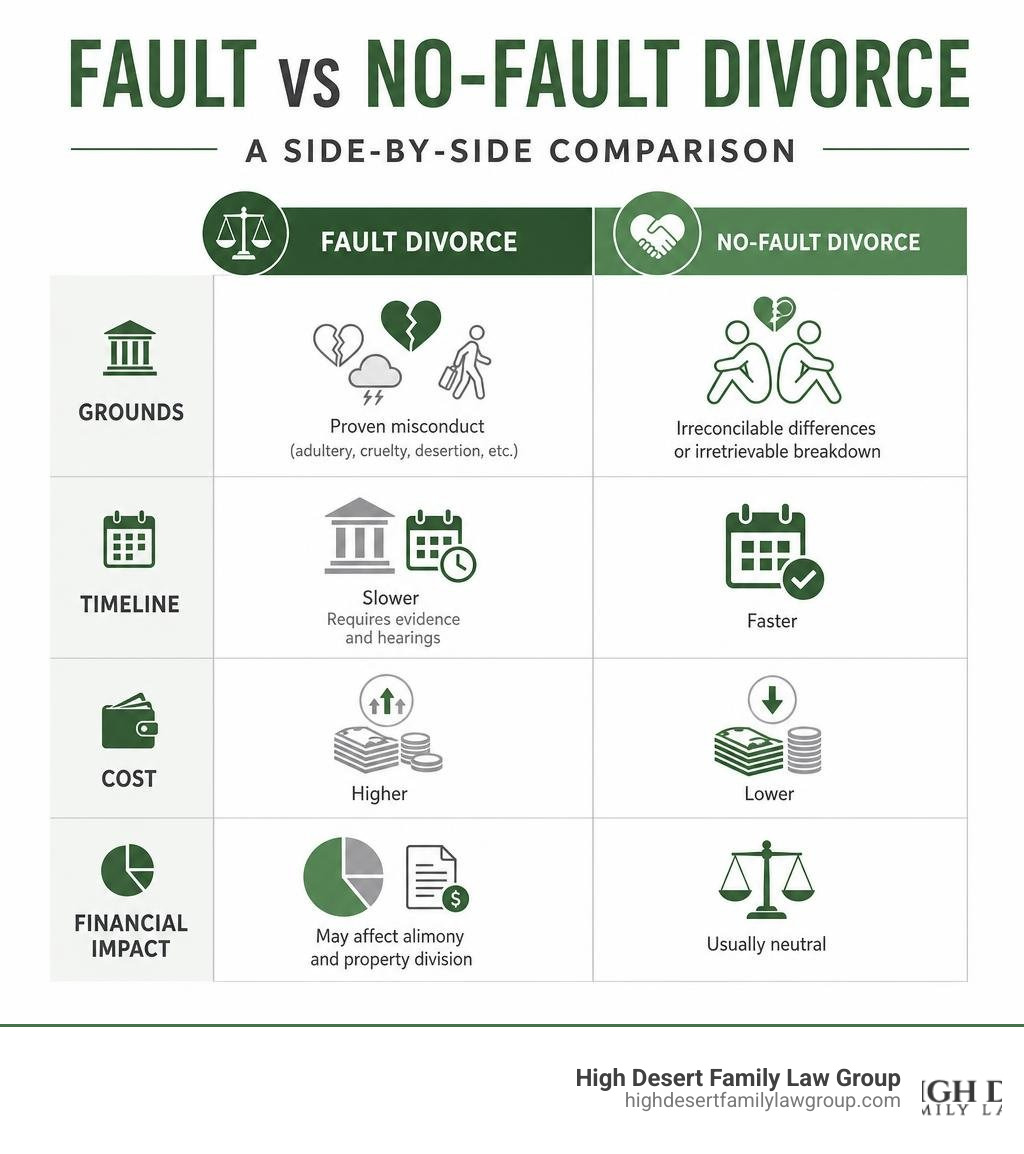
| Feature | No-Fault Divorce | Fault Divorce |
|---|---|---|
| Grounds required | Irreconcilable differences or irretrievable breakdown | Proven misconduct (adultery, cruelty, desertion, etc.) |
| Spouse’s consent needed | No | No, but spouse can contest |
| Available in | All 50 states | About 33 states |
| Typical timeline | Faster | Slower — requires evidence and hearings |
| Cost | Lower | Higher |
| Impact on finances | Usually neutral | May affect alimony and property division |
When a marriage ends, the path forward is not always clear. The type of divorce you file — and where you file it — can shape everything from how your assets are divided to whether you receive spousal support.
All 50 states now offer no-fault divorce. But roughly 33 states still allow fault-based filings, and in those states, proving misconduct can sometimes shift financial outcomes significantly.
This guide explains both options in plain language, so you can make an informed decision about your situation.
Understanding Fault and No-Fault Divorce

To understand how modern marriages end, it helps to look at how the legal landscape has evolved. Historically, getting a divorce was incredibly difficult. In the mid-20th century, if you wanted to end your marriage, you had to prove your spouse committed a specific legal wrong. This often led to elaborate, fabricated scenarios where couples staged “adultery” just to satisfy strict judges.
The legal landscape shifted dramatically in 1969 when California, under Governor Ronald Reagan, enacted the nation’s first pure no-fault divorce law, which took effect in 1970. Other states quickly followed suit, recognizing that forcing couples to remain in broken marriages or lie under oath was bad public policy. In fact, economists Betsey Stevenson and Justin Wolfers found that states adopting no-fault divorce saw an 8% to 16% decline in wives’ suicide rates and a 30% reduction in domestic violence. Historian Stephanie Coontz also pointed out that since no-fault divorce became widespread, the national divorce rate actually dropped from about 23 divorces per 1,000 married couples in 1979 to under 17 per 1,000 in 2005.
Today, a no-fault divorce | Wex | US Law | LII / Legal Information Institute allows either spouse to file for dissolution without pointing fingers. You only need to state that the marriage is “irretrievably broken” or that you suffer from “irreconcilable differences.”
Conversely, a fault-based divorce requires the filing spouse to legally prove that the other party’s specific misconduct caused the marriage to fail. While this dual system still exists in about 33 states, navigating the choice requires a clear understanding of the Different Types of Divorce and how they operate in your local court system.
Proving Grounds in a Fault and No-Fault Divorce
If you choose to file a fault-based divorce in a state that permits it, you cannot simply say your spouse was a difficult partner. You must prove one of several legally recognized statutory grounds. According to Fault and No-Fault Divorce: An Overview – FindLaw, the most common fault grounds include:
- Adultery: Voluntary sexual intercourse between a married person and someone other than their spouse.
- Cruelty: Extreme physical or mental abuse that makes living together intolerable or unsafe.
- Desertion/Abandonment: When one spouse physically leaves the marital home without consent for a continuous, specified period (often one year or more).
- Imprisonment: Confinement in a state or federal prison for a set number of years.
- Incurable Insanity: Requiring medical testimony and long-term confinement in a mental health facility.
In a no-fault filing, the “grounds” are much simpler. You do not have to present evidence of bad behavior. You simply assert that the relationship has broken down past the point of reconciliation.
Defenses and Contesting a Fault and No-Fault Divorce
In a no-fault proceeding, one spouse generally cannot block the divorce. If one person wants out and states the marriage is broken, courts will grant the dissolution because forcing someone to remain married is contrary to modern legal principles.
However, in a fault-based system, the accused spouse can legally contest the allegations. If they successfully disprove the fault grounds, the court may deny the divorce petition entirely. According to Fault vs. No-Fault Divorce, several traditional legal defenses exist to counter fault claims:
- Condonation: Arguing that the innocent spouse knew about the misconduct but forgave it (for example, continuing to live and sleep together after discovering an affair).
- Connivance: Claiming the filing spouse set up or encouraged the misconduct (such as inviting an outside party into the home to bait the other into adultery).
- Collusion: An agreement between both spouses to fabricate a story of misconduct just to get the court to grant a divorce.
- Provocation: Asserting that the filing spouse’s bad behavior directly provoked the actions complained of (for example, provoking abandonment by making the home environment physically hostile).
Because proving these defenses is highly complex and costly, they are rarely used in modern courts, but they remain powerful tools in jurisdictions that still heavily weigh marital misconduct.
Financial and Custody Impacts of Divorce Filings

Many clients ask us if choosing one filing method over another gives them a strategic advantage. The answer depends heavily on your state’s laws, but filing for a fault-based divorce or raising issues of marital misconduct can directly impact the financial and child-related outcomes of your case. For those navigating this process locally, it is helpful to understand how these concepts apply to a Divorce in Arizona.
Property Division and Debt Allocation
In the United States, marital assets and debts are divided using either “equitable distribution” or “community property” rules.
In a pure no-fault state, marital misconduct like cheating or emotional cruelty is completely irrelevant to how property is split. The court will divide community assets down the middle or equitably without looking at who broke the marriage vows.
However, there is a major exception: asset dissipation (also known as “marital waste”). If one spouse spent community funds on extramarital affairs, gambling, substance abuse, or expensive gifts for a paramour, we can ask the court to intervene. Even in no-fault jurisdictions, judges will often offset this waste by awarding the innocent spouse a larger share of the remaining assets to compensate for the squandered funds.
Spousal Support and Alimony Determinations
While property division focuses on tangible assets, spousal support (alimony) is highly sensitive to marital conduct in certain states.
In some dual-system states, a spouse proven to have committed adultery may be legally barred from receiving any spousal support, regardless of their financial need. Conversely, an innocent spouse may receive a more substantial or longer-lasting support award if they can prove their partner’s cruelty or abandonment caused the marriage to collapse.
In contrast, pure no-fault states base alimony determinations strictly on financial need, the duration of the marriage, and the earning capacities of both parties. For a deeper look at how these dynamics play out during negotiations, you can read more about Fault vs No-Fault Divorce.
Child Custody and Visitation Decisions
When it comes to child custody and parenting time, courts across the country use the “best interests of the child” standard.
It is a common misconception that a cheating spouse will automatically lose custody. Courts generally separate marital misconduct from parental fitness. A parent’s infidelity or emotional breakdown during a divorce rarely impacts custody decisions unless that behavior directly harms or exposes the child to inappropriate or unsafe situations.
However, if the “fault” involves physical abuse, domestic violence, severe substance abuse, or criminal behavior, it will heavily influence parenting time decisions. Courts will restrict or supervise visitation to ensure the child’s safety, prioritizing parental fitness over any desire to punish a spouse for breaking the marriage contract.
State-by-State Variations and the Arizona Landscape
Divorce laws are governed entirely at the state level, meaning your geographic location dictates your legal options. To see how these differences manifest in practice, it is useful to review the No-Fault vs Fault Divorce Explained: What It Really Means in Court – Law Interpretation framework.
Pure No-Fault States vs. Dual-System States
States generally fall into two categories:
- Pure No-Fault States: These states (including California, Colorado, Florida, and Wisconsin) have completely abolished fault-based divorces. You cannot file on grounds of adultery or cruelty, and the court will not hear evidence of marital misconduct except in cases of asset waste or child endangerment.
- Recent Update (June 2026): For example, California recently implemented Senate Bill 1427, which allows couples with children or significant assets to file joint petitions for dissolution to bypass lengthy waiting periods, reinforcing their commitment to streamlined, administrative no-fault options.
- Dual-System States: States like Texas, Virginia, and Georgia allow couples to choose. You can file a quick no-fault petition, or you can file a fault-based petition if you want to leverage misconduct to secure a more favorable property division or alimony ruling.
Is Arizona a No-Fault Divorce State?
Yes, Arizona is primarily a no-fault divorce state. For standard marriages, the filing spouse only needs to state under oath that the marriage is “irretrievably broken.” The court does not want or need to hear about infidelity or emotional incompatibility to grant the dissolution.
However, Arizona has a unique legal option: Covenant Marriage.
If you legally entered into a covenant marriage (which requires premarital counseling and a specific declaration on your marriage license), you cannot obtain a standard no-fault divorce unless both spouses mutually agree to it. If one spouse objects, the filing party must legally prove specific fault-based grounds to end the marriage, such as:
- Adultery
- A felony conviction resulting in imprisonment
- Abandonment for at least one year
- Physical or sexual abuse
- Habitual drug or alcohol abuse
For standard Arizona divorces, the process is governed by strict procedural timelines. At least one spouse must meet the 90-day residency requirement before filing, and there is a mandatory 60-day waiting period after the petition is served before a judge can sign the final decree. To learn more about how these rules apply to your specific situation, check out our guide on whether Is Arizona a No-Fault Divorce State?.
Frequently Asked Questions about Divorce Types
What is the timeline difference between fault and no-fault divorces?
No-fault divorces are almost always faster. If both parties agree on the terms (an uncontested divorce), the case can be finalized as soon as the state’s mandatory waiting period expires (60 days in Arizona).
Fault-based divorces take significantly longer — often a year or more. Because you must legally prove misconduct, these cases require extensive discovery, depositions, and evidentiary hearings, which can easily clog court calendars and delay your final decree.
What evidence is required to prove fault in a divorce?
Proving fault requires clear and convincing evidence. Courts will not accept mere suspicion. Typical evidence includes:
- Financial Records: Bank statements or credit card bills showing money spent on hotel rooms, trips, or gifts for a paramour (to prove adultery or asset waste).
- Witness Testimony: Statements from friends, family members, or private investigators who observed the misconduct.
- Digital Evidence: Text messages, emails, or social media posts confirming inappropriate relationships or abusive behavior.
Can a spouse prevent or block a no-fault divorce?
No. In almost every state, a spouse cannot prevent a no-fault divorce. If one party believes the marriage is over, the court will grant the dissolution. The only notable exception is Mississippi, which still requires mutual consent for an irreconcilable differences divorce; otherwise, the filing party must prove fault grounds.
Conclusion
Deciding how to navigate a divorce is one of the most significant choices you will ever make. While no-fault divorce offers a more private, streamlined, and cost-effective path to a new beginning, understanding how marital misconduct can still influence property and support negotiations is vital to protecting your future.
At High Desert Family Law Group, we understand that no two marriages are alike. Our four-person legal team provides aggressive, highly individualized representation to clients throughout the Greater Scottsdale and Chandler, Arizona areas. We are here to help you evaluate your options, protect your financial interests, and secure a stable future for your family.
If you are ready to discuss your situation with an experienced advocate, explore our resources on Fault vs No-Fault Divorce or contact us today to schedule your consultation.