



What You’ll Actually Pay in Real Estate Attorney Fees (And Why It Matters)
Real estate attorney fees typically fall within the following ranges:
| Service | Typical Cost |
|---|---|
| Standard residential closing | $750 – $1,250 |
| Full transaction (buying or selling) | $500 – $2,000 |
| Complex or high-cost market closing (e.g., NYC) | $2,000 – $3,500 |
| Hourly rate | $150 – $600/hr |
| Contract review only | $400 – $700 |
These are national averages. Your actual cost depends on your location, the complexity of the deal, and how the attorney structures their fees.
Buying or selling a home is likely the largest financial transaction of your life. Yet many people walk into it with almost no legal protection — and only discover the risks when something goes wrong.
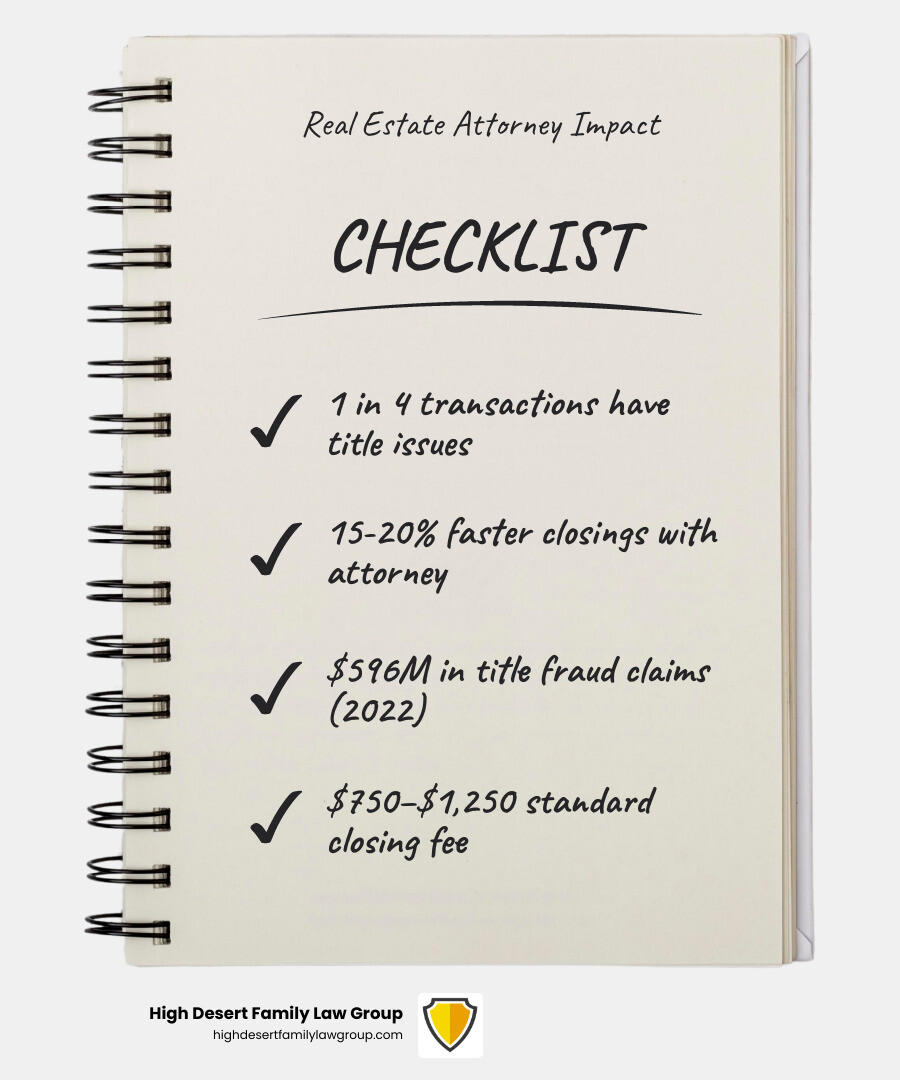
About 1 in 4 residential real estate transactions contains a title problem that needs to be resolved before the deal can close. Fraud and forgery alone accounted for $596 million in title insurance claims in 2022. And if you’re going through a divorce in Arizona, the stakes are even higher — because how a property is titled, valued, and transferred can have lasting consequences on your financial future.
Understanding what legal help costs — and what it’s actually worth — is the first step to protecting yourself.
Understanding Real Estate Attorney Fees: Structures and Rates
When you begin your search for legal representation in Scottsdale or Chandler, the first thing you’ll notice is that not all lawyers bill the same way. In May 2026, the market has shifted toward more transparent pricing, but the structure still depends largely on the “flavor” of your transaction.
Flat Fees
For standard residential transactions, flat fees are becoming the gold standard. A flat fee provides predictability, allowing you to budget exactly what you’ll owe at the closing table. Most Real Estate Attorney Cost models for residential deals range from $500 to $2,000. This usually covers contract review, title examination, and coordination with the escrow company.
Hourly Rates
If your situation is “messy”—perhaps a boundary dispute, a complex commercial lease, or a high-conflict property division in a divorce—you will likely encounter hourly billing. Real Estate Attorney Cost Per Hour typically ranges from $150 to $600. In Arizona, experienced attorneys often fall in the $300 to $500 range. Lawyers usually track this time in six-minute increments.
Retainer Agreements
For ongoing litigation or complex commercial developments, an attorney may require a retainer. This is an upfront deposit held in a trust account, from which the lawyer draws as they perform work.
| Fee Structure | Best For… | Pros | Cons |
|---|---|---|---|
| Flat Fee | Standard home buy/sell | Budget certainty | May not cover “extra” disputes |
| Hourly Rate | Litigation, Zoning, Divorce | Pay only for time used | Costs can spiral without “caps” |
| Hybrid | Foreclosures, Short sales | Balances risk/reward | Can be confusing to track |

Average Costs for Common Legal Services in 2026
As we look at the 2026 landscape, real estate attorney fees are often categorized by the specific task performed. Not every deal requires a lawyer to hold your hand from start to finish; sometimes, you just need a professional “second pair of eyes.”
- Closing Fees: In a typical residential closing, the attorney fee is often between $750 and $1,250. This covers the final review of the settlement statement and ensuring the deed is recorded correctly.
- Contract Review: If you just need a lawyer to look over Purchase and Sale Agreements, expect to pay a flat fee of $400 to $700. This is a small price to pay to ensure you aren’t signing away your rights to inspection credits or earnest money.
- Title Search and Opinion: About 25% of deals hit a snag because of “clouds” on the title—liens from previous owners, unpaid taxes, or clerical errors. An attorney-led title review ensures these are cleared before you take ownership.
Typical real estate attorney fees for buyers and sellers
The role of the attorney—and what they charge—differs depending on which side of the table you sit on.
- For Sellers: Fees typically range from $500 to $2,000 for a straightforward sale. The seller’s attorney focuses on drafting the deed, clearing title issues, and ensuring the mortgage payoff is handled correctly. In the Chicago area, for example, sellers might pay a $400–$500 closing fee, but in Arizona, these costs are often bundled into a larger representation package.
- For Buyers: Buyers often pay slightly more, as their attorney must coordinate with the lender and review complex loan documents. For a deeper dive into these variations, check out How much does a real estate attorney cost? and our own guide on How Much Do Real Estate Attorneys Charge?.
Factors that influence real estate attorney fees
Why does one neighbor pay $800 while another pays $3,000? Several variables drive the price:
- Geographic Location: Rates in urban centers like Scottsdale are generally higher than in rural parts of the state. In extreme markets like NYC, fees can hit $3,500, whereas Arizona remains more moderate.
- Transaction Complexity: A cash deal for a single-family home is simple. A “seller-carry” deal involving private financing or a property with unpermitted additions requires significantly more legal “heavy lifting.”
- Property Type: Commercial properties involve zoning laws, environmental reports, and multi-tenant leases, often pushing legal fees into the $2,000 to $10,000+ range. You can learn more about these complexities in our Real Estate Law section and the Category: Real Estate Attorney archives.

When is a Real Estate Attorney Essential?
In Arizona, you aren’t legally required to hire an attorney for a standard home sale—escrow companies handle much of the administrative work. However, “legal” and “essential” aren’t always the same thing.
For Sale By Owner (FSBO): Without a realtor to guide the paperwork, FSBO sellers are at a high risk for lawsuits regarding disclosures. An attorney charging $500–$2,000 to draft an ironclad contract is a bargain compared to a $50,000 lawsuit later.
Foreclosures and Short Sales: These involve navigating bank bureaucracies and complex title histories. Missing one lien can cost you tens of thousands of dollars down the road.
Disputes and Zoning: If you are dealing with property line arguments or need to change how a property is used, you’ll need expertise in Analyzing and Litigating Real Estate Disputes and Land Use and Zoning.
Mandatory Attorney States vs. Escrow States
It is important to know that 22 states (plus D.C.) require an attorney to be present at closing. Arizona is an “Escrow State,” meaning title companies facilitate the closing. However, remember this: A title company is a neutral third party. They cannot give you legal advice. They won’t tell you if a contract clause is “bad” for you; they just make sure the paperwork is signed. Only an attorney has a fiduciary duty to protect your specific interests. Sometimes, we even provide Expert Witness Services in Real Estate to clarify these roles in court.
Real Estate in Transition: Divorce and Property Division in Arizona
This is where our expertise at High Desert Family Law Group truly shines. In Arizona, real estate isn’t just a house; it’s often the largest “Community Property” asset.
Arizona is a community property state, meaning assets acquired during the marriage are generally split equitably. But “equitable” doesn’t always mean 50/50. We look for:
- Separate Property: Did you own the house before the wedding? Did you inherit it? If so, it might be yours alone—unless you “commingled” it by using joint funds to pay the mortgage.
- Marital Waste: If a spouse spent community money on an extramarital affair or a gambling addiction, the court might award the other spouse a larger share of the home’s equity to make up for it.
- Valuation Disputes: In a high-net-worth divorce, we often coordinate with appraisers and experts in Real Estate Partnerships or Private Equity Capital Raising and Deployment to ensure the property is valued correctly before it’s divided.
Frequently Asked Questions about Real Estate Legal Costs
Who pays the attorney fees at closing?
In most cases, each party pays for their own legal counsel. These fees are itemized on the Closing Disclosure or Settlement Statement. However, everything is negotiable. A buyer might ask the seller to cover a portion of their legal fees as part of the closing credits, especially if the title search reveals issues the seller needs to fix.
Is an attorney cheaper than a realtor?
They offer different services. A realtor charges a commission (typically 5-6% of the sale price) to market the home and negotiate the price. An attorney charges a fee (usually a few thousand dollars) to ensure the deal is legally sound. On a $500,000 home, a realtor commission might be $30,000, while real estate attorney fees might only be $1,500. Using a “hybrid” model—a low-commission agent plus a great attorney—is a popular way to save money in 2026.
How can I reduce my real estate legal expenses?
- Negotiate a Flat Fee: For standard deals, don’t accept hourly billing.
- Be Prepared: The more documents you organize yourself (deeds, tax records, HOAs), the less time the lawyer spends hunting them down.
- Mid-Month Closings: Some firms offer slight discounts (10-15%) if you close mid-month when they aren’t slammed with the end-of-month rush.
- Bundle Services: If you are selling one home and buying another, ask for a “dual transaction” discount.
Conclusion
At High Desert Family Law Group, we understand that whether you are buying your first home in Scottsdale or dividing a multi-million dollar real estate portfolio in a Chandler divorce, you aren’t just paying for paperwork—you’re paying for the peace of mind that comes with knowing your investment is secure.
Our team provides aggressive, individualized representation tailored to the unique landscape of Arizona law. We don’t just “process” transactions; we build strategies to protect your wealth and your future. If you’re facing a complex property issue or need a steady hand during a transition, we are here to help.