



What It Really Means to Claim Spousal Maintenance — and Why It Matters
If you need to claim spousal maintenance after a divorce or separation, here is the short answer on how it works in Arizona:
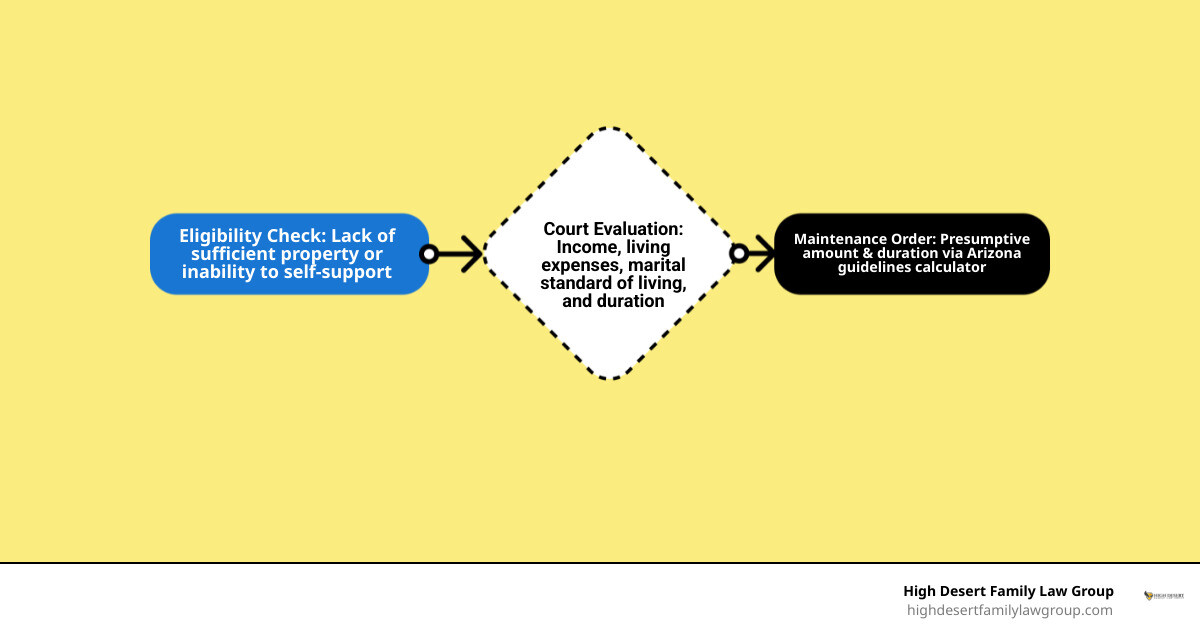
- Check eligibility — You must meet at least one of five legal grounds under A.R.S. § 25-319, such as lacking sufficient property or being unable to support yourself through employment.
- File a petition — Request maintenance as part of your divorce petition or in a separate family court filing.
- Gather financial documentation — Income records, living expenses, and evidence of the marital standard of living all matter.
- Let the court calculate — Arizona courts use a standardized guidelines calculator to determine a presumptive amount and duration.
- Enforce or modify as needed — If circumstances change, either party can return to court to adjust the order.
Divorce is hard enough without also worrying about how you will pay your bills next month. Whether you stayed home to raise children, supported a spouse through school, or simply earned less over the course of a long marriage, the law recognizes that a financial gap can exist after separation — and that gap is exactly what spousal maintenance is designed to address.
But this area of family law is not automatic. Courts do not hand out support without a clear legal basis. The rules vary significantly depending on where you live, how long you were married, and what each spouse earns. Getting it wrong — or missing a filing deadline — can cost you real money.
Simple claim spousal maintenance glossary:
What is Spousal Maintenance and Who is Eligible?
Before we dive into the math, let’s clear up the terminology. In Arizona, we use the term “spousal maintenance.” In other parts of the country, you might hear it called “alimony” or “spousal support.” No matter what you call it, the core purpose is the same: to prevent a post-divorce economic disparity where one spouse is left financially destitute while the other continues living in luxury.
However, to legally claim spousal maintenance in Scottsdale, Chandler, or anywhere else in Arizona, you must first clear the eligibility hurdle. Under A.R.S. § 25-319, a court will only award maintenance if the requesting spouse meets at least one of the five statutory grounds:
- Lacks sufficient property — You do not have enough property (including property apportioned to you in the divorce) to provide for your reasonable needs.
- Unable to be self-sufficient — You are unable to support yourself through appropriate employment, or you are the custodian of a child whose age or condition is such that you should not be required to seek employment outside the home.
- Contributed to the other’s education — You made significant financial or non-financial contributions to your spouse’s education, training, vocational skills, career, or earning ability.
- Long marriage and advanced age — You had a marriage of long duration and are of an age that may preclude the possibility of gaining employment adequate to be self-sufficient.
- Reduced career opportunities — You significantly reduced your income or career opportunities for the benefit of your spouse.
If you want to understand these rules in greater depth, you can read our comprehensive guides on alimony qualifications and our beginners guide to spousal maintenance.
A common point of confusion for many divorcing couples is the difference between spousal maintenance and child support. These are two completely distinct legal concepts, and courts treat them as such. Spousal maintenance must always be calculated and determined before child support is calculated, as the maintenance payments affect each party’s gross income for child support purposes.
Here is a quick breakdown of how they compare:
| Feature | Spousal Maintenance | Child Support |
|---|---|---|
| Primary Purpose | To support a financially dependent former spouse. | To cover the financial needs of the minor children. |
| How Calculated | Based on statutory guidelines, income, and marriage length. | Based on the Arizona Child Support Guidelines (parental income, parenting time, health costs). |
| Standard of Living | Aims to reflect the marital standard of living. | Aims to ensure the child’s needs are met consistently in both households. |
| Tax Treatment | Tax-free for the recipient, non-deductible for the payer (post-2018). | Always tax-free for the recipient and non-deductible for the payer. |
| Duration | Typically temporary (transitional), unless a long marriage dictates otherwise. | Generally ends when the child turns 18 or graduates high school. |
How to Claim Spousal Maintenance: A Step-by-Step Guide

Claiming spousal support is not as simple as asking a judge for a check. It requires a structured legal approach. If you are preparing to file, you should understand the general path your case will take.
Here is how the process works in Arizona:
- Determine Eligibility: Work with your attorney to evaluate your financial situation against the five statutory grounds of A.R.S. § 25-319(A).
- File the Petition: You must formally request spousal maintenance in your initial Petition for Dissolution of Marriage (or in your Response, if your spouse filed first).
- Request Temporary Orders: Divorce cases can take months—or even more than a year—to resolve. If you cannot afford your basic living expenses while the divorce is pending, we can file a motion for temporary orders. This secures a temporary spousal support order to keep you afloat during the litigation.
- Exchange Financial Disclosures: Both parties are legally required to exchange comprehensive financial documents. This includes tax returns, pay stubs, bank statements, and monthly budgets.
- Negotiate or Mediate: Many couples can reach an agreement on the amount and duration of support outside of court. If you agree, we can draft a consent decree.
- Go to Trial: If your spouse refuses to agree to a fair amount, we will present your case to an Arizona family court judge, who will issue a final, binding spousal maintenance order.
To learn more about navigating this process in our local courts, check out our guide on alimony in Arizona.
Legal Time Limits to Claim Spousal Maintenance
When it comes to family law, timing is everything. If you do not request spousal maintenance during your divorce proceedings, you generally lose the right to claim it forever once the final divorce decree is signed. You cannot come back years later and ask for support because you fell on hard times.
It is worth noting how these rules differ internationally. For example, under Australian spousal maintenance rules, divorced couples have a strict 12-month window after their divorce order takes effect to apply for spousal maintenance, while de facto (unmarried) couples have two years from the date of separation.
In Arizona, however, we do not recognize “de facto” relationships or common-law marriages. If you were not legally married, you cannot claim spousal maintenance under Arizona law, no matter how long you lived together. Additionally, all maintenance claims must be raised and resolved during the active divorce or legal separation case before the final decree is entered.
How Jurisdictional Differences Affect Your Right to Claim Spousal Maintenance
Family law is state-specific, and how courts calculate support varies wildly across the United States.
In Arizona, courts rely on the Arizona Spousal Maintenance Guidelines, which utilize a standardized calculator to generate a presumptive range for both the amount and duration of support. This mathematical approach was designed to bring consistency and predictability to Arizona divorces.
Contrast this with other states:
- Colorado: Under the Colorado guidelines, courts use an advisory formula (typically 40% of the combined adjusted gross monthly income minus the lower-earning party’s income) for couples with a combined annual income of $240,000 or less, but the guidelines are strictly advisory.
- Illinois: Under Illinois 750 ILCS 5/504, courts apply a rigid statutory formula (33 1/3% of the payer’s net income minus 25% of the recipient’s net income) capped at 40% of the combined net income, with duration determined by specific fractional multipliers based on the exact length of the marriage.
Because Arizona has its own distinct, data-driven system, relying on advice or online calculators designed for other states will only leave you confused.
How Courts Determine Support Amount and Duration
For divorces filed on or after September 24, 2022, Arizona uses a standardized Spousal Maintenance Calculator. This calculator is based on real-world economic data from the U.S. Bureau of Labor Statistics Consumer Expenditure Survey. The goal is to calculate a support amount that meets the reasonable needs of the receiving spouse while accounting for the paying spouse’s ability to pay.
When we run the calculator, we must input several key figures:
- Actual Income: This includes gross wages, salary, bonuses, commissions, and even attributed income if a spouse is voluntarily unemployed or underemployed.
- Family Size: This metric includes the spouses and any children they are legally obligated to support.
- Mortgage Principal: The average monthly mortgage principal payment can impact the final calculation.
The calculator then generates a presumptive range for both the monthly payment amount and the duration of the award. The duration is typically determined by a multiplier based on the length of the marriage, with the legal system prioritizing transitional support that allows the receiving spouse to eventually achieve self-sufficiency.
However, high-earning individuals in areas like North Scottsdale require a different level of analysis. If you are dealing with a complex estate, you should read our specialized article on spousal maintenance in high-income Scottsdale divorce cases. For a practical look at managing this process without getting overwhelmed, our guide on navigating spousal maintenance in Arizona without losing your mind is an invaluable resource.
Enforcement, Modifications, and Tax Implications
Once a judge issues a spousal maintenance order, the legal journey is not necessarily over. You still have to navigate taxes, potential modifications, and enforcement if your ex-spouse refuses to pay.
Tax Implications: The Post-2018 Reality
Under the federal Tax Cuts and Jobs Act, the tax treatment of spousal maintenance underwent a massive shift:
- Agreements executed after December 31, 2018: Spousal maintenance is non-deductible for the paying spouse and tax-free for the receiving spouse.
- Agreements executed before January 1, 2019: The old rules still apply. The paying spouse can deduct the payments on their tax return, and the receiving spouse must report them as taxable income.
This shift means that in 2026, any new spousal maintenance order we secure for you will be completely tax-free income, while your ex-spouse must pay the taxes on those funds.
Modifying Your Support Order
Unless both parties explicitly agree in writing to make the maintenance order “non-modifiable,” Arizona courts retain continuing jurisdiction over the support order. This means either party can request a modification if there is a “substantial and continuing change in circumstances.”
Common reasons for modification include:
- A significant, involuntary drop in the paying spouse’s income.
- A severe illness or disability that prevents the receiving spouse from working.
- The receiving spouse achieving financial self-sufficiency earlier than expected.
Additionally, under Arizona law, spousal maintenance automatically terminates if the receiving spouse remarries or if either spouse passes away, unless the written agreement states otherwise. If you want to learn more about how to manage your payments or what to do if your financial situation shifts, read our guide on collecting spousal support.
Frequently Asked Questions About Spousal Support
Does marital misconduct affect spousal maintenance?
No. Arizona is a strict “no-fault” divorce state. Under A.R.S. § 25-319, courts must determine spousal maintenance “without regard to marital misconduct.” This means that infidelity, lying, or cheating will not increase the amount of support you receive, nor will it prevent an unfaithful spouse from claiming support if they legally qualify. The court focuses strictly on objective financial factors and economic need.
What happens if my ex-partner stops paying spousal maintenance?
If your ex-spouse stops paying, they are in violation of a court order. We can file a Motion for Contempt or a Petition to Enforce Spousal Maintenance. The court has aggressive tools to collect unpaid support, including:
- Wage Garnishment: Ordering their employer to deduct support directly from their paycheck.
- Interest Accrual: Unpaid maintenance automatically accrues interest.
- Asset Seizure: Licensing and property liens can be placed on their assets.
- Contempt of Court: In extreme cases, a judge can sentence a non-paying ex-spouse to jail time for refusing to comply.
Can spousal maintenance be modified after it is ordered?
Yes, unless your divorce decree explicitly states that the award is “non-modifiable.” To secure a modification, you must prove a substantial and continuing change in circumstances, such as a major job loss, retirement, or a permanent disability.
Conclusion
Claiming the spousal maintenance you deserve is not about greed; it is about establishing a fair financial foundation so you can successfully rebuild your life after a divorce. The legal framework in Arizona is highly technical, and a single mistake on a financial disclosure form or a poorly negotiated agreement can impact your financial security for years to come.
At High Desert Family Law Group, we provide aggressive, individualized representation designed to protect your interests. Our dedicated four-person legal team serves clients throughout Greater Scottsdale and Chandler, Arizona. We understand the local court systems, we know how to navigate the complex spousal maintenance guidelines, and we are ready to stand by your side.
If you are facing a divorce and need to secure your financial future, do not leave your spousal support to chance. Contact High Desert Family Law Group today to schedule your consultation.