



How to file for divorce in Arizona: what you need to know first
Divorce in Arizona is legally called a Dissolution of Marriage, and the Arizona Superior Court handles every case. Before you file a single form, two residency rules apply: at least one spouse must have lived in Arizona for 90 days before filing, and if minor children are involved, they must have lived in Arizona for the required residency period before filing. Once those boxes are checked, the basic process looks like this:
- File a Petition for Dissolution with the Clerk of the Superior Court in your county
- Serve the responding spouse with the court papers
- Wait out the mandatory 60-day waiting period before the court can finalize anything
- Resolve all outstanding issues (property, custody, support) through agreement or a hearing
- Receive your final decree
One more thing to check before you start: whether you have a covenant marriage. Standard Arizona divorce forms and procedures do not apply to covenant marriages, which require a separate legal path and almost always need an attorney.
Table of Contents
- Which type of divorce decree fits your situation?
- Where to find and file the right Arizona divorce forms
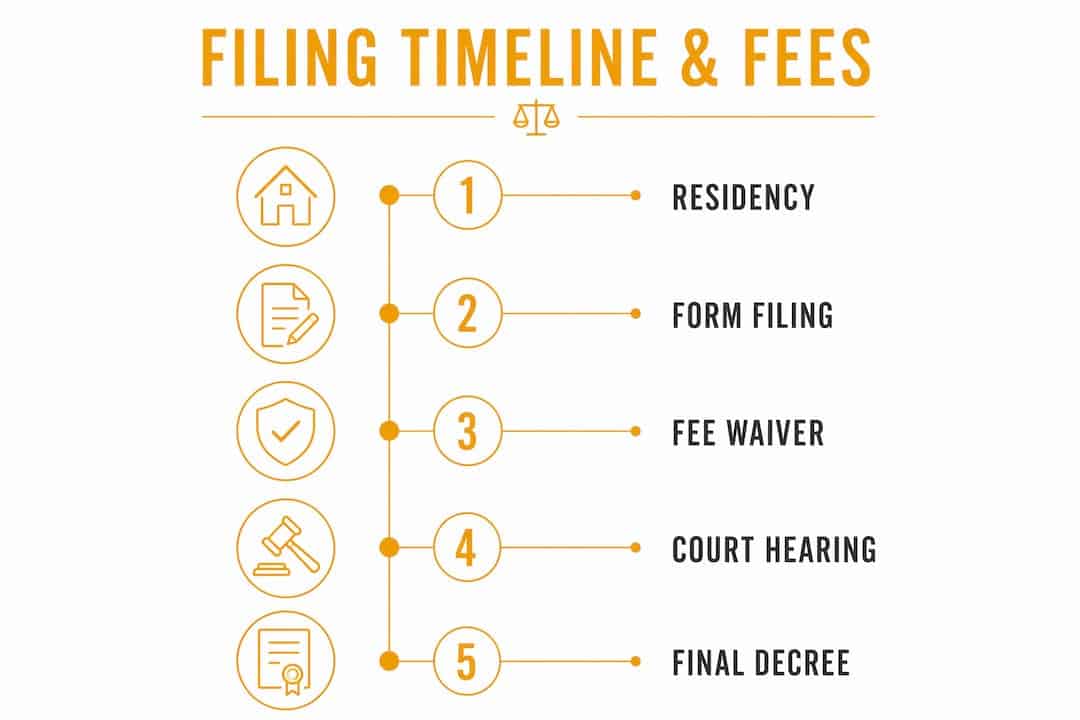
- Timeline and fees: what to realistically expect
- Court support resources and when to get an attorney
- Child custody and visitation during the filing process
- How Arizona handles property division
- Filing for temporary orders while your case is pending
- Step-by-step: completing and filing your divorce forms
- Highdesertfamilylawgroup: experienced Arizona divorce attorneys
- Key Takeaways
Which type of divorce decree fits your situation?
Arizona uses three distinct decree types, and picking the right one from the start saves time and money.
- Summary Consent Decree: Both spouses agree on every term before filing and submit everything together in one joint filing. This streamlined process carries reduced fees and is the fastest route when full agreement exists upfront. There is no option for a response because both parties sign off simultaneously.
- Consent Decree: The petition is filed first, the responding spouse is served, and both parties then negotiate and sign an agreed decree afterward. This works when spouses need time to work out the details of property division, custody, and support after the case is already open.
- Decree on Demand: If the responding spouse never files a response, the petitioner can request a default hearing and proceed with a Decree on Demand to finalize the dissolution without the other party’s participation.
When signing a Consent Decree, both parties must appear before a Court Clerk or Notarial Officer with valid photo ID. The court then rules on it within 21 days of lodging and notifies both parties once it is signed and filed.
Where to find and file the right Arizona divorce forms
Arizona divorce forms are available statewide through the Arizona Courts Self-Service Center, and Maricopa County Superior Court offers its own packet through the Law Library Resource Center. The statewide forms are generic and accepted by most courts, but individual counties sometimes prefer their own versions. Check AZCourtHelp.org for county-specific guidance before you print anything.
The correct packet depends on your situation:
- No minor children: Use form packet DRDA1, which includes the Petition (DRDA10F), Summons (DR11F), Preliminary Injunction (DR14F), and the Decree of Dissolution (DRDA81F)
- Minor children involved: Use packet DRDC, which adds the Affidavit Regarding Minor Children (DRCVG13F), a Parenting Plan (DRCVG11F), and a Child Support Order (DRS81F)
- Summary Consent Decree: Separate packets exist for cases with and without children; both require all terms to be agreed upon before submission
File completed forms with the Clerk of the Superior Court in the county where you or your spouse lives. After filing, you must serve the responding party, either through a process server, the sheriff’s office, or certified mail with acceptance, and then file proof of service with the court.
Fee waivers and deferrals are available if you cannot afford the filing fee. Ask the clerk’s office for the application when you file.
Timeline and fees: what to realistically expect
The 60-day waiting period starts the day the respondent is served, not the day you file. Even if both spouses agree on everything, the court will not sign the decree before those 60 days are up.
Key milestones in the Arizona divorce process:
- Day 1: Petition filed and case number assigned
- Within days: Respondent served; 60-day clock starts
- Day 20: Respondent’s deadline to file a response (20 days for in-state service, 30 days for out-of-state)
- Day 60+: Earliest possible date for a decree to be signed
- Contested cases: Can run six months to over a year depending on the issues involved
Uncontested cases with no children and full agreement often wrap up close to the 60-day mark. Add children, disputed assets, or a non-responsive spouse and the divorce timeline in Arizona stretches considerably. Filing fees vary by county; fee waivers are available for qualifying filers.
Court support resources and when to get an attorney
Maricopa County Superior Court offers an Early Resolution Conference (ERC), a virtual, mandatory resource for self-represented parties. A Family Law Case Manager facilitates the session and helps parties identify and resolve outstanding issues before a judge ever gets involved. It is not mediation, but it moves cases forward faster.

The Law Library Resource Center and AZCourtHelp.org both provide form guidance and procedural information. What they cannot do is give you legal advice. Court staff are not permitted to tell you what to do in your specific situation, only how the process works generally.
Pro Tip: If your case involves retirement accounts or pensions, you will likely need a Qualified Domestic Relations Order (QDRO) to divide those assets correctly. A QDRO is a specialized court order that plan administrators require before splitting retirement funds, and preparing one incorrectly can cost you the asset entirely. This is one situation where attorney involvement is not optional.
Child custody and visitation during the filing process
Arizona uses the terms “legal decision-making” and “parenting time” rather than custody and visitation. Legal decision-making covers major choices about education, healthcare, and religion. Parenting time is the physical schedule.
Courts start from the position that both parents should be involved in a child’s life. If you and your spouse can agree on a Parenting Plan, you file it with your divorce forms. If you cannot agree, the court decides based on the best interests of the child, weighing factors like each parent’s relationship with the child, the child’s adjustment to home and school, and each parent’s willingness to cooperate with the other.
How Arizona handles property division
Arizona is a community property state. That means most assets and debts acquired during the marriage are split equally between spouses. Property owned before the marriage, or received as a gift or inheritance during it, is generally separate property and stays with the original owner.

The divorce forms ask you to list all community property and how you propose to divide it. Agreed divisions go into the decree. Disputed ones go before a judge. Complex assets like businesses, real estate, or retirement accounts often require additional documentation or a QDRO to divide properly.
Filing for temporary orders while your case is pending
A divorce can take months. During that time, you may need court orders covering child custody, child support, spousal support, or who stays in the family home. These are called temporary orders, and you can request them at the start of your case.
File a Motion for Temporary Orders along with your petition or shortly after. The court can schedule a hearing quickly when children or financial hardship are involved. Temporary orders stay in effect until the final decree replaces them. They do not predetermine the final outcome, but they do set the day-to-day rules while the case is open.
Step-by-step: completing and filing your divorce forms
- Confirm eligibility: Verify the 90-day residency requirement and check that you do not have a covenant marriage.
- Choose your packet: Download the correct forms from the Arizona Courts Self-Service Center or Maricopa County’s Law Library Resource Center based on your situation (children or no children, Summary Consent or standard).
- Complete the petition: Fill out the Petition for Dissolution, Summons, and Preliminary Injunction. Be precise about property, debts, and parenting arrangements.
- File with the clerk: Bring completed originals and copies to the Clerk of the Superior Court in your county. Pay the filing fee or submit a fee waiver application.
- Serve the respondent: Arrange service through a process server, sheriff, or accepted certified mail. File proof of service immediately after.
- Wait for a response: The respondent has 20 days (in-state) or 30 days (out-of-state) to file a response.
- Attend the ERC (Maricopa County): If required, complete the Early Resolution Conference with a Family Law Case Manager.
- Finalize the decree: Once the 60-day period passes and all issues are resolved, lodge the decree with the court for signature.
Highdesertfamilylawgroup: experienced Arizona divorce attorneys
Filing the forms yourself is possible in straightforward cases. But when children, significant assets, or a disagreeable spouse are in the picture, the stakes of getting it wrong are high.

Highdesertfamilylawgroup brings over 20 years of Arizona family law experience to clients in Scottsdale and the surrounding area. The firm handles everything from uncontested and collaborative divorces to full litigation, child custody disputes, and complex property division. Their team works directly with clients to understand financial goals and parenting priorities, not just legal checkboxes. If your case involves a QDRO, a contested parenting plan, or a spouse who is not cooperating, that is exactly the kind of situation where personalized legal representation changes the outcome. See what divorce attorney fees look like in Arizona, or contact Highdesertfamilylawgroup directly to discuss your case.
Key Takeaways
Filing for divorce in Arizona requires meeting residency rules, choosing the right decree type, and complying with the mandatory 60-day waiting period before any decree can be signed.
| Point | Details |
|---|---|
| Residency requirements | One spouse must live in Arizona for 90 days; children must have lived there for 6 months before filing. |
| 60-day waiting period | The court cannot sign any decree until 60 days after the respondent is served, even in fully agreed cases. |
| Three decree types | Summary Consent, Consent Decree, and Decree on Demand each apply to different levels of spousal agreement. |
| Forms and filing | Use statewide forms from the Arizona Courts Self-Service Center or county-specific packets; fee waivers are available. |
| Highdesertfamilylawgroup | Scottsdale-based firm with 20+ years of experience handling contested and uncontested Arizona divorces, custody, and complex asset division. |