



Emergency Custody in Arizona: What Parents Should Do Now

Yes, you can get an emergency custody order in Arizona without notifying the other parent first. The formal mechanism is a Motion for Temporary Order Without Notice, governed by Rule 48 of the Arizona Rules of Family Law Procedure. If your child is in immediate physical danger right now, stop reading and call 911 or contact the Arizona Department of Child Safety (DCS) first. Court filings come after the child is safe.
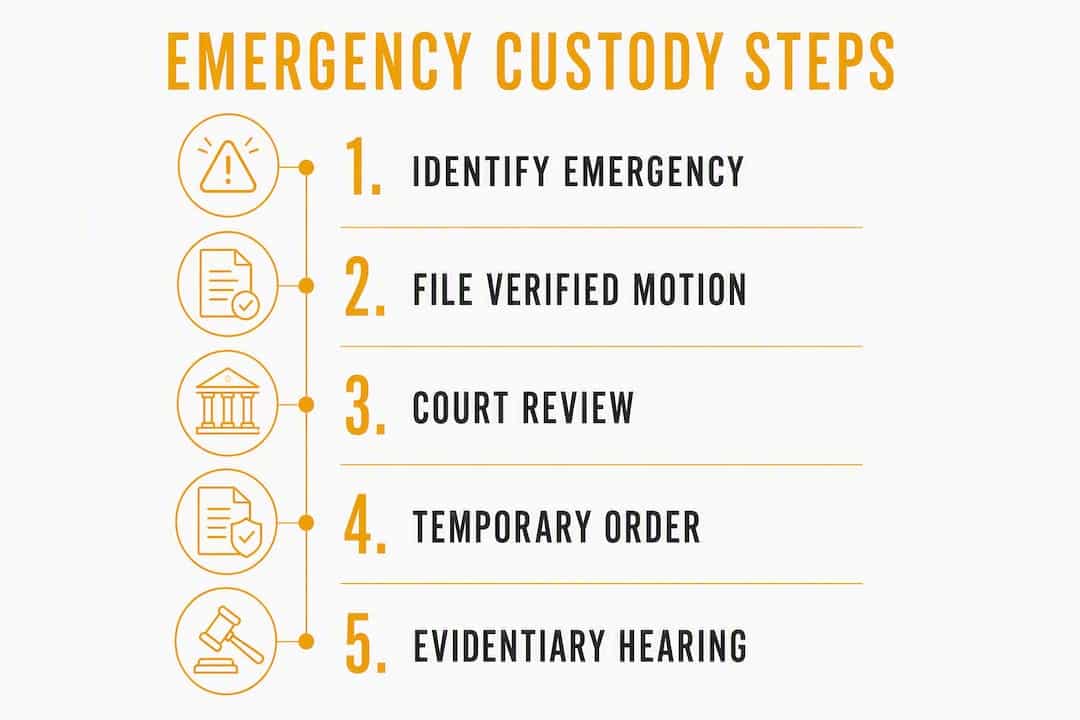
Here is what you need to do, in order:
- Call 911 or DCS immediately if there is any risk of physical harm, abuse, or imminent abduction.
- Preserve evidence — take photos, save texts and emails with timestamps, and request copies of any police or DCS reports.
- File a verified Motion for Temporary Order Without Notice (Rule 48) at your county’s Family Administration, or contact a family law attorney who can prepare and file it the same day.
- Know your county’s filing window. In Maricopa County, motions submitted before 4:30 PM are typically reviewed by 5:00 PM the same day.
- Expect a short-term order. An ex parte emergency order is temporary by design; a full evidentiary hearing must follow within 10 days.
Pro Tip: Contact Highdesertfamilylawgroup before you walk into the courthouse. An attorney can prepare a verified motion with the specific factual detail judges require, which dramatically reduces the chance of an immediate denial.
Table of Contents
- What legally qualifies as an emergency under Arizona’s Rule 48?
- How to file a Motion for Temporary Order Without Notice in Arizona
- What happens after you file: timing, order duration, and the hearing
- If the child is in immediate danger: police, DCS, and protection orders
- Legal risks of filing a baseless emergency custody motion
- Do you need an attorney for emergency custody in Arizona?
- Key Takeaways
- Why emergency custody cases are harder than they look
- Highdesertfamilylawgroup handles emergency custody filings across Arizona
- Authoritative sources and forms to download
What legally qualifies as an emergency under Arizona’s Rule 48?
Not every custody dispute qualifies. Arizona courts take due process seriously, and a judge will not bypass notice to the other parent without a compelling reason.

Rule 48) sets a clear standard: the verified motion must show, through specific facts, that immediate, irreparable injury, loss, or damage will occur before the other party can be heard. “Irreparable” is the operative word. The harm must be the kind that cannot be undone by a later order.
Situations that typically meet the threshold include imminent physical danger to the child, credible evidence of abuse or severe neglect, a documented threat of parental abduction, or a situation where a sibling or parent is being subjected to mistreatment. Under ARS 25-1034, Arizona courts also have temporary emergency jurisdiction when a child present in the state has been abandoned or faces threatened mistreatment — even if another state already has a custody order.
What courts routinely reject: general claims that the other parent is “unfit,” vague allegations without supporting facts, or statements that amount to “I’m worried.” Judges frequently deny ex parte requests when the motion lacks specific, verifiable facts showing irreparable harm would occur before the other side could be heard. Boilerplate language about unfitness is not enough.
Rule 48 callout: The motion must be verified — meaning signed under oath — and must describe specific facts, not conclusions. A motion that says “the child is in danger” without naming dates, incidents, witnesses, or physical evidence will almost certainly fail.
The broader statutory authority for temporary custody orders sits in ARS 25-404, which authorizes courts to enter or vacate temporary orders in legal decision-making and parenting time proceedings. Rule 48 is the procedural mechanism; ARS 25-404 is the underlying statutory power.
How to file a Motion for Temporary Order Without Notice in Arizona
Filing correctly the first time matters. A rejected motion wastes critical hours and can signal to the court that the emergency is not genuine.
Step-by-step filing checklist
- Prepare a verified motion. Write out the specific facts — dates, incidents, names, locations — that establish irreparable harm. Sign it under oath before a notary or court clerk.
- Draft a proposed order. The court needs a ready-to-sign order spelling out exactly what you are asking for: temporary legal decision-making, parenting time restrictions, or both.
- Prepare a notice of hearing. Even in an ex parte filing, the court will set a hearing date; this document notifies the other party once the order is entered.
- Compile your evidence packet. Police reports, DCS referral numbers, photographs of injuries, medical records, and screenshots of threatening messages — all with timestamps.
- Complete the correct court forms. For post-decree modifications in Maricopa County, use forms drmce11f (Motion for Temporary Order Without Notice) and drmce82f (Temporary Order Without Notice). For pre-decree matters, the equivalent forms are drte11f and drte82f. Pima County’s pre-decree packet provides detailed instructions on completing these forms and emphasizes the level of factual specificity required.
- File at Family Administration. In Maricopa County, bring your complete packet to the Family Court Administration window. Motions filed before 4:30 PM are reviewed the same day; after 4:30 PM, review happens by noon the next business day.
- Request immediate judicial review. Tell the clerk you are requesting emergency review. The packet goes to a duty judge who will review it and either sign the order or deny it.
- Arrange for service. Once an order is entered, the other parent must be served — typically by a process server or law enforcement — before the hearing date.
Evidence checklist
| Evidence Type | Why It Matters |
|---|---|
| Police reports | Establishes documented law enforcement contact and incident dates |
| DCS reports or referral numbers | Shows agency involvement and corroborates abuse/neglect claims |
| Photographs of injuries or unsafe conditions | Visual, timestamped proof of physical harm or hazardous environment |
| Medical records | Documents injuries treated by healthcare providers |
| Text messages and emails | Demonstrates threats, admissions, or patterns of behavior |
| Witness affidavits | Third-party corroboration of the facts in your motion |
The Maricopa County Superior Court’s filing guidance and the general temporary orders filing page both provide form packets and instructions specific to whether your case is pre-decree or post-decree. Download the correct packet before you go.
What happens after you file: timing, order duration, and the hearing
Speed matters here, and so does knowing what to expect so you are not caught off guard.
In Maricopa County, motions filed before 4:30 PM are typically addressed by 5:00 PM the same day; motions filed after 4:30 PM are addressed by noon the next business day. That is a tight window, which is why arriving early with a complete packet is critical.
If the judge signs the order, it takes effect immediately. But it does not last indefinitely. Under Rule 48), a temporary order without notice expires at the date and time set for the evidentiary hearing unless the court extends it. That hearing must be scheduled no later than 10 days after the order is entered, unless the court grants an extension.
Possible outcomes after the evidentiary hearing
| Outcome | What it means for you |
|---|---|
| Emergency order converted to temporary custody | Court continues restrictions until a final trial; both parties present evidence |
| Order modified | Court adjusts terms based on what both sides present at the hearing |
| Order dissolved | Court finds the emergency standard was not met; case proceeds on a regular schedule |
| Expedited hearing scheduled with notice | Court denies ex parte relief but fast-tracks a hearing where both parties appear |
At the evidentiary hearing, you carry the burden of proving the emergency was real and ongoing. Bring every witness who can corroborate your motion, organized documents with a clear timeline, and be prepared to testify. The other parent will have a full opportunity to respond. For a detailed look at what happens after temporary custody is granted, including how short-term orders can transition into longer arrangements, Highdesertfamilylawgroup has a dedicated resource on that process.
In cross-jurisdiction cases, the picture is more complex. Under ARS 25-1034, if Arizona issues a temporary emergency order and no prior custody determination exists elsewhere, that order may remain in effect until a court with continuing jurisdiction acts — and under certain conditions, Arizona can become the child’s home state, making the order potentially permanent.
If the child is in immediate danger: police, DCS, and protection orders
The fastest path to protecting a child is not always through the courthouse. Pinal County’s guidance on emergency custody orders states plainly that when a child has been physically harmed or is in immediate danger, contacting law enforcement or DCS is often the most appropriate first response.
Here is how the three routes compare:
- Call 911 when there is immediate physical danger, a weapon is involved, or the child needs medical attention. Law enforcement can remove a child from a dangerous situation on the spot and generate a police report that becomes critical evidence for your Rule 48 motion.
- Contact Arizona DCS (1-888-SOS-CHILD / 1-888-767-2445) when you have concerns about abuse, neglect, or an unsafe living environment that does not require an immediate police response. DCS has authority to investigate, remove children, and make referrals to the court.
- File an ex parte court order when you need a legal custody change and the situation does not require immediate physical removal by law enforcement. This is the right tool when, for example, a parent is threatening to flee the state with the child or is exposing the child to a dangerous person.
These routes are not mutually exclusive. A 911 call and a DCS report can both feed directly into your Rule 48 motion as documented evidence.
Pro Tip: When you call 911 or DCS, be specific. Give the child’s name, age, location, the nature of the danger, and the other parent’s name and contact information. Ask the responding officer or caseworker for a report number before they leave. That number goes into your motion.
Legal risks of filing a baseless emergency custody motion

Using the emergency process as a tactical move is a serious mistake, and courts are alert to it.
County guidance is explicit: filing a Temporary Order Without Notice solely to get an earlier hearing date, to harass the other parent, or to cause unnecessary delay is improper and may result in sanctions. Those sanctions are not hypothetical. Courts can hold a parent in contempt, order payment of the opposing party’s attorney’s fees, award damages, and in extreme cases, refer the matter for criminal review.
“Courts may impose sanctions if an emergency motion is filed without good legal reason or contains false information, including contempt findings or ordering payment of opposing counsel’s costs and damages.” — Maricopa County Superior Court guidance
Beyond sanctions, there is a custody risk. A judge who sees a pattern of bad-faith filings may view it as evidence of poor co-parenting judgment, which is a factor under ARS 25-403 when determining the best interests of the child. What you file against the other parent can be used against you in a custody battle if it reflects poorly on your candor or motives.
Equally dangerous: removing a child from the other parent’s home without a court order. Even if you believe the child is in danger, unilateral removal without law enforcement involvement can expose you to charges of custodial interference or parental kidnapping. The right move is to call police and let them act, then file your motion with their report in hand.
If your emergency motion is denied, do not refile the same request at a different courthouse. Forum shopping after a denial can itself trigger sanctions. The court will typically schedule an expedited hearing with notice instead, giving you a fast path to relief through proper channels.
Do you need an attorney for emergency custody in Arizona?
In most cases, yes. The Rule 48 standard is demanding, the filing window is narrow, and a motion that lacks specific facts will be denied — sometimes with consequences.
Here is what an emergency family law attorney does from the moment you call:
- Triages the safety issue to determine whether 911, DCS, a protection order, or a Rule 48 motion is the right first move.
- Prepares a verified motion with the specific factual detail judges require, including a proposed order ready for signature.
- Coordinates evidence — police reports, DCS records, photos, medical records, and witness affidavits — into a coherent filing packet.
- Handles Family Administration logistics — knowing the county’s cutoff times, the correct forms, and how to request immediate judicial review.
- Represents you at the evidentiary hearing, where the other parent will appear and challenge your evidence.
An attorney is especially important when there is an existing custody order (modification requires a higher showing), when the other parent is threatening to leave Arizona with the child, when the case involves out-of-state jurisdiction questions under ARS 25-1034, or when you have any prior adverse rulings in the case.
Highdesertfamilylawgroup handles emergency custody matters across Maricopa and Pinal counties, with direct familiarity with local Family Administration procedures and hearing schedules. The firm’s attorneys can prepare and file a verified Rule 48 motion the same day you call, appear at the emergency intake, and represent you at the follow-up evidentiary hearing. With over 20 years of Arizona family law experience and thousands of cases handled, the firm brings courtroom-specific knowledge that generic legal advice simply cannot replicate. Learn more about what a family lawyer does in an emergency custody context.
Key Takeaways
In Arizona, an emergency custody order requires a verified motion showing specific facts of immediate, irreparable harm — and a full evidentiary hearing must follow within 10 days of the order’s entry.
| Point | Details |
|---|---|
| Rule 48 is the standard | Your verified motion must show specific facts proving irreparable harm before the other parent can be heard, according to the legal standards. |
| Safety first, then court | Call 911 or DCS for immediate physical danger; file the ex parte motion once the child is safe. |
| Maricopa filing window | Submit before 4:30 PM for same-day review; after 4:30 PM, review happens by noon the next business day. |
| Orders expire at the hearing | A temporary order without notice expires at the scheduled hearing date unless the court extends it. |
| Highdesertfamilylawgroup | The firm prepares and files verified Rule 48 motions the same day, handles Maricopa and Pinal county intake, and represents clients at the evidentiary hearing. |
Why emergency custody cases are harder than they look
Most parents who walk into a courthouse expecting a same-day emergency order walk out without one. Not because their concern is wrong, but because the motion they filed described a situation rather than proved one.
Rule 48 is not a complaint form. It is a legal instrument that asks a judge to act without hearing the other side — which is a significant departure from how courts normally operate. Judges protect that departure carefully. A motion that says “my child’s father is dangerous” will not move a judge. A motion that says “on March 3, 2026, my child’s father struck her on the left arm, leaving a bruise documented in the attached photograph and treated at Banner Health on March 4, 2026, case number 2026-XXXXX” will.
The other thing parents underestimate is the hearing that follows. Getting the ex parte order is step one. Keeping it requires showing up to the evidentiary hearing with organized evidence, credible witnesses, and a clear narrative. Parents who treat the initial order as a win and show up unprepared to the hearing often lose the relief they fought to get.
Courts balance child safety and due process simultaneously. An emergency request is not a shortcut to permanent custody — it is a narrow tool to prevent immediate harm until both sides can be heard. The parents who use it well understand that distinction going in.
Highdesertfamilylawgroup handles emergency custody filings across Arizona
When the situation is urgent, the difference between a granted order and a denied one often comes down to how the motion is written and whether it lands on a judge’s desk before the day’s cutoff. Highdesertfamilylawgroup offers same-day emergency intake for custody matters in Scottsdale and across Arizona, with attorneys who know Maricopa and Pinal county procedures from the inside.

An initial emergency consultation covers a review of your facts, an honest assessment of whether the Rule 48 standard is met, an immediate action plan, and a clear explanation of retainer and fee expectations for emergency filings. There are no surprises about cost before you commit.
What the firm provides for emergency custody matters:
- Same-day preparation of verified Rule 48 motions and proposed orders
- Evidence compilation and coordination with law enforcement or DCS
- Direct filing with county Family Administration before cutoff times
- Courtroom representation at the emergency hearing and the follow-up evidentiary hearing
- Guidance on serving the other parent and managing post-order compliance
Call Highdesertfamilylawgroup now or schedule an emergency consultation to get your case in front of a judge as fast as Arizona procedure allows.
Authoritative sources and forms to download
The resources below are the primary references for Arizona emergency custody filings. Download forms directly from county court sites; statutes are available through the Arizona Legislature’s official portal.
Rules and statutes:
- Rule 48, Arizona Rules of Family Law Procedure — the procedural standard for temporary orders without notice
- ARS 25-1034 — Temporary emergency jurisdiction — Arizona’s authority to act when a child faces abandonment or mistreatment
- ARS 25-404 — Temporary orders — statutory authority for temporary legal decision-making and parenting time orders
- ARS 25-403 — Best interests of the child — the standard courts apply in all custody determinations
County form packets and filing guidance:
- Maricopa County — Motion for Temporary Order Without Notice (post-decree) — forms drmce11f and drmce82f, plus filing instructions and cutoff times
- Maricopa County — How to File a Motion for Temporary Orders (pre-decree) — forms drte11f and drte82f
- Pima County — Pre-decree Temporary Orders Without Notice packet — detailed form completion instructions and factual-showing requirements
- Pinal County — Emergency Orders for Legal Decision Making / Parenting Time — county-specific guidance and triage information
Arizona DCS:
Immediate legal representation:
This article provides general legal information about Arizona emergency custody procedures, not legal advice. Laws and court procedures can change; confirm current rules with the Arizona courts or a licensed Arizona family law attorney before filing.