



Child Custody Modification Arizona: What Parents Must Know

Arizona law allows you to modify an existing child custody (legal decision-making) or parenting-time order, but you have to clear two hurdles first. Under A.R.S. §25-411, you generally cannot file a modification motion until at least one year has passed since the original decree was entered. Once you clear that timeline, the court applies a two-step test: you must show a substantial and continuing change in circumstances since the last order, and then the judge evaluates whether a change serves the child’s best interests under A.R.S. §25-403. If safety is at stake, the one-year wait can be bypassed entirely.
Before you do anything else, run through these steps:
- Check your decree date. Pull the signed order and confirm the exact date the judge entered it. That date starts the one-year clock.
- Identify whether an exception applies. Domestic violence, child abuse, a parent’s failure to comply with a joint order for six months, or an agreement between both parents can all allow earlier filing.
- Download the correct petition packet. Maricopa County parents can access the official Petition to Modify Legal Decision-Making, Parenting Time, and Child Support packet (PDF) directly from the Superior Court website.
- Consult an attorney if safety or complexity is involved. Emergency petitions, domestic violence histories, and relocation cases carry procedural risks that self-service forms rarely handle well.
One distinction matters before you file: legal decision-making covers major choices like education, medical care, and religious upbringing, while parenting time governs who the child lives with and when. Identifying precisely which right you want to change determines what your affidavit must say and what evidence you need to present.
Table of Contents
- When can you file for a custody modification in Arizona?
- What does the court actually look for in a modification case?
- How do you file a custody modification petition in Arizona?
- What evidence proves a substantial change in circumstances?
- How long does a modification case take, and what does it cost?
- Are there faster alternatives to a contested modification hearing?
- What happens at the modification hearing?
- How can an attorney strengthen your modification case?
- Key Takeaways
- What practitioners see most often in modification cases
- Highdesertfamilylawgroup handles custody modifications across Arizona
- Useful sources and official forms
When can you file for a custody modification in Arizona?
The default rule under A.R.S. §25-411 is a one-year waiting period. A parent cannot file a motion to modify legal decision-making or parenting time until at least one year after the decree date, unless the court allows an earlier filing based on affidavits showing the child’s present environment may seriously endanger the child’s physical, mental, moral, or emotional health.
That “serious endangerment” language is the key phrase. Courts read it narrowly. Discomfort with the other parent’s new partner or a scheduling dispute does not meet it. Documented abuse, a parent charged with a dangerous crime against a child, or an active substance-abuse crisis typically does.
Statutory exceptions that allow earlier filing:
- Domestic violence or child abuse after the order. If a parent is charged with certain dangerous crimes against children or domestic violence after the original order is entered, the other parent may request an expedited hearing. The court can suspend parenting time or change legal decision-making on an ex parte basis, meaning without the other parent present, pending a full hearing.
- Six-month noncompliance rule. For joint legal decision-making orders, if one parent has failed to comply with the order for at least six months, the other parent may petition for modification before the one-year period expires.
- Agreed (stipulated) modifications. Both parents can agree to modify the order at any time. A written, signed stipulation filed with the court and approved by a judge is enforceable immediately.
- Military deployment. A.R.S. §25-411 includes specific provisions protecting the parenting-time rights of deployed service members and their families, preventing deployment alone from being used as grounds for a permanent modification.
Pro Tip: Write the decree date on the inside cover of your case file folder and calculate the one-year date in your calendar the day you receive the order. If you ever need to file quickly, you will know instantly whether you are inside or outside the waiting period, and whether you need to rely on an exception.
What does the court actually look for in a modification case?
Arizona courts use a two-step approach. First, the judge asks whether there has been a substantial and continuing change in circumstances since the last order. This is the threshold question, and it is a real filter. Courts dismiss petitions that rest on minor, temporary, or subjective complaints. Second, if the threshold is met, the court applies the best-interests factors under A.R.S. §25-403 to decide whether and how to modify the order.

Best-interests factors under A.R.S. §25-403
The statute directs the court to consider all relevant factors, including:
- The past, present, and potential future relationship between the parent and the child
- The interaction and interrelationship of the child with parents, siblings, and other significant persons
- The child’s adjustment to home, school, and community
- The mental and physical health of all individuals involved
- Which parent is more likely to allow the child frequent, meaningful, and continuing contact with the other parent
- Whether one parent has provided false information to the court in a prior proceeding
- Whether there has been domestic violence or child abuse, as defined in Arizona statutes
- The nature and extent of coercion or duress used by a parent in obtaining an agreement
- Whether a parent has complied with the court’s educational requirements regarding domestic violence
- Whether either parent was convicted of an act of false reporting of child abuse or neglect
- The child’s wishes, when the child is of suitable age and maturity
On that last point, Arizona courts do consider a child’s preference, but a teenager’s stated wish carries more weight than a seven-year-old’s. The judge decides how much weight to give it based on the child’s age, maturity, and the circumstances. For more on how children participate in these proceedings, see does a child speak at a child custody hearing in Arizona.
What typically meets the “substantial and continuing” threshold
- A parent relocating 100 or more miles away, which materially disrupts the existing parenting schedule
- A documented, sustained substance-abuse relapse with evidence such as drug-test results, police reports, or medical records
- Repeated, documented refusal to comply with parenting-time exchanges over several months
- A new and credible safety risk to the child, such as a parent’s cohabitation with a person who has a violent criminal history
What usually does not meet the threshold
- One parent beginning a new romantic relationship, absent any demonstrated harm to the child
- Minor scheduling inconveniences or occasional late pickups without a pattern of noncompliance
The reasons a judge will change custody page at Highdesertfamilylawgroup walks through additional real-world examples that courts have found sufficient.
How do you file a custody modification petition in Arizona?
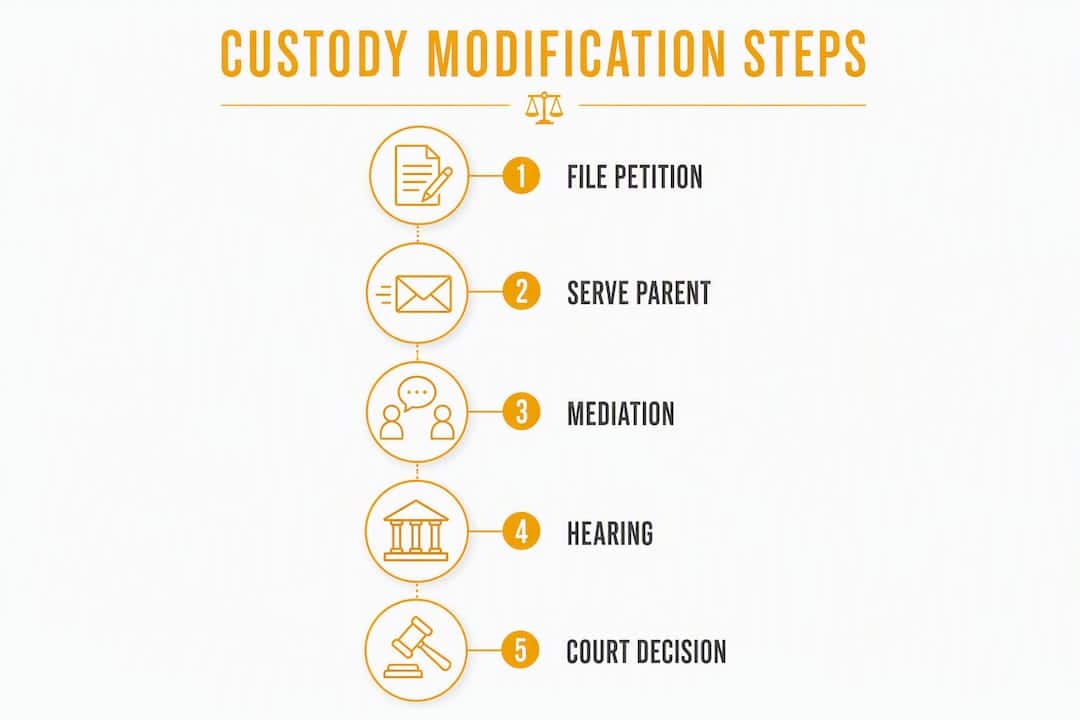
Filing a modification petition is a multi-step process. Getting the paperwork right matters because courts can deny a petition for “lack of adequate cause” before it ever reaches a hearing, costing you filing fees and time.
Core documents you will need
- Petition to Modify Legal Decision-Making, Parenting Time, and/or Child Support — (the primary pleading)
Maricopa County parents should start with the official petition packet and LLRC instructions from the Superior Court’s Law Library Resource Center. The packet includes the petition form, affidavit templates, a parenting plan form, and a child support worksheet, along with step-by-step procedural notes.
What your affidavit must contain
Courts expect affidavit statements to be specific, dated, and tied to exhibits. Vague complaints or unspecific emotional assertions are regularly dismissed as inadequate cause. A strong affidavit includes:
- A short, verified statement of the facts showing a substantial and continuing change, with specific dates and incidents
- Identification of witnesses and the exhibits you are attaching
- A chronological timeline of the key events since the last order
- A clear statement of the specific relief you are requesting (parenting-time modification, change in legal decision-making, or both)
Serving the other parent
After filing, you must serve the other parent with a copy of the petition and summons. Arizona requires personal service by a process server or sheriff’s deputy for initial filings. The other parent cannot serve themselves. Once service is complete, you file a proof of service with the court. If the other parent cannot be located after diligent effort, you may petition the court for alternative service (typically by publication), but this adds time and cost.
County-level variations
File in the county that issued the original decree unless a venue change is warranted. Maricopa County has specific e-filing requirements and local rules; other counties such as Mohave have their own form kits available through the local clerk’s office. Always confirm current filing fees and e-filing procedures directly with the clerk, as these change periodically. The Arizona Courts filing fees page lists current Superior Court fees by county.
| Form / Document | Purpose | Source |
|---|---|---|
| Petition to Modify Legal Decision-Making, Parenting Time, and Child Support | Primary pleading to initiate the modification | Maricopa County packet (PDF) |
| LLRC Instructions and Kit | Step-by-step county procedural guide | Maricopa LLRC page |
| A.R.S. §25-411 | Controlling statute for modification eligibility and waiting period | azleg.gov |
| A.R.S. §25-403 | Best-interests factors the court applies | azleg.gov |
Pro Tip: Keep a filing log: a simple spreadsheet with the date filed, document name, file-stamp confirmation number, and the date you served the other parent. Courts occasionally lose documents, and a timestamped log protects you.
What evidence proves a substantial change in circumstances?
Evidence wins or loses modification cases. Judges are not moved by a parent’s frustration with the other parent. They are moved by objective, documented facts tied to the child’s welfare.
Evidence types that carry weight:
- School records showing declining grades, chronic absences, or teacher concerns tied to the other parent’s household
- Medical records documenting injuries, untreated conditions, or missed appointments during the other parent’s parenting time
- Police reports and criminal records, particularly for domestic violence, DUI, or drug-related arrests
- Documentation of missed or refused parenting-time exchanges, including dated text messages, emails, or a written log
- Drug-test results from a certified laboratory
- Employer schedules or work records showing a parent’s availability has materially changed
- Sworn witness statements from teachers, coaches, doctors, or other credible third parties
Sample exhibit checklist for your affidavit
Organize your exhibits before you file. Label them clearly:
- Exhibit A: School records (attendance, grades, teacher communications) with dates
- Exhibit B: Police or incident reports with case numbers and dates
- Exhibit C: Text message or email log, printed with timestamps and metadata visible
- Exhibit D: Drug-test results from a certified provider, with chain-of-custody documentation
- Exhibit E: Witness statements, signed and dated
For cases involving relocation as the triggering event, the moving out of state with a child in Arizona resource explains the additional procedural requirements that apply.
Pro Tip: For digital evidence, take screenshots that capture the full screen including the date, time, and sender information. Save originals in a cloud folder you do not share with the other parent. When submitting text messages or emails to the court, print them with metadata visible and request certified copies from the platform provider if the messages are critical to your case.
How long does a modification case take, and what does it cost?
Realistic expectations matter here. Modification cases in Arizona rarely resolve in a few weeks, and costs can escalate quickly if the case becomes contested.
A typical case moves through these stages: you file the petition and serve the other parent, the court schedules a preliminary conference or status hearing, the parties may be ordered to mediation or conciliation, and then the case proceeds to an evidentiary hearing or trial if unresolved. In Maricopa County, the time from filing to a first hearing typically runs 30–120 days depending on the court’s calendar and whether service is straightforward. A contested evidentiary hearing can take six months to a year or longer to schedule, particularly in high-volume counties.
| Procedural Milestone | Typical Time Range |
|---|---|
| Filing to first court date / status conference | 30–120 days |
| Service completion (uncontested location) | 1–3 weeks |
| Mediation / conciliation (if ordered) | 4–8 weeks after referral |
| Evidentiary hearing (contested case) | 6 months or more from filing |
| Final signed order after hearing | 2–6 weeks after ruling |
All ranges are typical estimates. Confirm current calendar windows with the clerk in your county.
On costs: filing fees vary by county and case type; the Arizona Courts website publishes current Superior Court filing fees. Beyond the filing fee, expect potential costs for process service, mediation or conciliation services, expert evaluations (a custody evaluator can add significant expense to a contested case), and attorney fees if you retain counsel. Courts can award attorney fees against a party who files a modification without adequate grounds, so filing prematurely carries a real financial risk.
Pro Tip: Call the clerk’s office and ask specifically about the current calendar window for modification hearings and whether the court automatically refers modification cases to conciliation. Some counties do; knowing this in advance lets you prepare for mediation rather than being caught off guard.
Are there faster alternatives to a contested modification hearing?
Yes, and for many families, they are the better path. A fully contested modification trial is expensive, time-consuming, and unpredictable. When both parents can communicate, a stipulated modification or mediated agreement often gets the child to a better arrangement faster.
How mediation works in a modification context
- Intake. Both parents (with or without attorneys) contact a private mediator or the court’s conciliation services.
- Mediated session. A neutral mediator facilitates discussion of the proposed changes. Sessions can be joint or separate (shuttle mediation) if the relationship is high-conflict.
- Tentative agreement. If the parties reach an agreement, the mediator or attorneys draft a written stipulated modification.
- Court submission. The stipulated modification is filed with the court and submitted to the judge for signature.
The mediation step matters even when you think the other parent will never agree. Courts in Maricopa County often require it before setting an evidentiary hearing, and arriving at mediation with a clear, specific proposal tends to produce better outcomes than arriving without one. For a deeper look at how mediation compares to other dispute-resolution options, mediation vs. arbitration in divorce explains the key differences.
Why a verbal agreement is not enough
An informal, verbal agreement between parents does not change a court order. The original order remains fully binding until a judge signs a new one. If the other parent later decides to revert to the original schedule, you have no legal recourse unless the new arrangement is in a signed court order. The Maricopa LLRC instructions make this explicit: the agreement must be written, filed, and signed by a judge to be enforceable.
Checklist for a clean stipulated modification
- Specific dates and times for the new parenting schedule (no vague “reasonable” language)
- Clear allocation of legal decision-making authority
- A dispute-resolution clause specifying how future disagreements will be handled
- Signature lines for both parents and their attorneys if represented
- A periodic review date if circumstances are expected to change again
Pro Tip: Include an enforceability clause that states the parties agree the order may be enforced by contempt proceedings. Courts can enforce it regardless, but including the language signals to both parties that the agreement is serious and reduces the chance of future noncompliance.
What happens at the modification hearing?
If the case does not settle, it goes to an evidentiary hearing before a judge. There is no jury in Arizona family court.
The hearing typically opens with brief remarks from each side’s attorney (or the parties themselves if self-represented), followed by the presentation of evidence. Each parent calls witnesses, introduces exhibits, and may be cross-examined. The judge controls the pace and can ask questions directly. Closing arguments follow, and the judge may rule from the bench or issue a written ruling within a few weeks.
Possible outcomes:
- Changed legal decision-making — The court shifts from joint to sole decision-making, or vice versa, based on the best-interests analysis.
If the other parent still does not follow the new order after it is entered, your remedies include a motion to enforce, a contempt petition, or a new modification petition based on noncompliance. Courts can award attorney fees against a parent who willfully violates an order or who files a modification petition without adequate grounds.
How can an attorney strengthen your modification case?
Filing a modification petition without legal counsel is possible, but the risks are real. Self-service forms often fall short for complex issues like relocation, domestic-violence histories, or contested noncompliance. An inadequate petition can be denied for lack of adequate cause, costing you filing fees and resetting the clock on when you can refile.
A family law attorney handles the tasks that most directly affect whether your petition survives the threshold review:
- Assessing whether your facts meet the A.R.S. §25-411 threshold before you spend money filing
- Drafting a verified petition and affidavit that frames the substantial and continuing change in statutory language the court recognizes
- Organizing exhibits so they are properly labeled, authenticated, and tied to specific affidavit paragraphs
- Advising on whether an emergency petition is warranted and what evidence it requires
- Representing you at hearings and cross-examining the other parent’s witnesses
- Negotiating a stipulated modification when settlement is possible, and drafting it to be enforceable
Highdesertfamilylawgroup brings over 20 years of Arizona family law experience to modification cases, including contested hearings, emergency petitions, and relocation disputes. The firm’s attorneys understand both the procedural requirements and the evidentiary standards that Maricopa County judges apply. For background on the types of custody arrangements available in Arizona, that resource explains the full range of options you might request in a petition.
What to bring to a first consultation
- Your original decree and any subsequent orders
- Key dates (decree date, dates of significant incidents)
- Documentation of the change in circumstances (police reports, medical records, school records, text logs)
- Names and contact information for potential witnesses
- Questions about the retainer structure and estimated costs
Pro Tip: Write a one-page timeline of events before your first consultation. List dates, what happened, and what evidence you have for each event. Attorneys can assess your case faster and more accurately when the facts are organized, and you will get more out of a paid consultation hour.
Key Takeaways
Arizona custody modifications require meeting the A.R.S. §25-411 one-year waiting period and proving a substantial and continuing change in circumstances before the court applies the best-interests factors under A.R.S. §25-403.
| Point | Details |
|---|---|
| One-year waiting period | A.R.S. §25-411 bars most modification filings until one year after the decree, with exceptions for danger, domestic violence, noncompliance, or agreement. |
| Two-step court standard | You must first show a substantial and continuing change, then the court applies the best-interests factors under A.R.S. §25-403. |
| Affidavit specificity | Courts dismiss vague petitions; affidavit statements must be specific, dated, and tied to labeled exhibits. |
| Verbal agreements are not orders | An informal parenting agreement is unenforceable; a judge must sign a written stipulation for it to replace the existing order. |
| Highdesertfamilylawgroup | Highdesertfamilylawgroup’s attorneys assess A.R.S. §25-411 eligibility, draft verified petitions, and represent parents at modification hearings in Arizona. |
What practitioners see most often in modification cases
Most modification petitions that fail do not fail because the parent lacked a real grievance. They fail because the petition leads with emotion and trails off on evidence. A parent who has genuinely watched their child’s situation deteriorate will often write an affidavit that reads like a personal journal entry: full of frustration, light on dates, and absent of exhibits. Judges cannot act on frustration. They need documented facts tied to the child’s welfare.
The other pattern worth naming: parents sometimes file for modification when what they actually need is enforcement. If the other parent is violating the existing order, a motion to enforce is often faster, cheaper, and more targeted than a full modification petition. Knowing which tool fits the situation is half the battle.
One practical point that gets overlooked: narrow your request to what the child actually needs. Asking for everything (sole legal decision-making, primary residence, restricted parenting time) when the facts only support a schedule adjustment tends to make the petition look retaliatory to a judge. Courts notice when the relief requested is disproportionate to the evidence presented. A focused, evidence-backed petition for a specific change almost always lands better than a sweeping one.
Highdesertfamilylawgroup handles custody modifications across Arizona
When the stakes involve your child’s daily life, the difference between a well-drafted petition and a dismissed one matters. Highdesertfamilylawgroup’s attorneys work with Arizona parents on every stage of the modification process: initial eligibility assessment, petition and affidavit drafting, emergency filings, mediation support, and contested hearings before Maricopa County Superior Court judges.

The firm’s approach starts with a direct conversation about whether your facts meet the statutory threshold before any money is spent on filing. If the case warrants an emergency petition, the team moves quickly. If a stipulated modification is the smarter path, the attorneys draft it to be enforceable and court-ready. For parents weighing whether to pursue ending a custody dispute through agreement versus a contested hearing, that conversation is part of the first consultation.
Bring your decree, your documentation, and your questions. Contact Highdesertfamilylawgroup to schedule a consultation and get a clear answer on where your case stands.
Useful sources and official forms
The table below maps the key statutes and county resources you will need when filing or reviewing a modification petition.
| Resource | What it contains | Link |
|---|---|---|
| A.R.S. §25-411 | Controlling statute: one-year rule, exceptions, affidavit requirements, military provisions | azleg.gov |
| A.R.S. §25-403 | Best-interests factors the court applies after finding a substantial change | azleg.gov |
| Maricopa County Petition Packet (PDF) | Petition to Modify, parenting plan form, affidavit template, child support worksheet | superiorcourt.maricopa.gov |
| Maricopa LLRC Instructions | Step-by-step procedural guide, when to use forms, local notes | superiorcourt.maricopa.gov |
| Arizona Courts Filing Fees | Current Superior Court filing fees by county | azcourts.gov |
Filing county reminder: File in the county that issued the original decree unless a venue change is legally justified. Mohave County and other counties maintain their own form kits; contact the local clerk’s office directly for current packets and e-filing instructions.
- Always use the most current version of a form packet. Court forms are updated periodically, and submitting an outdated version can delay your case.
- If you are unsure whether your county has specific local rules that differ from the statewide forms, call the clerk’s office before filing.
- For self-represented parties, the Arizona Courts self-service center at azcourts.gov provides additional guidance on forms and language access resources.
This article provides general legal information about Arizona custody modification procedures and is not a substitute for advice from a licensed Arizona family law attorney. Statutes and local court rules change; confirm current requirements with the relevant court or a qualified attorney before filing.