



Parenting Time in Arizona: Schedules, Laws, and Filing Steps

In Arizona, parenting time is the court-recognized schedule that determines when each parent has physical access to their child, and it’s defined by statute, not personal preference. A.R.S. §25-401(5) spells this out and gives the parent exercising parenting time the authority to make routine day-to-day decisions for the child during that period. The court decides how much time each parent gets based on the child’s best interests, a legal standard set out in A.R.S. §25-403.
If you want a schedule that actually holds up in court, don’t wait for a judge to hand you one. Your best move right now:
- Draft a written parenting plan using Arizona court templates before your hearing date.
- Contact your county’s family court services or a mediator if you and the other parent disagree on a schedule.
- File your proposed plan with the court clerk so it becomes part of the record, not just a verbal understanding.
Key Takeaways
Arizona courts require a specific, written parenting plan under A.R.S. §25-403.02, and vague schedules are the leading cause of enforcement disputes and repeat court filings.
| Point | Details |
|---|---|
| Parenting time is not custody | It’s the schedule of physical time with each parent, separate from legal decision-making authority. |
| Courts must maximize time | A.R.S. §25-403.02 requires judges to adopt a plan maximizing each parent’s time when consistent with best interests. |
| Specificity prevents disputes | Name exact exchange locations, travel cost responsibility, and makeup time terms in your plan. |
| Support and parenting time are separate | Withholding a child over missed support, or vice versa, isn’t legally valid and can backfire in court. |
| Get tailored language, not just a template | Highdesertfamilylawgroup drafts precise parenting plans and handles enforcement or modification when disputes arise. |
This article is general information, not a substitute for advice from a qualified lawyer. Consult a qualified legal professional about your own circumstances before acting on anything here.
Table of Contents
- What Is Parenting Time in Arizona?
- How Do Arizona Courts Decide Parenting Time?
- Sample Parenting Time Schedules Arizona Courts See Often
- How Do You File or Modify a Parenting Time Order?
- What If the Other Parent Blocks or Ignores Parenting Time?
- What Does High Desert Family Law Group Bring to a Parenting Time Case?
- Why Statute-Backed Planning Beats Guesswork
- Get Help Building a Parenting Plan That Holds Up
- Sources
What Is Parenting Time in Arizona?
Parenting time is not the same thing as custody, and mixing up the two terms causes real problems on court forms. Arizona replaced the word “custody” years ago with two distinct concepts: legal decision-making (who decides on schooling, medical care, and religion) and parenting time (the actual schedule of when the child is with each parent). You can have joint legal decision-making but a parenting time schedule that’s far from 50/50, or the reverse.
A parenting plan is the written document that spells out the schedule, holiday rotations, exchange logistics, and decision-making authority. Courts expect one whenever parents can’t agree informally.
A few terms you’ll see repeatedly on Arizona forms:
- Visitation — an older term still used casually, though “parenting time” is now the statutory phrase.
- Right of first refusal — a clause giving one parent priority to care for the child before the other parent hires a babysitter.
- Short distance vs. long distance parenting time — schedules change significantly depending on how far apart the parents live, often triggered around the 75 mile mark used in Mohave County’s guidelines.
Pro Tip: If your paperwork says “custody,” it’s probably an older template. Arizona courts now expect “legal decision-making” and “parenting time” as the correct terms, and using outdated language can slow down your filing.
How Do Arizona Courts Decide Parenting Time?
Judges don’t default to a 50/50 split. They evaluate a list of factors under A.R.S. §25-403, and in contested cases, they’re required to make specific findings on each one. The factors include the child’s adjustment to home, school, and community, the mental and physical health of everyone involved, and, critically, which parent is more likely to encourage a healthy, ongoing relationship between the child and the other parent.
Where parents can’t agree, A.R.S. §25-403.02 requires each side to submit a proposed parenting plan. The court then has a duty to adopt a plan that maximizes each parent’s parenting time to the extent it’s consistent with the child’s best interests. That’s a meaningful legal standard. Judges aren’t looking for an excuse to limit time with a parent. They’re required to find one that works unless something in the record justifies limiting it.
Two things override the maximize-time default:
- Documented domestic violence or an active order of protection changes the analysis substantially, often leading to supervised or restricted parenting time.
- A child’s own wishes may factor in once they’re old enough to express a reasoned preference, though this is one factor among many, not a deciding vote.
Sample Parenting Time Schedules Arizona Courts See Often
Templates exist for a reason. They give parents and judges a starting point that’s already been tested for practicality, and Arizona’s own statewide parenting plan booklet walks through several by age group.
- Alternating weeks. Works well for school-age kids with cooperative parents living close together. Downside: a full week without seeing one parent is a long stretch for younger children.
- 3-4-4-3 rotation. A common compromise where the schedule alternates in short blocks, giving both parents regular contact without a week-long gap.
- Weekend-plus-weekday. One parent has most weekdays, the other gets weekends plus a midweek dinner or overnight. This tends to fit better when one parent’s work schedule is inflexible.
Mohave County’s parenting time guidelines set a baseline of roughly two days per week for the noncustodial parent when parents live within the county’s short-distance range, expanding to longer blocks and extended summer time once that distance grows.
Developmentally, infants generally need shorter, more frequent exchanges rather than long stretches away from a primary caregiver. School-age children handle week-long rotations reasonably well. Teens often do best with a schedule built around their own activities and social lives, not a rigid template imposed from outside.

When drafting your plan, spell out exchange locations by name, who pays for travel when parents live far apart, and how makeup time works if a scheduled visit falls through. Vague language here is where most future disputes start.
How Do You File or Modify a Parenting Time Order?
Getting a schedule down on paper is only half the job. It needs to go through the court to be enforceable.
- File a petition to establish parenting time if none exists yet, or request pre-decree temporary orders if you need an interim schedule while the case is pending.
- Submit your proposed parenting plan alongside it, using the format outlined in Maricopa County’s Parenting Time Resource Guide, which breaks schedules into school-year, summer, and holiday sections.
- If you and the other parent are close but not aligned, ask about family court services or mediation before the hearing. Many counties require this step.
- To change an existing order, file a petition to modify and show a material change in circumstances since the last order, such as a move, a change in work schedule, or a shift in the child’s needs.
Quick reference for what to file when:
- No order exists yet → petition to establish parenting time.
- Case is pending, need something now → request temporary orders.
- Order exists but circumstances shifted → petition to modify.
- Parents agree on most terms → mediation before litigation, often faster and cheaper.
If a move might take you outside Arizona with your child, modification rules get more complicated, and filing before you relocate is almost always safer than after.
What If the Other Parent Blocks or Ignores Parenting Time?
Start with a paper trail. Document every missed exchange with dates and details, then send a written request for makeup time before running to the courthouse. If that goes nowhere, file a motion to enforce.
Arizona treats non-exercise (a parent who simply doesn’t show up) differently from interference (a parent actively blocking access), and remedies can differ depending on which one you’re dealing with. Either way, child support and parenting time are legally separate issues: a parent can’t withhold the child because support is late, and a parent can’t stop paying support because parenting time isn’t happening.
- Use neutral exchange locations (a police station lobby, a busy public parking lot) when tension runs high.
- Keep exchange communication to logistics only. Save the emotional conversations for mediation or counsel.
- Consider requesting a parenting coordinator if conflict keeps recurring around exchanges.
Pro Tip: Text or email your requests instead of calling. A timestamped record of “can we swap this weekend” is worth more in front of a judge than your memory of a phone call.
What Does High Desert Family Law Group Bring to a Parenting Time Case?
Court templates get you started, but they don’t account for your specific family’s friction points. Highdesertfamilylawgroup has spent more than 20 years handling Arizona family law cases, from child custody and parenting plan disputes to full litigation when mediation doesn’t resolve things.
- Mediation and collaborative drafting for parents who want to avoid a courtroom fight.
- Precise plan language covering right of first refusal, travel cost allocation, and exchange logistics.
- Litigation support when a parenting time order needs to be enforced or modified.
A generic template can’t anticipate the argument you’ll have in eight months about who drives to soccer practice. Precise language now is what prevents a return trip to court later.
Why Statute-Backed Planning Beats Guesswork
Most parenting time disputes I’ve seen dissected in court filings don’t stem from bad intentions. They stem from vague plans that never anticipated a real-world scheduling conflict. The conventional advice, “just be reasonable with each other,” sounds nice and fails constantly, because reasonable people disagree about what’s reasonable once emotions and new relationships enter the picture.
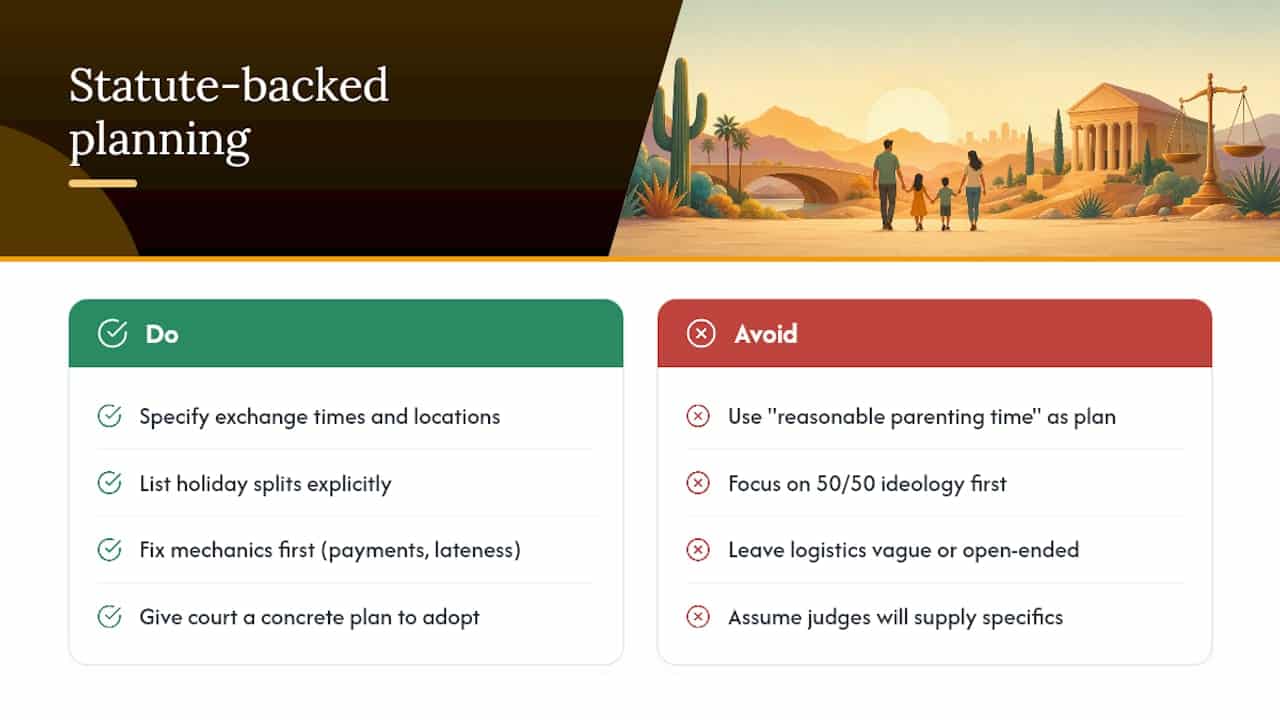
What the statutes actually reward is specificity. A.R.S. §25-403.02 tells judges to maximize parenting time consistent with best interests, but that only helps you if your proposed plan gives the court something concrete to adopt. A plan that says “reasonable parenting time” is nearly useless in front of a judge. A plan that names exchange times, locations, and holiday splits gets adopted with minor edits.
My honest read: parents spend too much energy negotiating the schedule’s ideology (is 50/50 fair?) and not enough on the mechanics (who pays for gas, what happens when practice runs late). Fix the mechanics first. The philosophy usually sorts itself out once the logistics are nailed down.
Get Help Building a Parenting Plan That Holds Up
Highdesertfamilylawgroup is the direct route to a parenting time order that survives real life, not just the hearing where it gets approved. Rather than starting from a blank court template and guessing at language, you work with a team that has drafted thousands of these plans and knows exactly which clauses prevent the disputes that send parents back to court six months later.

Whether you need a first parenting plan drafted, an existing order modified after a move or job change, or mediation to avoid litigation entirely, Highdesertfamilylawgroup handles the full range from collaborative divorce to contested custody fights. If cost is part of your hesitation, their guide on what a divorce and custody case typically costs in Arizona breaks down what to expect before you commit. And if safety concerns are part of your situation, resources on recognizing patterns of partner abuse can help you document what the court needs to see. Schedule a consultation to get your parenting plan drafted and filed correctly the first time.
Sources
- Arizona Revised Statutes §25-401
- Parenting Time Resource Guide | Maricopa County Superior Court
- Planning for Parenting Time: Arizona’s Guide for Parents Living Apart (AOCDRD1H)