



401(k) Divorce in Arizona: How Retirement Splits Actually Work

In Arizona, retirement contributions made during the marriage are typically community property, split between spouses regardless of whose name sits on the account. Getting your share off paper and into your actual account requires a properly drafted QDRO (for 401(k)s and other private employer plans) or a DRO under A.R.S. §38-773 for public plans like ASRS. A divorce decree by itself does not move a dollar. The plan administrator has to receive, review, and approve a separate order before any money changes hands.
If you’re heading into or already inside a divorce, start now:
- Pull every retirement account statement you can find, going back to the marriage date if possible.
- Confirm the valuation date your decree will use, usually the date of service of the divorce petition.
- Get your attorney or a QDRO specialist drafting the order early and send it to the plan administrator for pre-approval before it goes to a judge.
Key Takeaways
Protecting your 401(k) or pension in an Arizona divorce depends on starting the QDRO or DRO process early and securing plan pre-approval before a judge signs anything.
| Point | Details |
|---|---|
| Community property applies during marriage | Contributions, employer matches, and growth during the marital period are typically split, but pre-marriage balances need documentation to stay separate. |
| QDRO and DRO are not interchangeable | Private 401(k)s need a QDRO under ERISA rules; ASRS and public plans need a DRO under A.R.S. §38-773. |
| Pre-approval prevents costly delays | Sending a draft order to the plan administrator before filing with the court avoids rejection and re-filing months later. |
| Pensions and 401(k)s divide differently | Pensions use the coverture time-rule formula; 401(k)s segregate a share into a separate account, adjusted for loans. |
| High Desert Family Law Group drafts and files orders | The firm handles document collection, plan-compliant drafting, administrator communication, and certified order filing for Arizona divorces. |
This article is general information, not a substitute for advice from a qualified lawyer. Consult a qualified legal professional about your own circumstances before acting on anything here.
Table of Contents
- What Does 401k Divorce in Arizona Mean for Your Retirement Accounts?
- Do You Need a QDRO or a DRO for Your Retirement Plan?
- What Does the QDRO/DRO Process Look Like Step by Step?
- How Do Pension and 401(k) Divisions Actually Differ?
- What Protections Should You Build Into Your Order?
- How High Desert Family Law Group Handles Retirement Division
- What Are the Tax Implications of Dividing a 401(k)?
- How Do Early Withdrawal Penalties and RMDs Work After Division?
- How Should You Approach Negotiating a 401(k) Split?
- Does Remarriage or a Delayed Retirement Change Your Share?
- Why Getting This Right the First Time Matters More Than Speed
- Get Help Protecting Your Retirement Share
- Sources
What Does 401k Divorce in Arizona Mean for Your Retirement Accounts?
Arizona is a community property state, which means almost everything acquired during the marriage belongs equally to both spouses, retirement accounts included. The relevant window, called the marital period, typically runs from your wedding date to the date the divorce petition was served, not the date the divorce is finalized.
Inside that window, several things count as marital property subject to division:
- Employee contributions made to a 401(k) during the marriage.
- Employer matching contributions credited during that same period.
- Investment growth or earnings on those contributions while married, unless one spouse can trace them to separate funds.
Balances that existed before the wedding, along with gifts or inheritances kept separate and undocumented, usually stay separate property. The catch is proof. If you can’t produce statements showing what existed before the marriage date, a court may treat the entire account as community property by default. Arizona’s community property framework rewards spouses who keep paperwork, not spouses who assume fairness will sort itself out.
Do You Need a QDRO or a DRO for Your Retirement Plan?
The order you need depends entirely on who holds your retirement money. Private employer 401(k) plans governed by federal ERISA rules require a Qualified Domestic Relations Order, or QDRO. Arizona’s public pension system, ASRS, along with other state and municipal plans, requires a Domestic Relations Order under A.R.S. §38-773 instead.
- A QDRO applies to 401(k)s, 403(b)s, and most private-sector pensions.
- A DRO applies to ASRS and other Arizona public employee retirement systems.
- Neither order is optional if you want the plan to actually pay you.
Here’s the part that trips people up: a divorce decree that awards “half the 401(k)” is a court judgment, not a qualified order the plan is required to honor. According to DOL guidance on QDROs, ERISA plans cannot pay an alternate payee without a separately qualified order, no matter what the decree says.
ASRS is slightly more forgiving. It will accept a full divorce decree in place of a DRO only if that decree already contains every field ASRS requires, including marriage dates, the valuation date, and exact payment instructions, according to ASRS’s own divorce guidance. Miss one field and you’re back to drafting a certified DRO from scratch. That’s why smart attorneys send a draft order to the plan administrator for informal pre-approval before anyone asks a judge to sign it. It costs a little time up front and saves months of rejected filings later.
What Does the QDRO/DRO Process Look Like Step by Step?
Getting an order from draft to fully qualified with the plan usually follows the same sequence, whether you’re dealing with a 401(k) custodian or ASRS directly.
- Gather your documents. Account statements, your marriage and service dates, employment history for pension calculations, current beneficiary designations, and any outstanding plan loan balances.
- Draft the order. An attorney or dedicated QDRO specialist writes language that matches both Arizona law and the specific plan’s requirements. Fees for a straightforward QDRO typically run $500 to $1,500 per plan; complex cases with pensions or multiple accounts cost more.
- Send it for pre-approval. The plan administrator reviews the draft and flags any missing or incorrect language before a judge ever sees it.
- File for court signature. Once the plan signs off, the order goes to the family court judge for signature as part of, or following, the decree.
- Deliver the certified order to the plan. The plan then formally qualifies it, which is when segregation of funds or payment actually begins.
ASRS estimates its own draft review takes roughly four to six weeks, and private plan administrators often take a similar window, sometimes longer for larger custodians.
Pro Tip: Don’t wait until the decree is final to start this process. If your ex-spouse retires, takes a loan against the account, or rolls it into an IRA before your order qualifies, recovering your share gets dramatically harder, sometimes impossible.
How Do Pension and 401(k) Divisions Actually Differ?
Pensions and 401(k)s look similar on a settlement worksheet, but the math behind them is nothing alike, and the order language has to reflect that difference.
Pensions are divided using the coverture, or time-rule, formula: you take the years the employee spouse participated in the plan while married, divide by their total years of participation, and multiply that fraction by the benefit. Married 20 of a 30-year career means a marital fraction of 20/30, and the non-employee spouse typically receives half of that fraction, applied to the eventual monthly benefit, according to LegalClarity’s breakdown of Arizona pension division.
| Plan Type | Division Method | Key Order Language Needed |
|---|---|---|
| Pension (defined benefit) | Coverture/time-rule formula applied to eventual monthly benefit | Survivor benefit election, marital fraction calculation |
| 401(k) (defined contribution) | Percentage or dollar amount segregated into a separate account | Loan treatment, valuation date, post-valuation gains/losses |
A 401(k) works differently. Once a QDRO qualifies, the plan administrator typically segregates the alternate payee’s share into its own account or rolls it into a separate IRA. Outstanding loan balances against the 401(k) reduce what’s actually available to divide, so the order needs to state explicitly whether the loan comes out of the employee spouse’s share or gets split between both. Pensions also demand survivor-benefit language that 401(k)s don’t need. Skip that clause and the non-employee spouse’s payments can simply stop the day the employee spouse dies, with no benefit continuing.
What Protections Should You Build Into Your Order?
The single biggest mistake divorcing spouses make with retirement accounts is treating the decree as the finish line instead of the starting gun. Begin QDRO or DRO drafting while the divorce is still pending, not after, and get the plan administrator’s eyes on the draft before it goes to court.
Before you sign off on anything, ask your attorney or the plan administrator these questions directly:
- Is the valuation date the date of service, the date of divorce, or something else, and how does that change the number?
- How are outstanding loan balances against the account treated in the split?
- Do investment gains or losses after the valuation date belong to you or your ex-spouse?
- Does the order preserve survivor benefits, and did the divorce automatically revoke beneficiary designations under Arizona law?
That last question matters more than most people realize. A.R.S. §38-773 states that divorce revokes beneficiary designations by default unless an acceptable DRO explicitly keeps the ex-spouse listed. If nobody addresses that in writing, a former spouse can lose survivor rights they thought were guaranteed.
Pro Tip: If your ex-spouse’s mailing address is unknown or likely to change, flag it for your attorney. Under Arizona law, plans can hold your share or require the participant to hold funds in trust until you’re located, which can delay payment for months over something as simple as an address update.
How High Desert Family Law Group Handles Retirement Division
We’ve spent more than 20 years handling Arizona divorces, including cases where retirement accounts were the single largest asset on the table. Our team drafts plan-compliant QDROs and DROs, communicates directly with plan administrators to secure pre-approval, and files certified orders so nothing sits in limbo waiting on paperwork.
If your case involves multiple retirement accounts, a pension close to payout, a spouse near retirement age, or a disputed valuation date, that’s exactly when representation earns its cost. We handle the full range of family law services around asset division, not just the order itself.
What Are the Tax Implications of Dividing a 401(k)?
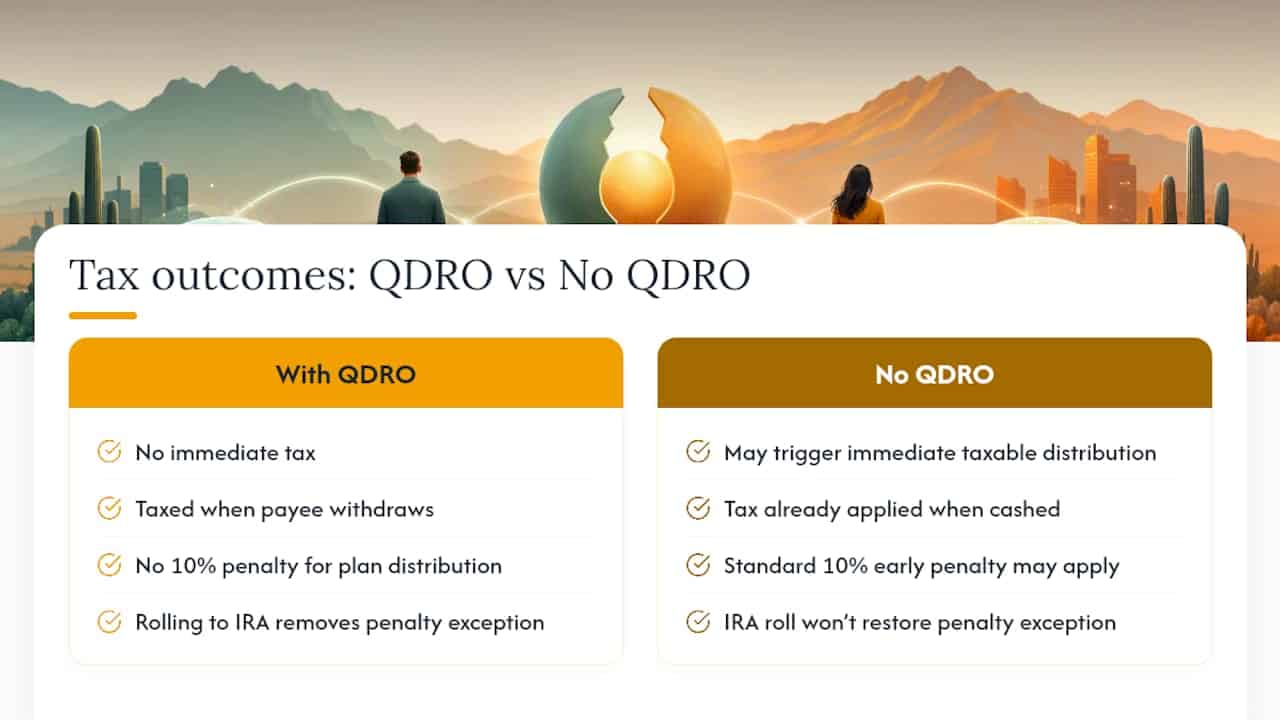
A properly executed QDRO lets you divide a 401(k) without triggering an immediate tax bill on the transfer itself. Federal rules allow what’s called a transfer incident to divorce, and under DOL and IRS guidance, funds moved this way between spouses’ retirement accounts don’t count as a taxable distribution at the moment of transfer.
The tax bill doesn’t disappear, though. It just moves down the road to whoever eventually withdraws the money. Once the alternate payee’s share lands in their own account or IRA, ordinary income tax applies when they take distributions, same as it would for the original account holder. The rate depends on their income bracket in the year they withdraw, not the year of the divorce.
There’s one quirk specific to QDROs worth knowing. A QDRO alternate payee can take a distribution directly from the qualified plan without the usual 10% early withdrawal penalty, even if they’re under 59 and a half. That exception applies only to QDRO-based distributions from an employer plan, not to funds that have already been rolled into an IRA. Roll the money into an IRA first and you lose that exception entirely. If cash flow is tight right after the divorce, this timing decision is worth discussing with a tax professional before you choose how to receive your share.
Get the order’s language wrong, or skip the QDRO step and try to divide the account informally, and you risk turning a tax-neutral transfer into a fully taxable distribution for whoever pulled the money out. That’s an expensive mistake to discover after the fact.
How Do Early Withdrawal Penalties and RMDs Work After Division?
Once your share of a 401(k) is segregated into its own account, either under the original plan or rolled into an IRA, it follows the standard withdrawal rules for that type of account going forward.

If you take a QDRO distribution directly from the employer plan, the 10% early withdrawal penalty doesn’t apply, regardless of your age. That’s a genuine advantage over pulling money from your own retirement account outside a divorce context. But this exception is a one-time window tied to the QDRO distribution itself. Once those funds sit in a rollover IRA, standard IRA withdrawal rules kick in, including the 10% penalty for withdrawals before age 59 and a half, with the usual narrow exceptions for things like disability or certain medical expenses.
Required minimum distributions work exactly as they would for any other retirement account once you’re the owner of record. If you receive your share in your own 401(k) or IRA, the RMD age and calculation rules apply to that account independently of what your ex-spouse’s original account is doing. Divorce doesn’t reset or delay this clock, and it doesn’t tie your RMD timeline to your ex-spouse’s age or retirement date either. Each account, once split, runs on its own rules from that point forward.
The practical decision most people face is whether to take a lump distribution now (penalty-free under the QDRO exception, but taxable as income) or roll the full share into an IRA to preserve tax-deferred growth and decide later. Neither choice is automatically better. It depends on whether you need the cash immediately or can afford to let it keep growing.
How Should You Approach Negotiating a 401(k) Split?
Retirement accounts don’t have to be divided in a strict 50/50 split on every asset. Arizona courts allow spouses to negotiate a settlement where one spouse keeps a larger share of the 401(k) in exchange for giving up equity in the house, a larger share of a business interest, or other marital property of comparable value.
This kind of trade only works if both sides agree on accurate present-day values, which for a 401(k) is usually straightforward since it’s just the account balance as of the valuation date. Pensions are trickier to trade against other assets because their true value depends on projected future payments, sometimes requiring an actuary to calculate a present-day lump-sum equivalent before anyone can negotiate a fair swap.
A few negotiation points come up again and again in Arizona settlements:
- Whether to split every account 50/50 or offset one spouse’s larger 401(k) share against another asset entirely.
- Whether outstanding 401(k) loans get paid off before division or get factored into the alternate payee’s share.
- Whether one spouse keeps the full 401(k) in exchange for a larger share of home equity, which avoids the cost and delay of drafting a QDRO altogether.
That last option is worth serious consideration if the account balance is modest. QDRO drafting fees and the multi-month qualification wait can eat a meaningful chunk of a smaller account’s value, so trading it for a comparable asset that transfers immediately sometimes makes more financial sense than dividing it. For larger accounts, the calculation usually favors going through the QDRO process rather than giving up a bigger asset to avoid the paperwork.
Does Remarriage or a Delayed Retirement Change Your Share?
Once a QDRO or DRO qualifies and your share of the 401(k) is segregated into your own account, your ex-spouse’s remarriage has no legal effect on it. The money is yours, subject to the same tax and withdrawal rules as any other retirement account you own. Their new marriage doesn’t reopen the division or give a new spouse any claim to funds already awarded to you under the qualified order.
Delayed retirement is a different story, particularly for pensions rather than 401(k)s. Because a 401(k)’s value is simply the account balance, once your share is segregated, it grows or shrinks based on how it’s invested, independent of when your ex-spouse actually retires. A pension divided under the time-rule formula, by contrast, is often tied to the benefit amount calculated when the employee spouse actually starts drawing payments. If they delay retirement and their final average salary or years of service increase, the benefit calculation, and therefore the ex-spouse’s marital-fraction share, can shift depending on how the order was drafted.
This is exactly why order language matters so much upfront. A well-drafted DRO or QDRO should specify whether the marital share is fixed at the valuation date or continues to track the plan’s calculations until actual retirement. Leaving that ambiguous is how people end up back in court years after the divorce, arguing over a number nobody nailed down the first time.
Why Getting This Right the First Time Matters More Than Speed
Most divorce guides treat retirement division as a paperwork afterthought, something to knock out after the house and custody schedule are settled. That ordering is backward. A 401(k) or pension is often the single largest asset in an Arizona marriage, larger than home equity in plenty of cases, and it’s also the asset most likely to get permanently mishandled because nobody wants to deal with plan administrators and federal order requirements while everything else feels more urgent.
The conventional advice to “just put it in the decree” undersells how differently ERISA plans and ASRS actually operate. A decree that satisfies a judge doesn’t automatically satisfy a plan administrator, and that gap is where people lose money, sometimes permanently if a participant retires or rolls funds before the order qualifies.
My honest read: the plan pre-approval step is the most underrated move in this entire process. It costs a phone call and a few weeks of patience, and it prevents the single most common and expensive failure mode, a rejected order discovered months too late. Prioritize that conversation before you finalize anything else.
Get Help Protecting Your Retirement Share
High Desert Family Law Group handles 401(k) and pension division as a core part of Arizona divorce cases, not a side task handed off to a generic form. Unlike drafting a QDRO yourself from a template you found online, our team writes order language matched to your specific plan’s requirements and works directly with the plan administrator to get pre-approval before anything reaches a judge, cutting down the risk of rejection and re-filing.

That matters most if you have multiple retirement accounts, a pension nearing payout, or a spouse who might retire, take a loan, or roll funds before your order qualifies. We also help with the bigger picture once the accounts are divided, including financial planning after divorce and connecting clients with resources like Amber Wealth’s retirement planning guidance for longer-term account management. If you’re weighing whether to negotiate a settlement or need a family law attorney to draft and file your QDRO or DRO, reach out to discuss your specific accounts and timeline before your decree is finalized.