


Protect Crypto in Arizona Divorce: Preserve Records, Meet 20 Day Rule
Cryptocurrency acquired during a marriage is presumptively community property in Arizona and must be disclosed to the court and the other spouse, regardless of which wallet or exchange account holds it. If you suspect crypto is part of your marital estate, your first move is to preserve records: do not transfer, convert, or delete any wallet or exchange data without talking to counsel first. Valuation and tax consequences follow once disclosure is complete, and those details often shape what settlement actually makes sense.
TL;DR:
- Cryptocurrency acquired during marriage is presumed community property and must be disclosed with full transaction history and KYC records; concealment can lead to sanctions.
- Valuation depends on the chosen date—either acquisition, service of divorce, or settlement— with exchange spot prices, averages, or expert appraisals used for accuracy.
- Discovery tools like subpoenas, blockchain analysis, and forensic reviews are critical, especially for overseas platforms or concealed assets, to establish ownership and transaction flow.
- Crypto forks, airdrops, and loans impact property division, with the former usually considered community property if received during marriage, and debts needing detailed disclosure and offsetting.
- Proper control of private keys and traceable transfers are essential during proceedings to prevent unilateral moves that could be construed as concealment or trust violations.
Table of Contents
- How Arizona law treats cryptocurrency: community and separate property
- Disclosure obligations and procedural deadlines in Arizona
- How hidden crypto gets discovered in a divorce case
- Valuing cryptocurrency for property division
- Tax and reporting implications for crypto in a settlement
- Practical steps: evidence checklist and questions for your lawyer
- Arizona court decisions shaping cryptocurrency disputes
- Strategies for negotiating cryptocurrency division in a settlement
- Wallet and private key control during divorce proceedings
- How crypto forks and airdrops affect property division
- Handling cryptocurrency debt and loans in divorce
- When to act and how local counsel approaches crypto discovery
- How we help with crypto and high-asset divorce cases
- FAQ
- Sources
How Arizona law treats cryptocurrency: community and separate property
Arizona is a community property state. Under Arizona’s family law statutes, property acquired during the marriage belongs equally to both spouses, while property owned before the marriage or received by gift, devise, or inheritance stays separate. That framework applies to Bitcoin, Ethereum, stablecoins, or any other digital asset exactly as it applies to a bank account or a car.
A few points determine which bucket your crypto falls into:
- Coins purchased, mined, or earned from employment during the marriage are presumptively community property and subject to equal division.
- Coins bought before the wedding date, or received as a gift or inheritance, generally stay separate property as long as they are not mixed with marital funds.
- Separate crypto can lose its protected status through commingling, such as moving inherited coins into a joint-funded wallet or using marital income to pay transaction fees or staking costs on separate holdings.
- The date a divorce petition is served matters because income and purchases after that date may be treated differently than those made during the marriage, so timing and record keeping both count.
Acquisition dates and wallet histories end up doing a lot of work in these cases, which is why blockchain’s permanent transaction record can cut either way: it protects a spouse who can prove separate ownership, and it exposes one who tried to hide activity.
Disclosure obligations and procedural deadlines in Arizona
Arizona’s Rules of Family Law Procedure require both spouses to disclose their financial picture early, and recent amendments sharpen those expectations for digital evidence. Under the Arizona Supreme Court’s order amending Rules 49, 51, and 91, parties face mandatory disclosure at the outset of a case and a continuing duty to update that disclosure as new information surfaces. The amended rules also address electronically stored information, with a presumptive production window of 20 days after initial disclosure unless the parties agree otherwise.
For a reader with crypto in the marital estate, that means disclosing:
- Every exchange account, including Coinbase, Kraken, Binance.US, or similar platforms, with account numbers and balances.
- Wallet addresses for hardware wallets, software wallets, and any cold storage devices.
- Full transaction histories, not just current balances, since courts look at acquisition patterns over time.
- Know Your Customer (KYC) records tied to exchange accounts, which help confirm ownership.
- Who physically or digitally controls private keys and seed phrases, and on what devices.
- An inventory of phones, laptops, and external drives that store wallet software or backup files.
Courts take concealment seriously. A spouse who hides crypto assets can face sanctions, contempt findings, or a reallocation of property that favors the other spouse once the omission comes to light, consistent with the disclosure and enforcement authority in A.R.S. §25-318.
Pro Tip: Keep a running log of every wallet and exchange account you know about, even ones you believe are separate property, so your disclosure is complete from day one rather than amended later.
How hidden crypto gets discovered in a divorce case
Spouses who assume crypto is untraceable usually misjudge how discovery actually works. Attorneys and forensic experts have several tools available once a case is underway:
- Subpoenas sent directly to exchanges like Coinbase or Gemini, which hold KYC data and transaction logs tied to a specific identity.
- Bank and payment-processor records that show transfers to or from an exchange, even when the crypto itself moved off-platform afterward.
- Blockchain-analytics reports that trace coin movement across public ledgers and link wallet addresses to known exchange deposits.
- Forensic review of phones, laptops, and cloud backups that can reveal wallet apps, seed phrase photos, or browser history tied to trading platforms.
Jurisdictional limits complicate matters when an exchange or custodian operates overseas. A subpoena enforceable in Arizona may carry no weight against a platform based outside the United States, which sometimes requires mutual legal assistance requests or additional civil discovery steps that take longer to resolve.
A forensic accountant or blockchain investigator becomes worth the cost once there is reason to believe assets are incomplete or deliberately obscured. These experts can produce a wallet-linkage report, a reconstructed transaction timeline, and a valuation opinion, all of which carry more weight in court than a spreadsheet one spouse put together alone.
Valuing cryptocurrency for property division
Crypto’s volatility makes the valuation date one of the most contested details in these cases. A coin worth $40,000 on the date of service might be worth $28,000 or $55,000 by the time a settlement is signed, so courts and attorneys typically anchor valuation to one of three points:
- The date of acquisition, useful for separating property claims.
- The date of service of the divorce petition, often used as a baseline for community estate value.
- The date closest to trial or settlement, which reflects current market conditions but can require recalculation if talks drag on.
Common valuation methods include pulling the exchange’s spot price on the chosen date, averaging prices over a short window to smooth out single-day swings, converting the holding to cash value for an equal offset against other assets, or bringing in an expert appraiser who reconstructs the full transaction history to account for cost basis and prior transfers.
New federal reporting rules mean more of this data is on the record than ever before. Starting with certain transactions after January 1, 2025, brokers must report covered digital-asset dispositions on Form 1099-DA, which means exchange statements, KYC records, and withdrawal histories are increasingly available to support or challenge a valuation claim in court.
Tax and reporting implications for crypto in a settlement
The IRS treats cryptocurrency as property, not currency, which means selling, trading, or converting it is a taxable event with capital gains or losses attached. That distinction matters in a divorce because a coin’s market value and its after-tax value can differ substantially depending on original cost basis.
Form 1099-DA reporting, which applies to certain broker transactions after January 1, 2025, increases the paper trail tied to digital-asset sales. That added visibility can surface dispositions a spouse did not disclose voluntarily, which is one more reason early, complete disclosure tends to work out better than hoping a transaction goes unnoticed.
Practical planning points worth raising with your attorney and a tax adviser:
- An in-kind award of crypto avoids an immediate taxable event but leaves the recipient exposed to future capital gains based on the original cost basis.
- A forced sale before division triggers tax consequences immediately, which should be factored into how the sale proceeds get split.
- Cost basis records matter as much as current value, since they determine the tax bill on a future sale.
Practical steps: evidence checklist and questions for your lawyer
Protecting your position starts with preservation, not negotiation. Before anything else, take dated snapshots of wallet balances and exchange statements, avoid moving or converting any crypto without your attorney’s sign-off, and keep a written record of who accessed which accounts and when.
From there, an evidence checklist typically includes:
- Exchange account statements covering the full marriage, not just the past year.
- Exported transaction histories from every wallet, including timestamps.
- An inventory of devices that store wallet software, seed phrases, or backup files.
- Purchase receipts for hardware wallets like Ledger or Trezor devices.
- KYC documentation tied to each exchange account.
- Any records of loans, margin positions, or staking arrangements tied to crypto holdings.
When you sit down with counsel, useful questions include whether a subpoena to a specific exchange makes sense given the evidence so far, whether a forensic accountant or blockchain investigator should be retained now or later, how a tax adviser should weigh in before a settlement is signed, and what the realistic timeline looks like under the disclosure deadlines in your case.
Pro Tip: Export wallet and exchange data as timestamped CSV files rather than screenshots, since a dated export holds up better as evidence than an image that can be questioned for authenticity.
Arizona court decisions shaping cryptocurrency disputes
Arizona courts apply the same community property framework to crypto that they apply to any other asset, since neither A.R.S. Title 25 nor the equitable division statute carves out a separate category for digital currency. That means existing case law on hidden assets, commingling, and valuation disputes in traditional property, like bank accounts, stock options, or business interests, provides the template judges reach for when crypto shows up in a filing.
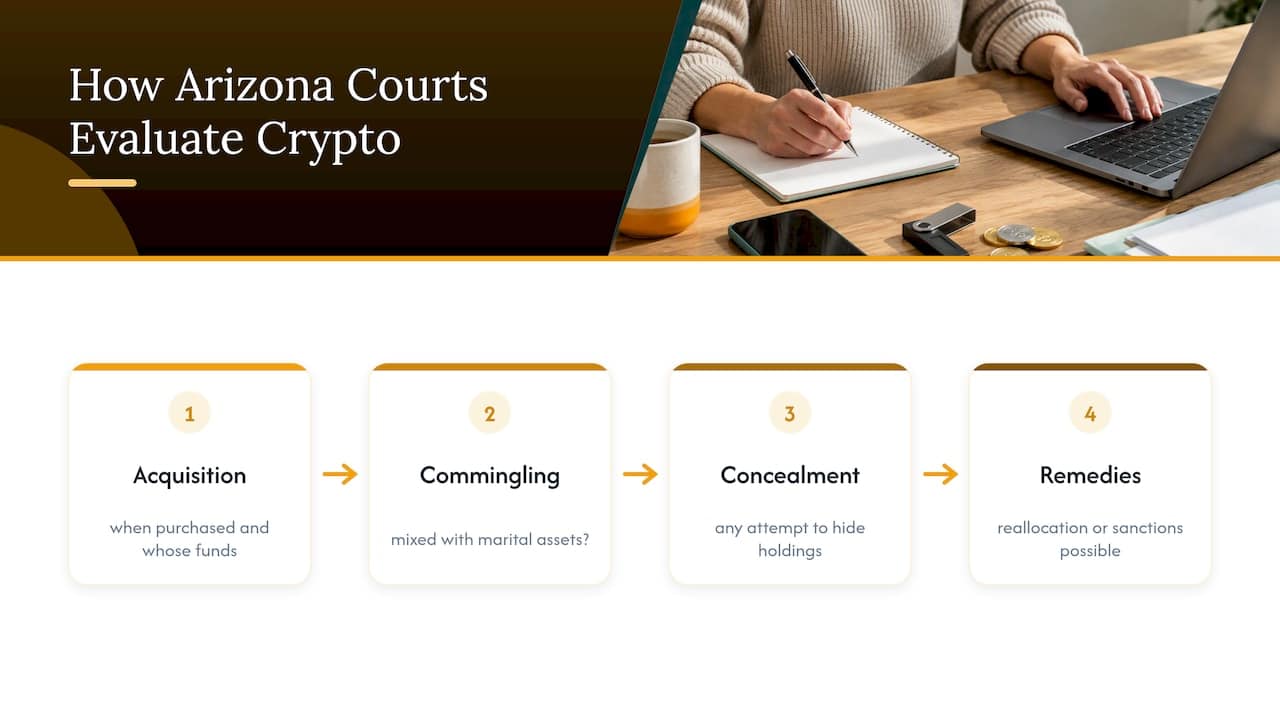
In practice, this means a judge evaluating a disputed Bitcoin holding asks the same questions asked about an undisclosed brokerage account: when was it acquired, whose funds purchased it, was it commingled with marital assets, and did either spouse attempt to conceal it. Courts have broad authority under existing equitable division principles to reallocate property or impose sanctions when a spouse fails to disclose an asset, whether that asset is a coin, a collectible, or real estate.
Because crypto-specific appellate rulings remain limited, expect your case to be argued largely through analogy to how Arizona courts have already handled concealment and valuation disputes involving other hard-to-trace assets. That is one more reason a complete disclosure record and solid documentation matter more than hoping for a crypto-specific legal exception that courts have not yet carved out.
Strategies for negotiating cryptocurrency division in a settlement
Negotiating crypto division works best when both sides agree on a valuation date and method before arguing over the split. Locking that down first prevents a negotiation from collapsing every time the market moves.
A few approaches tend to come up repeatedly in settlement talks:
- Offsetting with other assets: one spouse keeps the crypto holding while the other receives cash, retirement funds, or equity in the home of comparable value, which avoids splitting a volatile asset down the middle.
- In-kind division: both spouses receive a proportional share of the actual coins, which can make sense when neither party wants to take on the tax exposure alone.
- Staggered liquidation: the parties agree to sell at a set future date or price trigger, spreading out market risk rather than locking in a value on a single bad day.
- Mediation over litigation: because valuation disputes often come down to timing and methodology rather than hidden facts, mediation can resolve crypto disputes faster and with less cost than a contested hearing.
Whichever approach you consider, build in the tax consequences from the start. An asset that looks like an equal split on paper can leave one spouse with a much larger tax bill once a sale happens, so settlement terms should account for cost basis and who absorbs that liability.
Wallet and private key control during divorce proceedings
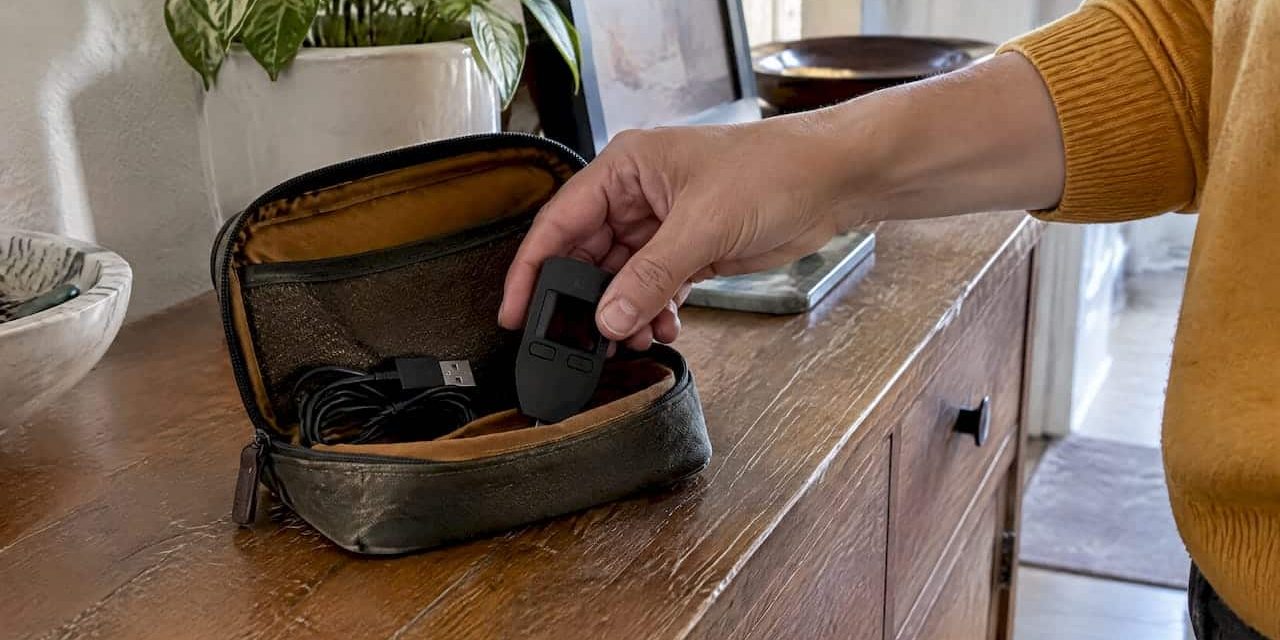
Whoever controls the private keys controls the asset, which makes key custody one of the more sensitive details in a crypto divorce. A spouse who holds sole access to a hardware wallet or seed phrase has the practical ability to move funds regardless of what a court order says, at least until enforcement catches up.
A few practical safeguards matter here. If you share access to a wallet, avoid making unilateral transfers once a divorce is underway, since moving funds without the other spouse’s knowledge can be treated as evidence of concealment. If you are the spouse without access, request a full accounting of wallet addresses and seed phrase custody as part of disclosure, and ask your attorney whether a court order should require funds to move into a neutral, multi-signature arrangement during the case.
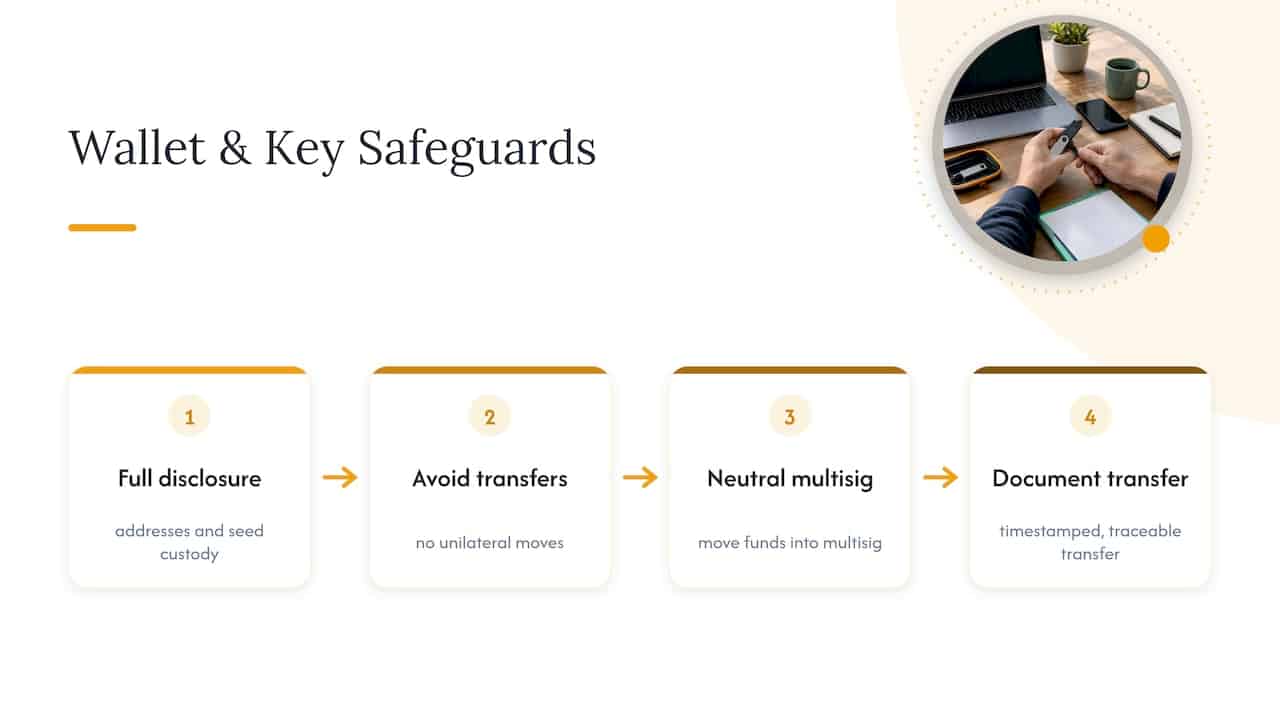
When a settlement finally allocates specific coins to a specific spouse, the actual transfer should happen through a documented, traceable process: moving funds to a new wallet controlled solely by the receiving spouse, with a timestamped export confirming the transaction. Treat hardware wallet devices like Ledger or Trezor units as physical evidence, not just storage tools, since the device itself may need to be inventoried and transferred as part of the settlement.
How crypto forks and airdrops affect property division
Forks and airdrops create a wrinkle that traditional assets do not: new coins can appear in a wallet without either spouse doing anything, simply because the underlying blockchain split or a project distributed tokens to existing holders. The question in a divorce is whether that new asset counts as part of the original holding or as a separate acquisition.
The most consistent approach treats a fork or airdrop received during the marriage as community property if the original holding was community property, since the new coins exist only because of an asset the couple already owned together. A fork or airdrop tied to separate property, such as coins purchased before the marriage, generally follows the same separate classification, provided it was not commingled afterward.
Because these events are not always well documented, disclosure should specifically address them. A spouse who received an airdropped token without mentioning it, even one with little market value, risks that omission being treated as incomplete disclosure if it surfaces later through blockchain analysis.
Handling cryptocurrency debt and loans in divorce
Crypto-backed loans and margin positions need to show up in disclosure just as much as the assets themselves. If a spouse borrowed against crypto holdings through a lending platform, or opened a margin position on an exchange, that debt is part of the marital balance sheet and affects how much net value the underlying crypto actually represents.
A few practical points to work through with counsel:
- Debt incurred during the marriage is generally treated as a community obligation, which means it gets factored into the overall division rather than assigned solely to the spouse who holds the wallet.
- Collateralized positions carry liquidation risk if the underlying crypto drops in value, which can wipe out the collateral and leave a balance owed, a scenario that should be flagged early rather than discovered mid-negotiation.
- Loan documentation, including platform terms, interest rates, and repayment schedules, should be part of the same disclosure packet as wallet and exchange records.
Settlement terms should specify who assumes responsibility for an outstanding crypto loan and how that liability offsets the value of any coins awarded in the same transaction, since treating the debt and the asset separately can produce a lopsided outcome.
When to act and how local counsel approaches crypto discovery
The biggest mistake we see is waiting to disclose or preserve crypto records until a dispute forces the issue, so it is vital to understand how to safeguard assets early in crypto custody. Early, complete disclosure protects you far more than hoping an omission goes unnoticed. We coordinate subpoenas, forensic accountants, and valuation experts when Arizona cases call for it, and we encourage anyone holding crypto to talk with counsel before moving, converting, or deleting any related records.
How we help with crypto and high-asset divorce cases
We built our practice around the parts of divorce that get complicated fast, and crypto division is exactly that kind of case. Rather than treating digital assets as an afterthought, we coordinate the forensic accountants and valuation experts a crypto dispute often requires, while keeping your disclosure obligations under Arizona’s rules on track from the first filing.

Our services relevant to a crypto-involved divorce include:
- Property division representation that accounts for volatile and hard-to-trace assets alongside traditional property.
- Divorce mediation for couples who want to negotiate a crypto split without a contested hearing.
- Collaborative divorce for spouses who want expert-guided settlement talks instead of litigation.
- Support for contested divorce proceedings when disclosure disputes or concealment allegations require court intervention.
We bring extensive family law experience to cases where digital assets complicate an otherwise standard property division. If cryptocurrency is part of your marital estate, reach out to our team for a case review before you make any decisions about your accounts or wallets.
This article is general information, not a substitute for advice from a qualified lawyer. Consult a qualified legal professional about your own circumstances before acting on anything here.
FAQ
What assets cannot be touched in divorce?
Separate property, meaning assets owned before the marriage or received individually as a gift or inheritance, generally stays with the original owner under Arizona’s community property framework. That protection can be lost if separate funds are commingled with marital assets, so keeping clear records of a separate crypto holding matters.
Does the IRS know if you sell Bitcoin?
Increasingly, yes. Brokers are required to report certain digital-asset dispositions on Form 1099-DA starting with transactions after January 1, 2025, which gives the IRS, and by extension, a divorce court, more visibility into crypto sales than in prior years.
Who suffers most financially in divorce?
There is no single answer that applies to every case, since outcomes depend heavily on asset mix, disclosure accuracy, and debt allocation. A spouse who fails to disclose assets like crypto holdings risks a less favorable outcome if concealment is discovered, since Arizona courts can reallocate property or impose sanctions under A.R.S. §25-318.
How are assets divided in a divorce in Arizona?
Arizona divides community property, meaning assets acquired during the marriage, on an equitable basis with courts aiming for a fair outcome under A.R.S. §25-318. Separate property owned before the marriage or received by gift or inheritance generally stays with the original owner, provided it was not commingled with marital funds.
Sources
- Arizona Revised Statutes, Title 25 (Family Law) — A.R.S. §25
- IRS: Frequently Asked Questions on Digital Asset Transactions / Digital-assets guidance