



Contested Divorce Process in Arizona: Steps and Timeline

A divorce is contested when you and your spouse disagree on at least one issue the court has to decide: custody, parenting time, support, the division of property and debt, or whether to divorce at all. In Arizona, that means a sequence of filings, disclosures, temporary orders, settlement efforts and, only if nothing else works, a trial. This guide walks through each stage in order, explains where the time and money go, and shows where you can still keep decisions in your own hands.
TL;DR
- A contested divorce is one where the spouses cannot agree on one or more core issues, so a judge must decide them if they are not settled first.
- In Arizona, the earliest a decree can issue is 60 days after your spouse is served, and a contested case commonly takes many months. Some sources put complex cases at more than 18 months.
- Most of the real work happens before trial: temporary orders, financial disclosure, discovery and mediation.
- Settling part or all of the case usually gives you more control than leaving it to a judge who has never met your family.
Table of Contents
- What makes a divorce “contested”
- The contested divorce process in Arizona, step by step
- How long does a contested divorce take?
- Contested vs. uncontested: what changes
- What a contested divorce costs
- Custody in a contested divorce
- How to prepare before you file or respond
- Our perspective: contested does not have to mean combative
- Getting help with a contested divorce in Scottsdale
- FAQ
- Sources
What makes a divorce “contested”
Courts treat a divorce as contested when spouses disagree about one or more issues. The common ones are:
- Legal decision-making and parenting time for your children
- Child support and spousal maintenance
- Who keeps the house, the business, retirement accounts and other property, and who carries the debt
- Whether the marriage should end at all
You do not need to disagree about everything. A couple that agrees on the house and the finances but fights over the parenting schedule still has a contested case. That matters, because the issues in dispute set the cost and the length of the process.
In a contested case, the court has to resolve what you cannot. In an uncontested case, you file a signed agreement and the judge approves it. If you are not sure which category you are in, our page on uncontested divorce shows what that route requires.
The contested divorce process in Arizona, step by step
The order below is the usual path. Judges, counties and individual cases vary, and some steps overlap.
Step 1: Filing the petition
The process starts when one spouse files a Petition for Dissolution of Marriage with the superior court in the county where they live. The petition states what that spouse wants: the parenting plan, support, and how property should be divided. Preparing it well matters, because it frames the case. Our guide on how to file for divorce in Arizona covers residency requirements and paperwork.
Filing also triggers protections. Arizona’s standard preliminary injunction restricts both spouses from things like hiding or selling community property once the papers are served. We explain how it works in our overview of the Arizona preliminary injunction.
Step 2: Serving your spouse
The petition must be formally delivered. Arizona courts list several accepted methods: your spouse signing an acceptance of service, certified mail with a signed receipt, a process server, or the sheriff. Once served in Arizona, your spouse generally has 20 days to file a response. If they live out of state, that window is longer.
This is the fork in the road. If your spouse does not respond, you can ask for a default. If they respond and disagree with what you asked for, the case is contested.
Step 3: The response and the 60-day clock
Your spouse’s response says which requests they accept and which they oppose. They may also file a counter-petition asking for their own terms. Arizona law bars the court from holding a trial or hearing on the decree until sixty days after service or acceptance of process. That is a minimum. A contested case will run well past it.
Step 4: Temporary orders
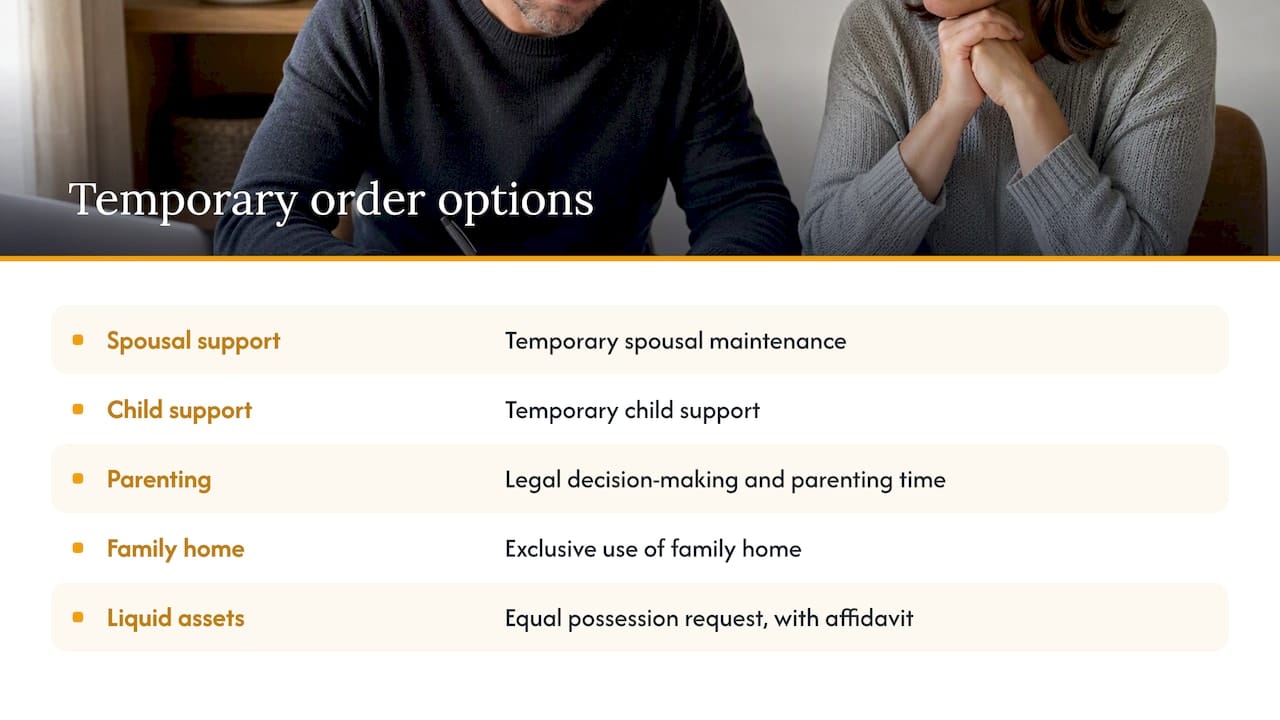
Because the case can take months, either spouse can ask the court for orders that apply while it is pending. Under A.R.S. § 25-316, these can cover temporary spousal maintenance, child support, legal decision-making and parenting time, and exclusive use of the family home. These orders do not decide the final outcome, but they often shape how everyone lives for the next year, and judges notice what has been working in the interim.
The same statute allows a request, supported by an affidavit, for equal possession of liquid assets, defined to include cash, cryptocurrency, nonretirement funds and lottery winnings. If one spouse controls the accounts, this can give the other money for living expenses and legal fees. Read more in our guide to temporary orders in a Scottsdale divorce, and if digital assets are involved, our page on protecting crypto in an Arizona divorce.
Step 5: Disclosure
Arizona requires both spouses to exchange financial and relevant information early, without waiting to be asked. Missing a deadline or leaving out an account can hurt your credibility and invite sanctions. Our Rule 49 disclosure checklist lists the documents to gather: tax returns, pay records, bank and retirement statements, debts, and property records.
Step 6: Discovery
When disclosure leaves gaps, discovery fills them. That can mean written questions, requests for documents, subpoenas to banks or employers, and depositions, where a spouse answers questions under oath. In disputes about a business, hidden income or a complicated estate, this is often the most expensive stage. We cover the mechanics in divorce discovery in Arizona.
Step 7: Mediation and settlement conferences
Most courts push contested cases toward settlement before trial. Judges may order mediation, or hold a settlement conference where a neutral judicial officer helps both sides test their positions. Mediation is not a sign of weakness. Federal data on court-connected dispute resolution shows it works: in a Department of Justice annual report for fiscal year 2016, 75% of voluntary ADR cases and 52% of court-ordered cases settled. Even where cases did not settle, participants reported benefits like narrower issues and better understanding of the dispute.
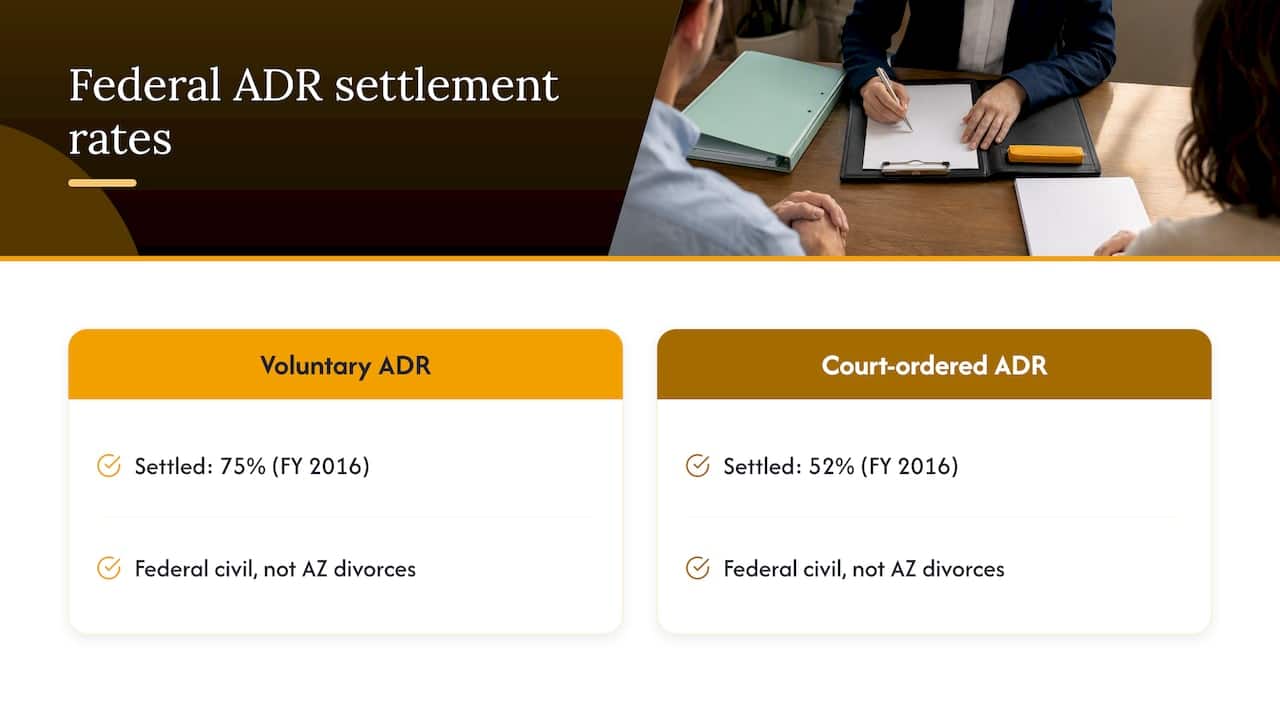
That report covers federal civil cases, not Arizona divorces, so treat it as evidence of how mediation tends to work rather than a promise about your case. Our divorce mediation service is built for this stage.
Step 8: Pretrial and trial
If issues remain, the court schedules a trial. Each side presents witnesses, financial records and, in custody disputes, evidence about the child’s needs and each parent’s role. The judge then issues rulings on what is left. In some cases the court appoints a best interest attorney to represent the child’s perspective.
Trial is where you have the least control. Legal commentators note that the core risk of a contested case is that a judge, a stranger to your family, makes life-altering decisions about your children and finances.
Step 9: The decree and what comes after
The judge signs a decree that divides property and debts and sets custody, support and maintenance. A decree is final, and errors in it are hard and costly to fix later. If a parent later ignores the order, enforcement is a separate court process. Our family law page lists decree enforcement and related services.
How long does a contested divorce take?
There is no fixed answer. The New Jersey courts describe contested timelines as ranging from several months to well over a year, depending on how complex the issues are and how crowded the court calendar is. Arizona’s own floor is the 60-day waiting period, but nothing about a disputed custody case or a business valuation fits inside it.
What tends to lengthen a case:
| Factor | Effect on timeline |
|---|---|
| Disputed parenting time or decision-making | Adds evaluations, interviews and hearings |
| Business, real estate or crypto holdings | Adds valuation experts and extended discovery |
| Missed or incomplete disclosure | Adds motions and delays |
| Refusal to mediate | Pushes the case toward trial |
| A crowded court calendar | Adds waiting between hearings |
What shortens it: complete early disclosure, realistic positions, and settling issues one at a time. A case that starts contested often ends with a settlement on most or all issues.
Contested vs. uncontested: what changes
| Contested | Uncontested | |
|---|---|---|
| Agreement on all terms | No | Yes |
| Court involvement | Hearings, possibly trial | Review and approval |
| Discovery | Often needed | Rarely |
| Typical timeline | Many months or more | Can be as soon as the 60-day wait allows |
| Control over outcome | Shared with a judge | Yours |
| Cost | Higher, driven by hours worked | Lower |
There is a middle path. Collaborative divorce commits both spouses to negotiating a settlement outside court, with professionals helping on finances and children. A contested case can also move toward settlement at any point. Many cases start in dispute and finish as agreed decrees.
What a contested divorce costs
The cost comes down to hours: how many motions, how much discovery, how many experts, and whether you try the case. A divorce that settles after one mediation costs a fraction of one that goes to a multi-day trial. We explain the main cost drivers in how much a divorce costs in Arizona. Fees depend on your situation, and we discuss them in your consultation before you commit.
If you cannot afford to fund the case because your spouse controls the money, ask about temporary orders early. The liquid-asset provision described above exists for that situation.
Custody in a contested divorce
When children are involved, custody is usually the issue that keeps a case contested. Arizona uses “legal decision-making” for who makes major choices on health, education and religion, and “parenting time” for the schedule. They are separate questions. Shared decision-making does not require a 50/50 schedule, which we explain in our piece on Arizona joint custody. If you are weighing a request for sole authority, see sole custody in Arizona. For the evidence courts weigh, our legal decision-making checklist is a good start, and our child custody page describes how we represent parents.
How to prepare before you file or respond
- Gather financial records. Collect three years of tax returns, recent pay stubs, bank, credit card, retirement and brokerage statements, mortgage and loan documents, and business records.
- List every asset and debt, including digital accounts and crypto.
- Write down your parenting history. Who handles school, doctors, activities and daily routines? Keep it factual.
- Stop discussing the case on social media and by text. Anything you write can be used in court.
- Decide your priorities. Know which outcomes matter most and which you can trade.
- Do not move or hide money. Doing so can violate the preliminary injunction and damage your case.
- Talk to a lawyer before you sign anything. Legal aid guidance cautions that the complexity of disclosure, custody and property rules makes professional help highly advisable.
Our perspective: contested does not have to mean combative
We have handled family law cases in Scottsdale for more than 20 years, and our view is simple: a contested divorce is a process to manage, not a war to win. The clients who are happiest at the end are rarely the ones who fought the hardest. They are the ones who knew what they wanted, understood what it would cost, and made decisions on purpose.
That starts with understanding your financial goals and your children’s needs before the first filing. A plan built around those two things tells you what is worth litigating and what is worth settling. Some issues deserve a hearing, such as safety concerns, hidden assets or a spouse who will not follow orders. Many others do not, and spending a year and a large retainer on a dispute that mediation could have closed in an afternoon rarely serves anyone.
We also keep communication open. You should know what is happening in your case, what each step costs, and what your options are. We try to be responsive, and our clients’ testimonials say so. We prepare every case as if it might go to trial, because that preparation is what gives you leverage to settle on good terms. And we keep settlement options open from day one, because a judge’s ruling is a high-risk outcome compared with an agreement you shaped.
Getting help with a contested divorce in Scottsdale
If your spouse has served you, or you expect a fight over custody or property, talk to a lawyer before you respond. Deadlines start the day you are served. At High Desert Family Law Group, we represent clients in contested divorce, legal separation and related matters, as well as mediation and collaborative options if your case can move that way. Contact us to discuss your situation and plan your next step.
FAQ
Do all contested divorces go to trial?
No. Most contested cases settle before trial, often through mediation or a settlement conference. Federal dispute resolution data shows many court-connected mediations end in settlement. Trial happens only on issues the spouses cannot resolve themselves.
Can my spouse stop the divorce by contesting it?
In Arizona, generally not. The court enters a decree of dissolution when it finds the statutory requirements are met, including that the marriage is irretrievably broken. A spouse who does not want the divorce can delay the case and dispute the terms, but cannot ordinarily force you to stay married. Covenant marriages follow different rules.
How long does a contested divorce take in Arizona?
The earliest possible decree is 60 days after service. A truly contested case usually takes many months, and complex ones can pass a year. The length depends on the issues, the amount of discovery and the court’s calendar.
Is a contested divorce worth it?
Sometimes it is. If your spouse is hiding assets, putting your children at risk or refusing to negotiate in good faith, litigating may be the right move. If the dispute is mainly about pride or a few negotiable items, mediation or a collaborative process usually costs less and protects your relationship as co-parents.
How do I prepare for a contested divorce?
Gather your financial records, document your role in your children’s lives, and avoid moving or hiding money. Meet with a family law attorney before you respond to any filing so you understand your deadlines and options.
Sources
- Contested and Uncontested Divorces, NJ Courts
- A.R.S. § 25-316, Temporary orders
- A.R.S. § 25-329, Waiting period (FindLaw)
- Default Timetable, Arizona Court Help
- Fiscal Year 2016 Annual Report, U.S. Department of Justice
- Contested vs. Uncontested Divorce, Justia
- What is a contested or uncontested divorce? Illinois Legal Aid Online
- What if my spouse contests the divorce? LawHelpNY