



Arizona Partition Actions: Divorce Complicates Sales for Joint Owners

A partition action in Arizona lets a co-owner ask the superior court to divide jointly owned real property or order it sold under A.R.S. §12-1211. The court can direct a physical division when that’s practical, or order a sale under A.R.S. §12-1218 when it isn’t. You file in the county where the property sits, and when title disputes, a pending divorce, or complicated ownership claims are involved, we recommend talking to an attorney before filing.
TL;DR:
- A complaint must identify every owner and claimant, each claimed ownership share, a legal property description, and the property’s estimated total value.
- Commissioners inspect the property and report whether a fair physical division is possible; if it is not, the court orders a sale.
- An owner who wants to keep the property should offer a buyout early, which may avoid the time and expense of a forced sale.
- The initial filing fee is typically about $222, while commissioner and surveyor costs are allocated among owners according to the value of their respective shares.
- When divorce proceedings already involve the property, a separate partition case can duplicate costs or create conflicting court orders, so coordinate with family law counsel.
Table of Contents
- What Counts as a Partition Action Under Arizona Law
- How the Court Decides: Division or Forced Sale
- Partition in Kind vs. Partition by Sale: What Each Looks Like
- What a Partition Lawsuit Typically Costs
- Filing a Partition Action: Steps and Timeline
- When Partition Overlaps a Divorce or Family Court Case
- Common Pitfalls We See With Partition Cases
- How We Help With Partition and Property Division Disputes
- FAQ
- Sources
What Counts as a Partition Action Under Arizona Law
A.R.S. §12-1211 gives any owner or claimant of an interest in real property the right to compel partition by filing a complaint in superior court. The statute doesn’t require you to own an equal share, just a legitimate interest, whether that’s a tenancy in common, a joint tenancy, or another recognized ownership stake.
Venue matters here: you file in the superior court of the county where the property, or at least part of it, is located. The complaint itself needs specific information to move forward.
- Names of all owners and claimants with an interest in the property
- Each party’s claimed share or percentage of ownership
- A legal description of the property, including boundaries and parcel details
- An estimated value of the property as a whole
Skipping any of these details is one of the most common reasons a complaint gets challenged early in the case.
How the Court Decides: Division or Forced Sale
Once a partition case is filed, the court typically appoints commissioners to inspect the property and assess whether it can be divided fairly among the owners. Their report carries real weight in what happens next.
Under A.R.S. §12-1218, if commissioners report that a fair and equitable division isn’t possible, the court orders a sale instead of a physical split. When division is feasible without harming the property’s overall value, the court can direct that instead. A single-family home on one lot almost always falls into the “sale” category, since you can’t cut a house in half without destroying its worth.
Courts generally favor the option that preserves the most value for everyone involved. When a sale is ordered, the court appoints a commissioner to handle it, and the proceeds return to the court for distribution according to each owner’s documented interest, not necessarily split evenly.
- Commissioners inspect the property and file a written report with the court
- The report determines whether division in kind or sale is the next step
- Sale proceeds are distributed based on each party’s proven ownership share
Partition in Kind vs. Partition by Sale: What Each Looks Like
Partition in kind means physically splitting the property, which works best with land that can be divided without destroying its value, like undeveloped acreage or a large parcel with clear boundary lines. Partition by sale is the more common outcome, especially for a single house or a property where one owner has been living there alone.
Sale becomes the likely path when the parcels would be unequal, when marketability would suffer from splitting the land, or when one co-owner already occupies the whole property and buying out their interest makes more sense than forcing a move.
- The court orders a sale, and proceeds are divided according to ownership interest
- A co-owner buys out the other party’s share, often at a negotiated or appraised value
- The parties reach a private agreement before the court finalizes any order
Pro Tip: If you want to keep the property, raise a buyout offer early. Courts and opposing parties often prefer a clean buyout over the time and expense of a forced sale.
What a Partition Lawsuit Typically Costs
Filing a partition action comes with several cost categories, and most of them get apportioned among the owners rather than paid entirely by whoever files first. Superior court filing fees in Arizona are set under the Arizona Code of Judicial Administration, with a typical initial filing fee around $222.00 depending on the county and any applicable surcharges.
- Superior court filing fees and administrative surcharges
- Commissioner and surveyor compensation, taxed as costs under A.R.S. §12-1225
- Appraisal and title search costs
- Taxed court costs tied to the final judgment
Commissioner and surveyor pay is taxed as a cost of the action and apportioned by each party’s share value, according to A.R.S. §12-1225, so whoever holds a larger interest generally carries a larger piece of these costs. Mediation or an early settlement often cuts these expenses significantly compared to a fully litigated sale.
Filing a Partition Action: Steps and Timeline
Filing follows a fairly predictable sequence, though the pace depends heavily on whether the other owners contest the case.
- Prepare the complaint with names, ownership interests, property description, and estimated value
- File in the superior court of the county where the property is located
- Serve all respondents with the complaint
- Request appointment of commissioners if division or valuation is disputed
- Review the commissioners’ report once filed
- Request a court order for sale or division based on that report
- Receive the final decree distributing proceeds or confirming the division
Gather documents early: deeds, mortgage statements, HOA records, property tax bills, and any written agreement between co-owners. Our guide to preparing for divorce covers similar document checklists that apply directly to partition cases tied to a separation.
Pro Tip: Title disputes, unresolved liens, or a parallel divorce case are the most common reasons a straightforward partition drags on for months longer than expected.
When Partition Overlaps a Divorce or Family Court Case
Partition is a separate civil remedy, but family courts already have authority to order a sale or award property as part of a divorce. Filing a standalone partition action while a divorce is pending can create duplicate costs and conflicting orders from two different courts.
- Confirm whether the family court already has jurisdiction over the property before filing separately
- Weigh timing: a partition case can outlast or collide with divorce proceedings
- Preserve community-property claims by coordinating with family-law counsel first
- Consider mediation or a settlement that meets Rule 69 standards to make the agreement binding
Our page on community property and divorce walks through how Arizona courts typically handle marital real estate, which is often the better starting point than a separate partition filing.
Common Pitfalls We See With Partition Cases
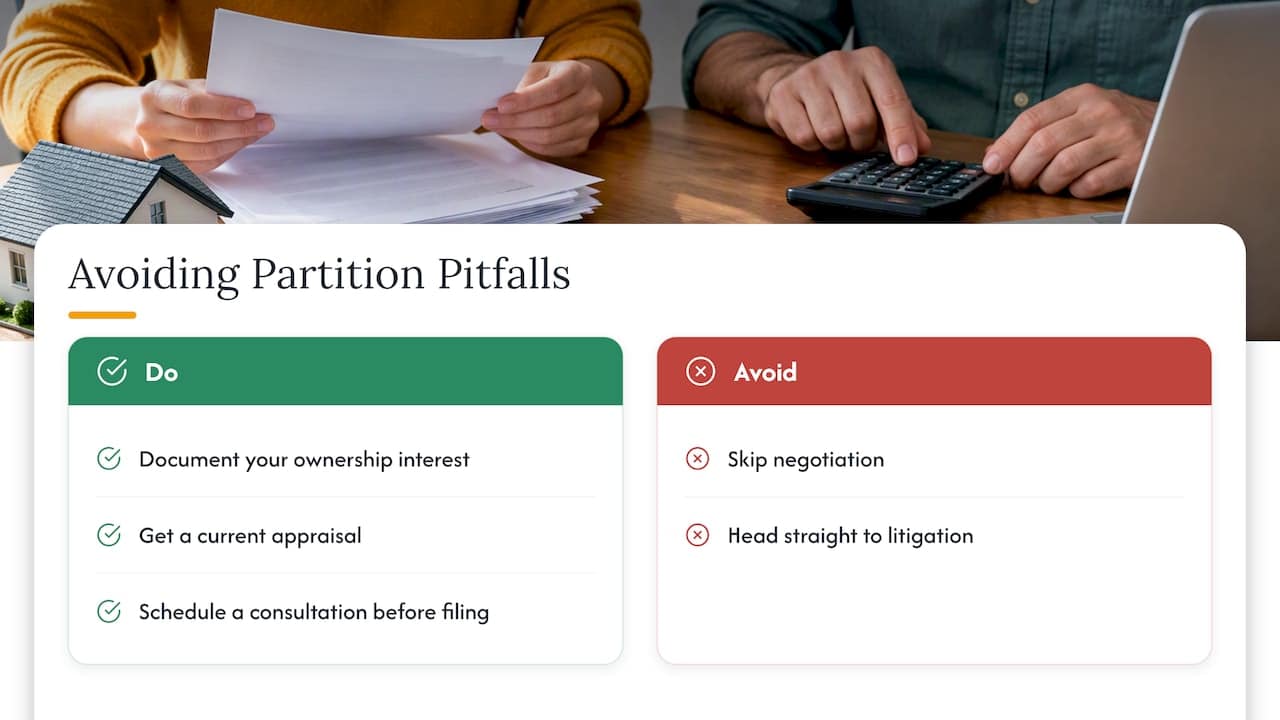
Most co-owners skip negotiation and head straight to litigation, which usually costs more than a mediated buyout or sale agreement. Hidden costs, commissioner fees, title defects, unresolved liens, catch people off guard, especially when a divorce is already underway and timing gets tight.
Document your ownership interest, get a current appraisal, and schedule a consultation before filing anything.
How We Help With Partition and Property Division Disputes
When a partition dispute overlaps a divorce or separation, we bring both family-law and property-division experience to the table, which means one coordinated strategy instead of two courts working against each other. We build each plan around your financial goals and the practical outcome you actually want.

Depending on your situation, we can help with:
- Property division counseling when real estate is part of a divorce settlement
- Divorce mediation to resolve ownership disputes without a drawn-out court fight
- Collaborative divorce representation when both parties want to avoid litigation
- Guidance on whether a separate partition filing makes sense alongside your family court case
If a sale ends up being the right outcome and you need to move quickly, resources like Sunshine State Buyers offer a direct-sale path for sellers who want to skip repairs and showings, though that route is specific to Florida properties. Bring your deed, mortgage statements, and any prior ownership agreement to your first consultation, and we’ll walk through whether partition, family court, or a negotiated settlement fits your case best. Schedule a consultation to get started.
This article is general information, not a substitute for advice from a qualified lawyer. Consult a qualified legal professional about your own circumstances before acting on anything here.
FAQ
How do you win a partition action in Arizona?
Winning typically means securing a favorable division of property or a sale that reflects your documented ownership interest, which requires clear title records and a well-supported complaint under A.R.S. §12-1211. Strong evidence of your share, early settlement talks, and a credible buyout offer often produce a better outcome than contested litigation.
How expensive is a partition lawsuit in Arizona?
Costs include a superior court filing fee around $222.00 under the Arizona Code of Judicial Administration, plus commissioner, surveyor, and appraisal costs apportioned by ownership share under A.R.S. §12-1225. Mediation or an early settlement generally keeps total costs lower than a fully litigated sale.
What is Rule 69 in Arizona family law?
Rule 69 governs how settlement agreements become binding in Arizona family court cases, including agreements that resolve property disposition. When a partition issue overlaps a divorce, a Rule 69 compliant agreement can make a property settlement enforceable without further litigation.
Is Arizona a 50/50 marriage state?
Arizona is a community property state, meaning marital property is generally divided equitably rather than by a strict equal split in every case. Separate property, including assets owned before marriage, usually stays with the original owner, which our community property guide explains in more detail.
Can a lien or mortgage affect a partition action?
Yes, an existing mortgage or lien typically gets paid from sale proceeds before the remaining funds are distributed among the owners. Unresolved liens can also extend the timeline of a partition case while the court sorts out priority and payoff amounts.
Sources
- 12-1211. Compelling partition; complaint
- Arizona Code of Judicial Administration Part 3: Superior Court — Section 3-404: Superior Court Fees