



Legal separation is a formal court process that lets married couples live apart and divide finances, property, and parenting responsibilities — without ending the marriage.
Here’s a quick overview of what that means in practice:
| Question | Answer |
|---|---|
| Does it end the marriage? | No — you stay legally married |
| Can you remarry? | No — not without a divorce |
| Does it divide property and debts? | Yes — by court order or agreement |
| Does it cover child custody and support? | Yes |
| Can it become a divorce later? | Yes — through a conversion process |
| Is it available in Arizona? | Yes |
Marriages don’t always fall apart all at once. Sometimes couples need time — time to figure out finances, time to protect benefits, or time to decide if divorce is truly the right step. A legal separation gives couples a structured, legally protected way to do exactly that.
It’s not the same as simply moving out. And it’s not the same as divorce. It sits in a distinct middle ground, with real legal consequences and real legal protections.
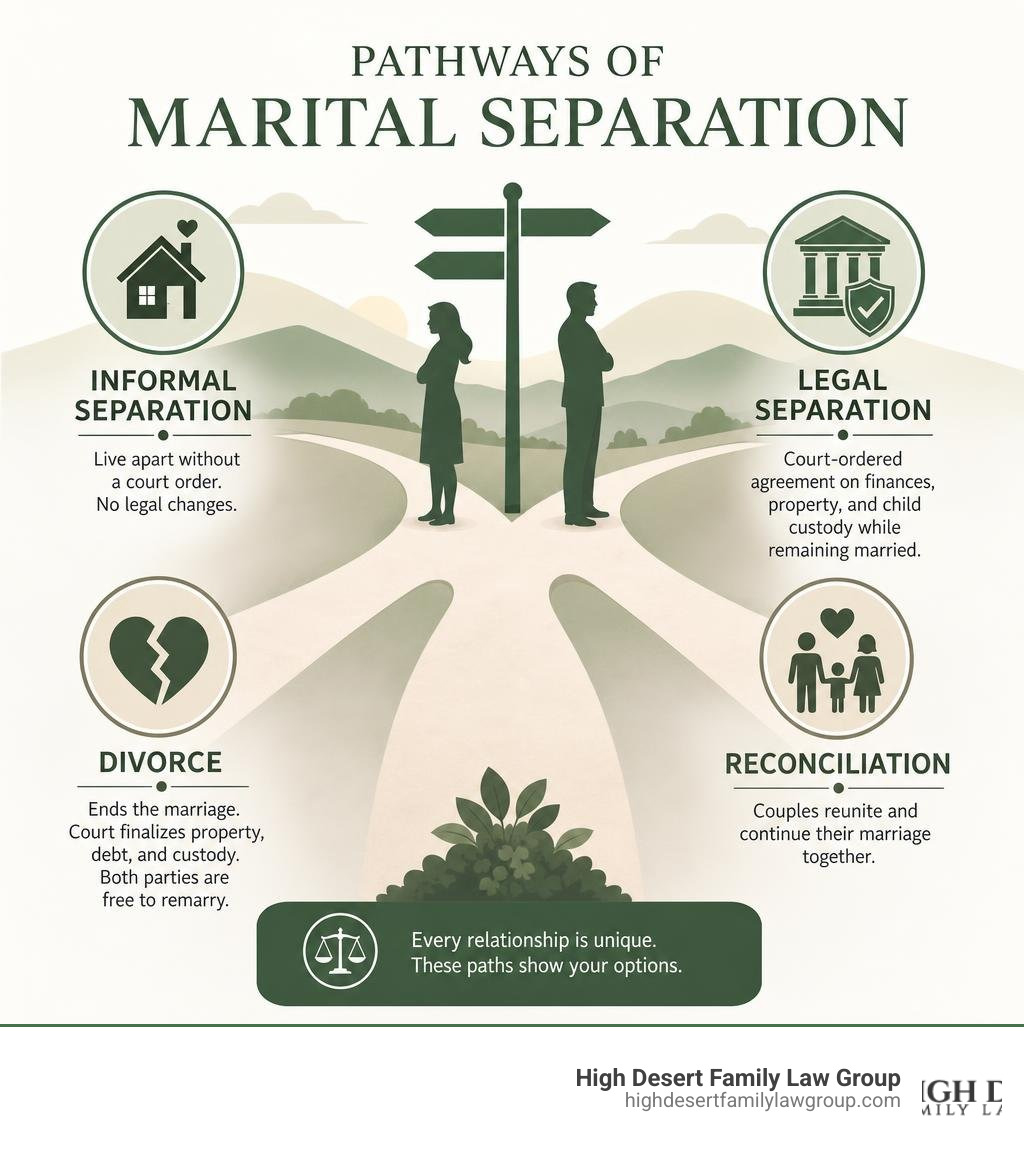
What is a Legal Separation?

When couples face severe marital discord, they often assume their only choices are to stay together in misery or file for a complete divorce. However, family law provides another powerful pathway. As defined by the legal separation | Wex | US Law | LII / Legal Information Institute, a legal separation is a court-ordered arrangement that allows a married couple to live apart and establish clear boundaries regarding property, custody, and support while keeping the legal marriage intact.
To obtain a formal separation, one or both spouses must petition the court. If approved, the judge issues a judicial decree. This decree is a legally binding order that outlines each spouse’s rights and duties. Unlike a divorce, which legally dissolves the marital bond, a separated couple remains legally married in the eyes of the law.
In the United States, this option is more common than many realize. Approximately 2.5% of married couples in the U.S. choose legal separation instead of divorce each year. While that might sound like a small slice of the pie, it represents thousands of couples who utilize this legal tool to protect their financial interests, secure their parental rights, and give themselves space to breathe without permanently severing their vows.
The Difference Between Separation and Legal Separation
It is incredibly common for people to confuse a trial or informal separation with a formal legal separation. In our practice, we often hear clients say, “We’ve been legally separated for six months because my spouse moved into an apartment in Chandler.”
Under Arizona law, simply moving into different zip codes does not make you “legally separated.” Let’s break down the Different Types of Separation to clarify:
- Informal / Trial Separation: This occurs when you and your spouse decide to live in separate residences. You might have a verbal agreement about who pays which bills or when the kids visit, but the court is not involved. Legally, your marital status is unchanged, and any assets acquired or debts accumulated by either spouse during this time are still considered community property and joint liabilities.
- Legal Separation: This is a formal court action. You must file a petition, pay a filing fee, and have a judge sign a decree. The court establishes legally binding terms for asset division, spousal maintenance, and child custody.
Understanding The Difference Between Separation and Legal Separation is vital for your financial security. Without a court decree, you remain financially tied to your spouse’s spending habits, debts, and legal liabilities. By pursuing a formal process and Defining Legal Separation in Arizona through the court, you erect a legal firewall that stops the accumulation of community property and joint debt from the date of filing.
Marital Separation vs. Divorce: A Detailed Comparison
Deciding between these two paths requires a clear understanding of how they differ across various legal and financial categories. To help you visualize the landscape, we have put together a comparison of The Difference Between Separation and Divorce:
| Feature | Legal Separation | Divorce (Dissolution) |
|---|---|---|
| Marital Status | You remain legally married. | The marriage is legally dissolved. |
| Right to Remarry | No. Remarrying while separated is bigamy. | Yes. You are free to remarry. |
| Property Division | Marital assets are divided and community property stops accumulating. | Marital assets are permanently divided. |
| Debt Allocation | Debts are divided; future debts are individual. | Debts are permanently divided. |
| Next-of-Kin Status | Retained (unless modified by estate planning). | Terminated automatically. |
| Health Insurance | Often possible to keep a spouse on an employer plan. | Coverage on a spouse’s plan almost always terminates. |
| Taxes | Can file as Married Filing Jointly or Separately. | Must file as Single or Head of Household. |
When analyzing Divorce vs Legal Separation, the primary distinction is the finality of the marital status. However, the financial mechanisms used by the court to address property division, debt allocation, and asset protection are nearly identical in both processes.
In both cases, the court will divide your community property equitably and allocate responsibility for marital debts. This ensures that if you choose to separate, you still receive a fair share of the marital estate and are protected from future liabilities incurred by your spouse.
Key Differences in Marital Status and Benefits
When weighing Legal Separation vs Divorce in Arizona, you must look closely at how your choice impacts daily life, taxes, and long-term benefits.
First, let’s look at remarrying. Because a legal separation does not dissolve the marriage, neither spouse can marry anyone else. Doing so would violate state laws against bigamy. If you or your spouse has met someone else and wants to move on, a divorce is the only legal pathway to make that happen.
Second, consider your tax filing status. Since you remain legally married under a separation decree, you still have the option to file your taxes jointly with your spouse. This can result in significant tax savings compared to the “Single” or “Head of Household” statuses required after a divorce.
Third, health insurance retention is one of the most common reasons couples choose separation. Many employer-sponsored health insurance plans will immediately terminate coverage for a spouse once a divorce is finalized. However, because a separated couple remains married, many insurance policies allow the non-employee spouse to remain covered under the family plan.
Note: You must always review the specific terms of your insurance policy, as some insurers treat a legal separation decree as a qualifying event that terminates coverage.
Finally, pension rights and retirement benefits are handled differently. A separation allows a spouse to continue accumulating years toward certain federal benefits, such as military pensions or Social Security, which we will discuss in detail below.
Why Couples Choose to Separate Instead of Divorcing

Every family’s story is unique, and the reasons for choosing one legal path over another are deeply personal. When evaluating When is a Legal Separation Better Than Divorce, we find that couples generally fall into a few distinct categories.
For many, religious beliefs and personal values play a dominant role. Certain faiths strictly forbid or strongly discourage divorce. A legal separation allows spouses to honor their religious vows and maintain their standing within their spiritual communities while legally dividing their lives, finances, and parenting duties to live in peace. Nationally, legal separation is chosen by roughly 10% of couples who cite religious or financial reasons for not pursuing a full divorce.
Financial benefits are another major driver. Beyond health insurance, couples may choose to remain legally married to preserve tax advantages, protect business interests, or ensure that a spouse with chronic health issues does not lose access to vital medical care.
Additionally, some couples use a separation as a formal trial period. It provides a structured environment where both parties can experience living apart while having clear, court-enforced rules regarding bills, child support, and parenting time. This takes the chaotic guesswork out of physical separation.
This structured breathing room can sometimes save a marriage. In fact, about 20% of legally separated couples eventually reconcile and return to living together. If reconciliation occurs, the couple can petition the court to dismiss the separation decree, restoring their original marital status without having to go through the expensive and emotionally draining process of getting remarried.
For other couples, exploring their Legal Separation Options is simply a practical way to manage a difficult transition while keeping the door open for future decisions.
Navigating the Separation Process
Entering the legal system can feel overwhelming, especially when you are already dealing with the emotional weight of a changing marriage. Understanding the steps, court forms, and financial requirements can demystify the process and help you feel in control.
To begin, you must file a petition with the court. The paperwork is highly detailed and requires a full disclosure of your assets, debts, income, and expenses. If you have minor children, you must also submit proposed parenting plans and child support worksheets.
Naturally, one of the first questions clients ask us is: How much does this cost?
The Cost to File for Legal Separation can vary depending on your location and whether your spouse contests the filing. Generally, you can expect to pay a court filing fee, which ranges from $200 to $350 depending on the county. For a detailed breakdown of what to expect financially, you can read our guides on Legal Separation Cost and How Much is a Legal Separation.
If you are looking at historical pricing trends to understand how legal fees have evolved, you can also review our archived resources on Legal Separation Costs 2022 and Legal Separation Costs 2023. An uncontested separation where both parties agree on all terms will always be significantly less expensive than a contested case that requires court hearings.
Arizona Legal Separation Requirements and Procedures
If you live in the Greater Scottsdale or Chandler areas, you must follow the specific rules established by the state of Arizona. To help you prepare, we have outlined the basic Arizona Legal Separation Requirements and the steps for How to File for Legal Separation in Arizona.
First, Arizona has a strict 90-day residency requirement. At least one of the spouses must have lived in Arizona (or been stationed here in the military) for a minimum of 90 days before filing the petition.
Second, the process differs slightly depending on your county. If you live in Scottsdale or Chandler, you will likely file your paperwork through the Maricopa County Superior Court. You can access local court resources and check schedules via the Divorce Proceedings – Maricopa County Superior Court . If you live further south or east, you might need to understand How Does Legal Separation Work in Pinal County AZ, which has its own local rules and filing systems.
To ensure you have a complete picture of the local legal landscape, it is helpful to review general Arizona legal separation guides and seek out trusted local resources. Whether you are gathering Chandler legal separation information or looking for experienced Arizona legal separation attorneys, having local representation is key.
In Arizona, a legal separation is a “no-fault” process. This means you do not have to prove that your spouse did something wrong to get separated. You only need to state under oath that your marriage is temporarily disrupted, or that you and your spouse prefer to live apart. For a deeper dive into the statutes, please read Legal Separation in Arizona, What is Legal Separation in Arizona, and How Legal Separation Works in Arizona.
Drafting a Binding Separation Agreement
The cornerstone of a successful separation is a comprehensive, written separation agreement. This document is a contract between you and your spouse that details how you will handle your affairs while living apart. To be legally binding and enforceable, the agreement must be in writing, signed by both parties, and notarized.
As noted in Legal Separation – FindLaw , a separation agreement allows couples to maintain control over their assets and schedules rather than leaving those decisions to a judge who doesn’t know their family.
A thorough agreement should cover:
- Asset and Debt Division: Who keeps the family home in Scottsdale? Who is responsible for the car payment? How will bank accounts be divided?
- Spousal Maintenance: Will one spouse pay alimony to the other? If so, how much, and for how long?
- Child Custody and Parenting Time: A detailed schedule outlining where the children will sleep on school nights, how holidays will be split, and who makes major decisions regarding education and healthcare.
While some couples look to other states or countries for inspiration — such as reviewing how courts handle a Legal Separation , checking the Get a legal separation – GOV.UK framework, or looking at agreed separation forms like the Ask for a Legal Separation packet — your agreement must be tailored strictly to Arizona family law to stand up in a local court.
Once the judge reviews your agreement and incorporates it into the final decree, it carries the full weight of a court order. If your spouse fails to follow the terms, you can file a motion for enforcement, and the court can penalize them for non-compliance.
Frequently Asked Questions about Marital Separation
Can you convert a legal separation into a divorce?
Yes, absolutely. If you are legally separated and realize that reconciliation is no longer possible, you do not have to start your legal journey from scratch.
You can file a motion to convert your separation into a divorce. If your original separation decree already resolved all your property, debt, and custody issues, this conversion process can be incredibly streamlined. The court will typically adopt the terms of your separation agreement into your final divorce decree, saving you time, emotional stress, and legal fees.
If you are wondering, Do I Need to Get a Legal Separation Before a Divorce in Arizona?, the answer is no. It is not a required stepping stone. You can file directly for divorce if you are certain the marriage is irretrievably broken. However, if you started with a separation, the transition to a divorce is a well-traveled legal path.
How does separation affect health insurance and Social Security?
This is a critical area where the timing of your legal choices can have massive financial consequences.
- Health Insurance: As mentioned earlier, many employer-sponsored health plans allow a separated spouse to stay on the policy because the legal marriage is still active. However, you must read the employer’s benefits handbook carefully. Some companies treat a court-ordered separation the same as a divorce, which would trigger the end of coverage and require the separated spouse to seek COBRA or independent insurance.
- Social Security Benefits: Under federal law, if you were married for at least 10 years, you may be eligible to receive Social Security benefits based on your spouse’s (or ex-spouse’s) earnings record once you reach retirement age. Because a legal separation keeps you legally married, those years of separation continue to count toward that crucial 10-year milestone. If you divorce before reaching the 10-year mark, you lose access to those spousal retirement benefits.
- Pensions and Retirement Accounts: Marital separation allows you to divide retirement assets using a Qualified Domestic Relations Order (QDRO) just like in a divorce, protecting your financial future while keeping your marital status intact.
What happens to child custody and support?
When children are involved, their well-being is always the court’s primary concern. In Arizona, the legal standards for child custody, parenting time, and child support are identical in both legal separation and divorce cases.
The court will evaluate all decisions based on the best interest of the child. This includes looking at which parent has been the primary caregiver, the child’s adjustment to their home and school, and any history of domestic violence or substance abuse.
You and your spouse will need to draft a comprehensive parenting plan. Additionally, child support will be calculated using the official Arizona Child Support Guidelines, which factor in both parents’ incomes, parenting time days, and healthcare costs. If you are preparing to file with minor children in Maricopa County, you can find the necessary local forms and instructions on How to Start the Legal Separation Process with Minor Children in … .
Conclusion
Navigating marital difficulties is one of the most challenging experiences a person can face. Whether you are leaning toward a legal separation to preserve vital financial benefits, honor your personal values, or simply give your family some structured breathing room, you do not have to walk this path alone.
At High Desert Family Law Group, we understand that every family deserves a strategy tailored to their specific needs. We provide aggressive, individualized representation designed to protect your rights, your assets, and your children. Our experienced four-person legal team is dedicated to guiding clients throughout Greater Scottsdale, Chandler, and the surrounding Arizona communities through every step of the family law process.
If you are ready to explore your options and secure your future, contact us today to schedule a consultation. Let us help you find the clarity and peace of mind you deserve.
For more information on how we can assist you, visit our primary resource on Legal Separation in Arizona.