



Arizona Joint Custody: Shared Decisions Do Not Mean 50/50 Time

Arizona no longer uses the word “custody” in its statutes. Under A.R.S. § 25-401, Arizona law distinguishes two questions: who shares legal decision-making, and how parenting time is divided. You can share decisions without splitting time 50/50, and joint decision-making requires a signed parenting plan. Domestic violence can bar a joint award.
TL;DR:
- Arizona separates decision making from parenting time, so parents can share major decisions even when the child lives mostly with one parent.
- Judges weigh the child’s best interests, parental cooperation, and practical logistics; bring records of school routines, civil communication, work hours, and exchanges.
- Significant domestic violence or child abuse triggers a presumption against joint authority or equal time; a parent found to have committed violence faces limits.
- Complete the Parent Information Program, have both parents sign a detailed plan covering decision authority, schedules, exchanges, disputes, and costs, then submit it for court approval.
- Parenting time affects child support calculations, and changing an existing order generally requires changed circumstances supported by records such as school documents or work schedules.
Table of Contents
- What do legal decision-making and parenting time mean?
- How do courts decide who gets joint legal decision-making?
- When can joint authority be limited?
- What belongs in a parenting plan and Joint Legal Decision-making Agreement?
- Which parenting-time schedules work best?
- How do you request or change joint legal decision-making step by step?
- Why do careful drafting and legal review matter?
- Need help with a parenting plan or custody case?
- FAQ
- Sources
What do legal decision-making and parenting time mean?
Under A.R.S. § 25-401, legal decision-making is the right to make non-emergency decisions about a child’s education, health care, religion and personal care. Parenting time is the schedule that sets when each parent has the child. Courts treat them as two different orders, which is why “joint custody” can mean very different things in practice.
- Joint legal decision-making: both parents share authority over major non-emergency decisions, and neither parent’s rights are inherently superior.
- Parenting time: governs physical possession and routine daily care, such as meals, homework and bedtime.
- Unequal time is common: a child can live mostly with one parent while both parents still share the big decisions.
Think of it this way: one order answers “who decides,” and the other answers “who has the child on Tuesday.”
How do courts decide who gets joint legal decision-making?
Judges decide by the child’s best interests under A.R.S. § 25-403, looking at the child’s physical and emotional well-being, the child’s wishes if old enough, and which parent is likely to allow meaningful contact with the other. For joint awards, A.R.S. § 25-403.01 adds whether parents can cooperate and whether joint decision-making is logistically possible.
The statute on parenting plans, A.R.S. § 25-403.02, directs courts to adopt a plan that maximizes parenting time for both parents when that fits the child’s best interests. In practice, many people treat this like a presumption toward shared time where logistics allow.
Evidence that helps show you can cooperate:
- Written, civil communication between you and the other parent.
- Proof of school stability, such as shared pickup and drop-off routines.
- A realistic exchange plan that accounts for work hours and travel time.
- A history of keeping the other parent informed about medical and school matters.
Pro Tip: Bring a one-page logistics summary to mediation: school address, both homes, work schedules and the exchange point. Concrete logistics persuade more than general promises.
When can joint authority be limited?
Safety comes first. A.R.S. § 25-403.03 creates a rebuttable presumption that awarding joint legal decision-making or equal parenting time is contrary to the child’s best interests when there has been significant domestic violence or child abuse. A parent found to have committed domestic violence faces a mandatory presumption that decision-making or parenting time awarded to them is contrary to the child’s best interests, and it limits orders unless the parent overcomes it with the required evidence.
- Joint decision-making: may be unavailable unless the presumption is overcome.
- Parenting time: may be supervised or restricted.
- Recent DUI or drug convictions: court packets ask about them, and parents who still seek joint authority must explain how the arrangement protects the children, as the Maricopa County court instructions describe.
If any of this applies to your family, our guide on domestic violence and custody in Arizona explains the evidence that matters.
What belongs in a parenting plan and Joint Legal Decision-making Agreement?
Court packets, including the Joint Legal Decision-making Agreement form, require specific plan elements, and a signed plan becomes part of the court order once the judge approves it. The court order forms confirm that approval step. Without a detailed plan, a joint arrangement is hard to enforce.
Include these items:
- Which parent holds which decision-making authority, and how it is shared.
- A parenting-time schedule covering weekdays, holidays, school breaks and vacations.
- Exchange and transportation procedures.
- A dispute-resolution step, such as mediation, before anyone returns to court.
- Review intervals and provisions for major life events.
- How uninsured medical and education costs are split.
Before filing, expect to work through these steps:
- Answer the checklist questions about domestic violence and recent convictions honestly.
- Complete the Parent Information Program.
- Both parents sign the agreement and plan.
- Submit them for court approval.
For deeper drafting guidance, see our article on the Arizona parenting plan.
Which parenting-time schedules work best?
The Parenting Time Resource Guide offers practical framing for building schedules and points to the statutes and forms that govern them. Common patterns include:
- Alternating-week schedule: may suit parents who live close to each other and the school.
- 2-2-3 rotation: keeps young children from going long stretches without either parent.
- Primary residence with frequent contact: fits when one parent’s work or distance makes equal time unrealistic.
- Holiday splits: alternate major holidays by year or divide each holiday in half.
Parenting-time days feed into child support calculations, so a schedule change can change the monthly amount. Account for that before proposing changes to an existing order. To modify an order later, you generally need a change in circumstances plus documents that support it, such as school records or an updated work schedule. Our guide to child custody modification in Arizona covers the paperwork, and our page on parenting time in Arizona covers schedules and filing.
How do you request or change joint legal decision-making step by step?
The path differs slightly for agreed and contested cases, but the core sequence is the same:
- Complete the Parent Information Program.
- Draft the Parenting Plan and the Joint Legal Decision-making Agreement.
- File the petition or complaint with supporting forms, following the Part 1 instructions.
- Attend conciliation or mediation if the court requires it.
- Submit the plan for approval so it becomes part of the court order.
In an uncontested case, the judge reviews your signed agreement. In a contested case, the court must make findings under A.R.S. § 25-403.01 and may hold hearings.
Gather existing orders, school records, proof of program completion and any required background information. Our guide to legal decision-making factors includes an evidence checklist.
Pro Tip: If there is high conflict, a safety concern or a relocation question, have an attorney review the plan before you sign.
Why do careful drafting and legal review matter?
We focus on family law, and a well-drafted parenting plan is where we see the most avoidable trouble. Vague exchange times, missing dispute steps and unclear cost-sharing are what send parents back to court. We draft the Joint Legal Decision-making Agreement, negotiate terms that reduce disputes after the decree, and prepare evidence for contested hearings. When your facts are complicated by domestic violence, relocation or substance issues, tailored advice matters far more than a template.
Need help with a parenting plan or custody case?

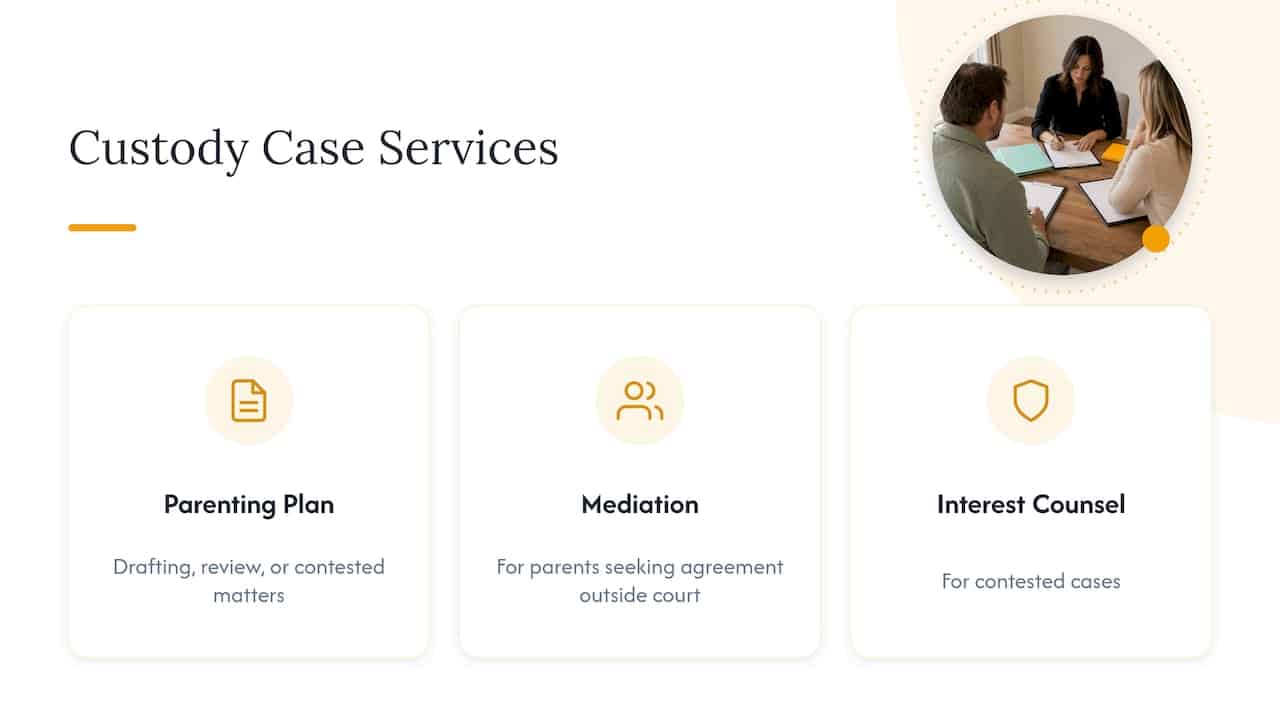
If you need a parenting plan drafted, reviewed or contested, we can help through our Child Custody services, our Divorce Mediation option for parents who want to agree outside court, and our Best Interest Attorney services for contested cases. We bring extensive family law experience to Arizona matters. Book a consultation and bring your draft plan, and we will walk through it with you.
This article is general information, not a substitute for advice from a qualified lawyer. Consult a qualified legal professional about your own circumstances before acting on anything here.
FAQ
How do I deal with child custody stress?
Focus on what you can control: a clear parenting plan, organized records and predictable routines for your child. Mediation can lower the temperature because you shape the outcome together instead of waiting on a judge. A counselor or support group can help with the emotional side.
Does co-parenting work?
It tends to work best when both parents keep communication brief, respectful and focused on the child. A detailed parenting plan helps because it settles routine questions in advance. Where safety is a concern, Arizona law limits joint arrangements under A.R.S. § 25-403.03.
How do I prepare for a custody hearing without a lawyer?
Read the statutes and court forms, organize school and medical records, and draft a proposed parenting plan with a realistic schedule. The Parenting Time Resource Guide is a good starting point. For complex or high-conflict cases, a consultation is worth it.
What if my child wants to live with the other parent?
The judge considers the child’s wishes if the child is of suitable age and maturity, but it is one factor among several under A.R.S. § 25-403. Parents can also agree to a schedule change and submit it to the court for approval.