



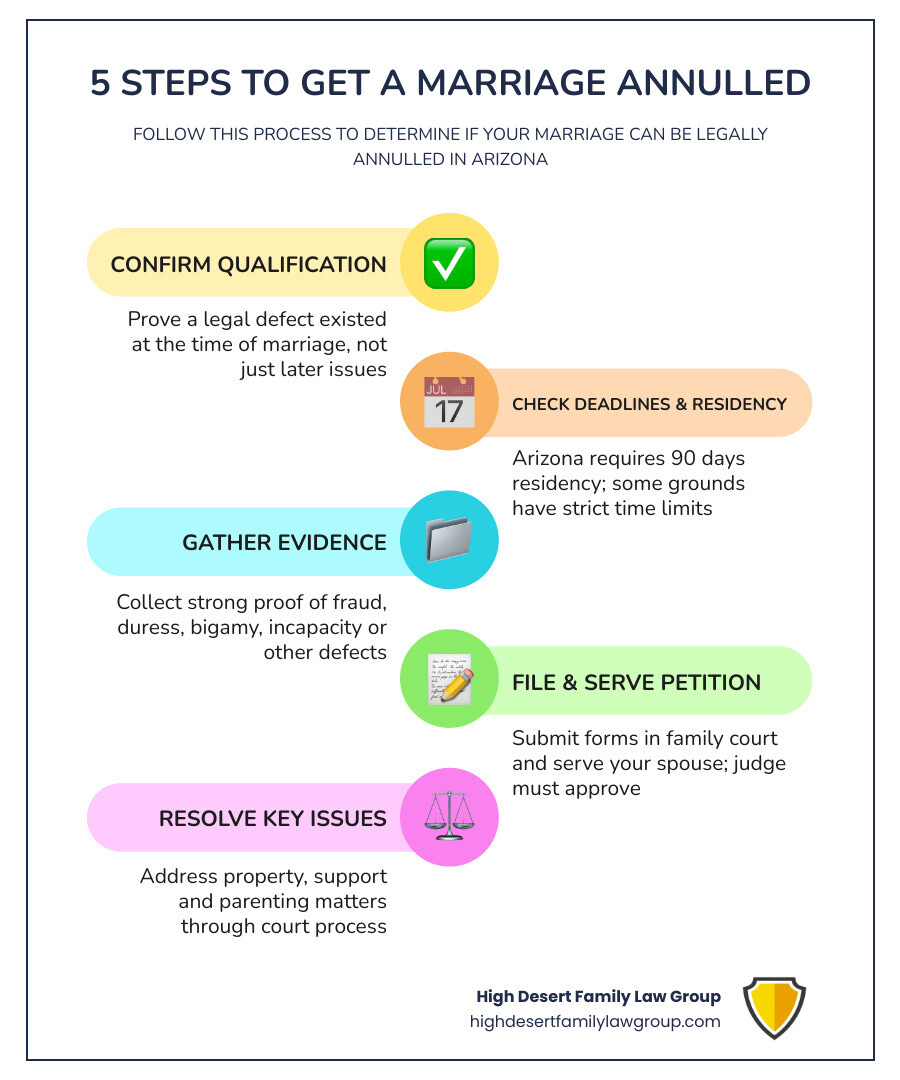
If you need to get a marriage annulled, here is the short answer on how the process works:
- Confirm you qualify — you must prove a specific legal defect existed at the time of the marriage (not just that things went wrong afterward)
- Check your deadline and residency — Arizona requires 90 days of residency before filing; some grounds have strict time limits
- Gather your evidence — annulments require stronger proof than most civil cases
- File your petition and serve your spouse — a judge must approve every annulment, even if both spouses agree
- Resolve property, children, and support — these issues are handled differently than in a standard divorce
Unlike a divorce, which ends a valid marriage, an annulment does something more fundamental — it tells the court the marriage was never legally valid in the first place. If granted, the law treats the marriage as though it never happened.
That distinction matters. It affects your property rights, whether you can receive spousal support, and how you move forward financially and legally. Annulments are relatively rare, and courts in many states — including Maryland — will simply grant a divorce instead if the legal grounds aren’t clearly met.
In Arizona, specific grounds must be proven, a 90-day residency requirement applies, and a judge must review every case before issuing a ruling.
Step 1: Confirm You Qualify to Get Marriage Annulled
The first step is the most important: not every unhappy marriage qualifies for annulment. To get marriage annulled in Arizona, you generally must show there was a legal problem with the marriage from the very beginning.
That means annulment is not for:
- growing apart
- arguing all the time
- a very short marriage
- cheating that happened later
- realizing too late that you married someone annoying enough to make toast feel dramatic
Those facts may support divorce, but they usually do not support annulment.
Arizona courts look for a legal defect such as:
- bigamy
- incest or prohibited family relationship
- underage marriage without proper legal authority
- lack of mental capacity
- intoxication severe enough to prevent real consent
- fraud
- duress or force
- other circumstances showing the marriage was invalid when it began
For a deeper look at Arizona-specific qualifying issues, see our guide on annulment requirements.
| Issue | Annulment | Divorce |
|---|---|---|
| Legal theory | Marriage was never valid | Marriage was valid but is ending |
| Grounds required | Yes, specific legal grounds | Usually no-fault grounds available |
| Proof burden | Higher | Usually lower |
| Timing concerns | Often urgent for voidable claims | More flexible |
| Judge approval | Always required | Also required, but standard grounds are easier |
| Effect on support/property | Can differ significantly | Standard divorce rules apply |
What a marriage annulment is and how it differs from divorce
A marriage annulment is sometimes called a nullity. In plain English, it means the court declares the marriage invalid.
A divorce does something different. Divorce ends a legally valid marriage. Annulment says the marriage should not have been legally recognized in the first place.
That difference can create both benefits and drawbacks.
Possible benefits of annulment:
- may align better with certain religious or personal beliefs
- may better reflect what actually happened if the marriage was based on fraud or coercion
- may affect property and support rights differently than divorce
Possible drawbacks:
- harder to prove than divorce
- not available just because the marriage was brief
- may require more documentation and testimony
- if the judge denies the annulment, you may still need to pursue divorce
If you are weighing both options, our page on annulment vs divorce can help you compare them.
Void vs. voidable marriages: the rules that decide whether you can get marriage annulled
This is one of the biggest legal distinctions in annulment law.
A void marriage is invalid from the start, sometimes described as invalid ab initio. Common examples include bigamy and incest. In many legal systems, a void marriage can be challenged at any time because it was never lawful.
A voidable marriage is different. It is treated as valid unless and until a court sets it aside. Fraud, duress, intoxication, and some capacity-related issues often fall into this category. With voidable marriages, delay can be dangerous. If someone continues living as spouses after learning the truth, the other side may argue the marriage was effectively accepted or “ratified.”
That is why prompt action matters.
If you want a helpful comparison from another court system on how void and voidable marriages work, the California courts’ annulment basics page does a good job explaining the concept, even though Arizona rules govern local cases.
Common grounds by jurisdiction
Because annulment law varies a lot, people often get confused by internet advice. What works in one place may not work in Arizona.
A few examples from the research:
- Arizona focuses on whether there was an impediment making the marriage invalid, such as fraud, duress, incapacity, underage marriage, or bigamy
- California recognizes multiple legal grounds and makes clear that a short marriage alone is not enough
- New York allows annulments only for limited reasons such as age, incapacity, fraud, force, or incurable mental illness
- The UK distinguishes between void and voidable marriages under nullity law
- Maryland courts describe annulment as relatively rare and often grant divorce instead
For comparison only, you can review the UK nullity overview here: Annul a marriage in the UK.
Step 2: Check Deadlines, Residency Rules, and Where to File
Once you think you qualify, the next step is timing and jurisdiction. This is where many people stumble.
In Arizona, at least one spouse generally must have been domiciled in the state for 90 days before filing. That requirement matters even if the marriage happened somewhere else.
You also need to file in the proper county. For many people in our area, that means filing in the county where one spouse lives.

For timing guidance, start with our article on how long after a marriage can it be annulled.
Time limits to get marriage annulled after the wedding
There is no one universal annulment deadline. The deadline depends on the legal ground.
General rule of thumb:
- void marriages may be challenged at any time
- voidable marriages should be filed as soon as possible after the problem is discovered
- delay can hurt credibility and create arguments that you accepted the marriage after learning the facts
Examples of timing issues:
- fraud claims often depend on when the fraud was discovered
- underage marriage claims may be affected by age and later conduct
- incapacity claims may depend on medical proof and whether the person later affirmed the marriage
- very old cases can still succeed in some situations, but they are usually harder to prove
If someone asks, “Can I get an annulment after 10 years?” the honest answer is: maybe, but only if the facts fit and the evidence is strong. Time alone does not automatically kill every claim, but delay rarely helps.
For more detail, see our page on the time frame for an annulment.
Residency requirements in Arizona, California, Colorado, and the UK
Because people search nationwide before hiring locally, it helps to compare how different systems treat residency:
- Arizona: generally 90 days of domicile before filing
- California: unlike divorce, annulment does not require the same 6-month residency period; living in California when filing may be enough
- Colorado: if married in Colorado, filing may be allowed immediately; otherwise one spouse generally must have lived there at least 30 days
- UK: nullity can be pursued without the one-year waiting period required for divorce
Those comparisons explain why so much online annulment advice seems inconsistent. The rule set changes with the jurisdiction.
For Arizona-focused guidance, read marriage annulment in Arizona. For a Colorado comparison, see Annul or cancel a marriage in Colorado.
Can both spouses agree and still need court approval?
Yes. This surprises many people.
Even if both spouses agree the marriage should be annulled, court approval is still required. Annulment is not a private agreement. A judge must decide whether the legal grounds actually exist.
In other words:
- agreement helps
- agreement can simplify service and reduce conflict
- agreement does not replace proof
- agreement does not guarantee approval
This is similar to California’s approach, where even agreed annulments still require judicial review. Arizona courts also require a proper legal basis.
If you are wondering how an uncontested case works, visit obtain an annulment in Arizona.
Step 3: Gather the Proof You Need Before Filing
Annulments are evidence-driven cases. If divorce is often about ending the relationship, annulment is about proving the relationship was legally flawed from day one.
That means documents matter. Dates matter. Witnesses matter. Texts you wish you had deleted at 2 a.m. may suddenly become exhibits.

For a full overview, see our page on annulment criteria.
Documents commonly required to support an annulment petition
Typical documents may include:
- certified marriage certificate
- photo identification
- proof of Arizona residence
- the petition and related court forms
- copies for the court and for service
- financial information if property, support, or children are involved
- child-related information if you share children
- exhibits supporting your legal ground
Depending on the issue, exhibits may include:
- texts, emails, or social media messages
- medical records
- prior marriage records showing a marriage was never dissolved
- birth records
- witness statements
- photographs
- timeline notes
- proof of misrepresentation
A simple evidence checklist:
- marriage certificate
- proof of residency
- proof of the defect at the time of marriage
- names of witnesses
- copies of all relevant communications
- child and financial documents if applicable
How to prove fraud, force, incapacity, or an invalid marriage
Different grounds require different proof.
Fraud:
- messages showing intentional deception
- proof the lie was material to the marriage
- evidence you relied on the misrepresentation in deciding to marry
Duress or force:
- witness accounts
- contemporaneous messages
- timeline evidence showing pressure or coercion
- any available documentation showing lack of free consent
Mental incapacity or severe intoxication:
- medical records
- witness testimony about the person’s condition at the ceremony
- evidence the person could not understand the nature of the marriage
Bigamy or invalid prior marital status:
- certified copies of prior marriage records
- proof no valid divorce occurred before the later marriage
Concealment cases:
- records showing hidden facts existed before marriage
- evidence those facts were important enough that you would not have married had you known
The big lesson: courts do not grant annulments on suspicion alone. You need clear, organized proof.
When weak evidence makes divorce a better option
This is where strategy matters. Sometimes people clearly feel wronged, but the evidence is too weak to support annulment.
In those cases, divorce may be the safer legal path because:
- Arizona divorce does not require proving a specific defect at the time of marriage
- annulment can be denied if the judge thinks the evidence is thin
- pursuing the wrong remedy can waste time and money
This does not mean annulment is a bad idea. It means annulment is the right tool only when the facts fit.
If you are unsure whether the evidence is strong enough, review when is an annulment not a good idea.
Step 4: File, Serve, and Attend the Court Hearing
Once you confirm grounds and gather proof, you move into the formal court process.
This step usually includes:
- preparing the petition
- filing it in the correct Arizona court
- paying the filing fee or requesting a fee waiver
- serving the other spouse
- addressing any response
- attending a hearing if required
- obtaining the court’s final order
For an Arizona-specific walkthrough, see obtaining an annulment in Arizona.
How to file the petition to get marriage annulled
In Arizona, the case is typically filed in the family court in the appropriate county. The exact forms and local filing procedures can vary, so it is important to use current court-approved paperwork.
Expect to prepare:
- a petition requesting annulment
- a summons
- confidential information sheets or related required forms
- supporting documents and exhibits
- child-related filings if children are involved
You will also need to pay filing fees unless you qualify for a fee deferral or waiver. Costs vary by jurisdiction. Research from other places shows how wide the range can be: Colorado lists an annulment filing fee of $260, while the UK nullity application fee is £612.
For a non-Arizona comparison of the filing process, see the UK government’s page on apply for an annulment.
Serving your spouse and what happens if they disagree
After filing, your spouse must usually be served. This is true even if you think they already know what is happening.
Service may happen by:
- acceptance of service
- formal service through an authorized server
- another court-approved method if standard service is not possible
If your spouse agrees, the case may proceed more smoothly. If your spouse disagrees, they can respond and contest the annulment.
A contested case may involve:
- disputes over whether grounds exist
- arguments that the marriage was ratified
- disagreements over facts, property, or parenting
- additional hearings or evidence
If a spouse does not respond after proper service, the case may move forward by default, but the judge still must find legal grounds before granting annulment.
What to expect at the hearing and after the judge rules
At the hearing, the judge may review:
- your testimony
- your spouse’s testimony
- documents and exhibits
- witness statements
- whether the evidence proves the marriage was invalid at inception
The judge is evaluating both facts and credibility. Clear organization helps. So does honesty. Courts tend to notice when a story is doing gymnastics.
If the judge grants the annulment, you will receive a final order declaring the marriage void or annulled. That order becomes part of the public court record and may be important if you later remarry or need to prove your marital status.
Timeline expectations vary. Some cases resolve in a few months, while contested cases can take longer.
Step 5: Resolve Property, Support, and Parenting Issues the Right Way
Many people think annulment means the court ignores everything else. Not true.
Even when a marriage is annulled, practical issues may still need to be addressed:
- property
- debts
- child custody
- child support
- parentage
- temporary financial arrangements
This is where legal advice becomes especially important.
For cost-related questions, see is annulment cheaper than divorce.
How property and spousal support work in an annulment
Property treatment in annulment can be more complicated than people expect.
In some jurisdictions, courts may still divide property fairly or protect a putative spouse, meaning a spouse who genuinely believed the marriage was valid. California expressly addresses putative spouse rights, and some other states also recognize similar equitable concepts.
Arizona cases can involve property disputes even when annulment is requested, especially where fairness issues exist. But annulment does not automatically work exactly like divorce.
A few practical points:
- property rights may depend on whether one or both spouses believed the marriage was valid
- spousal support is not as automatic or straightforward as in divorce
- cost savings are not guaranteed just because the case is labeled an annulment
- if major assets are involved, legal guidance is strongly recommended
For more on expenses, visit our pages on annulment cost and annulment vs divorce cost.
Child custody, child support, and legitimacy after annulment
Children do not lose legal protection because a marriage is annulled.
That point matters a lot. Courts can still make orders involving:
- legal decision-making
- parenting time
- child support
- parentage
The child’s best interests remain the focus. Annulment does not erase parental responsibilities.
Research from multiple jurisdictions consistently notes that children of annulled marriages remain legitimate, and courts retain authority to protect them financially and legally.
If children are involved, do not assume annulment will be simpler than divorce. In some cases, it can be just as complex.
Benefits and drawbacks of annulment vs. divorce
Annulment can be the better option when:
- the marriage was legally defective from the beginning
- one party was deceived or coerced
- religious or personal beliefs make annulment especially important
- the legal facts clearly fit annulment grounds
But divorce may be better when:
- evidence is weak
- no-fault dissolution is available
- property and support issues are substantial
- speed and predictability matter more than the label
A few common myths to avoid:
- “A short marriage automatically qualifies.” No.
- “If we both agree, the judge has to sign off.” No.
- “Annulment is always cheaper.” No.
- “Annulment means children don’t count legally.” Definitely no.
Frequently Asked Questions About How to Get Marriage Annulled
Can I get marriage annulled if we were only married for a short time?
Not based on short duration alone. A brief marriage may make annulment feel intuitive, but Arizona still requires a valid legal ground. You must prove the marriage was defective at the time it began.
Can I get an annulment without my spouse’s cooperation?
Yes, cooperation is not required, but service is. Your spouse must be properly notified and given a chance to respond. If they do not cooperate, the court can still decide the case. The judge, not your spouse, makes the final call.
When should I talk to a lawyer or legal aid service?
You should speak with a lawyer as soon as possible if:
- you are unsure whether your facts qualify
- fraud or capacity issues are involved
- your spouse disputes your version of events
- children are involved
- there are property or debt issues
- you may have missed a deadline
- the marriage involved another state or country
Annulment law is narrow, technical, and very fact-specific. Early advice can prevent expensive mistakes.
Conclusion: Take the Next Step if You Think Your Marriage Was Never Legally Valid
If you believe your marriage was never legally valid, the best next step is to get clarity quickly. The sooner you review the facts, the easier it usually is to preserve evidence, meet deadlines, and choose the right legal path.
At High Desert Family Law Group, we help clients in Scottsdale, Chandler, and surrounding Arizona communities assess whether annulment truly fits their situation or whether divorce offers stronger protection. We take an individualized approach because no two cases are the same, and annulment cases especially depend on details.
If you are ready to move forward, learn more about our family law services and related Arizona annulment resources:
- Marriage Annulment in Arizona
- Obtaining an Annulment in Arizona
- How Long to Annul a Marriage
- Can You Get an Annulment After 10 Years of Marriage
If you think you may qualify to get a marriage annulled, we can help you evaluate the facts, the proof, and the smartest next step under Arizona law.