



A temporary spousal support order is a court-issued directive requiring one spouse to make monthly payments to the other while a divorce or legal separation case is still in progress. It ends when the divorce is finalized.
Here’s what you need to know right away:
- Who can request it: Either spouse can ask for temporary support as soon as a divorce or legal separation case is filed in Arizona.
- Purpose: It keeps both spouses financially stable during the divorce process — preserving the marital standard of living before a final settlement is reached.
- How it’s calculated: Courts look at the lower-earning spouse’s financial need and the higher-earning spouse’s ability to pay. Arizona courts now follow the Arizona Spousal Maintenance Guidelines as a starting framework.
- How long it lasts: Only until the final divorce decree is issued. It does not automatically become permanent support.
- Can it be modified: Yes — if either spouse’s financial situation changes significantly during the case.
Divorce is rarely just an emotional crisis. For many Arizona residents, it’s also an immediate financial emergency. When one spouse controls most of the household income, the other can be left scrambling to cover rent, groceries, and bills from one week to the next. A temporary spousal support order exists precisely to prevent that financial free-fall — keeping both households afloat while the bigger questions of property division and long-term support are still being worked out.
Related content about temporary spousal support order:
What is Temporary Spousal Support and How Does It Maintain the Status Quo?

At its core, temporary spousal support (historically referred to as alimony pendente lite, which is Latin for “pending the litigation”) is designed to maintain financial parity while your divorce winds its way through the legal system. When a couple separates, the sudden transition from running one household to funding two separate residences is incredibly expensive. Without a legal mechanism to balance the scales, the spouse with lower earning power is at an extreme disadvantage.
In Arizona, temporary spousal support is not intended to be a final judgment on what one spouse “owes” the other. Instead, its primary purpose is to preserve the status quo. This means keeping both parties as close as possible to the financial standard of living they enjoyed during the marriage.
By ensuring that the lower-earning spouse has sufficient funds to cover basic living expenses, rent, utilities, and even legal representation, the court prevents the higher-earning spouse from using financial starvation as a litigation tactic. This temporary arrangement protects the marital estate, ensures that bills are paid on time to preserve credit scores, and maintains savings and investment habits when possible. For More info about spousal maintenance, understanding this baseline protection is the first step toward reclaiming your financial independence.
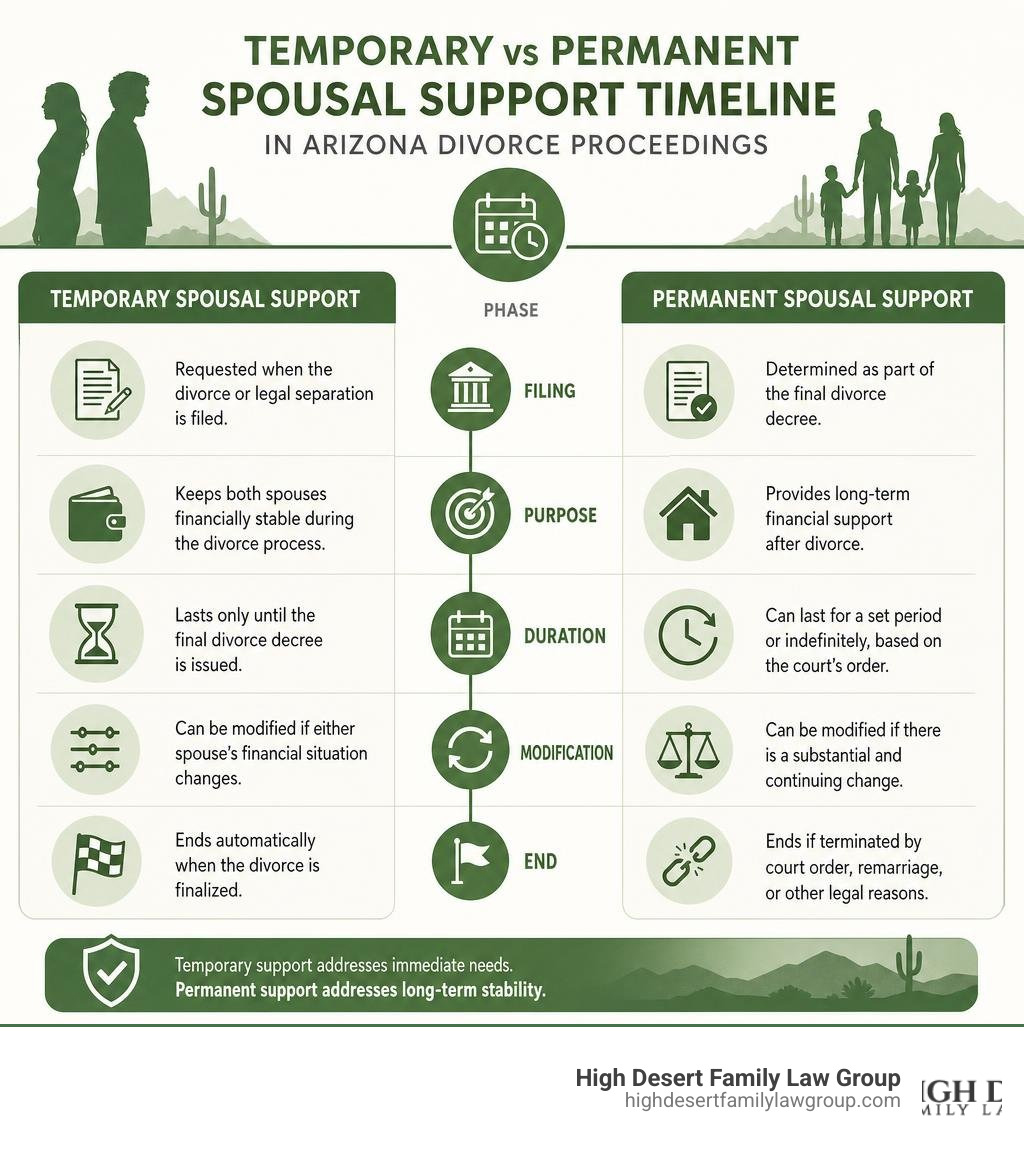
Temporary vs. Permanent Support: Key Differences
It is common to confuse temporary spousal support with permanent (or long-term) spousal maintenance. However, they serve entirely different legal purposes, utilize different calculation standards, and have distinct lifespans.
While a temporary spousal support order is strictly focused on immediate financial survival and preserving the status quo during litigation, permanent spousal maintenance is focused on the future. When determining a final, post-divorce spousal maintenance award, the court must meticulously evaluate all statutory factors under Arizona Revised Statutes (A.R.S.) § 25-319, such as the duration of the marriage, the age and health of the spouses, and the time necessary for the receiving spouse to acquire education or training for appropriate employment.
Here is a quick breakdown to help you understand how these two types of support differ:
| Feature | Temporary Spousal Support | Permanent Spousal Maintenance |
|---|---|---|
| Primary Purpose | Maintain the financial status quo during active divorce litigation. | Facilitate transition to post-divorce self-sufficiency or address long-term disparity. |
| Duration | Begins during the divorce process and terminates automatically when the final decree is signed. | Lasts for a specified duration of months/years, or indefinitely (rarely, in long-term marriages). |
| Calculation Basis | Emphasizes immediate “need” vs. “ability to pay” using guideline software as a baseline. | Requires a deep, multi-factor statutory analysis under A.R.S. § 25-319. |
| Typical Amount | Often higher, as it must support the sudden, unoptimized split into two immediate households. | Typically lower or more structured as assets are divided and budgets stabilize. |
To delve deeper into how your final post-divorce support structure is established, check out our guide on Everything You Need to Know About Your Spousal Maintenance Order.
Securing a Temporary Spousal Support Order: Eligibility and Timing

You do not have to wait until your divorce is finalized to secure financial relief. In fact, you can request a temporary spousal support order the very same day you file your petition for dissolution of marriage or legal separation.
Under Arizona Revised Statutes Section 25-316, either party in a domestic relations proceeding may move for temporary orders, which can include temporary spousal maintenance, temporary child support, and temporary division of debts or use of property.
To get the ball rolling, the requesting spouse must file a formal motion for temporary orders along with a comprehensive financial affidavit. Because courts are busy, it can take several weeks or even a couple of months to secure a formal hearing date. However, once the judge signs the temporary order, it becomes a legally binding mandate that remains in effect until your final divorce decree is issued. Knowing your Alimony Qualifications early on allows us to move swiftly, gathering the necessary proof of income and expenses to present a compelling case to the court.
How Courts Calculate a Temporary Spousal Support Order
Unlike final spousal maintenance, which requires a rigorous evaluation of the A.R.S. § 25-319 factors, the calculation of temporary spousal support is much more streamlined. Arizona family law judges rely heavily on the Arizona Spousal Maintenance Guidelines to establish a baseline.
The guidelines use a standardized formula that evaluates each spouse’s gross and net income, the length of the marriage, and other concurrent obligations like child support. While the guidelines provide a highly mathematical starting point, they are not completely rigid. Judges retain broad judicial discretion to deviate from the formula if we can show that strict adherence would be unjust or fail to meet the actual, real-world needs of the dependent spouse. To learn more about the legal landscape of support in our state, read our comprehensive overview of Alimony in Arizona.
Determining Financial Need and Ability to Pay
Even with guideline calculators, the two pillars of any temporary support case remain financial need and the ability to pay.
To establish your financial “need,” you must submit a sworn Affidavit of Financial Information (AFI). This document details your actual monthly expenses—such as mortgage or rent, groceries, insurance, health care, and transportation—alongside your current income. The court will look at whether your reasonable expenses exceed your income.
Simultaneously, the court evaluates the other spouse’s “ability to pay.” This involves looking at their gross income, earning capacity, and reasonable living expenses. If the paying spouse has significant discretionary income after meeting their basic needs, the court is highly likely to order support.
At High Desert Family Law Group, we excel at dissecting financial declarations to ensure that your spouse’s true income—including bonuses, commissions, or self-employment perks—is fully disclosed. For practical advice on navigating this stressful process, read our guide on Navigating Spousal Maintenance in Arizona Without Losing Your Mind.
How Temporary Support Interacts with Property, Debts, and Child Support
A temporary spousal support order does not exist in a vacuum. It is deeply intertwined with how your community property, household debts, and child support obligations are managed during the divorce.
When a court issues temporary orders, it will often decide who gets to live in the marital residence and who is responsible for paying the mortgage or rent. If the higher-earning spouse is ordered to pay the mortgage on the family home and pay temporary spousal support, the court will balance these obligations. For instance, if one spouse is paying community debts during the litigation, they may receive “Epstein credits” (reimbursements) during the final property division, or the temporary support obligation may be adjusted downward to reflect those direct debt payments.
Additionally, child support always takes priority over spousal support under Arizona law. The court will first calculate child support using the Arizona Child Support Guidelines. Once the child support obligation is established, that amount is factored into the spousal maintenance calculation, as it directly impacts both the recipient’s income and the payor’s ability to pay. To understand how these moving parts fit together in our state, consult our detailed resource on Temporary Alimony During Divorce in Arizona.
The Impact of Domestic Violence and Marital Misconduct
Arizona is a strict “no-fault” divorce state. This means that marital misconduct—such as infidelity or irreconcilable differences—is generally irrelevant when determining whether a spouse is eligible for spousal support or how much they should receive. The court will not punish a spouse financially for being unfaithful.
However, domestic violence is treated with extreme seriousness by the courts. Under Arizona law, if a spouse has been convicted of domestic violence against the other spouse within a certain timeframe, this can heavily influence the court’s assessment of financial resources, need, and overall equity.
If you are navigating a situation involving out-of-state elements, you might also find it helpful to look at comparative resources, such as the California Courts Guide to Requesting Temporary Support, to understand how different jurisdictions handle the intersection of conduct and support.
Enforcement and Modification of Temporary Support
A court order is not a polite suggestion. Once a judge signs a temporary spousal support order, it has the full force of law. If the paying spouse decides to stop paying or arbitrarily reduces the payment amount, they are in direct violation of a court mandate.
If your spouse refuses to pay, we can petition the court to enforce the order. The court has powerful tools at its disposal to compel compliance, including:
- Income Withholding Orders (Wage Garnishment): Directing the payor’s employer to deduct the support directly from their paycheck.
- Contempt of Court: A judge can find the non-paying spouse in contempt, which can carry penalties including fines and even jail time.
- Interest and Fees: The court can order the delinquent spouse to pay interest on the arrears, along with your reasonable attorney’s fees.
For step-by-step guidance on how to secure your payments without unnecessary conflict, read Spousal Support 101: A Guide to Collecting Your Payments Without the Drama.
Modifying a Temporary Spousal Support Order
Can a temporary support order be changed? Absolutely. Because divorce litigation can take months—or even more than a year in highly contested cases—it is common for financial circumstances to shift before the final decree is signed.
To modify a temporary order, the requesting party must show a substantial and continuing change in circumstances. Examples of valid reasons for modification include:
- A sudden, involuntary job loss or significant reduction in income.
- A medical emergency that prevents a spouse from working.
- Proof of willful unemployment or underemployment (where a spouse intentionally quits a job or refuses to work to avoid paying support or to inflate their financial need).
It is vital to note that modifications are generally not retroactive. They only apply to payments due after the formal motion to modify has been filed with the court. Therefore, if your financial situation changes, you must act immediately. We can help you draft and file the necessary paperwork to protect your interests, or assist you in negotiating structured Divorce Settlement Agreements that clearly outline support expectations.
Frequently Asked Questions About Temporary Spousal Support
How long does a temporary spousal support order last?
A temporary spousal support order lasts only for the duration of the active divorce or legal separation litigation. It automatically terminates when the judge signs the final divorce decree. At that point, the temporary order is replaced by whatever permanent spousal maintenance terms (if any) are established in the final judgment. Any unpaid support (arrears) that accumulated during the temporary period do not disappear; they merge into the final decree as a debt that must still be paid.
Can a temporary spousal support order be retroactive to the date of separation?
Yes, the court has the discretion to make temporary spousal support retroactive. Generally, support can be made retroactive to the date the petition for divorce was formally filed and served on the other party. In some cases, if there was an explicit agreement or an immediate financial need established from the date of physical separation, the court may consider that timeline, though retroactive awards are highly dependent on the specific facts of your case.
What happens if a spouse refuses to work while receiving temporary support?
Arizona courts expect both spouses to take reasonable steps toward self-sufficiency. If a receiving spouse is capable of working but willfully refuses to seek employment, the court will not allow them to use temporary support as a permanent financial cushion. During a modification or final hearing, we can ask the court to impute income to that spouse. This means the court will calculate support based on what that spouse should be earning given their education, health, and work history, rather than their actual zero-dollar income.
Conclusion
Navigating the financial realities of a divorce can feel overwhelming, but you do not have to go through it alone. A temporary spousal support order is a vital legal tool designed to keep you secure, stable, and on equal footing with your spouse while your marriage is dissolved.
At High Desert Family Law Group, we provide aggressive, individualized representation to clients throughout Greater Scottsdale and Chandler, Arizona. Our dedicated four-person team understands the local court systems and the nuances of Arizona family law. We work tirelessly to ensure that your financial needs are met from the moment your case is filed until the final decree is signed.
If you need help securing, modifying, or enforcing a temporary spousal support order, contact us today to discuss your options. Secure Your Financial Future with High Desert Family Law Group and let our experienced team advocate for you.